Keeping The Wrong Company, Luke 15:1-10 (Ordinary 24 Year C)

Luke 15:1-10

Back in prehistoric times when I was training for the ministry, one of our tutors told us that we should be at our desks every morning at 9 am with our shoes on. I’m sure I wore out some carpet by wearing shoes rather than slippers in my first manse.

I used to follow that pattern at first. But in one appointment, I was rarely (if ever) at my desk at 9 am. For at this point, we had young children going first through pre-school and then on to primary school. These were at the top of our road, and Debbie and I made a point of building relationships with the other parents.

We didn’t always make it back by the sacred hour of 9 am, and sometimes there would be phone messages from church members who had an expectation of me being there for them at that time.

Christ and a Pharisee. Wikimedia Commons CC 1.0

I think of those church members when I read about the Pharisees and teachers of the law in today’s reading. They thought I was mixing with the wrong people, because to them I was their private chaplain, just as the religious leaders thought Jesus was mixing with the wrong sorts, and that this reflected badly on his character. Their attitude was rather like the saying that you know a person by the company they keep.

Yet it was Jesus’ vocation to be with ‘tax collectors and sinners’. He uses the two parables we heard (plus what follows – the Parable of the Prodigal Son) to lay out why this was so important.

And if it were important for Jesus, it is also important for us. If we are to renew our commitment to following him, then we need to understand why he did this, and then get on with doing it ourselves.

Now the parables have a lot in common. They both (all) speak about finding what is lost and rejoicing. Bringing, or bringing back those who are lost from the love of Jesus into that love and into his family is a high priority for Jesus.

It is not always a high priority for us. We like to run our Sunday services, have a few nice midweek activities, make sure there’s enough money in the kitty to keep the building in good order, and that’s quite enough.

But not for Jesus. Each of these parables has something important to tell us about why he spends so much time outside the synagogue with ordinary (and even disreputable) people for the sake of God’s kingdom. So let’s look at what we pick up from the Parable of the Lost Sheep and the Parable of the Lost Coin.

Firstly, the lost sheep

As you know, we were proud as anything a couple of months ago when our son graduated with a Maths degree from Cambridge. And when people asked us where he got his love of Maths from, I said that it had always been my subject at school. It was later that I developed my interest in Theology.

I have always loved numbers, even if I have not concentrated on Maths for decades now. And there is something about numbers in these parables. A hundred sheep, ten coins, and two sons. In relation to the lost sheep parable, I was reading the New Testament scholar Ian Paul this week, and he cited another scholar, Mikeal Parsons, from whom he learned this:

Counting on one’s fingers (flexio digitorum) was very commonplace in the Roman world, and was in fact seen as an indispensable skill for the educated (See Quintilian Inst 1.10.35). Up to 99, you would count on the left hand, but for three-digit numbers from 100, you would count on the right hand. In an age that preferred the right to the left, Luke’s Jesus is telling us that the whole flock is out of kilter as long as the one is missing—and the whole flock is ‘put right’ when the one returns. No wonder there is so much rejoicing!

The flock is not complete and whole while the lost sheep is missing. And we, the church, are also not whole and complete while there are lost people still to be brought into the orbit of God’s love in Christ, or former sheep to be coaxed back.

Lost Lamb by Roberto and Bianca on Flickr. CC 2.0

To put it another way, the Body of Christ is missing a limb while a lost person is still lost. We cannot stay as our own private association, just enjoying one another’s company or even saying dreadful things like, ‘As long as this church sees me out I’m happy.’ That is to take the opposite attitude to Jesus. The church was not founded by Jesus to be a religious club. It was founded to be his junior partner, working for the kingdom of God. It has an outward focus.

A few years ago, I saw a job advertised for a chaplain at an Army rehabilitation centre for soldiers who had lost limbs in military service. An admirable organisation, I am sure, helping soldiers to adapt and to get on with the fitting of prosthetic limbs.

I fear, however, that the church has spent too much time simply adjusting to living without certain limbs and to be content with the absence of many people. Certainly, much of the institutional leadership has set an agenda which is little more than the management of decline.

You may have come into the church because someone invited you to try it. I can think of someone I know who now attends church because she was invited by her elderly neighbour to try it when she was heartbroken over a relationship breakdown. The elderly neighbour said, I think Jesus might be able to help you in your sorrow.

All this requires us to have friends and relationships outside the church. And it means loving those people. It means being ready for the appropriate time to say something gentle and clear about our faith to them.

I am not asking anyone to go door-knocking. But I am asking that we look for those moments when we need to take a little bit of courage and speak about our faith to people outside the church. Jesus is missing them, and the church will be more complete when they find faith.

Secondly, the lost coin

Ever since the Covid pandemic accelerated the move in our society towards cashless ways of making payments in shops, our family has been divided in our attitudes. One of us occasionally pays by a contactless method but really regards cash as king. Another usually pays by contactless on their phone but keeps a small amount of cash. Another pays by contactless on their phone, and a fourth pays by contactless on their watch. I’ll leave you to guess who’s who!

You might think that in Jesus’ time cash was king when you hear the Parable of the Lost Coin, but actually coins were less common in their use. Kenneth Bailey, a New Testament scholar who spent most of his life in the Middle East, said this:

The peasant village is, to a large extent, self-supporting, making its own cloth and growing its own food. Cash is a rare commodity. Hence the lost coin is of far greater value in a peasant home than the day’s labour it represents monetarily.[i]

Ian Paul suggests that the woman’s ten coins in the parable are either family savings or possibly the dowry her husband gave her on marriage. Dowry coins were often worn by the wife either around the neck or on the forehead.

When you understand this, you realise that the loss of this coin is a catastrophe. She hasn’t mislaid a 5 pence piece. Something profoundly valuable has gone.
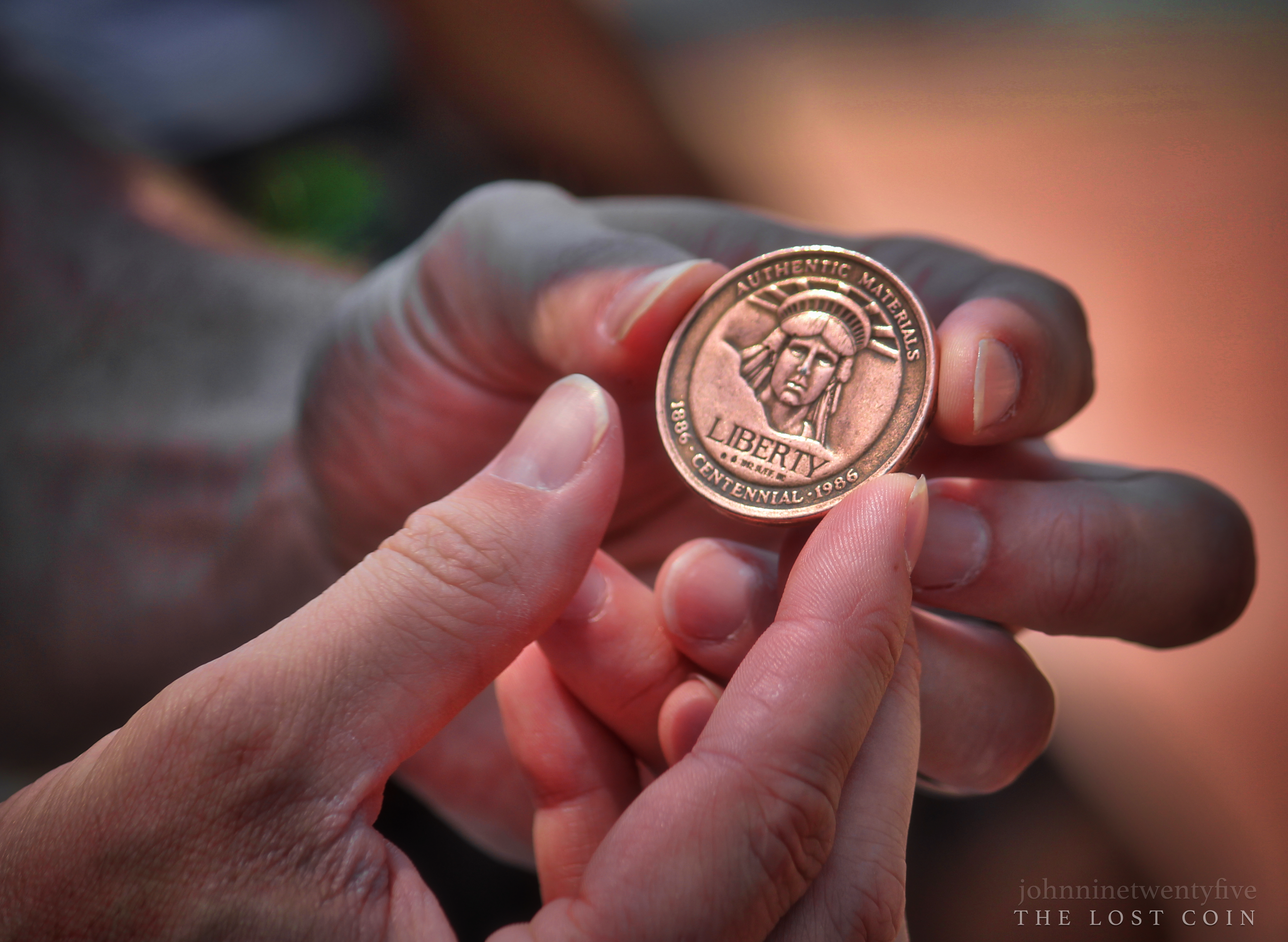
The Lost Coin by On Borrowed Time on Flickr. CC 2.0

What would it be like for me? It would be like me losing my wedding ring. It is not the most expensive item I own, but I do regard it as my most valuable possession, for what it represents. Earlier this week, when our elderly and grumpy cat bit my hand and I had to have a tetanus shot and strong antibiotics, I was told at the Urgent Treatment Centre that I had to remove my wedding ring in case my hand swelled up. I was careful to put the ring somewhere safe.

Those who are lost from the church and faith in Jesus are therefore to be seen as immensely valuable to Jesus. It doesn’t matter whether they are former Christians or never-been Christians, Jesus values them hugely. Sometimes we are very dismissive of judgmental of people outside the church, and of course some of them can be hostile to us, but the Jesus who tells us to love our enemies puts a high value on them. They are precious to him.

Like us, they are made in God’s image. Like us, they are loved so much by God that Jesus died for their sins. They are treasured by God.

Before he wrote worship songs, Graham Kendrick was a Christian folk singer. One of his most popular songs from that period of his life was called, ‘How Much Do You Think You Are Worth?

The first verse says this:

 Is a rich man worth more than a poor man?
A stranger worth less than a friend?
Is a baby worth more than an old man?
Your beginning worth more than your end?

It goes on to consider various ways in which we might or might not value human life highly. Then it comes to a climax with these words:

If you heard that your life had been valued
That a price had been paid on the nail
Would you ask what was traded,
How much and who paid it
Who was He and what was His name?

If you heard that His name was called Jesus
Would you say that the price was too dear?
Held to the cross not by nails but by love
It was you broke His heart, not the spear!
Would you say you are worth what it cost Him?
You say ‘no’, but the price stays the same.
If it don’t make you cry, laugh it off, pass Him by,
But just remember the day when you throw it away
That He paid what He thought you were worth.

Every single person outside the church is valuable to God. The neighbour who annoys you. The child who keeps kicking his football at your fence. The greedy businessman. The politician whose policies you hate. The sex worker. The drug dealer. All these, as well as the ones we find it easy to like! The Cross tells us how much God values them.

And – while they are missing from God’s family, not only are they incomplete, so is the church.

It’s time to expand our networks, increase our love, and let faith prompt our courage.


[i] Kenneth Bailey, Poet & Peasant and Through Peasant Eyes: A Literary Cultural Approach to the Parables in Luke, 1983, p 157

Advent, The Prologue and Relationships: 1, Jesus and the Father (John 1:1-18)

Introduction to series

For Advent this year, I want to explore one of the great Bible passages – the one that above all talks about ‘The Mystery of the Incarnation’, as it is often called in carol services.

It’s the passage we more widely call ‘The Prologue’ – but people of a certain generation must not think about Frankie Howerd and Up Pompeii when I say that!

It’s The Prologue to the Gospel According to John, the first eighteen verses of the wonderful Fourth Gospel, in which the evangelist introduces many of the themes of his Gospel in the context of Jesus’ birth.

There are so many ways we could explore this passage, for there are so many riches there. A friend of mine wrote his PhD on it, and I could easily imagine preaching every Sunday for a year on these verses.

But I’m going to resist that temptation! This is just an Advent series. And one way of exploring the Prologue over the four Sundays of Advent is to take a particular strand in it about Jesus’ relationships. So we shall look first of all at Jesus’ relationship with the Father, and in other weeks at his relationships with Moses, John the Baptist, and human beings generally.

John 1:1-18

I am not the most avid television watcher, but I did set our satellite box to record Monday night’s quiz programmes on BBC2 – Only Connect, Mastermind, and the one that goes right back to my childhood, University Challenge. That was something we used to watch as a family on Sunday lunchtimes – that and Thunderbirds.

For some reason, I still remember one starter question from an early series: ‘Which two books of the Bible begin with the same three words in English?’

Now, leaving aside the awkward issue of differing translations, the answer they wanted was Genesis and John’s Gospel, both starting with the words, ‘In the beginning.’

And that’s where we’re going today – to the beginning, to that relationship between Jesus and the Father that existed before creation and led to creation. I follow those scholars who say that the inner relationships of the Trinity are demonstrated in their actions towards human beings and the world. In the case of the Incarnation, they tell us something about why Jesus came, and that’s what we’re going to explore today.

Firstly, unity:

In the beginning was the Word, and the Word was with God, and the Word was God. He was with God in the beginning. 

Note those words ‘with God’, ‘was God’, and ‘with God in the beginning.’ The Word, that is, Jesus, and the Father are united in fellowship and very nature. Theirs is a perfect and pure unity of relationship. They are one in heart, mind, and spirit.

It is this inner experience of unity that Jesus comes to bring at the Incarnation. It is the knowledge that human relationships with God, each other, and creation are broken that leads him to come. This is not what was intended. Humankind was made in the image of God, the One God in Three Persons who is unity, but sin has distorted and destroyed that.

So when Jesus comes, his is a mission of reconciliation. He wants human beings at one with the Godhead again. He wants human beings reconciled to each other. He wants the alienation of human beings from the creation healed.

To bring this unity will involve a great cost. It will take him from Bethlehem to Calvary, from the manger to the Cross. It makes me think of a Graham Kendrick Christmas song, ‘Thorns in the straw’, where he imagines Mary seeing the thorns for Jesus’ crown of thorns in the straw of the manger.

Therefore as Christians we remember our need to draw ever closer to our God, as we receive the forgiveness of our sins. We remember our need to work for unity with one another, putting right our broken relationships, and finding reconciliation with each other. We remember that our reconciliation with one another is one of the deeds that witnesses to our preaching about reconciliation with God.

And we remember our calling to bind up the wounds of the creation – not out of the desperation many have over things like climate change, but in the Christian hope of the God who is making all things new.

Let us remember this Advent that the unity of Father and Son leads to Jesus’ mission to bring unity. And just as that was costly for him, let us be prepared to pay a cost to proclaim and demonstrate Christ’s nature and message of unity to the world.

Secondly, love:

Through him all things were made; without him nothing was made that has been made. 

Jesus is the Father’s agent in creation. But what has that got to do with love?

Let me ask you a question that the famous twentieth century Swiss theologian Karl Barth asked: was it necessary for God to create?

Barth answered that question with a ‘Yes’, and so do I. Here’s why. It’s certainly true that love between people can be personal and exclusive, but it is never private. If two people love each other exclusively but it never touches others for good, how is it so very different from mutual self-indulgence?

Take marriage as an example. The most common way in which a married couple express this love is when they are able to have children. Their personal and exclusive love naturally reaches out in a creative act and they sacrificially love their children.

Of course, I know that many couples don’t want children immediately and others cannot have children at all. So one of the things I do when I prepare a couple for marriage is I challenge them to show the love they have wonderfully discovered between themselves in service of others. Can they do something in their community? Is there a cause they could support?

I think something like that has happened on a cosmic, spiritual scale in the Godhead. Such is the love between the members of the Trinity that it has to be expressed beyond them. The Father creates through the Son and in the power of the Spirit. A universe is created beyond the Godhead for the Godhead to love.

And it is out of this love at the heart of God that Jesus comes in the Incarnation. Seeing the brokenness and lack of unity that I talked about in the first point, it is his very nature of love that brings him to earth. Remember that most basic of all statements about God in the Bible: ‘God is love.’

What I’m talking about here is what Christina Rossetti wrote about in one of her Christmas carols:

Love came down at Christmas,
Love all lovely, Love divine;
Love was born at Christmas,
star and angels gave the sign.

Worship we the Godhead,
Love incarnate, Love divine;
worship we our Jesus:
but wherewith for sacred sign?

There it is: Jesus comes in love because the very nature of the Godhead is love.

And Rossetti also tells us what the only fitting response is:

Love shall be our token,
love be yours and love be mine,
love to God and all the world,
love for plea and gift and sign.[1]

If the Incarnation is about the love at the heart of the Godhead coming to us in Jesus, then our response is ‘love to God and all the world’ – love God and love our neighbour, as Jesus was to say the two greatest commandments were. Even the new commandment he gave was about love: ‘Love one another as I have loved you.’

Howard Thurman, who was a great influence on Martin Luther King, wrote a short poem called ‘The Work of Christmas.’ It says this:

When the song of the angels is stilled,
When the star in the sky is gone,
When the kings and princes are home,
When the shepherds are back with their flock,
The work of Christmas begins:
To find the lost,
To heal the broken,
To feed the hungry,
To release the prisoner,
To rebuild the nations,
To bring peace among others,
To make music in the heart.

Thirdly and finally, light:

In him was life, and that life was the light of all mankind. The light shines in the darkness, and the darkness has not overcome it.

At the heart of God’s life is light: purity, wholeness, righteousness, hope. But we have a world of darkness: sin, brokenness, injustice, despair. So when Jesus brings very inner character of God to Earth in the incarnation, he comes as light, the light of the world who ‘stepped down into darkness’[2].

Wherever we experience darkness, Jesus comes to shed his light. It may be the darkness when we know ourselves to be a moral failure, but the light of Jesus’ seventy-times-seven forgiving love draws us back to him again.

It may be the wounds we carry through life that leave us with low self-worth or even a sense of self-loathing, but the hope found in Jesus gives us strength to carry on.

It may be that a particular issue of injustice in the world affects us and we get involved with campaigning but nothing seems to change for the better. I listened to a talk recently by a Christian journalist whose life work it is to expose corruption in the church, but she has suffered attacks and false accusations from parts of the Christian community for her work. She has been tempted to give up, but the light of Jesus keeps her persevering for justice in the darkness.

Or maybe it’s bereavement. Six years ago when my father died, I said that a light had gone out of my life. He had modelled for me so much of what it meant to live with integrity as a Christian man in the world. Yes, he was just two months shy of his ninetieth birthday. Yes, Alzheimer’s Disease had taken his true personality before death took his body, and you could say it was a merciful release. But you know what grief is like. The logical answers don’t remove the pain.

Dad died on 1st August. It was not until Advent that year and reading John 1 that I felt a sense of hope. It was verse 5: ‘The light shines in the darkness, and the darkness has not overcome it’ that made sense of things for me. Jesus gave just enough light in the darkness to take me forward in hope.

Let us begin this Advent with a sense of hope. The relationship between Jesus and his Father may seem like hi-falutin’ brain-bending stuff, but at its heart are characteristics that stretch out from the inner life of God to us through the Incarnation of Jesus. Let that unity, love, and light give us strength and hope.


[1] Christina Georgina Rossetti (1830-1894) in Singing The Faith #210.

[2] Tim Hughes, op. cit., #175.

Sermon: The Prologue – Word, Life And Light

And here beginneth the first blog entry in a few weeks. Not only have I spent the last two Sundays either repeating an old sermon 0r taking part in all-age worship, other matters have drained my time and energies – not least a painful situation that led to us urgently transferring our children to a new school.

But now, we begin a new sermon series for Advent, based on the Prologue to John’s Gospel. I’ve wanted to do this for a few years at Advent, and this is my chance. We kick off tomorrow morning with the first five verses from John 1:1-18.

John 1:1-5
He is the man for whom the word ‘curmudgeon’ was probably invented. Bitter that he has not become the international superstar he deserves to be, jealous of others and angry at the machinations of the music industry in which he works. He fluctuates between belief in God and a raw atheism.

Yet when he sings of things spiritual, and he combines his Celtic roots with the blues traditions he loves, his music transports me to another place. Ladies and gentlemen, I give you Mr Van Morrison.

And he’s here this morning. (If only.)

In one of my favourite songs of his, the chorus says,

Didn’t I come to bring you a sense of wonder?
Didn’t I come to lift your fiery vision bright?
Didn’t I come to bring you a sense of wonder in the flame?[1]

A sense of wonder is what this Advent sermon series is all about. For me, there is nothing like reading the Prologue to John’s Gospel for giving me a sense of wonder about Jesus, whose birth we are preparing to celebrate again.

Why not share for a moment with your neighbour what gives you a sense of wonder about the coming of Jesus?

What gives me a sense of wonder about the coming of Jesus is to think about who this Jesus is, who came in flesh. This morning, the first five verses of the Prologue give us three words to meditate on that give me that sense of wonder about the One who came.

And the first word is … Word:

In the beginning was the Word, and the Word was with God, and the Word was God. He was with God in the beginning. (Verses 1-2)

The Word. Because Jesus isn’t called Jesus until he is born, fully human, fully divine. Before the Incarnation, Jesus is the Word. Even before his birth, he is God speaking to us. He is God’s self-expression. We talk about the Bible as the Word of God, but because the Bible itself says that Jesus is the Word, we should refer to the Bible as the Word of God written, whereas Jesus is the living Word of God. Jesus is the guarantee that God speaks. God is not silent. In the Second Person of the Trinity, God speaks.

This Word of God is part of the divine fellowship: he is with God, and he is God, and he was with God from the beginning. Here, before all things, is the fellowship of love that is the Trinity. During our sermon series on 1 John, I argued that the statement ‘God is love’ only makes sense if God can express love within creation. The Father loves the Son and the Spirit; the Son loves the Father and the Spirit; and the Spirit loves the Father and the Son. We get a hint of that here: the Word was with God and the Word was God. He was with God in the beginning. Here is that fellowship of love that has existed since before creation. Here, the Word is part of that love which must extend beyond its own boundaries. When we read that the Word was with God, we get hints of the love that led to creation and the love that led to redemption.
Jesus, the Word, expresses this inner love of the Trinity that will lead to creation and redemption. In these coming weeks, as we sing carols such as ‘Love came down at Christmas’, we shall be singing of this truth. It is a truth that has been since before the foundation of the universe. What we celebrate at Advent and Christmas is something that goes back before the Big Bang. Look into the night sky at the stars, whose light we see so many aeons since they emitted the waves that finally reach the Earth, and realise that way before that light ever left those celestial bodies, God was love and God was speaking. In the Incarnation we are about to celebrate, we look with awe at the constellations and galaxies that fill our skies and our telescopes, and however much we marvel at them, we remember that before they were flung on their journeys through space, there was a Word. That Word, part of the eternal Godhead, sharing in love and speech, would one day share that love and speech with the world in human flesh. And so we are filled with a sense of wonder.

The second word is life:

Through him all things were made; without him nothing was made that has been made. In him was life, and that life was the light of men. (Verses 3-4)

So – the inner relationship of love in the Trinity that is hinted at when we say that the Word was with God from the beginning explodes beyond its boundaries into creation. Love cannot be contained within itself: love has to love outside itself. So God creates, and the Word is God’s agent of creation. Here, in the act of creation, is the first bursting out of God’s love. From Big Bang to infant worlds, from early microbes to human beings made in the image of God, here is the hand of God. The Bible never tells us how the world was made, for it is not a scientific text book, but it points us to the Maker.

In fact, God’s creative love involves giving life from within himself – ‘In him was life, and that life was the light of men’. Just as human parents give of their own lives to create life, so the Word does the same. This loving act of creation is an act of self-giving love. The life of God given to the pinnacle of creation, human beings, made in God’s image, is imparted. Remember the emphasis in Genesis upon God breathing life into human beings? Here is another way of saying that.

Moreover, as the Word gives life, ‘that life was the light of men’. Wherever there is light, it originates from the Word, the Second Person of the Trinity. Wherever you find truth, beauty and goodness in life, you find it because the Word of God gave life which is light to all.

Am I saying that all religions lead to God? By no means. But I am affirming what Paul said to the people of Lystra in Acts. Paul told them,

We are bringing you good news, telling you to turn from these worthless things to the living God, who made the heavens and the earth and the sea and everything in them. In the past, he let all nations go their own way. Yet he has not left himself without testimony: He has shown kindness by giving you rain from heaven and crops in their seasons; he provides you with plenty of food and fills your hearts with joy. (Acts 14:15b-17)

‘He has not left himself without testimony.’ ‘That life was the light of men.’ It’s what John Calvin called God’s common grace. In creation, God is good to all. And we affirm from the Prologue to John’s Gospel that it is through the Word, whom we came to know as Jesus, that God is good to all in creation.

How wonderful, then, to know that the One who was the agent of this loving creation, and whose gift of life provided for all goodness, would not only create but enter creation. As we enter Advent and prepare to mark the coming of the Christ child, we remember that the One who entered creation, born of a virgin, was God’s agent in making this creation, and his life already bestows beauty and truth throughout it. Look in the manger and see more than a baby boy. See the Life-giver. And then see if you are not filled with a sense of wonder.

We have heard the third and final word already, but it carries over from verse 4 to verse 5. The third word is light:

In him was life, and that life was the light of men. The light shines in the darkness, but the darkness has not understood it. (Verses 4-5)

I said earlier during the first point about the Word that the love in the Trinity had to go beyond the boundaries of the Godhead, and it did so in creation and redemption. In thinking about our second word, ‘life’, I showed that love in creation. Now in our third word, ‘light’, we see the love of the Trinity extending to redemption.

How? The light is not just the source of truth, beauty and goodness – ‘that life was the light of men’. It is more: there is not only light, there is darkness. Light is needed, because there is darkness. So the truth, beauty and goodness that come from the life-giving Word stand as a testimony in the face of sin. They are a testimony to the ways of God in opposition to the ways of a world that rejects that God.
But there is more. The light was to shine in the darkness in a more profound way. For the love of God sent into creation through the Word, which testified to love in contrast to hate and fear, could not stand still. The light would enter creation. It is what we celebrate as we approach Christmas by the route of Advent. So we marvel as, in the words of John Henry Newman, ‘A second Adam to the fight and to the rescue came.’ Darkness may abound, but light is coming. And on Christmas Day, we shall say: light has come! The baby of Bethlehem is born as a warrior of light, a sworn enemy of darkness.

And – again – there is more! This is no equal contest between light and darkness. Light and darkness, truth and falsehood, are not equal and opposite enemies. ‘The light shines in the darkness, and the darkness has not understood it.’ This is not an intellectual statement. To understand something is not merely to comprehend it, it is for that understanding to mean power over the other. The word ‘understood’ here can also be translated ‘overcome’ or ‘come to terms’. John is telling us that the darkness of the world cannot get to grips with the light of the Word. Once there is even a chink of light, the hold of darkness is broken. Though we still live in an age where light and darkness both exist, the light of the Second Person of the Trinity conquers, and will conquer.
How that light conquers, though, is another matter. Not for nothing did Graham Kendrick imagine Mary looking at Jesus lying in the manger and seeing thorns in the straw. Light would overcome darkness not by violence but by suffering, the suffering of the Cross.

Darkness will not have the final word. Light will. It is already guaranteed, in the coming of the Word who took the name Jesus. His birth, life, death and resurrection make light shine in the midst of a darkness that cannot come to terms with him.

Yes, the Word who experiences love within the Trinity is then the One who makes that love spill out in creation through his Life. And that love will stop at nothing, for it is the Light seen in sacrificial suffering to overcome the darkness.

Now tell me you’re not filled with a sense of wonder.


[1] Van Morrison, ‘A Sense of Wonder’, © Exile Music, 1984.

Singing The Faith: A First Look

Singing The Faith is the first new official British Methodist hymn book for nearly thirty years, superseding the (in my opinion) deadly dull Hymns and Psalms. My copy arrived in the post on Friday, and I’ve been skimming through it for some first impressions.

Hymns and Psalms just had to go, and many churches were voting with their wallets. It had the misfortune to come out just before the explosion in contemporary worship music (twelve months too early even for Kendrick‘s ‘The Servant King’,

I seem to recall). But you got the feeling that even if it hadn’t, that stuff would probably not have been included. It was published around the high water tide of liberal antipathy to evangelical and charismatic Christianity in Methodism. Furthermore, the musical arrangements were, as one friend put it kindly, ‘for musicians by musicians, to interest musicians’. I can’t judge the truth of that as a non-musician, but it may explain why they were largely deadly dull to me.

It had its bright spots – and I think particularly of the additional verse it includes in ‘When I Survey The Wondrous Cross‘ (retained here) that I’ve never seen elsewhere, the scholarship applied to restoring original texts and the Scripture Index in the music edition.

Methodist Conference and the panel that put together Singing The Faith faced the implications of several cultural revolutions that have deeply affected how Christians, Methodists included, approach faith and sung worship. Revolutions in communications (especially the Internet), transport (you can more easily get to a church whose style you prefer) and ecumenism (people are exposed to other traditions more easily and frequently) mean that fewer Methodists will be easily satisfied with ‘what we already know’. Some would argue (myself included) that technological changes and the fact that churches had already bought all sorts of supplementary books, such as Songs Of Fellowship, Mission Praise and The Source, meant that a new hymn book probably wasn’t the answer, and another approach was needed. The moment of publication is the beginning of fossilisation today. However, Methodism is almost umbilically attached to hymn books, and so a new book it was.

Given that fact, the new book, then, would need to embrace a diversity of musical and theological styles. Centralised or hierarchical control of doctrine may technically be still present in our system, but for many people it is long gone. There is therefore a huge question here of how Methodism maintains her doctrine in this central aspect of our piety, our singing. It may be that the forthcoming additional resource Singing The Faith Plus will act as some kind of clearing house to reflect on which of the newer material that is published from now on is consonant with Methodist doctrine, but we’ll see.

When it gets to the handling of theological diversity, there certainly is a spread in Singing The Faith. It embraces both the neo-Calvinist emphasis on the wrath of God at the Cross in Stuart Townend‘s ‘In Christ Alone’

and at the other end we have Marty Haugen‘s ‘Let Us Build A House (All Are Welcome)’

which some have criticised for allegedly extended the universal offer of salvation into universalism. So the issue of acceptable diversity is alive and well within the book!

It is also worth noting the considerable reduction in Charles Wesley hymns – very significant for Methodists, this. Hymns And Psalms was originally to be edited by an ecumenical committee, but when Methodist Conference insisted on at least two hundred Wesley hymns, the United Reformed Church pulled out. And for the URC to withdraw takes quite something! In the new book, at a quick count Wesley is down to seventy-nine contributions. Much as I love Wesleyan theology, I think this is the right move. Indeed, if many in our churches who have been most vocal about singing Wesley hymns had been as fervently aligned to his doctrine as to the music, Methodism might be more vibrant! Here is a prime example of the argument that allegiance to hymns, however central they are to Methodist spirituality, has not always maintained and fed our faith in the ways to which we might aspire.

Two more traditional-style contemporary Methodist hymn writers, Andrew Pratt and Marjorie Dobson, both participated in the STF committee, and both are represented in the final collection. Both have nine entries. With those numbers, I don’t think anyone can accuse the compilers of favouritism. I imagine the STF panel did what the HAP committee did, and required authors who were members of the group to vacate when their potential contributions were being discussed.

On, then, to think about those writers who have come more out of the explosion in contemporary worship styles. Matt Redman (also) features nine times, and the observation that interests me here is how it isn’t always his ‘hits’ that have been chosen. It looks to me like the committee has taken a real interest in what he writes about struggle and suffering. So as well as the popular ‘Blessèd Be Your Name’ we get ‘When We Were In The Darkest Night’ (‘God Of Our Yesterdays’)

and ‘We Have Nothing To Give’. No sign of ‘The Father’s Song’: one hopes that isn’t about avoiding male language for God, in the way that Fred Pratt Green‘s ‘For The Fruits Of His Creation’ has been altered to ‘For The Fruits Of All Creation’.

Having said that, the compilers are less confident that middle of the road Methodist congregations are ready for much by the late Delirious? Martin Smith and Stuart Garrard get in a couple each, but that’s it. This might be about some of the slightly unusual ways the band expressed itself lyrically, or it is about the more performance-oriented style, or possibly some other reason.

There is also evidence of taking into account the effect of contemporary worship trends on older hymns. It has become popular, particularly under so-called ‘Celtic’ influences, to sing the afore-mentioned ‘When I Survey The Wondrous Cross’ to the tune ‘O Waly Waly’ as well as ‘Rockingham’. This is recognised in Singing The Faith.

But beyond the contemporary worship movement, one area where I am particularly pleased to see innovation is in children’s worship songs. Mark and Helen Johnson of Out Of The Ark Music have been producing worship songs for primary schools for many years. Indeed, that is how I was introduced to them – by a primary head teacher. It’s a delight to see songs such as ‘Everywhere Around Me’

included, along with songs about the Incarnation and the Crucifixion (which actually doesn’t feature that often in their lyrics). Sadly, the wonderful ‘Harvest Samba’

Vodpod videos no longer available.

isn’t in. Did it lose out because it has a middle eight, and that would confuse some older congregations? I wonder.

However, overall, as you will gather, for someone who stays on the fringes of the Methodist establishment, and who is usually quite uncomfortable about it, I greatly welcome Singing The Faith. I still think a new book wasn’t the right approach in a fast-moving creative and digital world, but given that the decision was made, I think what has been produced is far better than many of us might have hoped.

Sermon: Nicodemus

I’m preaching from the Lectionary this week at my second church, and am following the Gospel reading.

John 3:1-17

Who was the only Irishman in the Bible?

Nick O’Demus.

Sorry! I blame Graham Kendrick. I once heard him tell that joke at a concert.

Here, in John chapter three, Nicodemus makes his entry into the story of Jesus. We know that near the end of our reading we hear possibly the most famous verse in the entire Bible:

For God so loved the world that he gave his only Son, so that everyone who believes in him may not perish but may have eternal life. (Verse 16)

And so we assume this is a story about whether and how people to come to faith. Which I think is about right. I’m not about to spring any surprises on you in that respect today. So let’s plunge into this familiar text and see what we learn about the journey of faith. However long we have been Christians, I pray we appreciate the elements of true Christian faith more deeply as we reflect on this passage.

Firstly, we observe that Nicodemus ‘came to Jesus by night’ (verse 2). Now you may think that’s just a casual memory of their meeting, preserved for us by John from whoever learned that fact. But in John’s Gospel there is symbolism behind a lot of the literal details. For example, after the Feeding of the Five Thousand, Jesus tells people he is the Bread of Life.

And when it comes to ‘the night’, we can be sure John uses this both literally and symbolically. A classic example would be when Judas Iscariot leaves the Last Supper to betray Jesus: John then says, ‘And it was night.’ You realise he doesn’t just mean the time of day, it is spiritually dark when Judas goes off.

What I want to suggest is this: that when Nicodemus arrives ‘by night’, it is also spiritually dark. Not in the sense of betrayal; rather, this is a man who is ‘in the dark’ spiritually about Jesus. He comes in utter sincerity to enquire of Jesus. When he opens by saying, ‘Rabbi, we know that you are a teacher who has come from God; for no one can do these signs that you do apart from the presence of God’ (verse 2), there is no reason to suppose he is anything other than a seeker after truth.

We see this from the way Jesus responds, He does not write him off or call him a hypocrite. Instead, he explains spiritual truth to him, about the need to be ‘born again’ or ‘born from above’. But when Nicodemus just doesn’t understand – he says, ‘How can these things be?’ (verse 9) – Jesus replies, ‘Are you a teacher of Israel and yet you do not understand these things?’ (verse 10) Clearly, Jesus perceives him to be ‘in the dark’. Truly, he has come ‘by night’. Nicodemus, teacher of Israel’s faith, is in spiritual darkness.

Is he so unlike some of the people in our churches? I think of the church steward who prayed with me before a Good Friday morning service, in which he referred to the Cross of Christ as a disaster. I wouldn’t have minded if he were referring to a sorrow that our sins led to Christ dying for us, but he seemed to think the whole thing was a mistake. Surely that steward came ‘by night’.

But whichever other people I think of, the person I most think of as having come ‘by night’ is myself. Growing up in a Christian home – in fact, my sister worked out that she and I were fifth generation, same congregation – I picked up all the wrong signals about what Christian faith was. I heard people asked whether they were Christians, and their reply was, ‘I’m trying to be a Christian.’ It all depended on them, and their efforts. No wonder that I, the keen mathematician, I expressed my understanding of Christianity in terms of an equation: Christianity equals believing in God plus doing good things. I was completely confused when a teenage Baptist friend took me to a youth event at his church and someone greeted me, saying, ‘Am I shaking hands with a born-again Christian?’ I hadn’t heard that language, but assuming I was a Christian, I offered my hand. I could see my friend Andy looking on with doubt.

Finally, it was the confirmation service, specifically the promises and professions of faith, in the old Methodist Service Book that brought me up short. The first question asked whether I repented of my sins. The second asked me whether I put my trust in Jesus Christ as Lord and Saviour. And the third question – only after the question of faith and trust – asked me whether I would obey Christ and serve him in the world.

So because of my own experience, I am never surprised to meet people in our churches who come ‘by night’, who think they know Jesus and faith, but don’t. Let’s all make sure this morning that we’re not in the dark.

All this mention of being ‘born again’ leads me into the second element to consider about Nicodemus. That second element is the prominence Jesus gives to the Holy Spirit. We talk generally about God, and we refer to Jesus, but Jesus himself draws attention to the work of the Spirit in bringing us to new birth:

Very truly, I tell you, no one can enter the kingdom of God without being born of water and Spirit. (Verse 5)

Here’s the point: while we are right to emphasise the importance of personal decisions to follow Christ and our free will to decide whether to do so or not, it still remains the fact that none of that would be possible unless the Holy Spirit had not already been working in our lives to reveal Jesus Christ and his Gospel to us.

That fact has a number of implications for us. One is that it takes the pressure off us in our witness for Christ. Sometimes we think that we have to get our witness just right for him, answering every question and doubt that our friends have. We don’t. Instead, we discharge our responsibility to be a witness to Christ in word and deed, but we rely on the Holy Spirit to reveal Jesus to our friends. We do what we can, as obediently as we can, but then we leave it and pray.

Another implication is that the prime rôle of the Holy Spirit punctures our pride. We cannot claim that by our cleverness or good deeds we worked out the importance of responding to Jesus Christ. Of course, the fact of needing the Cross should do this, but when we realise that we cannot come to Christ unaided, then we can only respond and live humbly. Our pride must go. It is another reminder that we are completely dependent upon the grace of God in order to know his love and walk in his ways. The superiority complex that some outside the Church detect in us is something we have to leave behind, because we could not find faith without the Holy Spirit.

One other implication: Jesus says something else about the centrality of the Holy Spirit’s work in the life of faith. In verse 8 he says,

The wind blows where it chooses, and you hear the sound of it, but you do not know where it comes from or where it goes.

You expect him to continue something like this: ‘So it is with the Spirit.’ But he says something else instead:

So it is with everyone who is born of the Spirit. (Italics mine)

The sovereign, unpredictable work of the Spirit is taken for granted. But it initiates us into a life of openness to where the wind of the Spirit blows us. Any notion of safety, predictability or comfort comes into question when the Holy Spirit leads your life. Yet that is what many of us settle for. But the Holy Spirit not only takes the initiative in making Christ known to us and keeping us humble, the Spirit then takes us on a wild journey of faith. The life of faith is one where Jesus says, ‘Follow me,’ and we don’t know where that will lead. I venture to suggest that churches which implement things like five-year visions and targets have very little sense of the blustery gale of the Spirit.

Some of the Celtic saints took this very literally. They set out in their coracles on the open sea, deciding they would trust that wherever the wind blew them, that was where God wanted them to go. We may not take things as literally as that, but the challenge is there: are we willing to let the wind of the Spirit blow us to new places in the life of faith, following Jesus?

But where is the Holy Spirit taking us in leading us out of darkness on the wild journey of faith? The answer comes in the third and final reflection. Our journey out of the night takes us on a strange journey to an unexpected place. It takes us to somewhere that Jesus, the Son of Man, will be lifted up (verse 14). Now ‘lifting up’ sounds like an exalted place, it perhaps sounds like a throne for a king. And in one sense it is.

But ‘lifted up’ is more of that symbolic language in John. There is more to it than meets the eye. Later in the Gospel, in chapter twelve, we discover that John uses it to indicate a place where Jesus was physically lifted from the ground. The Cross. This is the central location for the journey of faith.

For one thing, we see this in the fact that this is where God brings us to faith through Christ. It is when he is lifted up ‘that whoever believes in him may have eternal life’ (verse 15). We have already noticed how our need of the Spirit’s work makes us humbly dependent upon God’s grace: here is further evidence. We rely on the fact that God gave his only Son so that whoever believes in him may not perish but have eternal life (verse 16). Any message that downplays God’s reconciliation of us through the Cross of Christ is not the Christian message.

But the Spirit blows us to a strange place. A place of suffering and rejection. Yet here, in the plans of God, we find forgiveness, healing and acceptance. Here is where God pledges his commitment to us, and where we commit ourselves to him in response to his self-giving love in Christ.

But the eternal life promised there is not merely a ticket for heaven. In John’s Gospel, eternal life doesn’t wait. It starts now. When Jesus prays in chapter seventeen, he says, ‘Eternal life is knowing you’ (my italics). So if the Cross gives us eternal life, it shapes our ‘now’ as well as our future. The gift of eternal life is not only received through the death of Christ, the Cross also gives shape to the relationship of eternal life with God that we have since begun. That life of eternity is one marked by dying – we die to ourselves by rejecting self-indulgence to put Christ and others first, and we are willing to pay the price of following Jesus in a society where it is not and never will be popular.

This, then, in summary, is the life of faith. It is the call out of darkness to follow the wind of the Spirit who leads us to Christ and then on the wild journey of faith that is based on the Cross, where we find forgiveness and the shape of our new, eternal life.

But whatever happened to Nicodemus? He shows up twice more in John’s Gospel. In chapter seven, he defends Jesus against the criticisms his fellow Pharisees levelled. That was a brave thing to do. In chapter nineteen, he accompanies Joseph of Arimathea, the secret disciple who asks Pilate to give him the body of Jesus. Nicodemus helps with anointing the body for burial. Again, what would the other Pharisees have thought of him?

For me, these hints point towards the thought that while Nicodemus may have been in the dark when he met Jesus in chapter three, ultimately he was willing to live the life of faith.

Our question is whether we will.

Sabbatical, Day 1

The sabbatical began today with a visit to Holy Trinity, Springfield, which will be our worship home for the next three months. I jotted down a few items from the service that could make the transition to worship in smaller, more elderly congregations than Holy Trinity’s. Not least among these was a version of the Creed rewritten as a hymn and sung to the tune of ‘I will sing the wondrous story‘. Tim, the vicar, kindly emailed me the words.

Mind you, I do recall hearing Professor Frances Young say in a lecture once that the creeds were originally acts of worship, so perhaps putting them in a hymn is entirely appropriate for those who sing their worship.

It’s not the first time it’s been done: in recent years, Graham Kendrick has, as have Stuart Townend and Keith Getty. So has Wayne Drain. And those are just the ones I that come to mind immediately. So there’s something to store away for when I return in May.

 This afternoon, it was another church trip. This afternoon, our friends at St Andrew’s held one of their ‘Activ8’ Sunday afternoons for primary school age children. This time, however, parents were allowed to stay. They had a Christingle, timed to coincide not with Christmas but with Candlemas, the festival that celebrates the presentation of the infant Jesus in the Jerusalem Temple. But coincide was all it did: everything was Christingle.

Besides, while we were in the church, we could see the snow starting to arrive in thick quantities. And while that is more characteristic of February than December, it made the afternoon feel more Christmassy for some, not least two excited children with whom I am acquainted.

We played a game with paper pieces of a Christingle, rather like playing Beetle or Hangman with a Christian twist. There was a picture of a Christingle on an A4 piece of paper turned landscape-wise, with the text of a grace to say at mealtimes. Once you had coloured it in, you could have it laminated, and hey presto, one place mat. That was another idea, along with the sung creed this morning, to ‘borrow’. Finally, before sharing tea together, we made our own Christingles, albeit using glow sticks rather than lit candles.

So twice in one day I have found something to take back after the sabbatical, and I wasn’t even looking intentionally. Sometimes I say I don’t have an original idea in my body. My best ideas have been duplicated from someone else. 

How about you? Are you original? Do you borrow? Or both? And if you have borrowed something good, do you feel like sharing it further in the comments below?

Remembering

Isaiah 64:1-9

Three times a year, I need to meet some people in London. I have a standing arrangement to travel with someone to that meeting. We catch a train together from Chelmsford station.

One of those meetings was due on Wednesday. I arrived at the station, and bought my ticket. My friend was not in the ticket hall ahead of me. That was unusual, but I was early. I climbed the stairs to Platform One. We nromally catch the 10:40, but I was so early that I got to the platform just before the 10:27 service. In the absence of my friend, I let it go.

But he wasn’t there for the 10:40, nor the 10:46. I kept looking down the stairwell from the platform. No sign of him.

With the 10:58 imminent, I rang Debbie to get my friend’s office number and called him there. While doing so, the 10:58 came and went. That was the last train that would get us to the regular appointment in London on time. Eventually, someone from reception found my friend, who told him that the meeting had been postponed for a fortnight. (I had not received an email telling me of this change.) Despite all my waiting, my friend was not coming. I returned to the ticket hall, explained the situation, received a refund and came home to reshape my day.

Waiting is one of the great Advent themes. We wait, wondering whether the Messiah will come. The Jewish people waited for centuries. They are still waiting.

We who believe the Messiah did come and that his name was Jesus are also still waiting. We await the appearing of the Messiah who promised to return. We have been waiting for two thousand years.

People mock us for it. In 1975, I loved the song ‘I’m not in love’ by 10cc.

I went to buy the album it was on: ‘The Original Soundtrack‘. Some of the content shocked me, not least a song called ‘The second sitting for the Last Supper’.

It contained words that deride the Christian hope: 

Two thousand years and he ain’t come yet
We kept his seat warm and the table set
The second sitting for the last supper 

Isaiah 64 speaks of waiting – waiting for the God who has not shown up. How do we live with the need to wait? Isaiah cries out to God in terms of the need to remember. What do waiting, Advent-hope people ask God to remember, as they struggle with the waiting?

Remember Your Works 
Here’s the problem: the prophet longs for God to come down in mountain-quaking, fire-making, enemy-quaking mode (verses 1-2). After all, he’s done it before (verses 3-4), so why not now? All is quiet on the God front, and that isn’t good. You’ve parted the Red Sea, sent fire from heaven when Elijah asked for it, helped your people in battle and many other things: why do you seem to be so inactive now?

And don’t Christians feel similar at times? We think back to the wonders performed by Jesus and the apostles. We remember an angel rolling away a stone for women to see that God by his Spirit had raised Jesus from the dead. We recount church history, with its highlights of revivals like the Wesleyan one, where preachers could thunder on Sunday and politicians would then resign on Monday. We see church growth in other parts of the world, but decline in the West. And like the prophet, we think, God you have done these things in the past. You are even doing them elsewhere on the planet today. So why not here and now?

This, then, is part of the tension that comes when we are in a ‘waiting’ phase. It is something that turns us to urgent prayer. We know that God has a track record. We know what he is like, because we know what he has done in the past. And we plead with him to renew his mighty works today.

The late Pope John XXIII knew this approach to prayer. He gave this famous prayer to Catholics:

“Renew your wonders in this our day, as by a new Pentecost. Grant to Your Church that, being of one mind and steadfast in prayer with Mary, the Mother of Jesus, and following the lead of blessed Peter, it may advance the reign of our Divine Saviour, the reign of truth and justice, the reign of love and peace. Amen”

Naturally, I wouldn’t go with the Mary language, nor to a lesser extent with the Peter language. But when he begins that prayer with the words, ‘Renew your wonders in this our day, as by a new Pentecost’, then I hear the kind of Advent waiting that turns into passionate intercession.

And I suggest that is one of the things to which God calls us this Advent: prayer from the heart. Prayer where we don’t just moan all the time about the state of the world – we’re too good at that as Christians – but deep, meaningful prayer, because what really matters is for God to work as he has done in the past. Not necessarily in the same way – it would be presumptuous of us to expect that – but with the same intensity.

A waiting time need not be idle time for Christians, especially not waiting-for-Jesus time. This Advent, let us remember God’s works and turn that remembrance to prayer as we wait.

Remember Your Ways 
Next, the prophet recognises that those who remember God’s ways do what is right, but when there is a sense of God’s absence, it is easier to do wrong (verses 5-7). It’s almost as if we bring the childish attitude of trying to get away something if we think no-one’s looking to the spiritual life. If we think we are waiting around for an absent God, who knows what we might do? It’s as old as Eden, where the serpent speaks when God is not walking in the garden.

Turning waiting time into idleness is a way of fertilising the ground for sin. Maybe the classic biblical example of this is King David’s adultery with Bathsheba. The text of that story tells us that it happened at the time of year when kings normally went to war. While I’m not trying to justify war in noting that detail, the thing to be aware of is that David was at home instead, idling away his time, when he saw Bathsheba bathing naked. From there came adultery, the murder of his lover’s husband and the death of the baby that was conceived.

But what about the positive side, that those who remember the ways of God ‘gladly do what is right’ (verse 5)? The way to cope with the waiting time is to remember God’s ways. What is God like? What do we know of God’s character? What are God’s traits? If we had to give a character description of God, what would we say?

I hope we might come up with a list that recalls how the ways of God are the ways of love, holiness and sovereignty, of grace, mercy and justice. And if we want a clearer picture of these ways in action, we need only reflect on the life of Jesus, who said that if we had seen him we had seen the Father.

So if just thinking about the qualities of God is too abstract, think about the life of Jesus. Then imagine how we would behave if he were physically present. I know many people didn’t behave well in his physical presence on earth, but some of that was to do with not believing his claims to be the Son of God. We might fail like the disciples did, but the gist of the issue is this: what will we do with the waiting time?

If we use it for idleness, the end result is most likely sin. If instead we meditate on the character of God, our motivation may well be different. I am not recommending we become frantic with church duties, but I am saying that remembering the ways of God will give us focus and direction for holy living as we wait for the coming of God.

And that makes Advent rather like Lent – which, historically, it has been for the Church. The Advent waiting time is a preparation time that includes penitence for our sins. It is about purification for the coming of the King. Advent preparation is less about tinsel, trees, presents and daily chocolates than about holiness. It’s what we do when we use the waiting to remember the ways of God.

Do Not Remember Our Wickedness 
So far, we’ve thought about two appeals for us to remember God, and their consequences. Remembering God’s works leads us to intercessions; remembering God’s ways motivates us to holiness.

But what if the boot were on the other foot? Do we want God to remember things about us? Isaiah 64 says, no! In fact, we want God to forget rather than remember. It would be so easy for God to remember our sin, and Isaiah is forthright about it. Yet he appeals to God on the grounds that we are his people and so God is the potter and we are the clay: God can mould us. Therefore, he pleads, may the God who can mould and remake us not remember our iniquity forever (verses 8-9).

So if Advent waiting calls forth prayer and holiness from us, it also leads us into God’s mercy. The Advent season leads us up to the extravagant sign of God’s mercy: the gift of his Son. In four weeks, we shall see mercy in a manger. Graham Kendrick imagines Mary looking down at her newborn son in his song ‘Thorns in the straw‘:

And did she see there 
In the straw by his head a thorn 
And did she smell myrrh
In the air on that starry night
And did she hear angels sing 
Not so far away 
Till at last the sun rose blood-red 
In the morning sky 

A thorn in the straw. Gold, frankincense and myrrh. Advent is leading up to these things. We are waiting for the mercy of God in Christ. For in Christ God will choose not to remember the iniquity of his people. 

And we extend that into the present and future. In a day when we wonder about the future of the church, we affirm that we shall wait prayerfully for the God of mercy. When we wonder about the future of our society and of the world, we wait prayerfully for the God of mercy.

Indeed, the two earlier responses come into play here as we long for God’s mercy in Christ for ourselves, the Church and the world. One is that – as I have just said – we wait prayerfully. We bring ourselves, the Church and the world to God in prayer as we seek mercy. We confess our sins. We even identify with the sins of others, as Christ did on the Cross and as biblical saints did to a lesser degree in prayer. Daniel, for example, identified even with the sins of earlier generations as he interceded for the people of God. Waiting for the mercy of God means praying.

But it also means holy living. We can’t wait passively for God to come with mercy. We can’t just pray and put all the responsibility onto God, as if to say, ‘It’s your fault, not ours, if the church or the world goes down the tubes.’ We anticipate the mercy of God for the world by holy living, which is not severe living but a merciful lifestyle itself. 

There are those Christians who pray and do not act. They become hyper-spiritual, substituting vivid imagination for the word of God. They become harsh towards the world.

And there are those Christians who act and do not pray. Cutting themselves off from the source of spiritual fuel, they dry up and become harsh towards the church. 

Neither of these groups reflects the merciful God for whom we wait at this Advent season. Intercession and holy living are the ways in which we wait for the God of mercy.

Create a website or blog at WordPress.com

Up ↑