When George Carey was Bishop of Bath and Wells, he was once asked to perform the reopening of the Post Office in Wells. However, they didn’t tell him all the arrangements.
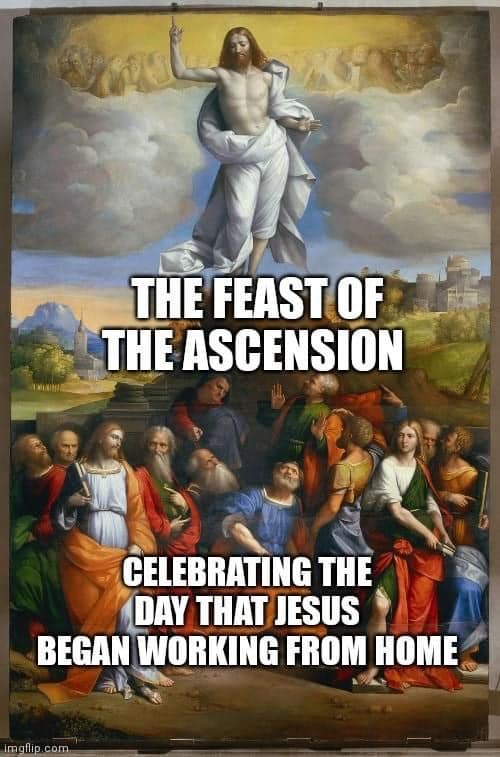
He turned up, and it was Ascension Day. There he found a hot air balloon, and the plan was for him to ascend in it while the assembled throng sang the hymn, ‘Nearer, my God, to thee.’
Whether the ancient Jews believed that heaven was spatially directly above us is disputed. Some scholars believe their understanding was more akin to heaven being like a parallel dimension to our existence but usually invisible to us. Put like that, it sounds a bit like science fiction, doesn’t it?
But the key aspect in the description of the Ascension that we have in Acts chapter 1 is not simply the being taken up (which is quite a vague expression) but also that ‘a cloud hid him from their sight’ (verse 9). Yes, the ‘taking up’ is reminiscent of Enoch and Elijah going directly to heaven in the Old Testament, but the cloud also has Old Testament connotations, for clouds were sometimes a sign of God’s direct presence. Think of the Exodus, where the Israelites were led by a pillar of cloud by day and a pillar of fire by night.
So the Ascension tells us that Jesus has left this existence and is now in the direct presence of God in heaven.
But what is he doing now? I want to take you around a few New Testament references today to answer that question.
Firstly, he is resting:
After he had provided purification for sins, he sat down at the right hand of the Majesty in heaven. (Hebrews 1:3b)
He sat down. That sense of satisfaction when a job is finished. You’ve probably done that after completing something at home. Put the kettle on, make a brew, and put your feet up. He sat down. Even Jesus.
And so he should, because his mission on earth was complete. John’s Gospel records that just before he died on the Cross, he cried out, ‘It is finished!’ (John 19:30). And ‘finished’ here doesn’t mean, it’s over, I’ve failed, that’s it, it means quite the opposite. It means, ‘It is accomplished.’ Jesus has completed everything his Father sent him to do. His suffering and death opened the way to God’s presence. He was vindicated in the Resurrection. It’s done. Big tick!
When we celebrate the Ascension, we rejoice that Jesus has done everything necessary to bring us into fellowship with the God Who Is Trinity. There is nothing we can do or need to do to add to it, for we do not earn our salvation. Jesus has done it all, and now offers it as a gift, which we receive with the empty hands of faith.
I once had a couple start worshipping at a church I served, and they asked about becoming church members. I visited them, and they wanted to know if they were good enough to be accepted as members. I wish I’d picked up on that language at the time, because they turned out to be very judgmental people – especially the husband. If you’re forever trying to earn your salvation, you either become hugely self-critical, because you can never live up to your own standards, or you become hugely critical of others, always taking them to pieces.
And indeed, to try to earn salvation is effectively to say to Jesus, you didn’t need to die on the Cross. Which one of us dares to look Jesus in the eye and say that? But it’s what we do when we try to earn our own passage to heaven.
Instead, rejoice that Jesus has sat down. He has done it all. Receive his wonderful gift!
Secondly, he is sending:
‘For John baptised with water, but in a few days you will be baptised with the Holy Spirit.’ (Verse 5)
In a few days the Father would send the Holy Spirit through Jesus upon the disciples. Now of course we’ll think about that next week at Pentecost, so at this point I want to focus on the words ‘in a few days.’
Yes, it’s true that we no longer have to wait for the gift of the Holy Spirit. When we turn our lives over to Jesus Christ, the Spirit comes into our life. Indeed, even to get to that point the Spirit has already been prompting us. But again, that’s for next week.
What about those occasions when Jesus promises something good but it’s a long time coming? We’re not used to that in an instant society. We like fast broadband, Amazon Prime with next-day delivery, twenty-four hour news channels where political spokespeople are expected to react immediately to the latest gossip rather than take the time to be considered and reflective.
Is there something to be said for Jesus to temper his sending with waiting? Could it be that our demand to have everything now has made us immature, like overgrown children, saying, in the words of the Queen song, ‘I want it all, I want it all, and I want it now’?
Jesus does indeed send us good things, but he may well make us wait. For in the waiting for what he sends he has work to do in us, forming us and shaping us into more mature disciples.
Even the psychologists agree that the ability to delay gratification is a sign of maturity. But Jesus knew that long before the rise of psychology!
Is there something we have been praying about for a long time? To the best of our knowledge, does it sound like something the Jesus of the Gospels would approve of? If it is, then I encourage us to keep praying, even if we have been disheartened. Let him use the time before it is fulfilled to prepare us and shape us.
As someone who had to wait longer than most to find a wife, I speak from experience. But she was worth waiting for. And what Jesus sends to you will also be worth waiting for.
Thirdly, he is praying:
Later in the Epistle to the Hebrews we read these words:
Therefore he is able to save completely those who come to God through him, because he always lives to intercede for them. (Hebrews 7:25)
Over time, I have known a few people who promised to pray for me daily. Most of them are now dead. They included my parents, and a wonderful elderly Local Preacher. I only know of one person who prays for me daily now.
Actually, there’s a second. I know that the ascended Jesus is praying for me. He ‘ever lives to intercede for [us].’ You can’t do better than that! Jesus is praying for his people!
Someone I know once had a conversation with some Catholic friends and asked them why they prayed to Mary. They replied, ‘Because she’s human, so she understands.’
This seemed rather sad to my friend, who realised that her Catholic friends were so fixated on the divinity of Jesus that they had forgotten his humanity.
Her response to them was, ‘Why go to the mother when you can go straight to the boss?’
We can go straight to the boss. He is already praying for us.
Have we ever thought of asking Jesus to pray for us? Because his answer is ‘yes.’
What about those times when we really don’t know what to ask for in prayer? Could we pray, ‘Jesus, I have this issue, and I don’t know the right way to pray about it. I’d love you to guide me in the right way to pray and the right things to ask, but would you also pray to the Father about it for me, please?’ It seems to me that this would be a perfectly biblical approach to take and is far better than simply stating our request and just tacking on the end the words ‘If it be your will.’
Fourthly and finally, he is reigning:
‘He sat down’ not only hints at Jesus resting after completing his earthly work, it is also an act of authority. A Jewish rabbi sat down in the synagogue to teach – as Jesus himself did in the Nazareth synagogue in Luke 4. A king or an emperor would sit down on a throne. And Jesus here sits down ‘at the right hand of the Majesty in heaven’ (Hebrews 1:3).
But how do we understand him to be reigning when so much continues to be wrong with his creation? Allow me to answer that by talking about The Lord Of The Rings.
If you saw all three three-hour movies, you may remember that the final film comes to a climax with victory at the battle of Minas Tirith, and the ring that caused all the trouble being cast into the fires of Mount Doom. After that, most of the heroes board a boat to The Undying Lands, whereas Samwise goes back to the peace of The Shire. It’s just as we would want it.
But that’s not how the original trilogy of books end. There, after the battle is won at Minas Tirith and the ring is destroyed in the fires of Mount Doom, we come to a penultimate chapter, entitled ‘The Scouring of the Shire.’ In it,
the Hobbits come back to the Shire to find it under the thumb of Saruman and Wormtongue. It’s an Orwellian nightmare of jobsworths, ruffians and snitchers. Frodo, Sam, Merry and Pippin join forces with Tom Cotton and his family to throw off the Orwellian oppressors and collaborators and MtSGA (Make the Shire Great Again).[1]
The decisive victories have been won, but there are still skirmishes to be had with evil. Can you tell what I’m about to say?
For Christians, the decisive victories have been won at the Cross and the Resurrection. Christ is now reigning at the Father’s right hand. But we still have battles with evil, because not all will bow the knee to Christ in this life, even though the Father has elevated him above all earthly authorities. J R R Tolkien, a devout Catholic, knew this when he wrote The Lord Of The Rings.
Just as in the United Kingdom we have a constitutional monarch on the throne and an elected government in office yet not everyone obeys the laws of the land, so the ascended Christ is on the throne of the universe but not everyone obeys him.
The day will come when everyone will see him and all will bow the knee to him, whether willingly or otherwise. In the meantime, this truth gives us tasks to do. One is to proclaim the good news that Jesus is on the throne of the universe and call people to give their allegiance to him. The other is to demonstrate that truth as we build for God’s kingdom.
In conclusion, I hope you can see how rich and important the doctrine of the Ascension is. Although only Luke mentions the actual event, so much of the New Testament refers to it and builds on it. One scholar even called it ‘The most important event in the New Testament’[2].
But most of all, I hope we can appreciate together what Good News the Ascension is. Jesus who rests, sends, prays, and reigns is in all these things rooting for us.
[1] James Cary, The Forgotten Feast: The Ascension and The Scouring of the Shire
[2] Ian Paul, Why is the Ascension of Jesus the most important event in the New Testament?

 Big Circumstance