Joy-Bringer, Isaiah 35:1-10 Advent With Isaiah 3 (Advent 3 Year A)

Isaiah 35:1-10

One popular Christmas carol, especially among American Christians, is ‘Angels we have heard on high.’ Its first verse reads,

Angels we have heard on high
Sweetly singing o’er the plains
And the mountains in reply
Echoing their joyous strains
Gloria in excelsis Deo!

Unfortunately, one source of the music misprinted ‘Echoing their joyous strains’ as ‘Echoing their joyous trains.’
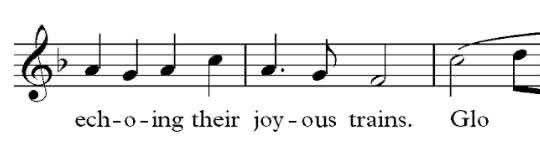
Source unknown. From the Church Service Typos group on Facebook.

I don’t suppose anyone who commutes would readily think of ‘joyous trains.’ I know my wife didn’t on Thursday evening when her train from Waterloo didn’t initially have a driver, when the passengers were told to disembark to find another train, only then to be told to stay on board. They left twenty-seven minutes late. Joyous trains, indeed.

But if the trains were transformed, that truly would be reason for joy.

The theme this week is ‘Joy’ but it is connected with transformation. So maybe a better title might be, ‘Joy in Transformation.’ These verses in Isaiah give five examples of the transformation the coming Messiah will bring, which lead to joy. It was something the southern kingdom of Judah needed to hear, nervous as the nation was due to the military power of Assyria, which had already conquered the northern kingdom of Israel.

But as so often in Isaiah, we shall see that no earthly king could completely fulfil the prophecy. Even with Jesus, the true Messiah, he would begin the transformational work prophesied, but it will only come to complete fruition with his return in glory.

However, in the meantime, in our in-between time, these point to our work for God’s kingdom today. There are five arenas for joy in the reading; I shall deal with each one briefly.

Firstly, joy for the desert:

The desert and the parched land will be glad;
    the wilderness will rejoice and blossom.
Like the crocus, 2 it will burst into bloom;
    it will rejoice greatly and shout for joy.
The glory of Lebanon will be given to it,
    the splendour of Carmel and Sharon;
they will see the glory of the Lord,
    the splendour of our God.

In the Middle East, the people know all about parched deserts in the heat. But God will restore life to the desert as he breaks the drought and beautiful plants bloom and flourish there.

Our droughts today are often caused by our failure as the human race to fulfil the command we were given when God created us: namely to rule over the created order wisely on his behalf. Instead of caring for it, we have exploited it. Now we pay the consequences – but worse, it is the poorer nations who are suffering first and most.

As Christians, we have common cause with those who are concerned for our environment. But we have a unique reason for being involved. It is that we are doing so as stewards of God’s creation, and as a prophetic sign that God will make all things new in his creation. We agree that the world is in a mess, but we engage out of a spirit of hope, not panic.

So let us engage in our creation care as an act of worship and of witness to the Messiah who will renew the earth. And if we listen carefully, we may catch the sound of the world rejoicing, too.

Secondly, joy for the fearful:

3 Strengthen the feeble hands,
    steady the knees that give way;
4 say to those with fearful hearts,
    ‘Be strong, do not fear;
your God will come,
    he will come with vengeance;
with divine retribution
    he will come to save you.’

At the time of the prophecy, Israel could well have been afraid of Assyria. But as we know, fear comes in many flavours. Fear of war. Fear of death. Fear of other people’s expectations. Fear of losing someone. The list of fears is long.

In the specific context, Isaiah promises that those who are afraid of wrongdoers can take heart, because God will judge the wicked who are scaring them.

And yet there is still a universal application. It is often said – and I confess I have not checked the veracity of this – that the words, ‘Do not be afraid’ occur three hundred and sixty-five times in the Bible. One for every day of the year. You can have one day of fear in a leap year!

God does not want us paralysed by fear. He wants us animated by love. And so, he promises to banish the forces and the people that cause us to fear. The life of the messianic age to come will not be characterised by fear. It will be an eternal age of love.

And if God promises that for us, we can ask ourselves, what can we do to help remove fear from the lives of other people? Sometimes we can banish the cause of fear. In other circumstances, we may not be able to do that, but we may be able to show how to live without fear when unwelcome things happen.

I know how easy it is to panic. My body goes into panic mode before my mind catches up with the truth. For me, God’s message of peace and love comes through human beings, not least my wife. There has been more than one occasion when people who didn’t like me in churches have made up false and malicious Safeguarding accusations against me. One time, my Superintendent phoned me and said, ‘Watch your back on Sunday morning.’ Debbie has helped me be anchored in truth when lies have flown about.

Thirdly, joy for the silenced:

5 Then will the eyes of the blind be opened
    and the ears of the deaf unstopped.
6 Then will the lame leap like a deer,
    and the mute tongue shout for joy.

There is more than one way of reading these words. Some take them literally as a promise of healing, and we saw in our Gospel reading from Matthew: Jesus did heal the blind, the deaf, and the lame. I wouldn’t want to deny that, nor the promise of full healing when Jesus comes again and makes all things new. I would encourage us to pray for the sick, just so long as we don’t treat chronically ill or disabled people purely as prayer projects rather than people with dignity. As the title of one book puts it, My Body Is Not A Prayer Request.

But I will say there is a wider meaning to these words. Why did I introduce this point as ‘joy for the silenced’? For this reason. Our English translations say at the end of the quote, ‘the mute tongue [will] shout for joy.’ But the words ‘for joy’ are not there in the Hebrew. The mute will shout. That’s it. People who have been silenced by those who oppress them find their voice in the kingdom of God. The persecuted are vindicated and set free. The people that society does not value are of great worth and significance to Jesus.

The early church did this by the way they gave importance to slaves and women. Jesus calls us too to value those who would not be elevated by our society. He longs for them to find their place in his family and his kingdom purposes. Let’s not evaluate people by worldly standards, but by the fact that they are loved and cherished by God in Jesus.

Fourthly, more joy for the desert:

Water will gush forth in the wilderness
    and streams in the desert.
7 The burning sand will become a pool,
    the thirsty ground bubbling springs.
In the haunts where jackals once lay,
    grass and reeds and papyrus will grow.

We’re back in the wilderness, but to make a different point. This time, we see the conditions coming together so that life can flourish. Water to drink. Papyrus to make documents. Reeds to make household items.

In this context, artisans, craftsmen, and business can flourish. Their raw materials are plentiful again.

And so, I want to suggest to you that one way we can be a sign of the Messiah’s coming kingdom is by supporting human flourishing, including our local businesses.

Is that a Christian thing to do? I think so. Remember how later the people of Judah were taken into exile in Babylon. The prophet Jeremiah wrote a letter to the exiles. You can find it in Jeremiah 29. In that letter, he tells these Jews who have been separated from their own land and temple that were so vital to their understanding of salvation that they were to seek the prosperity of the city to which they had been taken. Yes – even a pagan city. Go and bless the pagans, says Jeremiah: it is a sign of God’s covenant love.

Let’s cultivate our relationships with local shops and businesses. Not only by giving them our custom, but that when we do so we take an interest in them and we build relationships with them. I have known ecumenical groups of churches in a village take boxes of chocolates to every business in that village at Christmas, with a card thanking them for all they do, and offering to pray for them if they would like it.

Which shops, businesses, or community groups do you appreciate here? Can you bless them? I’m sure you can. Maybe it will provoke questions.

Fifthly and finally, joy for the temple:

8 And a highway will be there;
    it will be called the Way of Holiness;
    it will be for those who walk on that Way.
The unclean will not journey on it;
    wicked fools will not go about on it.
9 No lion will be there,
    nor any ravenous beast;
    they will not be found there.
But only the redeemed will walk there,
10     and those the Lord has rescued will return.
They will enter Zion with singing;
    everlasting joy will crown their heads.
Gladness and joy will overtake them,
    and sorrow and sighing will flee away.

The highway of holiness, on which only the redeemed and not the unclean may walk, is surely the road to the temple in Jerusalem.

This reminds us that when Jesus is present among his people, there is joy. Yes, of course we will be reverent: I am not calling for some religious chumminess with God. But for all that, to have the Messiah in our midst will be a cause for joy and it will reflect in the way we are together in worship and in the sharing of our lives together. With Jesus, church is to be a place of joy.

Today, we only have that experience of Jesus by the presence of his Spirit within us and in our midst. But part of the fruit of the Spirit is joy! And one day, we shall all be together in the presence of Jesus and his Father, too.

It’s nice that we look forward to seeing our friends at church. But that doesn’t make us any different from anyone else. Do we have a sense of joy that Jesus will be present with us, and indeed that we are each bringing him with us to our gathering? That is what the messianic community is like.

Conclusion

Joy to the world, we sing at this time of year, the Lord is come. And when the Lord comes, there is joy. Joy for the broken, joy for God’s people and joy for all creation.

And when he comes again, the joy will be magnified and sorrow banished.

Let us, the followers of Jesus, then, also be joy-bringers.

Why Does The Risen Jesus Appear To The Disciples? Luke 24:36-49 (Easter 3 Year B 2024)

Luke 24:36-49

It’s a thrill for parents when their child starts speaking. It’s less of a thrill when that child learns the word ‘Why.’ Every question becomes, ‘Why?’

As a child, I was certainly fond of asking ‘Why?’ Not only the dreaded ‘Why do I have to do this thing you are telling me to do?’ but also ‘Why’ in terms of wanting explanations for the way things worked in the world. I know I was persistent on that last kind of question, because my parents bought me a subscription to a children’s magazine called ‘Tell Me Why.’ You can still find old copies on eBay. It comes under eBay’s category of ‘Antiquarian Collectibles’, such is my age now.

As I read the familiar resurrection story from Luke, I realised that one of the questions I wanted to ask of this passage was ‘Why?’ Why did Jesus appear on this occasion to the disciples? What was this resurrection appearance about?

Going over the text, I came up with three answers to that question: why did the risen Jesus appear to the disciples on this occasion? I realised too that the reasons why Jesus appeared to the disciples here are also reasons that are relevant to us.

Firstly, the Risen Jesus brings peace:

36 While they were still talking about this, Jesus himself stood among them and said to them, ‘Peace be with you.’

These last couple of weeks I could have done with a dose of ‘Peace be with you’ from Jesus. Straight after Holy Week to Easter Day in which I preached or spoke eight times in eight days, I walked into a legal crisis over the text of my book, which I have had to remove from sale.

Then I had serious warning messages flash up on my car dashboard. An investigation by the dealer found that it needs repairs costing over £2000. The fault is something that the manufacturer should have put on the list for last year’s annual service but failed to do so. They are now trying to wriggle out of responsibility on a technicality.

Yes, I could have done with some peace from Jesus.

The one bright part was that I had to submit some blood pressure readings this week to the pharmacist at the doctors’ surgery, and he described my results as ‘gold standard’, so Debbie said that in fact I clearly haven’t had enough stress!

Now on the one hand ‘Peace be with you’ is a fairly standard Jewish greeting. When I flew to and from the Holy Land on El Al Airlines in 1989, every message over the plane’s PA from the pilot or cabin crew always began with ‘Shalom and good evening.’

But here, the disciples really need peace:

37 They were startled and frightened, thinking they saw a ghost.

A ghost: something not of God. So fear is natural. It’s equally possible to be fearful in the presence of God’s almighty power – which the Resurrection indicates.

The way in which Jesus leads the disciples to peace is basically to reassure them: ‘It’s me. You don’t need to be afraid. You know me.’

It was good news for the disciples then, and it is good news for Jesus’ disciples today. The Resurrection says, don’t stay at a distance from Jesus in your relationship with him.

Do you ever feel nervous about drawing near to Jesus? Here’s a secret: I do. My current devotional pattern comes in two parts. Earlier in the day, I have a reflection on a Bible passage, then at night I ponder how the day has gone in the light of Scripture. I find something to rejoice in, and something to confess. When I keep confessing the same sins and failures regularly, I can tell you I don’t want to draw near to Jesus. But what astonishes me is the way my devotional takes me every day to assurances of forgiveness in the Bible. It’s as if every evening Jesus is saying to me, don’t be afraid, don’t stay at a distance, the best thing you can do is draw near to me.

What about you? Where is the Risen Jesus saying ‘Peace be with you’ to you?

Secondly, the Risen Jesus brings proof:

When people invite others over for dinner, the hosts will usually ask in advance if there is anything they cannot eat or dislike. When people ask Debbie and me that question, they will find out that I am allergic to artichokes and dislike roast pork and gammon. Debbie will say that she cannot face fish or mushrooms. Whenever we go out to a pub or a restaurant for a meal, it is a standing joke that I will order fish to make up for not having it at home. If belly pork is on the menu, you can guarantee Debbie will be tempted.

I take great comfort in the Resurrection narratives, because there (including the one we read today) I learn that Jesus likes to eat fish. In John 21, he cooks a fish breakfast for the disciples after their overnight fishing trip. Here, he shows them his wounds and eats some fish to eat as proof that he is bodily to calm their fears and assuage their doubts (verses 38-43).

Now you may say that what was proof for the disciples two thousand years ago is not proof for us. But it is very strong historical evidence. We do not need to doubt the bodily Resurrection of Jesus.

I never tire of emphasising that the Resurrection is bodily. On Easter Day, I told Midhurst how that was a sign that God is renewing his material creation, and that’s why as Christians we care about things like healing, social justice, and the climate.

Today, I want to say that it also means we don’t need to doubt Jesus but trust in him. It’s why we sing lustily on Easter Day,

No more we doubt thee,
glorious Prince of Life[1]

We can trust Jesus because he has conquered sin and death in the Resurrection.

I know we will doubt him still from time to time. I do. But when I doubt, I always come back to the Resurrection. It’s real. It’s true. It’s bodily. It’s what makes life worthwhile. I hold onto that in my dark times. Or perhaps more accurately, that’s what holds onto me.

I don’t know what all your doubts and struggles are. Feel free to talk with me about them, if that would help. I simply invite you to remember that the bodily Resurrection is true, and so Jesus can be trusted.

I mean, the Risen Jesus must be trustworthy. He eats fish!

Thirdly and finally, the Risen Jesus brings purpose:

The Risen Jesus has brought good news for the disciples: fear replaced by peace and doubts replaced by proof. Now they can draw near to Jesus and trust him.

But if it’s good news for them it’s also good news for the world. And Jesus the Teacher gives his class of disciples a lesson. He recaps how he had told them he would die and rise again as the fulfilment of Israel’s hopes in her Scriptures (verse 44). Then he explains how this was rooted in those Scriptures (verses 45-46) – not so much proof texts, scholars suspect, as allusions to the whole story of Israel as Stephen would tell it before his martyrdom and passages like the Servant Songs, especially the Suffering Servant in Isaiah[2].

Israel’s vocation was to be a light to the nations. Jesus had fulfilled that. Now his disciples had to be the light of the world, taking this good news of peace and trust in Jesus from Jerusalem to the world (verses 47-49).

And in our day, that’s what we continue – being light in the world with the good news of Jesus.

But often we struggle with this vocation. If we have other events in our lives that are good news, we have no problem with sharing: the birth of a child or grandchild, a new job, exam success, a family wedding. We will tell our friends without any problems.

We are more reticent about the good news of Jesus. Has it become stale for us? Are we nervous about the response we shall receive? Are we worried about being a Bible-basher? There are many reasons why we may hold back.

Jesus knows that even though his disciples ‘are witnesses of these things’ (verse 48) they are not ready. They need to wait for the power of the Holy Spirit (verse 49).

We don’t have to wait for the Holy Spirit like they did, but this is a reminder to us that the key to fulfilling our purpose as witnesses is the power of the Spirit. We pray that the Holy Spirit will work through us so that we reflect the light of Jesus in the world. We also pray that the Holy Spirit will guide us to the right time to speak about Jesus, and the right way to talk about him. We further pray that the Spirit will give us courage when we find that difficult.

There’s a catchphrase from the movie and stage musical Mrs Doubtfire, where the title character repeats the words, ‘Help is on the way.’ That’s what Jesus promises his disciples at the end of this reading. Yes, his offer of peace enables us to draw near to him and not remain fearful of him. Yes, his proofs and evidence of his Resurrection enable us to trust him rather than doubt him. And yes, we are called to share this light with the world, which we may find daunting.

But help is on the way, because Easter will connect us to Pentecost.


[1] Edmond Budry (1854-1932), translated by Richard Birch Hoyle (1875-1939): Thine be the glory.

[2] Ian Paul, The risen Jesus meets the Eleven in Luke 24.

New Beginnings 2: Moving On (Deuteronomy 1:1-46)

Deuteronomy 1:1-46

“Are we nearly there yet?”

I’m sure you recognise that as the frustrated cry of a young child on a car journey. I’m pretty certain those words came out of my mouth when I was small.

A frustrated child would have been driven mad by the antics of ancient Israel:

2 (It takes eleven days to go from Horeb to Kadesh Barnea by the Mount Seir road.)

3 In the fortieth year, on the first day of the eleventh month, Moses proclaimed to the Israelites all that the Lord had commanded him concerning them.

Forty years to travel a distance that should have taken them eleven days. And now Moses preaches this recent history back to the Israelites by recognising this trait in them: 

The Lord our God said to us at Horeb, ‘You have stayed long enough at this mountain. 7 Break camp and advance …

God is calling them into a new future, a future of blessing, in the Promised Land. But they are resistant.

And that makes this a good passage to look at in the second of my sermons on New Beginnings at the start of my ministry here. Last week, I talked about how we must leave the past behind, learning from it yes, but living there no, and seek the new thing God wants to do in our day and age. (You can watch the video or read the blog). This week, I want to talk about moving on, and the spiritual qualities we need.

Here are four important things we need to practise.

Firstly, every member ministry.

In verses 9 to 18 we read of how Moses was overloaded and how he shared the leadership and pastoral care of the people. He knew the whole enterprise would grind to a halt unless he stopped everything funnelling through him. 

I once heard about a vicar who would go to the bottom of his garden every morning at 10:30 to watch the Inter-City express train whizz past. Someone asked him why he did so.

He replied, “I want to see the only thing in this parish that moves without me pushing it.”

I think Moses felt like that, and so he drew on the gifts and talents of others. He wasn’t worried about keeping all the glory for himself. 

At Monday’s welcome service I said how such occasions made me uncomfortable. The very fact that ministers get public welcome services but others don’t tends to raise people’s expectations of people like me. 

But, I said, we are not your saviours, because the job of Saviour of the world is not vacant. It was taken long ago by Jesus. Ministers come alongside to help lead the work of the kingdom, we don’t come to save your church. 

So – I won’t be the first preacher to say this to you, but it bears regular repeating – have you considered what your talents and spiritual gifts are? And have you offered them in the service of God’s kingdom? We are all what the Bible calls ‘vessels of honour’ who have the privilege of serving Christ in response to his great salvation. 

How does that work out for you?

Secondly, obedience.

After the spies come back with some beautiful fruit from the Promised Land and their message that ‘It is a good land that the Lord our God is giving us’ (verse 25), how does Israel respond? Moses says,

26 But you were unwilling to go up; you rebelled against the command of the Lord your God.

Let us not think that once we have received salvation we can behave as we like. Obedience is not what earns us the love of God, but it is the way we show our gratitude for the salvation we have received. It’s no accident that Israel receives the Ten Commandments after being set free from Egypt, and not before. 

And there’s a very specific command here that Israel disobeys: to take the presence of God into the world where he is not yet known, and where people at the time worshipped other gods, false gods. Oh no, they said, we’ll stay among ourselves here where we’re comfortable. 

And God gets mad. 

I was once asked to conduct the funeral of an elderly church member, and so I arranged a meeting with her family to discuss the service and talk about her life. When her grown-up children, who were no longer churchgoers, were telling me about her, they said one very striking thing.

They told me that the old lady’s whole life had been based on the church and its activities, even her social life.

I think they were trying to impress me, but inside my heart sank. Just as Israel had a command from God to get into the Promised Land, so we have a command from Jesus to get into the whole world with his redeeming love. 

It’s so easy just to have a nice quiet life with our Christian friends, but all of us are called to show and tell the Gospel in our words and deeds. There are people around us who need some demonstration of God’s love, and we are the people to do it. 

I was so sad when I heard one of the lecturers where I trained for the ministry say, “I don’t have any non-Christian friends.” What a tragedy for the Gospel that was. 

There are many ways we could explore this question of obedience, but let’s just concentrate on this for now: how are our lives shining with the Gospel in the world?

Thirdly, gratitude.

It’s more than disobedience to take the presence of God into the world, says Moses. He goes on to say, 

27 You grumbled in your tents and said, ‘The Lord hates us; so he brought us out of Egypt to deliver us into the hands of the Amorites to destroy us.

Grumbling, rather than gratitude, characterises Israel here. 

Please don’t misunderstand me. There are times to complain. We should not always let lazy or malicious people mistreat us or others. There are issues of justice to take into account.

But there is a grumbling negativity that pervades some Christians and some churches. Nothing is ever good enough for some people. 

In one church I had people refuse to take on a role with teenagers. Two of those I approached declined, giving the same reason. 

“I’m not taking that on just to be ripped to shreds at Church Council by [Name].”

And when we did get someone else to do the job, guess what happened to them?

When we consider all that God has done for us in Jesus Christ from creation to redemption to the gift of the Spirit and the promise of a New Creation, surely our default attitude in the community of faith needs to be one of gratitude. It will show in our worship. It will come through in our relationships and our sense of community. It will be a shining witness to the world. 

When I was a child, I recall my maternal grandmother, who lived with us, singing the old chorus ‘Count your blessings’ around the house. The thought of counting our blessings and being surprised how much the Lord has done is a good principle. Put into practice, it changes the atmosphere in a place. It brings a kingdom atmosphere, I might say. 

In saying all this I don’t want to minimise the hardships and struggles that some of you are doubtless facing. But I do want to say that the sort of church which can survive and thrive in the future is a grateful one. There is more than enough of the grumbling spirit in the world. Let’s live – as one Christian leader once put it – ‘in the opposite spirit.’

Fourthly and finally, faith.

Here is the last issue that Moses and God have with Israel:

28 Where can we go? Our brothers have made our hearts melt in fear. They say, “The people are stronger and taller than we are; the cities are large, with walls up to the sky. We even saw the Anakites there.”’

29 Then I said to you, ‘Do not be terrified; do not be afraid of them. 30 The Lord your God, who is going before you, will fight for you, as he did for you in Egypt, before your very eyes, 31 and in the wilderness. There you saw how the Lord your God carried you, as a father carries his son, all the way you went until you reached this place.’

32 In spite of this, you did not trust in the Lord your God, 33 who went ahead of you on your journey, in fire by night and in a cloud by day, to search out places for you to camp and to show you the way you should go.

Fear replaces faith. Israel sees the task ahead purely in terms of what they can or cannot do on their own. They do not see that when God commands something that seems to be humanly impossible, that same God will provide the means to achieve what he has commanded. Israel does not trust its God. Paralysing fear takes over.

This is certainly something we see in churches, and it inhibits their mission. It may even be the beginning of the death of those churches. 

Perhaps you have come across churches where they have been offered a great refurbishment and rebuilding project that will reinvigorate their premises for mission. Their existing building is getting old and expensive to run. Although a lively and loving community worships there, the local community looks at the building and thinks it’s closed. What do they do?

They can choose between fear and faith. Fear says, ‘We can’t do this. It’s too much money and too much work for the people we have.’ Faith says, ‘What is God saying to us here? If he is calling us to do this, then we will.’

Fear says we can’t. Faith says God can – provided it’s what he has said. 

Hudson Taylor, the famous nineteenth century missionary to China, once said this:

God’s work done in God’s way will never lack God’s supply.

Conclusion

Perhaps, like Israel at the beginning of Deuteronomy, we are on the verge of something new. Will we embrace these qualities and go forward with God?

  • Every member ministry, where all our gifts contribute
  • Obedience, to take the love of God into the world
  • Gratitude for all God has done for us in Christ
  • Faith, to run with whatever God calls us to do, even if it stretches us.

Tests Of Faith (John 6:1-21) Ordinary 17 Year B

John 6:1-21

Early in the pandemic my wife received a letter inviting us to take part in monthly testing for COVID-19 on behalf of the Office for National Statistics. Whenever you’ve seen reports about the ONS data, we’ve been part of that.

More recently, testing has become much more frequent than monthly for many people. Our kids had to take twice-weekly tests to attend their Sixth Form colleges on site. We ministers in my Methodist circuit have talked about self-testing before taking services and other appointments.

And testing is a major theme in today’s reading:

When Jesus looked up and saw a great crowd coming towards him, he said to Philip, ‘Where shall we buy bread for these people to eat?’ He asked this only to test him, for he already had in mind what he was going to do.

But to my mind that’s just the first of three tests in the passage. All three tests are tests of faith in Jesus, but in different ways.

Today, I’d like to explore those three tests of faith to think about how Jesus tests our faith in him.

Firstly, faith goes beyond our understanding:

Philip answered him, ‘It would take more than half a year’s wages to buy enough bread for each one to have a bite!’

Another of his disciples, Andrew, Simon Peter’s brother, spoke up, ‘Here is a boy with five small barley loaves and two small fish, but how far will they go among so many?’

It’s hard to be cruel about Philip and Andrew. They survey the scene, gather the evidence, and come to a conclusion.

Now I’m a big fan of evidence, logic, and reason. I’m quite an analytical person. But if this story had stopped at this point, it would have been tragic.

And sadly many church stories or individual Christian stories stop at a similar point. Jesus starts challenging them and the response is, ‘But we can’t do it.’ It all shuts down there. We can’t do it. End of.

It’s true that Philip and Andrew couldn’t sort out the problem. It’s true that Christians and churches on their own can’t do what Jesus calls them to do.

But the issue is this: what is Jesus saying? What does Jesus want to do?

Because for all the value of reason, logic, and evidence-gathering, the ultimate question here is Jesus saying, ‘Do you trust me enough to do what I say?’

When we do, then amazing things happen. When we don’t, we drift into spiritual decline.

Secondly, faith goes beyond our preferences:

14 After the people saw the sign Jesus performed, they began to say, ‘Surely this is the Prophet who is to come into the world.’ 15 Jesus, knowing that they intended to come and make him king by force, withdrew again to a mountain by himself.

You can see the preferences and the preconceived ideas going on in the people here. ‘We have just been miraculously fed. A king feeds his people. We want and need a king, especially one who will get rid of the Roman occupying forces. Let’s make Jesus king.’

But as we know with hindsight, Jesus refused that idea of kingship. The kingdom of God is different.

Sometimes we have our own preconceived ideas of Jesus, too. And those preconceived ideas are often based on what we would prefer to believe. So I’ve been in a service where I’ve read a passage from the Gospels in which Jesus says some tough things, only for someone to tell me afterwards, ‘Jesus wouldn’t have said anything like that.’ The trouble is, they’ve got a fantasy Jesus in their minds, one that won’t disturb their comfortable little worlds, one who conveniently agrees with them on sensitive subjects.

One of the most common forms of this fantasy Jesus is believing he loves us as we are (which is true) but forgetting that he loves us too much to leave us as we are (thus avoiding challenging things like the way Jesus challenges us to be transformed). It’s all the benefits of the Gospel, but none of the responsibilities.

The only real faith in Jesus is one where we accept and worship him for who he is, and where we are willing to come under the authority of his teaching, not our wishful thinking.

The crowd missed out on the real Jesus. Let’s make sure we don’t.

Thirdly and finally, faith goes beyond our fears:

Now we move onto the story of Jesus walking on the water.

19 When they had rowed about three or four miles, they saw Jesus approaching the boat, walking on the water; and they were frightened. 

Well, who wouldn’t be frightened by such an out of the blue experience? I’m sure I would be.

And even if we haven’t had strange supernatural experiences like that, it’s also true that in whatever way Jesus starts to come close to people, many become frightened like the disciples did.

Why is that? I think many of us become so conscious of our sins and failures when Jesus comes close that all we can think of is to say, ‘Please stay your distance!’

It’s like we want just enough Jesus to be sure our sins are forgiven, but not so much Jesus that we can’t cope. Because in our hearts we know that the fluffy fantasy Jesus I talked about in the last point doesn’t exist.

C S Lewis captured the feeling in this famous passage from ‘The Lion, the Witch and the Wardrobe’:

“Aslan is a lion- the Lion, the great Lion.” “Ooh” said Susan. “I’d thought he was a man. Is he-quite safe? I shall feel rather nervous about meeting a lion”…”Safe?” said Mr Beaver …”Who said anything about safe? ‘Course he isn’t safe. But he’s good. He’s the King, I tell you.”

And so it’s no wonder that when the disciples are frightened to see Jesus walking on the water towards their boat, what we read next is this:

20 But he said to them, ‘It is I; don’t be afraid.’ 21 Then they were willing to take him into the boat, and immediately the boat reached the shore where they were heading.

Let our faith overcome our fear of Jesus and welcome him close, because he is good. His presence makes a difference to the disciples with their boat reaching shore immediately, and he will make a difference to us, too.

Could it be that one reason we don’t see so much of Jesus’ power in our churches is that we don’t want him to come too close to us? Maybe it’s time to choose faith over fear.

So let’s wrap with a summary:

Jesus tests our faith, because alongside all our gifts of reason we still need to trust him.

He tests our faith so that we put our trust in the real Jesus, not some fantasy Saviour.

And he tests our faith so that it wins out over fear of him, he draws closer to us, and we begin to see amazing things happen for the kingdom of God.

So let’s not run away when Jesus tests our faith. He tests us so that our faith grows and the kingdom of God extends.

That’s what we want. Isn’t it?

April Jones And A Nation Afraid

I haven’t kept refreshing a news story so frequently for ages. But the story of five-year-old April Jones’ abduction chills me like nothing in ages, even in our information-saturated culture.

I’m a Dad. I have a nine-year-old daughter who wants to walk home from school alone. Sensible as she is, the answer is no. While I was coming home from school on my own at that age, I don’t feel it’s safe in our society. Yes, I know an argument will rage about whether these incidents are more prevalent or simply more reported, and yes as a Christian I am not to be ruled by fear, but I have a parental duty of protection to my children.

The fear is coming out socially in other ways. Many have already assumed that the arrested man is guilty of the abduction (and maybe much more). But we don’t know yet. We can’t allow fear to launch vigilante groups. Our craving for safety could create a new Wild West if we were to follow all the populist cries. There is a danger that some people will do anything or vote for anyone they think will bring peace and safety. That anything or anyone could bring greater trouble, though.

Meanwhile, I see many messages on social media from Christians who are praying for the safe return of April. I find myself adding the qualifier, ‘if she’s still alive.’ Since  little April wasn’t with the arrested man and they are searching in the area of a river, I feel sick about the prospects of finding the poor girl still breathing.

How, then, do Christians model living free from fear and full of compassion? Because right now, that could be a central part of our witness in the UK.

Sabbatical, Day 43: Worshipping, Not Drowning

This morning I headed off to church on my own. Debbie and the children went swimming. There were a few reasons behind this parting of the ways. Firstly, when I’m not sabbaticalling, the Sunday School at Broomfield is only alternate Sundays. Debbie doesn’t feel she can make the children sit through an adult service regularly, so she began taking them for fun swims to boost their skills. Yesterday, they said they wanted to go to the pool again.

A second reason would be that I’m still uneasy about missing worship for anything other than illness. I attribute that to my upbringing in a church family. There is something positive about keeping the Sabbath that is important to me. I’m going to find it hard next Sunday: not only is it Mothering Sunday, it is also Rebekah’s birthday, and I know there will be pressure for us to miss church and go out somewhere.

But there is a third reason. I can’t swim.

I had some lessons at school, but at primary school they were scuppered by a traumatic experience. I saw my best friend held under the water. That did things inside a seven-year-old’s mind, and I never recovered. Going onto secondary school at eleven, the games teacher was the macho sort who was aggressively unsympathetic to any boy who couldn’t swim. All he did was haul me across the width of the pool by a rope.

I’ve never seriously revisited the issue. When Debbie and I were on honeymoon, we spent a few days at an hôtel with a pool and she offered to help me learn. Since it was her, I didn’t mind. But I just couldn’t grasp it.

Every now and again, she asks me to take adult lessons. I feel there are so many fear barriers I would have to cross. One is whether I would be humiliated again by a teacher. Another is how I would cope without my glasses on. (I’m not a suitable case for contact lenses – long story.) And some other things. Yet I am one who stands in a pulpit and tells people that Jesus can help them through the painful memories of their past. One day, I’ll have to find a way of dealing with this. Right now, I’m not sure how. I only know it will have to be gentle.

As for the worship, one or two parts really struck me, not least the Collect for the Third Sunday in Lent:

Almighty God, 
whose most dear Son went not up to joy
but first he suffered pain,
and entered not into glory before he was crucified,
mercifully grant that we, walking in the way of the cross,
may find it none other than the way of life and peace;
through Jesus Christ our Lord. Amen.

How many times have I heard those words? How often have I read the biblical passages on which they are based, not least Paul’s words in Philippians, where he wants to know Christ and the power of the resurrection, but only through ‘fellowship in his sufferings’? Today, however, they were a living word for me, making sense of the down times and the dry spells since coming to Chelmsford. Perhaps these will prove to be ‘the way of the cross’ and that hope is coming.

It certainly tied in with what Paul, the vicar, preached about. He changed the Lectionary Epistle reading and preached about how we can face darkness as Christians. He should know. As he said publicly on this occasions, and has said before, he has battled depression for thirty years. It was an honest and hopeful word.

One lovely thing today, and one sadness. The former came this afternoon, when we took the children out to a playground in a local park. There, Rebekah saw someone from school. He is permanently in a wheelchair, but had been at the swimming pool this morning. He had thought Rebekah must be in Year 3 (she’s in Year 1). She asked if we could go and speak with him and his grandparents. We made a new friend, someone we can now speak to when we see him at the school. All because Rebekah made the overture of friendship. She’s learning missional before she’s six.

The sadness was to learn that another couple we know are separating. That is three couples is less than a year. Two of the couples are Christian families. Our hearts now go out to this couple, and to their children. Our prayers go up for their pain.

Create a website or blog at WordPress.com

Up ↑