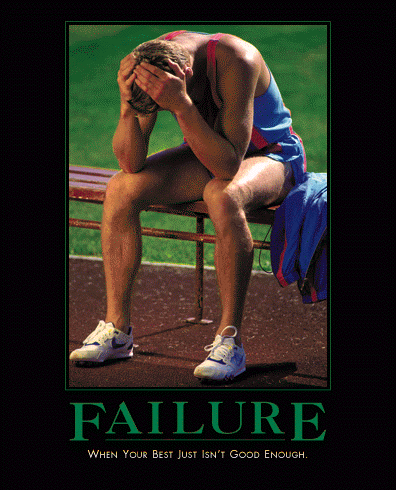
It’s that time of year when sign-ups to health clubs and gyms breed like rabbits. Yet in a few months’ time, many of the direct debits will still be going out from bank accounts, but a lot of the new fitness enthusiasts of January will have given up. The thought of ‘New year, new me’ will lie in tatters. Another set of New Year’s Resolutions will have failed.
Maybe that’s why I haven’t bothered with such resolutions for many years. I feel sure I’ll fail.
So much of life is made up of failures – cheerful thought, I know! – be they failures of good intentions or that much larger feeling that our lives themselves are a total failure. Not one of us is without our failures.
But on this first Sunday of the New Year, when we renew our covenant with God, and we traditionally become sombre and serious, wondering whether we can keep the solemn and intimidating promises we make, I want to preach Good News.
In my draft order of service, I simply called this sermon ‘The New Covenant.’ But now I want to give it a different title: ‘Good News For Failures.’ I want you to have a sense of hope from our reading in Jeremiah.
Yes, I know many people have Jeremiah down as a depressing and depressive prophet of doom. But if you read him closely, he preaches short-term doom but long-term hope. And that’s why we can have a theme of ‘Good News For Failures.’
I have two pieces of Good News from Jeremiah for Failures:
Firstly, God’s New Covenant means Failures Are Not Forgotten:
31 ‘The days are coming,’ declares the Lord,
‘when I will make a new covenant
with the people of Israel
and with the people of Judah.
32 It will not be like the covenant
I made with their ancestors
when I took them by the hand
to lead them out of Egypt,
because they broke my covenant,
though I was a husband to them,’
declares the Lord.
Jeremiah has preached doom to Israel. He warned them that if they did not turn from their sins the king of Babylon would come and conquer them and take them into exile. They didn’t listen. They thought they could find political solutions to their troubles without changing their ways while continuing to sin.
It didn’t work. The Babylonian army turned up. At this point, a first tranche of Israel has been marched off into Babylon. They are away from the land, which was so central to their religion, because it had been promised to them by God. If they are away from their own land, then surely they are forgotten and rejected by God for ever.
Yet Jeremiah comes with this word and others that looks forward to the future. God has not finished with his people. They may have broken the old covenant, but he will make a new covenant.
And of course, that is what the coming of Jesus at Christmas is about. If you re-read the nativity stories you will see how many of the promises don’t simply look forward to Christianity and the Church (which is the way we often read them) but are promises to Israel. God has not forgotten and rejected his people. His own Son is bringing the promised new covenant.
Now we Gentile believers are grafted onto the vine which is the People of God, and so we too are inheritors of this same promise. When we fail, God has not forgotten us.
If we come to this Covenant Service this morning conscious of how much we have not lived up to our promise a year ago, we come to a God of grace who in Jesus Christ offers us yet another new beginning. Just as we confess our sins every Sunday morning together and receive assurance of forgiveness, so too year on year at this service we shall confess our sins before we renew the covenant and again receive God’s promise of a fresh start.
Every now and again, I come across people in church who believe that God cannot continue forgiving them. A few will even say they think they have committed ‘The unforgivable sin.’ However, Jesus said the unforgivable sin was blasphemy against the Holy Spirit, and if someone is sensitive to their sin then believe me that usually indicates they are also sensitive to the Holy Spirit.
No: to everyone who fails, I believe God invites us to look at Jesus on the Cross and see his arms stretched out wide – so wide they embrace the world, including us.
Those who are excluded from his embrace are those who exclude themselves not simply by sinning but by refusing to accept they have sinned, perhaps painting their sin as righteousness (often self-righteousness), and thinking they have no need to repent.
But to those of us who are acutely aware of our need to repent, God says, I have not forgotten you. I have not rejected you. Come back. You will find I am already waiting for you.
Secondly, God’s New Covenant Means Failures Have New Hope:
33 ‘This is the covenant that I will make with the people of Israel
after that time,’ declares the Lord.
‘I will put my law in their minds
and write it on their hearts.
I will be their God,
and they will be my people.
34 No longer will they teach their neighbour,
or say to one another, “Know the Lord,”
because they will all know me,
from the least of them to the greatest,’
declares the Lord.
‘For I will forgive their wickedness
and will remember their sins no more.’
Neatly for me, this gives me a chance to link back to my sermon for the Fourth Sunday of Advent, when I looked at the relationship between Jesus and Moses. To recap part of it:
In the Old Testament, people were not saved by the Law but by grace. Keeping the Law did not save people, rather it was a response to having been saved. We can see this by the fact that God only gave Moses the Law for Israel after he had delivered them from Egypt.
Nevertheless, it was external to the people. It showed God’s righteousness, but it did not convey the power to obey it. On the other hand, the Christmas promise is that Jesus is Emmanuel, God with us, and when Jesus returns to the Father that changes to the Holy Spirit, God within us.
Now link that with what Jeremiah records God as saying here. The external Law will be replaced in the New Covenant with everyone knowing the Lord. In other words, the New Covenant promises God’s indwelling of every disciple.
Not only that, we do not have to depend on priests to mediate between us and God – again, because everyone will know the Lord.
We don’t have to struggle to know God, we don’t have to struggle to know his law, and we are also enabled with divine power to do his will.
Yes, we shall still fail from time to time, and God in his mercy will forgive us and lift us up. But we shall also find God’s own strength when we truly want to obey his will.
The Old Covenant was good – it was very good – but the New Covenant is like that moment when you are driving in your car, gently accelerating, but then the turbo cuts in, and whoosh!
The New Covenant contains not only the Old Covenant promises of forgiveness, but the additional promises of God’s presence and power with us. This is God’s side of the bargain. This is his generous, grace-filled offer to every disciple of the Messiah.
So when we come to renew our promises today, I want us to realise that we are not coming to a severe God who is ready to stoke the flames of Hell the moment we let him down. He is the God of mercy and love who has provided everything we need through the Cross of Christ. Forgiveness comes there. The restoration of our relationship with God comes there. The gift of the Spirit follows.
If we remember that this is the nature of our God who calls us to reaffirm our covenant with him, then perhaps we shall be more ready to make those challenging promises.
After all, we’re not making a New Year’s Resolution, we’re responding to God’s grace.

 Big Circumstance