Sermon: It’s Not The End of the World, Luke 21:5-19 (Ordinary 33 Year C)

Luke 21:5-19

Do you want to predict a date for the end of the world and the Second Coming of Christ? If so, I understand there is a website that logs all the various dates predicted by different people. You can look on that website, pick your own date, and join that happy band of heretics.

Some read Bible passages like today’s reading and assume this is about Jesus prophesying his return. They look beyond the verses we have read to verse 27, where Jesus says,

At that time they will see the Son of Man coming in a cloud with power and great glory.

They then assume this is about the Second Coming.

Having done that, they then get tied up in knots, thinking that Jesus said he was coming soon, but got it wrong.

Not so.

Because this episode is not about the Second Coming. We heard right at the beginning that it’s about the destruction of the Jerusalem Temple, which would happen approximately forty years after Jesus’ death and resurrection. That’s what the disciples asked him about in verses 5 to 7.

And that’s why the heading of this passage in the NIV is misleading. It says, ‘The destruction of the temple and signs of the end times.’ There are no ‘signs of the end times’ here.

But what about all that ‘Son of Man coming in a cloud with power and great glory’? Nope. Jesus is quoting from Daniel 7. In that passage, the Son of Man does indeed come in a cloud with power and great glory – but not to earth. He comes into the presence of Almighty God, the Ancient of Days. It is about his arrival in heaven. In New Testament terms, that’s the Ascension.

It’s not the end of the world.

What our reading today does for us is tell us how to live as Christians during difficult times in history. For sure, the destruction of the Jerusalem Temple would have felt like the end of the world to pious Jews like the disciples, but Jesus says it isn’t. And he tells them how they should live for him in cataclysmic times. Much of what he foretells here is fulfilled in Luke’s second volume, the Acts of the Apostles.

I don’t know whether we are living in cataclysmic times, but we are living in times of great uncertainty and potential peril. Therefore, we too can learn from Jesus here about how to live as his disciples when our world is being upended malicious and unstable world leaders, by economic convulsions, climate change, and more.

How might we live when things are bad, even if it’s not the end of the world? For in such times there will be serious pressures to face. Jesus here refers to opposition to our faith (verse 12), division that even extends to our families (verse 16), and outright hatred (verse 17).

Here are three qualities that stand out from Jesus’ teaching that we would do well to embrace:

Firstly, discernment:

Watch out that you are not deceived. For many will come in my name, claiming, “I am he,” and, “The time is near.” Do not follow them. (Verse 8)

How do we ‘watch out’ to avoid deception? How do we discern between what is of the Spirit of God, what is of the spirit of the age, and what is from a malicious spirit?

Well, Jesus has just spent three years grounding the disciples in his teaching, and that’s where we need to begin. Nothing less than a deep commitment to the Scriptures, remembering that their central focus is Jesus, will do. It is the sheer biblical illiteracy in our congregations that has left us so vulnerable to being blown every which way in recent times.

One of my previous congregations did a survey of everything about the Sunday morning experience, from arriving at the church building to departing. That included the worship, and one of the shocking discoveries was the number of church members who never read the Bible for themselves between Sundays, and only ever hear it once a week in the service.

Is it any wonder with practices like this that people get deceived by the world? An appealing and emotional story will tempt people away from Christian truth. Congregations that just want things kept as simple and unchallenging as possible and then wonder why they lose their young people to the YouTube videos peddled by atheists. The dilution of Christian truth leads people into error.

Only this week the Methodist Church reported about a church in Stoke-on-Trent that celebrated the Hindu Diwali festival, on the basis that Diwali is a festival of light and Christian too believe in the light and hope of God. The similarities, however, are superficial; the differences are significant. It’s honourable wanting to stand against racism. It was diplomatic of them to make it a community event and not a religious service. But it’s misleading to suggest a serious parallel between Christian and Hindu beliefs, and that the Holy Spirit was present when the work of the Spirit is to point to Jesus, not to a multiplicity of Hindu deities.

This is why I now have two of my churches starting to study a Bible Society resource called The Bible Course. It will help them see the overarching story of Scripture and help them to interpret the Bible sensibly.

Let me ask you what you are doing to get your faith rooted in the Scriptures, and focussed on Jesus? It’s something worth doing both on our own and in groups together. It’s critical to our discernment at all times, but it is all the more important in turbulent seasons.

Secondly, testimony:

12 ‘But before all this, they will seize you and persecute you. They will hand you over to synagogues and put you in prison, and you will be brought before kings and governors, and all on account of my name. 13 And so you will bear testimony to me.

Here’s one of the elements of today’s passage that was, as I said earlier, fulfilled in the Acts of the Apostles. Things got sticky for the early Christians on several occasions. They were hauled up before the authorities on trumped-up charges, much as Jesus had been.

And this pattern has continued through history. The Christian message rubs people up the wrong way, especially those who have so much to lose. And when the world is convulsing and people are under pressure, they sometimes look for scapegoats. We can’t rule that out happening to us at some time, even if we have many more freedoms than so many of our Christian brothers and sisters around the world.

Jesus says, when the pressure is on, you will bear testimony to me. Our lives will show how much of Jesus we have. Our willingness to speak for him when there is no advantage in doing so and perhaps even significant disadvantages is a commentary on our faith.

Our testimony comes not only in words in a courtroom, but in our deeds. The world will see whether our words and deeds match up.

And the focus of our testimony will not be ourselves, rather it will be Jesus. A testimony is not the preserve of those with a dramatic conversion story. Our testimony is our account of what Jesus means to us, and what he has done for us. Every Christian, whether their life has been dramatic or mundane, has something to say on that subject.

Thirdly and finally, endurance:

17 Everyone will hate you because of me. 18 But not a hair of your head will perish. 19 Stand firm, and you will win life.

Going back over thirty years to when I was a probationer minister, a report on my progress one year that my Superintendent Minister wrote about me said, ‘David needs to learn that ministry is a marathon, not a sprint.’ I had seen the need for change in the churches, and I saw it as urgent, but I was trying to rush things that would take a long time if they were to be done at a deep level and with substance. Eventually, I came to describe my work as like seeking to change the direction of an ocean liner: a task that takes time to achieve.

Likewise, over the years, I learned that the life of Christian faith itself is a marathon and not a sprint. We are in it for the long haul. ‘Stand firm, and you will win life,’ as Jesus says here.

Now I think that’s good news to us when we are seeking to live out our faith when the world is in tumult. How we would love to change things quickly.

I think we are particularly prone to that temptation in our technological society. We expect to be able flick a switch, press a button, click or tap on a link and things will change. O that it were so simple. But it’s not.

I believe that often God’s word to us in difficult seasons can be simply put: ‘Keep on keeping on.’ Remain faithful to Jesus. Obey the Word of God. Continue to do the Christian basics: worship, prayer, fellowship, discipleship, being the salt of the earth and the light of the world, speaking for Jesus, resist being squeezed into the world’s mould, be open to the Holy Spirit. And seek God that he will bring the change that is needed in his time and in his way.

It’s not glamorous, it’s not flashy, it can be mundane rather than exciting. But it’s the right thing to do. And we leave the consequences to God.

Conclusion

One time when I was young, my father said to me that there were times when he wondered what on earth he and my mother had done by bringing my sister and me into this world. There are times when I, as a parent myself, have wondered the same. COVID. A warmongering Russian President and an American President who caves into him. Will my son end up being conscripted one day?

These are the times for me to remember the Christian basics. Be discerning through fidelity to the Word of God. Maintain witness, even under pressure. And just keep on keeping on in the everyday one-foot-in-front-of-the-other tasks of Christian endurance.

May we all stand together in this calling.

Remember: it may not be the end of the world now, but we are Resurrection People. In the end, Jesus wins.

Sermon: Acts – Explain Yourself!

Acts 11:1-18

Light bulb
Light Bulb by JohnPoulos on Flickr. Some rights reserved.

How many Christians does it take to screw in a light bulb?
Three, but they are really one.

How many agnostics does it take to screw in a light bulb?
Agnostics question the existence of the light bulb.

How many fundamentalists does it take to screw in a light bulb?
THE BIBLE * DOES * NOT * SAY * ANYTHING * ABOUT LIGHT BULBS![1]

And finally … how many Methodists does it take to screw in a light bulb?
Change? What’s this word ‘change’?

Change is what our Bible readings these last three Sundays have been making us think about. Peter the Jewish apostle had to contemplate change in order to take the message of Jesus to Cornelius the Roman centurion. Cornelius had to consider change, because although he was a good man who believed in God, he needed more. Now, after Peter’s visit to Cornelius, where God has brought about dramatic change by the Holy Spirit, he is interrogated in Jerusalem who have heard about the incident on the grapevine and don’t like it:

‘You went into the house of uncircumcised men and ate with them.’ (Verse 3)

So what if you’re like these people, not involved in the big change at the time but coming to it second hand at a later date? What if, like these people, you are among those who has to consider whether a change is good or not? How do you judge it? What if your minister or your Church Council say to the congregation, “Such-and-such is the way we should go,” but it all sounds rather flaky to you. What would a good response look like?

After all, it’s easy to judge a proposed change based on your instinctive temperament. You may have heard it said that when a group of people is faced with a proposal for change, they fall roughly into four groups:

  • The radicals, who want change, and today would be too late. Yesterday would be preferable;
  • The progressives, whose natural instinct is for change, but who may not be as extreme as the radicals;
  • The conservatives, who would prefer not to change. However, if you can make a good case, then they will happily go along with it;
  • The traditionalists, who will not change at any price.

The traditionalists are rather like the Anglican church warden who had been in office for forty years when the bishop met him one day on a visit to the church.

The bishop said, “You must have seen a lot of changes here during your forty years.”

“Yes,” replied the church warden, “and I’ve opposed every one of them!”

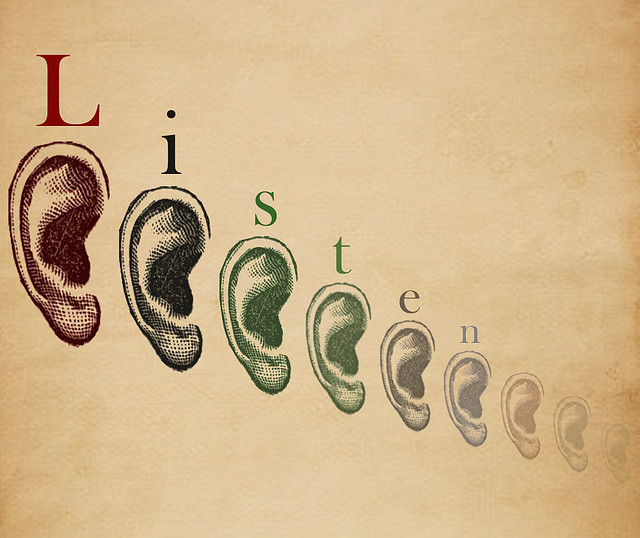
Listen
Listen by Ky on Flickr. Some rights reserved.

So, then, if you are not the first to hear the news, how do you respond toproposed change? The first constructive thing the Jerusalem disciples did was to listen.

I get the impression that when they say to Peter, ‘You went into the house of uncircumcised men and ate with them,’ it’s a rather hostile, aggressive, accusing question. I say that because Peter’s speech in response exhibits all the classic signs of an ancient defence speech. He quotes the testimony of witnesses, the evidence of signs, and concludes with a rhetorical question.[2]

But to their credit, ‘the circumcised believers’ (verse 2, as Luke describes them) do not interrupt or hassle Peter. They listen carefully to his speech. We can be grateful that for all their initial antagonism, they are not the sort of people we sometimes find in our churches and in the wider world whose motto could be, ‘I’ve made my mind up, so don’t confuse me with the facts.’ You know the sort of person who only listens to a contrary view with the greatest of reluctance. Perhaps they are actually afraid that if they listen, the truth will persuade them they are wrong and they will have to change when that is the last thing they want to do.

Not the Jerusalem disciples, though. Sceptical they may be, but their actions show they want to go in the direction of God’s truth. And since a major part of that discernment process will be to detect where God is already at work, they devote themselves to listening to Peter.

So how good are we at listening to others in order to perceive the work of God? It requires above all that we have a heart and mind that is committed to finding the will of God and following it. Sadly, there are people in our churches who are too embedded to the traditions they love that they will not take the holy risk of listening. I suggest that such people probably love their traditions more than they love God.

Or there are those of us who prefer the sound of our own voices to those of others. We have an inbuilt pride that assumes God is more likely to speak through us than through other Christians, and so we don’t invest time and energy in listening to others.

Rather, listening is an act that honours other people. What they claim to be an account of God at work is worthy of our attention. We grant them dignity is people made in the image of God and called to be servants of God by giving them our time and concentration.

Critiquing Eyes
Critiquing Eyes by David Goehring on Flickr. Some rights reserved.

Note that in all this I am not saying that listening should be naïve and uncritical. It certainly should not be the kind of exercise where we absorb everything that is said without filtering it. That is why the second element of responding toproposed change is to discern.

Here’s where I see discernment going on in the story. Peter does something very modest in his speech. He omits all reference to the sermon he preached – he is not claiming that the conversion of the Gentiles is his work. Instead, as he prepares to tell his listeners about how the Holy Spirit fell upon Cornelius and his household, he substitutes for his sermon the words of Jesus:

John baptised with water, but you will be baptised withthe Holy Spirit. (Verse 16)

Now these words of Jesus were originally aimed at his disciples, not later Gentiles, but Peter clearly sees an applicable parallel. He knows how the words were fulfilled at Pentecost, and he has just seen something similar at Caesarea. The words of Jesus are an appropriate interpretation of the recent ground-breaking events he has witnessed.

What does this have to do with discernment? These words of Jesus, taken by Peter to support a valid interpretation of the spiritual experience in question, are the decisive matter for ‘the circumcised believers’. Now they know that what they are hearing about from the apostle fits within the grand sweep of God’s purposes, because they fulfil a great biblical theme. Later in Acts the believers in the town of Berea will test what they encounter against the Scriptures, so here the listeners don’t even have to search the Scriptures themselves, a relevant one is given to them on a plate by Peter. Not only that, it fulfils ancient prophecies in which Israel is called to be a light to the nations. The call that Jonah ran away from is embraced here.

The test of discernment, then, is whether what they hear in their concentrated listening constitutes something that is in harmony with the great purposes of the God who sent his Son and later sent his Spirit.

We, too, would do well to engage in a similar approach to discernment. If something is being proposed, it will not be something with a proof text we can find in the Bible – and let’s remember how the various disciples in Acts underwent vastly different fates. Some survived and were honoured; others suffered; still others were martyred. So with varying destinies in this life, we can hardly take the proof text approach.

But what we can do is ask whether what is being proposed fits harmoniously in with what we know of God’s great story, his grand narrative of salvation. Does the proposal honour Jesus Christ? These should be the ways in which we discerningly evaluate whether to accept the suggested change. What we should not do is merely evaluate according to our own tastes and preferences.

Praise God
Praise God by Tim Shields on Flickr. Some rights reserved.

Finally, there is a third characteristic of responding to calls for change, but it is one that only comes into play if the first two stages – the listening and the discerning – have been passed positively. If the proposal has been filtered out by those two, then what I am about to talk about does not apply. So – if the proposal for change has met the tests, this third element is praise. Hear the final verse of the reading again:

When they heard this, they had no further objections and praised God, saying, ‘So then, even to Gentiles God has granted repentance that leads to life.’ (Verse 18)

What a transformation this is for the Jerusalem disciples, who began this dialogue with a sceptical, even hostile question. The aggression has gone, and now we have worship. Division has been averted, and we have a heightened sense of unity among the believers. There is a great opportunity now for the early church to take giant strides forward, not only with those who could have been at odds united, but also with an expansion to include the Gentiles.

Nothing energises the Church of Jesus Christ like a united sense of joy in his purposes, and delight in the God who calls us to be his worshippers, disciples, and witnesses. Holding onto what we’ve got because we feel the need always to defend the old ways will not lead us into joy and praise, because it will only inculcate in us a grim defensiveness like Canute vainly telling the waves to retreat. And changing just for the sake of change will not lead us to deeper and truer praise, either, because all that will do is make us into flaky fly-by-night characters.

No: true praise bursts out from among us when we detect God taking us back in a fresh way to his ancient plans and purposes. Praise comes when we sense that God is doing something new among us, something new that is yet also compatible with all he has revealed about himself in the past.

What is our corporate voice as a church? Is it one of joy and praise, because we are committed to going forward in the purposes of God? Or do we have an uncertain voice, because we have not made up our minds whether we are serious about following God’s will rather than our own self-indulgences? Or is there a heaviness among us, because we fill our time with criticising one another or taking pot-shots at all our petty hates?

Or do we have a heart as big as the world, a heart that therefore embraces God’s love for all creation, where he longs to do his transforming work, and to which end he desires to change us first so that we might be suitable vessels for his purposes?


[1] The first three light bulb jokes are taken from http://txipl.org/lightbulbjokes

[2] Ben Witherington III, The Acts Of The Apostles: A Socio-Rhetorical Commentary, p363.

Sermon: Testing Truth And Error

I’m back tomorrow from a week off, and return with another sermon in our series on 1 John, which follows below. Then in the evening we have our annual All Souls service for bereaved people, and I’ll be posting my brief sermon for that service here on the blog tomorrow.

1 John 4:1-6
During the 1960s and 1970s, denominations such as the Methodist Church and the Church of England tried various experimental forms of worship. From that period comes the story of an Anglican bishop who visited a parish. He went to begin the service with the new form of words he had become used to. He said: “The Lord is here,” expecting the response, “His Spirit is with us.” But when he cried out, “The Lord is here,” nobody responded.

He said it a second time, slightly louder, in case people hadn’t quite heard him properly. “The Lord is here!” But again, there was no response.

A third time he said, “The Lord is here,” but again no-one said anything in reply. Finally, in desperation, he found himself saying, “The Lord is here, isn’t he?” To which the vicar replied, “Not in our service, he isn’t.”

How do we tell when the Holy Spirit is present? It’s an issue we have to deal with in the church. How do we assess people’s claims when they say that the Holy Spirit led them to say or do certain things?

Here is one occasion when perhaps I should have thought a little more discerningly about that question. We were sitting in the living room of an Anglican rector friend’s rectory. Several of us from an ecumenical group in our area were present, along with two other pastors from elsewhere in the county. One was a prominent vicar of a huge church ten miles away that attracted a huge congregation from all over London and the South East. The other was the pastor of a large independent church from down on the coast.

We were gathered along with the representative of an Argentinean evangelist to consider inviting him to lead a conference for the whole county. In the middle of the prayer time, the independent pastor started making huge claims about how he could feel the Holy Spirit very close to him, telling him what we should call the conference.

As it happens, the conference wasn’t bad – a few exaggerated spiritual claims from one or two people, but nothing sinister. Except the time when the aforesaid independent pastor made the appeal for the offering. He dished out twenty minutes of emotional manipulation about giving, some of it connected to the idea that the more you gave, the more likely it was that God would make you rich, and all to a background of stirring music. If I hadn’t been on the team organising the conference and if I hadn’t had a rôle to play that night organising the team that prayed with and counselled people afterwards, I would have walked out. In retrospect, I think I should have seen the warning signs when he started making his grand claims a few months earlier about how close he claimed the Holy Spirit was to him.

You may not find yourself in that situation, but we all hear claims from time to time that the Holy Spirit has led someone to say something contentious or do something controversial. We have to weigh these claims carefully. Just because something is out of the ordinary doesn’t necessarily mean it’s wrong – but nor does it automatically mean it’s right.

John faced a similar situation in the community to which he was writing. People were making bids for leadership in the community, and claimed the inspiration of the Holy Spirit, but clearly John himself was dubious about some of these people. He had to give counsel to the church about how to discern the godly from the fake. There are two tests he offers in this passage, and we’ll explore them for how they help us to separate the work of the Holy Spirit from that which is merely of the human spirit, or even of another kind of spirit.

The two tests are a test of belief and a test of behaviour. Let us consider, firstly, John’s test of belief.

This is how you can recognise the Spirit of God: Every spirit that acknowledges that Jesus Christ has come in the flesh is from God, but every spirit that does not acknowledge Jesus is not from God. This is the spirit of the antichrist, which you have heard is coming and even now is already in the world. (Verses 1-2)

John’s opponents are teaching that Jesus only appeared to be human – a denial of the doctrine of the Incarnation. A word from the Holy Spirit will glorify Jesus, the true Jesus. It will not undermine Jesus as fully divine and fully human. It will not deny the Cross and the Resurrection, the Ascension and his Return. In fact, a word from the Holy Spirit will bring praise to the name of Jesus Christ as Saviour and Lord.
So take, for example, the question of how you might respond to someone who tells you they have had a particular spiritual experience that seems strange or unsettling to you. Depending on your own Christian life and what you have become used to, that could be any one of a number of things. If, for example, you’re not used to the idea of people speaking in tongues and someone says to you they have received the gift of tongues, the question to ask is not, do I find this spooky and unsettling? Instead, the question to ask is, does this person praise Jesus more as a result of their experience?
Similarly, suppose someone tells you that they received prayer at a meeting and they claim that the Holy Spirit came powerfully upon them – so powerfully, indeed, that they couldn’t remain on their feet and they fell to the floor. The question to ask is not so much about the falling down as about the standing up afterwards. Did they acknowledge Jesus, the Jesus of the New Testament, as a result of their dramatic experience?

If the answer is yes, then you have a decent sign that the Holy Spirit was at work, because Jesus told his disciples (as recorded in John’s Gospel) that the work of the Spirit was to point to him. On the other hand, if someone’s conversation afterwards is all ‘me, me, me’ then you have reasonable grounds to doubt whether they had an authentic experience of the Holy Spirit.

Equally, if the spiritual experience is allied to a viewpoint that denies essential truths about Jesus, you can also be properly sceptical about its authenticity. So if someone claims something remarkable but it is in the name of, say, the Jehovah’s Witnesses, then you have every right to doubt not the reality but the validity of that experience. After all, Jehovah’s Witnesses dilute the full biblical revelation about Jesus into making him just a demi-god, rather than fully divine. The Holy Spirit bears no witness to claims like that.

It’s with things like that in mind that John talks about ‘the spirit of the antichrist’ – you have to delete from your memories the ideas you have had about some end times spiritual terrorist that you might have gained from horror films or tawdry Christian paperbacks. Instead, you have to see ‘the antichrist’ as all that opposes Jesus Christ in all his truth and majesty. Such opponents will not be drawing you into a legitimate experience of the Holy Spirit.

Secondly, let us consider John’s other test, the test of behaviour. Listen again to how this section ends:

We are from God, and whoever knows God listens to us; but whoever is not from God does not listen to us. This is how we recognise the Spirit of truth and the spirit of falsehood. (Verse 6)

The point John is making as a founding apostle of the Church is this: look for how people react to the teaching of the Church. John and his fellow apostles were witnesses to the Resurrection and many had spent time directly with Jesus, as John himself had. They were best qualified, under the guidance of the Holy Spirit, to say what was authentic faith in Jesus. Therefore it was reasonable to expect that anyone claiming true spiritual experience would listen to them and respond positively to their teaching. (It still is.)

If we want to know whether someone is being led by the Holy Spirit, we have a right to ask whether they are walking in ‘the faith once delivered to the saints’, as received, interpreted and transmitted by the Church over the centuries. We shall always be open to new insights into the Scriptures, and it is also true that following ‘what the Bible says’ is by no means always a simple and clear matter. However, we can still discern whether there is a desire to be faithful to the apostolic testimony.

It is therefore often a sign of someone living under the inspiration of the Holy Spirit that she or he finds the Scriptures coming alive, and that this experience is accompanied by a desire to live out the teaching found there. If a person who is living like that speaks about experiences of the Holy Spirit, it is worth taking them seriously. That doesn’t mean being uncritical, but it does mean being warmly disposed towards them.

I can look back on the experience I had in my first circuit when we had an ecumenical project that put youth worship in the local night club. Some people thought that the loud and exuberant worship of the teenagers was spiritual froth. But I recall how some of those youngsters took part-time jobs in local care homes, where they washed and cleaned incontinent elderly people out of their love for Christ, and I say they passed John’s test of behaviour.

I look back too at what has happened to several of those teenagers and young adults in the intervening years. I see some who entered church leadership. I see a scientist who works on pioneer treatments for people with HIV/AIDS. And so I say yes, the test of behaviour was met by many of them.

On the other hand, we should seriously question those who make great claims to spiritual experience but who are not prepared to match it with a desire for holy living. The person who claims remarkable insights into the ways of God yet is also rather too acquainted with the emptying of alcohol bottles is not to be trusted, as is the person who shows dangerous signs of greed and acquisitiveness, or the Christian who treats the opposite sex with less than complete respect.

Likewise, too, we should be suspicious of those who take the apostles’ teaching and twist it to their own ends, in order to justify their own behaviour. Be wary, for example, of the Mormons, who claim all sorts of spiritual experiences, but who also teach the highly dubious notion of ‘celestial marriage’, despite Jesus’ clear teaching that ‘there will be neither marrying nor giving in marriage in heaven’. And in promoting ‘celestial marriage’ they end up privileging married people and demeaning the single, the divorced and the widowed. They don’t seem to notice Jesus’ own marital status. In fact, they fail both the behaviour and the belief tests.

But although I’ve used examples of sub-Christian groups such as the Mormons and the Jehovah’s Witnesses, let’s remember that John was specifically addressing a problem of people who infiltrated the church herself with their dilution of who Jesus was and is, and their rejection of apostolic teaching. They tried to claim a following, but the whole problem with them was that their whole approach to life and faith was captive to the world’s way of thinking and living, not Christ’s:

They are from the world and therefore speak from the viewpoint of the world, and the world listens to them. (Verse 5)

Being sucked into the vain values of a world opposed to Christ is a danger we all live with. It is something each of us needs to guard against. To give into the world’s ways and seek approval there is one of the surest recipes for cutting ourselves off from true, Christlike spirituality. So as well as exercising discernment over the claims of others by examining their belief in Christ and their behaviour in response to apostolic teaching, we do just as well to guard our own hearts and minds. Let us devote ourselves to the full, biblical Jesus and to the teaching of the apostles, that in doing so we may be more open to the work of the Holy Spirit.

Create a website or blog at WordPress.com

Up ↑