RHS Wisley ‘Glow’ event, 3rd December 2020. Image copyright (C) Dave Faulkner.
Merry Christmas. I guess some of us could do with a Merry Christmas this year. It might be because of the national and international situation. The cost of living. Having to work longer before retirement. The difficulty of getting on the housing ladder. The threat of AI taking people’s jobs.
Or it might be that a Merry Christmas would cheer us up in the face of personal circumstances. A loved one has a serious illness. Family troubles.
Are we too ‘The people walking in darkness’ that Isaiah spoke of? It certainly feels like it at times.
The people of Judah in Isaiah’s day had all sorts of political troubles. They feared invasion by Assyria, who had already taken over the northern kingdom of Israel. And it was worse for them, because they had no way of voting in a new government. Imagine what good news it is to hear Isaiah saying that ‘The people walking in darkness have seen a great light.’
And Isaiah describes the one who is that great light:
6 For to us a child is born, to us a son is given, and the government will be on his shoulders. And he will be called Wonderful Counsellor, Mighty God, Everlasting Father, Prince of Peace.
If the government were to be on his shoulders, they will think this is a political leader, a king. But they will be disappointed. No king in their day fulfils these hopes. Just like us, they pin their hopes on politicians, only to be let down.
The prophecy is only fulfilled in Jesus. He came as the hope of Israel. He is our hope, too. He is the
Wonderful Counsellor, Mighty God, Everlasting Father, Prince of Peace.
But what do those titles mean? And what do they mean for us?
Well, they go in pairs. The Wonderful Counsellor is the Mighty God, and the Everlasting Father is the Prince of Peace.
Firstly, the Wonderful Counsellor is the Mighty God:
The word ‘counsellor’ here doesn’t so much mean an adviser or someone who listens to your problems. It is to do with someone who makes plans. It is a ‘wonder planner.’[1] The mighty God makes wonderful plans for his people.
And you might be cynical about that, especially if you are going through bad times.
But let me tell you about someone who went through terrible times but still had faith in this God. Corrie ten Boom was a Dutch woman who, along with her father Casper and sister Betsy, in World War Two, hid Jews from the Nazis. When they were discovered, they were arrested. Casper died ten days later. The sisters were put in a concentration camp. Betsy died there. Corrie survived.
After the war, she spoke widely and wrote about her experiences and her faith in those dark times. Towards the end of her life, she said she had lived by the promises of God in the Bible while in the concentration camp and found them all to be true. She observed,
When a train goes through a tunnel and it gets dark, you don’t throw away the ticket and jump off.[2]
One of her most famous quotes about God is this:
There is no pit so deep, that He is not deeper still.
She lived and died by that faith. She knew that the good plans of the mighty God for her were seen in Jesus, who came into the darkness of this world, and even died unjustly. But God worked for good in that.
Are you in a deep pit in your life? I invite you to trust Jesus, who is deeper than your pit. God sent him to be with you, to be alongside you by his Spirit, and to bring hope and light in your darkness.
Secondly, the Everlasting Father is the Prince of Peace:
How do we Christians understand the title ‘Everlasting Father’ when Jesus is not God the Father but God the Son? ‘Everlasting Father’ here is an extravagant ancient description of a king’s relationship with his people[3]. The king who ultimately fulfils Isaiah’s prophecy will be the Prince of Peace.
And that is Jesus. ‘Peace on earth, goodwill to all on whom his favour rests.’
Do you need peace in your life? Perhaps you feel you can never be forgiven for something that has left you with deep shame. Jesus can resolve that. He died on the Cross for you. Nothing is too big for him.
Perhaps you are dealing with the pain of broken relationships. Jesus can help. He can show the way to reconciliation through forgiveness, bearing one another’s burdens, and a commitment to truth and justice. And if the other parties will not respond, he can hold you in the certainty of his love.
Or maybe you are worried by the state of the world, as warmongers and aggressive and violent national leaders take centre stage. We can’t control the actions of others, although we can pray. We know that if those who made a lot of their support for Christianity would actually follow Jesus, things would be different. In the meantime, this too is another case of there being no pit so deep that Jesus isn’t deeper still. He will hold us in the storm.
And one day, as the mighty king, he will put all things right.
Conclusion
I don’t want to give you a long address in a Christmas Eve service. But I do want us all to know as we head towards Christmas Day that Jesus is the best present ever. We can begin and have a lifetime of unwrapping all that he is.
[1] John Goldingay, Isaiah (New International Biblical Commentary), p73.
How shall we sing the Lord’s song in a strange land? The words of the Psalmist have echoed throughout history. Most Christians live as the minority in their society. We have had to cope with a transition from being the majority culture to being the minority, seen in so many ways and not least the way recent decisions in Parliament trampled on the sanctity of life.
But the problem goes back to before the Psalmist. In today’s passage, we have a young Israelite girl taken captive by raiders from Aram (verse 2). It’s not the full exile of many centuries later, but it still poses the question of how to live out your faith as a good witness when your beliefs are not the dominant ones. Even those still living in the Promised Land know the threat of the King of Aram and his army, as the King of Israel makes clear by the fear he displays when he assumes his opposite number wants to pick a quarrel with him (verse 7).
The story of Naaman’s healing shows several Gospel values we would do well to emulate in our witness. Sometimes they are displayed by God’s people, sometimes by those receiving blessing, and sometimes they are the opposite of the behaviour that is condemned in the passage.
Firstly, love
Don’t you think the attitude of the young girl in forced slavery is remarkable? Separated from her parents, much like the dreaded ICE officers are doing to immigrants in the USA at present, surely she is living in fear.
And what does she do? She loves her enemy. She shows concern for Naaman’s condition and knows how he might be healed. No resentment gets in the way. Instead, she blesses a man who doubtless was significant in causing her plight.
In the later history of God’s people, when many had been taken into exile in Babylon, and the Psalmist had voiced their feelings with those words with which I began, ‘How shall we sing the Lord’s song in a strange land?’, the prophet Jeremiah had an answer for them. In his famous letter to the exiles in chapter 29 of his prophecy, he tells them to ‘seek the welfare of the city to which they have been taken’. It’s similar. And people notice it.
To whom can we show love, despite the fact that they may be opposed to our most cherished beliefs and values? It may be a family member who has rejected the way we brought them up. It may be a political representative who stands for a party or policies that we believe are harmful to us and to others.
Think of the ways in which our society is becoming more divided and ask where we can show love to all parties. The algorithms of social media promote the viewing of content that is negative and causes anger, thus contributing to division and even violence. We have seen the consequences at the ballot box and on the streets. Imagine what we could do if we brought love into those situations.
Secondly, grace
The King of Aram thinks that Naaman’s healing can be bought. He tries to buy favour with his opposite number in Israel by sending Naaman with ten talents of silver (that’s about 340 kilograms), six thousand shekels of gold (around 69 kilos), and ten sets of clothing (verse 5). It’s so over the top that the King of Israel thinks it’s a trick to provoke conflict.
It’s a common attitude. We think we can buy the favour and blessing of God. Some of us do it by trying to be good enough (whatever that is) in our lives. Some of us try, in the words of Kate Bush, to ‘make a deal with God.’
But it doesn’t work. God rejects these approaches. He gives freely to the undeserving. We cannot make ourselves deserving of his blessing, but he still gives. And here he heals way before Naaman professes any faith in him. It is undiluted grace.
It is our calling to be grace-bearers in the world, even to those opposed to us. It’s very easy for us to call down fire and brimstone on the enemies of God, and we are altogether rather too practised in the art of cursing others, but God in Christ calls us to a different approach. The Christ who prayed, ‘Father, forgive them, they don’t know what they are doing’ is our Lord. It may go against the grain for us, but how else are people going to be opened to the possibilities of redemption?
You may want to write to your MP. It may be something you feel passionately about, and you may think the MP is likely to disagree with you. Write with grace. Bless them. Tell them you are praying for them. So many Christians write letters and emails to their MPs in such a hostile spirit that we have a pretty terrible reputation in Parliament. Speak grace. Build a relationship, if you can. You never know what opportunities that might create in the long run.
Thirdly, humility
I see this in two ways in the reading, and it’s all to do with the central encounter between Elisha and Naaman. For Elisha’s part, he does not have to come out to Naaman and do something spectacular that will build his brand or his platform, as we would say today. He just sends his messenger with the instructions Naaman needs (verse 10). It’s not about show. Elisha only cares about the exalting of the name of the Lord, not the exalting of his own name. If that means staying in the shadows, then fine.
For Naaman’s part, he must put aside his pride to wash himself in the waters of the Jordan, not in the apparently superior rivers of Abana and Pharpar in Damascus (verse 12).
Humility in pointing to our God and not to ourselves, and humility in that we must put aside our pride to meet with the one true God. That is central. What else could be our response when the Gospel is about grace and mercy?
It is not that we want to do the exaggerated ‘very ‘umble’ Uriah Heep-type routine, nor is it that we want to dress up low self-esteem in some ‘I am a worm’ attitude, but it is to say that we want to deflect all the glory from ourselves to where it belongs.
You may recall Corrie ten Boom, the Dutch Christian of ‘The Hiding Place’ fame. She and her sister Betsy were imprisoned by the Nazis for hiding Jews as an expression of their faith. Betsy died in the concentration camp. After the war, Corrie exercised a remarkable ministry of compassion and reconciliation at no small cost to herself.
After she had given a talk or a sermon at an event, she would often have people come up to her and thank her for what she said. How did she handle the compliments? She said she thought of them as like a bouquet of flowers. She would smell the beautiful scent and then say, ‘These are really for you, Lord.’
Is that an attitude we can cultivate? A humility that gives glory to God?
Fourthly, thanksgiving
After he is healed, Naaman wants to offer Elisha a gift. But the prophet declines it. This is not about him. It was God who healed Naaman (verses 15-16).
But Naaman still wants to show his gratitude, and he wants to do so by transferring his allegiance to the Lord who had healed him. He does so, following the pagan belief of many cultures in Old Testament times, that the gods were limited to certain geographical areas, and so he asks to take some of the Promised Land home with him to the land where the idol Rimmon (whom he now probably realises is a false god) is worshipped (verses 17-18).
The measure of a true response to a genuine encounter with the Lord is simply this: thanksgiving. Remember when Jesus healed ten lepers, and just one returned to give thanks. That was the one who truly knew and appreciated what Jesus had done for him.
There are a couple of sides to this for us. For one, while we shall be unconditionally blessing people with grace and love in all humility, we shall be praying that some will respond with thanksgiving and encounter God in Christ. Our blessing is never conditional upon a person responding in a particular way, but it is a witness, and we put prayer behind that witness that people will respond in thanksgiving to God.
The other side for us is that we ourselves, as those who have already discovered the God of grace and love in Jesus Christ, are seen to be thankful people, too. At the graduation service for our son on Wednesday, the Dean spoke on Paul’s words in Colossians 3, ‘And be thankful.’ She quoted the famous words of Dag Hammarskjöld:
For all that has been, thank you. For all that is to come, yes!
How revolutionary would a thankful lifestyle be in an acquisitive society?
Fifthly, generosity
So the last part of the story is the dark episode that ends it, one that we often don’t read. Gehazi, the servant of Elisha, is scandalised that his master lets Naaman go without him leaving a gift. He says these chilling words to himself:
“My master was too easy on Naaman, this Aramean, by not accepting from him what he brought. As surely as the Lord lives, I will run after him and get something from him.” (verse 20)
‘My master was too easy on Naaman.’ Here is someone who does not understand grace. ‘I will run after him and get something from him.’ It’s all about getting, not giving. As such, his character is contrary to the God he supposedly serves. He is a precursor of the TV evangelists and other scammers, determined to make money out of those who have a need.
But God is a generous giver, not a taker. God gave out of love in creation. God gave his only begotten Son for the salvation of the world. God gave the Holy Spirit to the disciples of Jesus. Gave, gave, gave. God is generous.
I am not about to suggest that we are like Gehazi. He became diseased in body because he was diseased in spirit. But I do ask the question, what are we known for in society? Although we are called to speak out against wrongdoing, are we primarily known as those who are negative? Think again of those letters to MPs. Or are we known as those who positively give to society, who overflow with generosity to those in need and for the well-being of our towns, our cultures, and our nations?
By the grace of God, may it be that we are not a Gehazi, who grasp for ourselves, but a servant girl who knows how to love, an Elisha who humbly lives in and by the grace of God, and a Naaman, who by thanksgiving grows in grace.
Surely such a people will have an impact for Christ on their culture.
Ted Robbins by Thwaites Empire Theatre on Flickr. Copyright Mike Johnson Mikeseye Photographic. Some rights reserved.
One of the things about having children is that whether you like it or not, you become acquainted with some of the television programming aimed at them. One of the shows to which I admit a sneaking fondness is called ‘The Slammer’. Ostensibly set in a prison – hence ‘The Slammer’ – inmates can earn early release by performing in a weekly variety show called ‘The Freedom Show’. In reality, these are of course stage acts, and they are participating in a talent show. The children in the audience choose the winner by the loudness of their applause. Those who do not win are condemned to stay and face mealtimes where they always eat the dreaded ‘sloppy poppy porridge’.
‘The Freedom Show’ is compèred by the prison governor, who is imaginatively known as ‘The Governor’, played by the comedy actor Ted Robbins. He is assisted a warder called Mr Burgess, who is like a watered-down version of Fulton Mackay’s character Mr Mackay in Ronnie Barker’s comedy series ‘Porridge’.
However, the Governor wants to be more than a compère. He hankers to be a performer himself, and makes a big entrance to ‘The Freedom Show’ every week, often dressed garishly in clothes such as a yellow dinner jacket and bow tie.
When he comes on, he has a catchphrase. He calls out to the children in the audience, “Who’s the Governor?” and the children shout back, “You’re the Governor!”
I don’t know why it makes me laugh, but it does. Anyway, “Who’s the Governor?” becomes a suitable catchphrase for this sermon. Who’s the Governor – Herod Agrippa or God? Let me place that in context.
Herod Agrippa has just suffered a damaging reverse. Having gained political capital by imprisoning and executing some of the early church leaders, he thought he was onto a winner when he had the apostle Peter put in his ‘slammer’, and scheduled for execution. No long years on Death Row in those days. But Peter had miraculously escaped, and Herod in his temper – having been publicly shown up by the power of God – had the guards executed in a moment of pique. This has come not long after Luke has also recounted in Acts the story of the prophet Agabus foretelling a famine, and the church at Antioch responding by organising a relief collection for the disciples in Judea.
So we’re about to see a contrast between the worst of human rulership and the best of God’s kingly rule. As we do this, we shall learn more how to pray and witness today, even in the face of adversity, and more about the true nature of the God we serve.
Here are three areas of contrast:
Firstly, compassion. What’s wrong with this picture?
Now Herod was angry with the people of Tyre and Sidon. So they came to him in a body; and after winning over Blastus, the king’s chamberlain, they asked for a reconciliation, because their country depended on the king’s country for food. (Verse 20)
What’s wrong is that in the Hebrew Scriptures, a king was to look after the people. To be in dispute over the need for food was not good. To withhold food even from those of another nation was not normal behaviour for a good king. But the people of Tyre and Sidon need to grovel to get what they need from Herod. This is not right.
We already know that this Herod was a violent man from his treatment of the church leaders, and perhaps this is no surprise for a man who was the grandson of the so-called Herod the Great, the man who ordered the slaughter of the innocents in Bethlehem, and who might better be called Herod the Terrible. The Herod of our story, Herod Agrippa, had also been educated in Rome, and was a friend of the Emperor Caligula, to whom he owed his power[1].
We don’t know what this unsavoury ruler was going to do about the request from Tyre and Sidon, because he doesn’t get the chance. All we do know is that he had consciously allowed an unjust situation to develop, and there was only any possibility of resolution because one of his officials, Blastus, had taken a chance. This meeting was not by Herod’s initiative. He had shown no interest in the welfare of these people.
We know enough about heartless tyrants in the history of the world and in current affairs. Starving a population is a tactic both ancient and modern. From ancient Assyria to modern Syria, this is a common practice.
Contrast this with what we have seen in the church not long ago in Acts. The prophet Agabus has appeared on the scene and prophesied a coming famine. But the response of the church is to organise support for those who will suffer the most. It is like a reflex action. Think of Joseph in Genesis storing Egypt’s food in the seven years of plenty before the seven years of famine, and you will see a similar approach.
Esther McVey MP by the Department for Work and Pensions on Flickr. Some rights reserved.
What it comes down to is that while the tyrants of the world starve people into submission, the God of the Bible is compassionate, and his people are called to witness to that compassion by modelling it in their own behaviour. That is why it is good that we hosted the Runnymede Food Bank here for its first two years of existence. That is why it is also good that the growth of the food banks in our country, usually started by Christians, have become an embarrassing indictment against heartless government policies. When we see cases like that of David Clapson, the diabetic ex-soldier who was penalised by a Job Centre for missing an appointment, had his £71.70 benefits stopped, couldn’t then afford food or electricity, and died from a condition resulting from not being able to take his insulin because he couldn’t keep the fridge going, then it’s important that Christians witness to the compassion of God in the face of a serious lack in high places. Earlier this year, Esther McVey MP, the minister for employment, admitted
that the number of sanction referrals made by jobcentre advisers is part of a “variety of performance data” used to monitor their work.
Our witness to the God of compassion, who inspired Joseph to feed Egypt, Agabus to warn the early church, and Jesus to feed the multitudes, is needed more than ever today. How will you do it? Buying supplies for the food bank? Supporting a charity? Directly helping someone in need that you meet? It needs doing.
Who’s the Governor when it comes to compassion?
The second area of contrast is that of authority. There’s no doubt that Herod Agrippa enjoys power. We know what he does with it. It’s no surprise to see that he has an ego to match his sense of self-importance:
On an appointed day Herod put on his royal robes, took his seat on the platform, and delivered a public address to them. 22The people kept shouting, ‘The voice of a god, and not of a mortal!’ 23And immediately, because he had not given the glory to God, an angel of the Lord struck him down, and he was eaten by worms and died. (Verses 21-23)
Elsewhere in Acts, apostles like Paul are wrongly acclaimed as gods by adoring crowds, but they are always quick to deny it. Herod doesn’t. Was it all too appealing to him? He had turned up dressed in all his splendour, and had done everything to impress the need people of Tyre and Sidon with his status and power. It does him no good.
Corrie ten Boom on Flickr. Some rights reserved.
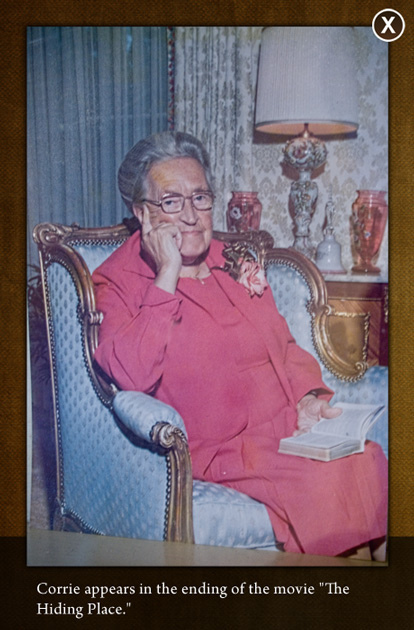
The Christian knows that the proper response in times like these is to do what Herod didn’t do, and to give the glory to God (verse 23), like the great Dutch Christian Corrie ten Boom. You may recall her story ‘The Hiding Place’, in which she and her family, including her sister Betsie, sheltered Jews from the Nazis and ended up in Ravensbruck concentration camp for their troubles, where Betsie died but Corrie survived. Corrie became a popular and famous Christian author and speaker, and as you can imagine, received much adulation. But she had a wise approach to the receipt of compliments: she described a compliment as like a bunch of flowers. She would say, “These smell nice, but they are for you, Lord.”
How might we approach a proper humility, then? There are some behaviours that look like humility, but aren’t. These include the so-called ‘humblebrag’, where we say something great about ourselves, but set it against a self-deprecating comment, yet really we are trying to tell people how wonderful we are. There is the wrong use of the word ‘humbled’ when we actually mean ‘proud’ – for example, “I am so humbled by the number of people who said they liked my sermon last week.” It’s OK to admit to excitement, but let’s not re-label pride as humility. There is the failure to take a compliment when God gave us the gifts – we need to remember Corrie ten Boom’s bouquet of flowers. Or there is the “All the glory goes to the Lord” school of hyper-spiritual sanctimoniousness. Again, Corrie ten Boom had the balance right.
True humility is not thinking less of yourself; it is thinking of yourself less.
Who’s the Governor when it comes to authority?
The third and final area of contrast is that of judgement.
And immediately, because he had not given the glory to God, an angel of the Lord struck him down, and he was eaten by worms and died.
24 But the word of God continued to advance and gain adherents. (Verses 23-24)
Does this sound unlikely to you – that Herod was struck down, eaten by worms, and died? What if I told you that the Jewish historian Josephus records this incident, too? His account is different from Luke’s, but it is complementary. Where Luke says that Herod didn’t give glory to God, Josephus says he failed to rebuke the impious remark. And where Luke says that an angel struck Herod and he was eaten by worms, Josephus tells us that he was struck by severe stomach pains for five days, and then he died.[2] The one who judged violently and unjustly was himself judged.
We know the frustration and horror of looking on while the depraved thrive in power. We can name any number of wicked despots from the present day or the recent past. So too could the biblical authors. They wondered aloud why the wicked prospered, often at the expense of the righteous. They asked why God wasn’t doing anything. And of course we know that Jesus told stories like the parable of the wheat and the tares and the parable of the net which indicated that the separation of the good and the evil would not happen until the last judgement.
Yet here we see an example of judgement being executed in this life. So perhaps this is a time to remember that when we are dealing with the kingdom of God, we speak about it as being both ‘now and not yet’. There is a ‘not yet’ about the kingdom of God in that all will come finally and fully under God’s rule at the end of all things, after the last judgement. But we should not lose sight of there also being a ‘now’ element to God’s kingdom, in that we do see some examples of God reigning in kingly power and overthrowing wickedness, sin, and suffering in our own day and time. That seems to be what the early church witnessed when God sent his angel to strike down Herod Agrippa.
And there are examples from even the darkest times in recent history. Rees Howells, a Welshman deeply affected by the Welsh Revival of 1904-1905, and the founder of the Bible College of Wales, was deeply affected by spiritual awakenings he witnessed as a missionary in southern Africa. During World War Two he was led by Christ into a deep ministry of intercession, which you can read about in the classic book ‘Rees Howells Intercessor’ by Norman Grubb. While some of the story is a little strange, Howells and his colleagues prayed with passion and vigour throughout the war, sensing particular direction from the Holy Spirit at certain times to pray in particular ways for certain specific outcomes. The book is an astonishing account of how God led and answered their prayers, leading eventually to the downfall of the Axis powers. We can talk about the genius of military leaders, the inspiration of politicians, tragic tactical mistakes, and so on. But there is an obscure yet vital story to be made known about the spiritual dimensions of Hitler’s downfall through intense, committed prayer.
Given that, let us not lose hope when we pray for the needs of the world today and every day. We may have to wait, because God’s actions are ‘not yet’, but we never know when he might execute justice ‘now’. So if that is possible, why should we not in prayer ask him to be at work in our time, tipping the thrones of the unjust until they fall from their perches?
Remember this question: who’s the Governor when it comes to judgement?
And more generally, that should be a question to guide our lives: who’s the Governor?
This Sunday, my church at Broomfield is experimenting with bringing its annual Covenant Service forward to the beginning of the ‘Methodist year’ rather than the calendar year. Hence what follows is a sermon for a Covenant Service, rather than on one of the regular weekly Lectionary readings.
Introduction At my office, I worked with a Muslim guy. Javed (or ‘Suave Jave’ as we called him, for his attitude to the ladies) was more Muslim by upbringing than practice. But one day, he brought in to show us his mother’s copy of the Qur’an. It was edged and blocked in gold leaf. It came in a special tissue-like wrapper. One thing neither Javed nor his mother would have done with that book was write in it. Even touching it seemed risky, in case of damage.
But I don’t treat my copies of the Bible that way. In particular, I was taught as a young Christian to underline words in my Bible. Not only verses that struck me, but also some key words. ‘But’ was a good word to underline. It indicated an important change in Paul’s arguments.
And Romans 12 starts with another key word: ‘therefore’.
I appeal to you therefore, brothers and sisters, by the mercies of God, to present your bodies as a living sacrifice, holy and acceptable to God, which is your spiritual worship. Do not be conformed to this world, but be transformed by the renewing of your minds, so that you may discern what is the will of God—what is good and acceptable and perfect. (Romans 12:1-2)
‘I appeal to you therefore’: therefore indicates all that has preceded Romans 12. It indicates the first eleven chapters of Romans, summarised here as ‘the mercies of God’. We make and renew our covenant because of ‘the mercies of God’. All we offer today is in response to the mercies of God. Not just one-off mercy in initial forgiveness, but mercies. Over and over again, God is merciful to us. Our sins, our mistakes, our foolishness and weakness: for all these things God is merciful to us in Christ through the Cross. And because he is relentlessly merciful – his mercies are ‘new every morning, [so] great is [his] faithfulness’ (Lamentations 3:23) – we offer ourselves to him.
How does Paul ask his readers to respond to the mercies of God? In these two verses are two ways:
1. Sacrifice Paul urges Christians to ‘to present your bodies as a living sacrifice, holy and acceptable to God, which is your spiritual worship’ (verse 1).
‘Spiritual worship’ here implies that it is reasonable, rational and true. This is the right and proper thing to do in light of God’s enduring mercies to us. The mercies of God come to us through the sacrifice of Christ: is it not appropriate, urges Paul, for us to make sacrifices as a grateful response?
But what are these sacrifices? ‘Present your bodies as a living sacrifice, holy and acceptable to God’, he says. It’s not just something we do ‘spiritually’: we present our bodies. And if I might just re-order the words to reflect what many commentators think is the sense of the Greek, we make ‘sacrifices, living, holy and acceptable to God’. Those adjectives ‘living’, ‘holy’ and ‘acceptable to God’ illustrate the kinds of sacrifices we might make with our bodies.
‘Living’ – we freely offer our bodies to God, because of what he has done for us in Christ. It may cost us something. The author Robert J Morgantells how one Sunday, the late Corrie ten Boom was preaching in Copenhagen on these very verses. She was eighty years old at the time. Two young nurses at the church invited her to lunch afterwards, but they lived in a tenth floor flat and there was no lift. Not what you want at eighty.
She struggled up the stairs as far as the fifth floor, but her heart was pounding and her legs buckled. Collapsing into a chair, she complained to the Lord. But she sensed God whispering to her that it was important she carried on.
When she finally made it to the tenth floor, she met the parents of one of the nurses. Neither was a Christian, but they were both interested in the Gospel. Corrie ten Boom led them to faith in Christ. All because she reluctantly followed her own sermon and made her life – her very body – a sacrifice in climbing ten flights. She was willing to go where God led her, despite the cost.
‘Holy’ – our dedication to God may also sometimes come at a price. The Covenant Service promises balances the way some parts of our discipleship are attractive and others are costly:
Christ has many services to be done: some are easy, others are difficult; some bring honour, others bring reproach; some are suitable to our natural inclinations and material interests, others are contrary to both; in some we may please Christ and please ourseleves, in others we cannot please Christ except by denying ourselves. Yet the power to do all these things is given to us in Christ, who strengthens us.’ (Methodist Worship Book, p288.)
Holy sacrifices are about being willing to pay the price of unpopularity and difficulty for the sake of dedication to the right thing. It is also a matter of doing so graciously, rather than with complaint, self-righteousness or attention-seeking.
‘Acceptable’ – this probes our motives. Other translations say, ‘well-pleasing to God’. It’s about a desire to please God. In marriage and other human relationships, we make it our first goal not to please ourselves but our spouse, or whoever it is we love. So too with God. When we know how merciful he has been to us and how regularly he has been merciful, the fitting response is to set our minds and hearts on doing the things that bring him joy.
There is a story told in the Old Testament that gives a small illustration of what I am talking about King David wanted to buy some land from a subject and use it for worship. The owner says he can have it free of charge, but David says, no: he insists on paying. Why? ‘I will not give to the Lord that which has cost me nothing,’ he says. Discipleship and giving need to cost us something to be genuine. It may be financial, material, emotional, psychological, even social. If we realise just how merciful God continually is to us, then out of joy we shall be willing to show love in return, even if it comes at a price.
2. Transformation Verse 2:
Do not be conformed to this world, but be transformed by the renewing of your minds, so that you may discern what is the will of God—what is good and acceptable and perfect.
‘Do not be conformed to this world’ – or, as J B Phillips famously translatedthis passage, ‘Don’t let the world around you squeeze you into its own mould’. Do not be conformed, be transformed, says Paul. Don’t be squeezed by the world, ‘let God re-mould your minds from within’ (Phillips).
Yet how easy it is to conform to the world, to let it squeeze us into its mould. Often we don’t notice. The late Lesslie Newbigin once observed that just as a goldfish is not consciously aware of the water in which it swims, so we are often unconscious of the culture we live in and its values.
In our society’s case, think about how we easily use popular words such as ‘tolerance’. It is presented as a quality that everybody must have. Woe betide the intolerant! But the word ‘tolerance’ carries with it overtones of a benign attitude to things that are wrong, enduring wrong things or having no deep convictions oneself. It’s a slippery slope towards tolerating sin. All these shades of meaning are therefore anathema to the Christian, but we refer to tolerance as much as anyone! The world is squeezing us into its mould, if we are not careful. I could give examples from other apparently innocent or positive words such as ‘inclusiveness’ and ‘community cohesion’.
So how do we resist social pressures to adopt ways of thinking that are inimical to the Gospel? Paul exhorts us to ‘be transformed by the renewing of [our] minds’, or to let God re-mould us from within, as Phillips puts it. Spiritual transformation involves a battle for the mind, because what we think affects our attitudes and our actions.
This doesn’t mean we all have to be intellectuals. Any Jesus-follower can develop Gospel thinking, Gospel attitudes and Gospel actions. That is Paul’s vision. Where do we begin?
We start with reading and reflecting on the Bible and its great story from the Garden to the New Jerusalem. It is Scripture above all that will help us to be Gospel thinkers. However, we don’t do so alone. Private Bible reading is good and worthy, but most of the books in the Bible itself were written or dictated to be heard less by individuals than by groups of disciples. It’s important, therefore, to get to grips with the Gospel together. If you’re not part of a small group that does that, you’re missing out! For starters, join the Living Faith course! It will help us get to grips with the big picture of our faith together.
But it’s not enough just to read the biblical message and discuss it. There are many people in churches who know their Bibles well, but who are harsh, unloving and judgmental. (Not that any of us is perfect – least of all, me.) So just reading the Bible and talking about it isn’t enough.
In other words, the biblical authors didn’t write their books just to be read or heard. They wrote them to generate action. The Bible isn’t just to be read, it’s to be done.
In my final year as a student minister, I spent half my time on placement in a circuit. At one of the two churches where I worked, I led a Bible study every week. However, the minister who supervised that group had been very frustrated with it. ‘When are they going to stop talking about the Bible and start doing something?’ he said to me once. ‘They’re more interested in the maps on the inside covers of their Bibles than in putting the teaching into practice.’
And that’s what I’m on about. Spiritual formation in Christ – the transformation of our minds to which Paul calls us – involves Bible reading, reflecting on it together where we support and challenge each other, and then getting on with what we’ve learned. It’s when the thinking leads to action that we truly learn. If I were a betting man, I would wager that Katie learned more about God’s love for the poor through her trip to Kenya with Hand In Hand than I would have done simply by reading about the poor.
One famous preacher said, ‘Never finish your sermon without telling your congregation what you want them to do about it.’ I suggest you might almost say, ‘Never finish your Bible reading without deciding what you are going to do about it.’
Conclusion
If God has been so persistently merciful to us, then what might we give him as a present? It would be appropriate if our offering involved sacrifice, when we recall all that he has done for us in Christ.
Transformation is also appropriate: Christ did not die on the Cross only for our forgiveness: he died that we might be saved from sin in every way. Not only the penalty of sin, but the practice of sin (which involves us co-operating with the Holy Spirit in being transformed) but also the presence of sin (as we anticipate God’s New Creation by being colonies of God’s Kingdom).
This Covenant Service, let us pledge ourselves again – in promise and in action – to the God of abundant mercy.






 Big Circumstance