Regime Change, Isaiah 11:1-10 (Advent With Isaiah, 2) Advent 2 Year A

Isaiah 11:1-10

Here are some extracts from a friend’s Facebook post:

3 WISEMEN KILLED ATTEMPTING TO ENTER U.S.

(Bethlehem) The 3 Wisemen were killed attempting to enter the U.S. early this morning. They were still hundreds of miles away from the actual border, but the White House determined there wasn’t time to actually investigate their suspicions.

A White House spokesperson said, “We could tell from the satellite photos that these were bad people. They had gold (probably stolen), myrrh and something that was possibly fentanyl.  It was hard to tell from the picture, but the President knew just enough to kill them without an actual investigation.”

Also arrested were two immigrants named Joseph and Mary, an unnamed child, and an angel. The White House elaborated, “We can tell you that the two suspects were trying to check into a hotel. When asked if they were married, they responded that they were “betrothed.” We can’t have people flaunting Christian moral conventions at this sacred time of the year.

“The undocumented mother was also secretly recorded as saying “(God) has brought down rulers from their thrones, and has lifted up the humble. God has filled the hungry with good things but has sent the rich away empty.” That sounds like communism, pure and simple. These were probably Antifa terrorists.”

I could read you much more, but I don’t have time!

In amidst all our cosy preparations, with Christmas adverts that tug at the heart-strings like this year’s Waitrose ad, we miss the fact that the coming of the Messiah is much more messy and radical. And I don’t mean the mess in the manger.

It’s about regime change.

Sometimes, we get so fed up with our leaders we want change. Maybe we don’t do it like some powerful nations do, where they act nefariously in another country to change the leadership. But look at last year’s General Election here. Broadly speaking, the country was so fed up with the Conservatives that people voted for anyone who wasn’t Conservative. It wasn’t so much a vote for, as a vote against. No wonder the Labour majority was called a ‘loveless landslide.’

In the ancient world, of course the general population didn’t have a say, but kings were replaced and sometimes entire dynasties were removed. It was their version of regime change.

Isaiah 11 proposes the most radical regime change of all. A regime change that brings in the Messiah. Verse 1:

A shoot will come up from the stump of Jesse;
    from his roots a Branch will bear fruit.

Not even a shoot from the stump of David, for he was far from perfect. An adulterer, it not actually a rapist, and a murderer. The greatest king of all had his faults. Instead, Isaiah prepares us to sing

Hail to the Lord’s Anointed,
Great David’s greater Son![1]

So what will characterise the much-needed Messiah, who alone can bring true regime change?

Three qualities:

Firstly, wisdom:

2 The Spirit of the Lord will rest on him –
    the Spirit of wisdom and of understanding,
    the Spirit of counsel and of might,

    the Spirit of the knowledge and fear of the Lord –
3 and he will delight in the fear of the Lord.

Do you recognise these words? We have adapted them for the laying-on of hands at Confirmation and Reception into Membership of the Methodist Church. The minister prays this for the candidates:

By your power and grace, Lord,
strengthen these your servants,
that they may live as faithful disciples of Jesus Christ.
Increase in them your gifts of grace,
and fill them with your Holy Spirit:
            the Spirit of wisdom and understanding;
            the Spirit of discernment and inner strength;
            the Spirit of knowledge, holiness, and awe.[2]

And doubtless we expect the Holy Spirit to impart these qualities: wisdom, understanding, discernment, inner strength, knowledge, holiness, and awe. I’m sure it’s right to expect that.

Wisdom: Public Domain Pictures

But there is a specific context to these qualities of wisdom in Isaiah 11. All of the qualities he lists – wisdom and understanding, counsel and might, the knowledge and fear of the Lord – are lacking in the people of Judah and also of their enemies, such as Assyria. There are various quotes in the preceding two or three chapters that illustrate this.[3]

The Messiah is the One who brings true godly wisdom without lack – we might say it’s wisdom, the whole wisdom, and nothing but the wisdom of God.

When Jesus comes and begins his ministry in the power of the Spirit, we see this without a shadow of a doubt. In Matthew’s Gospel, there are five blocks of Jesus’ teaching, reinforcing the fact that here is the ‘One greater than Moses’ who was prophesied, given that there are five books colloquially known as ‘The Five Books of Moses’ in the Old Testament.

We can gain wisdom from other sources, but nothing is like the wisdom of Jesus. It’s why our high church friends stand for the Gospel reading in worship. They are saying, here is the centre of divine wisdom and revelation in the life and teaching of Jesus.

If we believe we are living under the regime change of the Messiah (which Christians are as citizens of God’s kingdom) then there is a clear application of this truth to us. To honour Jesus as the coming Messiah, our calling is to immerse ourselves in the wisdom of his teaching and commit ourselves to following it more fully.

For that, we too will need the Spirit – just as even Jesus himself, the Son of God, did, at his baptism.

If we are citizens of the coming kingdom, then this is what we do.

Secondly, justice:

He will not judge by what he sees with his eyes,
    or decide by what he hears with his ears;
4 but with righteousness he will judge the needy,
    with justice he will give decisions for the poor of the earth.
He will strike the earth with the rod of his mouth;
    with the breath of his lips he will slay the wicked.
5 Righteousness will be his belt
    and faithfulness the sash round his waist.

Justice. We all want that, don’t we? Our governments should deliver justice. Just so long as we are the ones who are in the right, and those we don’t like are condemned. And we’d like just to leave us feeling comfortable.

Lady Justice Silhouette: Public Domain Pictures

If those are our hopes, then the justice of the Messiah’s regime change will not be what we want. He will bless the poor and the needy (verse 4) – well, that won’t be so great for those of who are used to living with comfort and privilege. For to elevate them, to give them what they need and what is rightfully theirs will means less for us.

And as for all that uncouth talk about striking the earth with the rod of his mouth and slaying the wicked with the breath of his mouth – oh, we don’t like all that violent stuff, do we? Isn’t this one of those parts of the Bible we’d rather strike out? Where’s gentle Jesus, meek and mild? Where’s inclusive Jesus in that?

Or let’s be honest: where’s nice, cosy, liberal, middle-class Jesus?

I’m sorry: he doesn’t exist.

But show passages like these and the similar ones in Revelation that we like to dismiss as altogether too gory to those who are suffering for their faith, and they will rejoice in them. Through the Messiah, God will put things right! If we believe in a God of justice, we must not deny that he will deal with the impenitent.

However, it will be delayed. When Jesus comes and gives his manifesto as Messiah to the synagogue at Nazareth in Luke 4, he reads from Isaiah 61, but he stops before it goes on to talk about ‘the day of vengeance of our God.’ That is coming, but not yet.

Why? Because in his mercy, the Messiah offers the opportunity for even the most reprehensible to repent and amend their ways.

But Jesus is indeed coming to bring good news for the poor. He is coming, as his mother prophesied in the Magnificat, to bring down rulers from their thrones, lift up the humble, fill the hungry with good things, and sent the rich away empty. This is what regime change under the Messiah looks like.

And so again, our duty as citizens of that coming kingdom can be stated very simply, even if it is challenging to implement. It is to advocate for the poor and challenge the powerful.

Thirdly and finally, peace:

6 The wolf will live with the lamb,
    the leopard will lie down with the goat,
the calf and the lion and the yearling together;
    and a little child will lead them.
7 The cow will feed with the bear,
    their young will lie down together,
    and the lion will eat straw like the ox.
8 The infant will play near the cobra’s den,
    and the young child will put its hand into the viper’s nest.
9 They will neither harm nor destroy
    on all my holy mountain,
for the earth will be filled with the knowledge of the Lord
    as the waters cover the sea.

The thought of peace between different animals is appealing. As you know, we are dog lovers, and our cocker spaniel can be a bit of a grumpy old man with other animals, especially other dogs, and most notably on his night-time walk. There’s something about the dark. We have taken to referring to one other dog on our estate as ‘Enemy Dog’, because ours has taken a particular dislike to the red flashing light he wears on his collar at night. The wolf will live with the lamb, the leopard will lie down with the goat, the calf, the lion, and the yearling together? I’d vote for that.

Sadly, we’re dealing with prophetic imagery here rather than a literal prediction. As John Goldingay, the scholar I cited last week, says here:

Context suggests that the talk of harmony in the animal world is a metaphor for harmony in the human world. … A literal interpretation of verses 6-8 would also have difficulty in explaining how wolves and leopards can remain themselves if they lie down with lambs and goats.[4]

So what is the metaphor saying? Goldingay again:

The strong and powerful live together with the weak and powerless because the latter can believe that the former are no longer seeking to devour them.[5]

The Messiah brings together and reconciles the strong and the weak, the powerful and the powerless. They are not divided, they are family. No-one takes advantage of anyone else. What matters in relationships is everybody’s well-being. The ‘goodwill to all on whom God’s favour rests’ that the angels spoke about to the shepherds becomes ‘goodwill among all’.
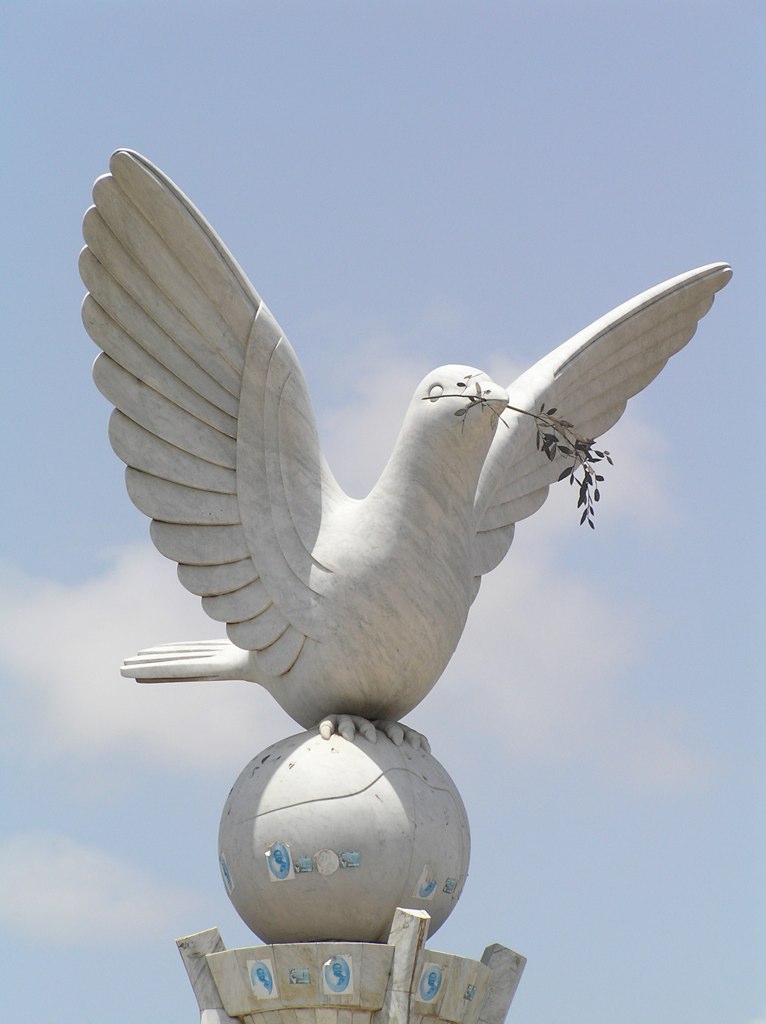
Peace dove: Wikimedia Commons CC 2.0

What does this sound like? Well, to me it sounds like what Jesus always intended his church to be. The redeemed community, the colony of God’s kingdom, is to be the place where the rich and the poor, the highly educated and the barely literate, Europeans, Africans and Asians, the neurotypical and the neurodivergent, old and young, male and female, all care for one another and promote each other’s welfare. Because that’s what Jesus does. That’s the sort of society the Messiah builds.

And imagine not only enjoying a fellowship like that (even though it entails hard and painful work at times). Imagine also inviting someone in to experience it, and being able to say, this is what life is like when Jesus is in charge.

Indeed, this is what regime change under Messiah Jesus brings.


[1] James Montgomery (1771-1854)

[2] Methodist Worship Book, p100.

[3] John Goldingay, Isaiah (New International Biblical Commentary), p84.

[4] Op. cit., pp 85, 88.

[5] p85.

Sermon: Born Again

John 3:1-17

Jesus answered [Nicodemus], ‘Very truly, I tell you, no one can see the kingdom of God without being born from above.’ (Verse 3)

What is it to be a ‘born again Christian’? We’ve become very used to hearing the phrase. The first time I remember hearing it was in my early teens, when a friend at school who went to a Baptist church invited me to a youth event. As my friend Andy brought me into the hall, someone greeted me and said, ‘Am I shaking hands with a born-again Christian?’ I said, ‘Yes,’ because as far as I knew I was a Christian. As I did so, Andy looked on quizzically. Clearly he doubted me. I didn’t understand at the time why he should doubt that I was a Christian. In later years, I would understand that he was right to be uncertain.

In popular parlance, we think of the phrase ‘born again Christian’ in connection with some American Christians. The first time I heard ‘born again’ used in the public domain was, I think, when Jimmy Carter ran for President in 1976. He would say, ‘My name is Jimmy Carter and I am a born-again Christian.’

Or we think that ‘born again Christians’ are those Christians we disparagingly refer to as ‘happy clappy’. I am sad when we disparage other Christians in this way, but what does remain is a sense that you can have two or more kinds of Christian: born again Christians, and other Christians.

So people have come to think that ‘born again Christians’ are one kind of Christian. But Jesus doesn’t put it like that. Either you’re born again (born from above, born anew) or you can’t see the kingdom of God. If you are born again, you are a Christian. If you are a Christian, you are born again. It’s not about the style of Christianity, it’s about the substance.

So we’d better know from Jesus what the substance of being one of his followers is. To explore what Jesus tells us, let’s look at the conversation he has with Nicodemus.

Except it’s not a conventional conversation. Three times Nicodemus asks Jesus something, or makes a statement to which he is seeking a reply. And three times, Jesus doesn’t answer him but says something else. If you’ve ever been frustrated that Jesus hasn’t answered the questions you’ve asked, you’re in good company. But Jesus has to do this here with Nicodemus, because otherwise he won’t get him to see the most important truths about the life of faith.

So let’s look at the three exchanges here, and see what they open up for us about true faith, about what it truly means to be ‘born again’.

Religion or Revelation
Nicodemus is religious. He is a Pharisee, which means at the very least he was devout and serious about following the heart of his religion. He was also ‘a leader of the Jews’, so whatever exactly that was, he held a responsible position and was probably respected for his faith (verse 1).

Furthermore, we have certain stereotypes of Pharisees from the New Testament as being regular opponents of Jesus, but it doesn’t look like Nicodemus can be lumped in with that description. He comes to see Jesus ‘by night’ (verse 2). I think that means he knew other Pharisees didn’t like Jesus, but he sincerely wanted to find out more. However, because of opposition from colleagues he comes under cover of darkness to avoid detection.

Not only that, he’s done his homework.

‘Rabbi,’ [he says,] ‘we know that you are a teacher who has come from God; for no one can do these signs that you do apart from the presence of God.’ (Verse 2)

In other words, he’s been part of a Pharisees’ committee that has looked into the early ministry of Jesus, just as we read two chapters earlier that a deputation of priests and Levites came to investigate John the Baptist (1:19). He would have been at home in the Methodist Church: working parties, committees and endless meetings would have been familiar to him!

Faithful, respected, sincere and devoted: that’s Nicodemus. Just the kind of person you want to join your church. Isn’t it?

It’s not far from the upbringing I had. My sister and I were taken to church in the womb. Our parents were active members of our Methodist church. Dad was a steward and was the Circuit Manses Secretary. Mum sang in the choir and taught in the Sunday School. You could hardly go out in the street with Mum without her bumping into someone and saying, ‘Didn’t I teach you Sunday School?’ In fact, it was so ingrained that my sister once worked out that she and I were fifth generation, same congregation.

And you know what? I wasn’t a Christian. It took a church membership class where at the last meeting our minister took us through the confirmation service when something clicked. I realised that Christianity wasn’t simply about believing in God and being good. It was about the grace of God reaching out to us, and us receiving it through repentance from our sins, faith in Christ and a grateful commitment to follow him in the world. I believe the ‘something’ that ‘clicked’ was the work of the Holy Spirit.

And Nicodemus has to learn that all his sincere religious belief and work counts for nothing. Religion gets you nowhere, Jesus says. Put in all the human effort you like, it’s a dead end. You need to hear from Jesus by his Spirit. You need to hear that it’s his work, not yours, that makes you a disciple of Jesus. It’s not what you’ve done for him. It’s what he’s done for you. That’s where the Gospel starts. Nowhere else.

Reason or Spirit
All this talk about being born again (born from above) is befuddling to Nicodemus. He can’t get his head around it:

‘How can anyone be born after having grown old? Can one enter a second time into the mother’s womb and be born?’ he asks (verse 4).

It doesn’t make sense. It doesn’t stand to reason. I don’t think he’s deliberately ridiculing Jesus, but he is saying that Jesus’ teaching makes no sense to him.

This is what happens when we privilege human reason over the work of the Spirit. There is an important place for human reason, and indeed Jesus elsewhere told us to love God with our minds. However, even the foolishness of God is wiser than our wisdom. And when we rely on our minds and our brains alone, we shall never discern the work of God and walk in the ways of Christ.

I’ve seen people do it, including in church circles. Often clever people, they ask all sorts of questions. They routinely criticise the preachers (not that we should be above criticism, mind). Unless they can intellectually justify something, they refuse to accept it. But the life of the Spirit doesn’t work like that, and I’ve seen such people make shipwreck of their lives, for all their brainpower. For it’s all very well using our minds, but even our thinking is fallen and sinful. Wernher von Braun, the greatest rocket scientist ever according to NASA, previously worked on inter-continental ballistic missiles for the USA and prior to that developed rockets such as the V2 for the Nazis.

Instead of limited and potentially sinful human intellect as our guide, Jesus calls us to follow the wild desert wind of the Holy Spirit. We must be born of water and the Spirit, he tells Nicodemus (verses 5-6). And just as you don’t know which way the wind blows, so it is with those born of the Spirit (verse 8). When we are born again, we don’t just pursue clinical logic, we submit to the Holy Spirit, who will take us into surprising places.

Being born again, then, is not just about the new birth. It is about the new life. A life empty of stale human prediction. A life where we ‘lean not on our own understanding’ but walk in obedience to the Holy Spirit, wherever we are led. Religion doesn’t understand that. Nor does reason. But the Spirit does.

Understanding or Faith
The last exchange, and Nicodemus still doesn’t get it: ‘How can these things be?’ he asks (verse 9).

Jesus replies, you still don’t understand –you, the teacher of Israel? If I talk about earthly things (birth, water and the wind), how will you ever believe in the things of heaven? (Verses 10-12) And he goes onto talk about that which most of all requires faith rather than human understanding: the Cross.

If you want to do everything by logic and understanding, you’ll never end up at the Cross. Yet Jesus knows it will be the central event in history. If you wanted good PR for a new religious movement in what we call the first century, you wouldn’t have picked the Cross. As Paul was to tell the Corinthians, it is foolishness to the Greeks and a scandal to Jews. Where is the fine-sounding rhetoric so beloved of Greeks at the Cross? Where is the wondrous miracle that conquers the enemies of God that Jews longed for?

Yet to those with faith in Christ, nothing speaks more eloquently than the agony of the Cross, where Christ dies in our place. And yes, it does conquer the enemies of God, as Jews would have hoped, but in a more radical way, dealing with the sin of the world by absorbing its cost, not lashing out.

And it’s as relevant today as it was two thousand years ago. The philosophers adored by the Greeks of the first century were the rock stars of their day. They were treated rather like the way our culture hangs on the words of celebrities. Those who are born again choose the wisdom of the Cross to guide their lives, not the vacuous pronouncements of the famous.

Likewise, those who are born again live at the Cross and are not persuaded that ‘might is right’. Killing abortion doctors – however evil abortion is – does not sit with life at the Cross. Nor do the recent statistics from America which showed church attendees as more likely to approve of torturing suspected terrorists. To be born again involves a commitment by faith to believe in the redeeming and transforming power of suffering love through Christ.

It’s not enough if we are born again to say that the Cross is where we find the forgiveness of sins – although we do. We must then allow Christ and his Cross to shape the way we live and speak.

Conclusion
We began by wondering what it means to be ‘born again’. Is it one particular style of Christian?

There is no evidence in Jesus’ teaching that this is the case. He applies the image of being born again to all who wish to be his followers. It is a challenging image.

For those who are born again reject the idea that religious devotion earns a ticket to heaven. Rather, we bow the knee and accept that God has done something for us in Christ. It isn’t about what we can offer. Is that us?

Those who are born again deny that we can proudly think our way to God. We depend, instead, on the work of the Spirit to reveal Christ and to lead our lives in unpredictable directions. Again – is that us?

Finally, those who are born again give short shrift to the empty example of the famous and the violent world of superior force. We find life at the Cross, and we continue to live at the Cross. Once more – is that us?

So: are we born again?

Sabbatical, Day 70, Holy Saturday: Jesus’ Body Lies In A Tomb

Vodpod videos no longer available.

more about “Damaris Trust Holy Week 2009, Holy Sa…“, posted with vodpod

This is the Damaris Trust video for Holy Saturday (not Easter Saturday, please: we’re not into Easter until tomorrow). Pete Greig talks about where God was on the day that Jesus lay dead in a tomb. He discusses our experiences of feeling in this inbetween state, and the hope that we can cling to.

…………

One of the themes of John’s Gospel after Jesus dies is that of secret disciples. Joseph of Arimathea and Nicodemus arrange for the burial of Jesus’ body. Joseph follows Jesus secretly for fear of ‘the Jews’ (i.e., the religious leadership); Nicodemus had come to see Jesus in chapter three ‘by night’. I mention that, because this morning I have had forwarded on to me the Premier Radio campaign to get Christians to sign up online to declare they are Christians. I first read about this a week ago on Jason Clark’s blog, where he expressed reservations about the initiative.

Now I have seen it for myself, I share Clark’s concerns. The declaration amounts to an assent to certain doctrines. Yet as the Epistle of James says, ‘Even the devils believe.’ Clark proposes an alternative that includes a strong element of discipleship action, and I don’t see how you can exclude that from any understanding of what a Christian is. I would add that the declaration also woefully omits any sense of faith being about the grace of God. It’s all couched in ‘me, me, me’ language. 

I don’t like saying this about Premier Radio, and especially about their Chief Executive Peter Kerridge. I met him a few times in his previous appointment, when he worked as an avowedly Christian radio professional on a community commercial radio station in Harlow, Essex, called Ten 17 radio. He was training Christian leaders (including me) to create snappy ninety-second ‘thoughts for the day’ that would be broadcast on their breakfast programme, in the midst of Top 40 hit singles. We could be as religious as we liked, so long as we were lively and entertaining. It was a great vision.

Equally, I don’t want any of this construed as sympathy for the National Secular Society’s campaign for ‘debaptism’. Their requests that churches delete records of baptism at the request of those who renounce Christian faith amounts to an altering of history that would make Soviets and Maoists proud. People are free to accept or reject faith anyway. It all amounts to a silly campaign from a tiny group of self-important self-appointed self-publicists.

…………

Tonight I’ve been to Chelmsford Cathedral. There was a Service of Light and Confirmations. I went for the confirmations. Five of the twenty candidates came from the parish church where we are worshipping. Another used to be part of that parish. It was great to support them.

I found the Easter Eve liturgy curious in one respect: already we were proclaiming ‘Alleluia, Christ is risen! He is risen indeed, alleluia!’ I had never uttered those words before Easter morning. I am sure there is a good reason, but I can’t see it. I thought we would still be marking the waiting period.

The Bishop of Chelmsford made a thought-provoking point at the beginning of his brief address. He spoke about how the tomb of Jesus was in a garden. Gardens are places of rest and new life. He then compared it with Eden, the symbolic place for the beginning of human life, and said that the Garden containing Jesus’ tomb was the place where new life and new creation began. (Sounded very Tom Wright!) You may have thought of that many times before, but it was a new and fresh thought for Easter this year for me.

See you tomorrow, when I shall be celebrating that Christ is risen!

Create a website or blog at WordPress.com

Up ↑