
Characteristics of the Early Church, Acts 2:42-47 (Easter 4 Year A)

Acts 2:42-47

Patience, frustration, cynicism, sarcasm, disbelief, contemplation…….

All kinda rolled into one. By Paul Howard at Flickr. CC 2.0.

One of my less attractive attributes – and there are many – is that I can be quite cynical. As I pondered why I was like that, I came across the idea that a cynic is a failed idealist.

And I thought, yes: that’s me. The failed idealist.

One of the things I’ve been an idealist about over the years is the church. I’ve been grieved by the difference between the New Testament church, even with all its imperfections, and church as we experience it today.

I had some sympathy with the late Billy Graham when someone criticised him, saying, ‘Mr Graham, you are setting the church back fifty years.’

Graham replied, ‘If I have only set the church back fifty years then I have failed. I wanted to set it back two thousand years.’

Today’s passage from Acts is one of those accounts where we see some of the core values of the early church. This description shows what they focussed on in the immediate aftermath of Pentecost, when three thousand were added to the number of the first disciples when Peter preached.

I think it would be good for us to measure ourselves against this plumbline.

The initial summary statement in verse 42 –

They devoted themselves to the apostles’ teaching and fellowship, to the breaking of bread and the prayers

is filled out in verses 43 to 47.

We’re going to reflect on those four key things to which the earliest church was devoted – the apostles’ teaching and fellowship, the breaking of bread and the prayers – and see how well we reflect them.

The first characteristic of the early church is the apostles’ teaching:
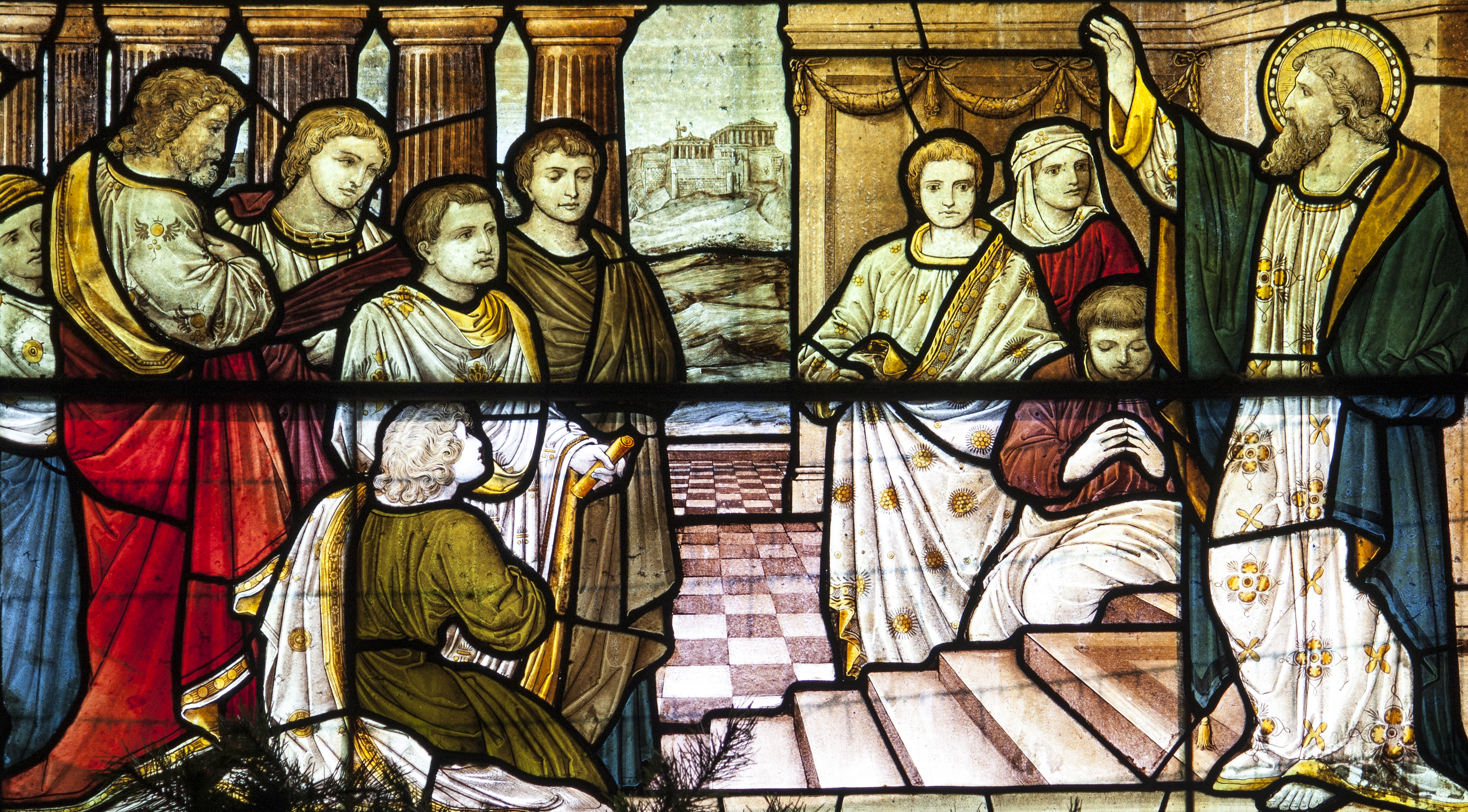
The Apostles preaching the Gospel by Fr Lawrence Lew, OP on Flickr. CC 2.0.

The converts are both listening to the spoken teaching of the apostles and also watching them put it into practice: ‘many wonders and signs were being done by the apostles’, according to verse 43.

There is no true Christian church unless it stands in continuity with the apostles, to whom Jesus entrusted his teaching. How is that guaranteed? Anglicans do it through a succession of laying-on of hands down the centuries, vouchsafed by the continuation of bishops. Catholics do it by a similar method, but especially by seeing the Pope as the successor to the Apostle Peter.

But both methods are suspect. There have been enough bishops who clearly have not believed the historic faith down the centuries. And some Catholic traditions and teachings are also questionable.

We may not be much better. We are right to say that we need a succession in the apostles’ teaching, but we certainly let a lot of people – church leaders included – sit very loose to that (to put it as diplomatically as I think I can).

The New Testament is the collection of writings that are either from the apostles or from their circles of influence, and it is the basis for the content of Christian faith. Our call is to know that teaching and to live it out. That makes us apostolic.

Therefore, let us all ask ourselves: what are we doing to learn more about what the New Testament calls ‘the faith once delivered to the saints’? Do we not only attend to its reading and exposition on Sundays but also read it for ourselves (preferably every day)? Do we discuss it with others? Do we take on its teaching by saying, OK, that’s what it means, now what am I going to do about it?

I love the story of the grandchild who observed Grandma reading her Bible, and saying, ‘Nanny, why are you still reading the Bible? Haven’t you read it over and over again in your life?’

‘Yes,’ said Grandma, ‘I have. But I’m studying for my finals.’

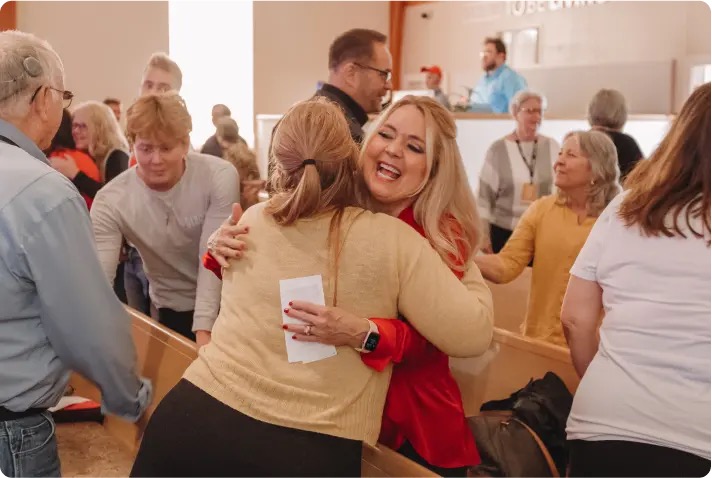
The second characteristic of the early church is fellowship:
Careers at Abundant Life. Found at Abundant Life. CC 4.0.

They are devoted to ‘the fellowship’ and this has its outworking in verses 44 and 45:

44 All who believed were together and had all things in common; 45 they would sell their possessions and goods and distribute the proceeds to all, as any had need.

We have such a shallow understanding of fellowship. We think it’s drinking coffee together while we chat about the weather. Somebody once said that the kind of fellowship we witness in some churches is no more than what he called ‘billiard ball fellowship’: we just bump into one another once a week. The New Testament church shows us up.

For the word translated ‘fellowship’ means ‘in common.’ Who or what do we have in common? They had Jesus in common, and because of that they shared not only him but every aspect of their lives, possessions included.

Let’s not write this off lazily as some have, by saying this was an early experiment in communism that failed. The earliest church shared their experience of Jesus, and because of that they also shared life together at a very deep level.

I have seen some wonderful examples of this over the years. I think of when my grandmother (who lived with us) died. Our West Indian Christian friends from the Bible study group we hosted turned up on the doorstep. Some came in and relieved my mother of the housework. Others arrived, carrying a fully cooked meal for the whole family. They shared and gave so that we as a family had time and space to grieve. I will never forget that.

Or this incident from the first theological college I attended: there was a Singaporean student whose mother died back home while she was at the college. She couldn’t afford a plane ticket to fly home for the funeral and then come back to England for the rest of her course. But the student body, comprised of people with very limited incomes, rallied around. She was given the money for a return ticket.

If we share Jesus in common, what else do we share?

The third characteristic of the early church is the breaking of bread:

From needpix.com. Public Domain.

This too is mentioned in the summary statement in verse 42. It is expanded upon in part of verse 46:

they broke bread at home and ate their food with glad and generous hearts

Now some Christians hear those words ‘the breaking of bread’ and ‘they broke bread’ and think this is some kind of primitive communion service held in people’s homes without the need for formal leadership. It isn’t – any more than when the risen Jesus broke bread with the two who walked to Emmaus at their house was. It was an ordinary meal.

You could say this is an extension of what I have just said about the true meaning of fellowship. It is a marker of how life was shared together. Homes were open. There was no limitation to just the nuclear family of Mum, Dad, and the kids, like there is in our society. Your family was not just biological. Your family was the family of God.

It’s quite a challenge to the concept that an Englishman’s home is his castle, and that we get in, shut the door, pull up the drawbridge, and shut out the rest of the world. The church family, according to the example of the early believers, has more of an ‘open door’ philosophy. Open to the family of God. Open to those in need.

When I was single, I was glad to know others who would open their home to me, so that I didn’t have to spend every mealtime alone. I think too of the Christian couple I know who applied to have an extension on their home. It wasn’t so that they could live in more comfort. They did it, because they wanted to become foster parents. Over the years, I believe they fostered somewhere between thirty and fifty children, many of whom came from traumatic backgrounds. As a result of their caring witness, some even found faith and joined the church.

What might it mean for us to eat our food ‘with glad and generous hearts’?

The fourth characteristic of the early church is the prayers:

Free hands praying in church image, public domain people. Found at Religion Unplugged. CC 1.0.

This is mentioned at the end of verse 42 and is amplified in the rest of verse 46 and the first half of verse 47:

46 Day by day, as they spent much time together in the temple, they broke bread at home and ate their food with glad and generous hearts, 47 praising God and having the goodwill of all the people.

Prayer and praise? Am I just stating the obvious here? Am I about to tell a collection of grandparents how to suck eggs?

I hope not. But here’s the thing. When the Holy Spirit is at work, prayer and praise moves from duty to desire to delight. It is no longer what we have to do, but what we want to do. The work of the Spirit is to reveal Jesus, and as we see more of who Jesus is and what Jesus is like, then our capacity for worship will inevitably increase.

I am not suggesting we should spend so much time in church that we ignore the needs of the world. If I thought that, I wouldn’t have shared the last point about our open homes.

And nor am I saying that duty on its own is necessarily bad. Sometimes we get through a difficult period or a dry spell by attending to the need for duty in coming to worship. We cultivate virtuous habits that help us.

But what does concern me is a lackadaisical attitude to worship that I sometimes see in church members. I’ll come to worship provided there’s no better attraction available to me. I won’t come to worship today, because it’s raining. I’ll come to worship, because I want to get something rather than give something.

A true church is committed to praise and prayer as a priority. I think of the Ugandan Anglican priest I knew at my first college who would walk up to twenty miles, carrying all his vestments and everything he needed. Over the years, he had developed a stoop from the weight of all he had carried, and while you might reasonably ask whether it was sensible in the African climate for clergy to wear the same attire that they do in the UK, that deformity also spoke of one who was committed to leading God’s people in praise and prayer.

I wonder what cost we were glad to pay to come to worship today.

Conclusion

Here’s the whole of verse 47:

praising God and having the goodwill of all the people. And day by day the Lord added to their number those who were being saved.

They wouldn’t always enjoy the goodwill of the people. But they did generally grow in number. We have much to learn from them about continuing in the apostolic faith, holding our lives in common because we have Jesus in common, having open homes, and being committed to worship.
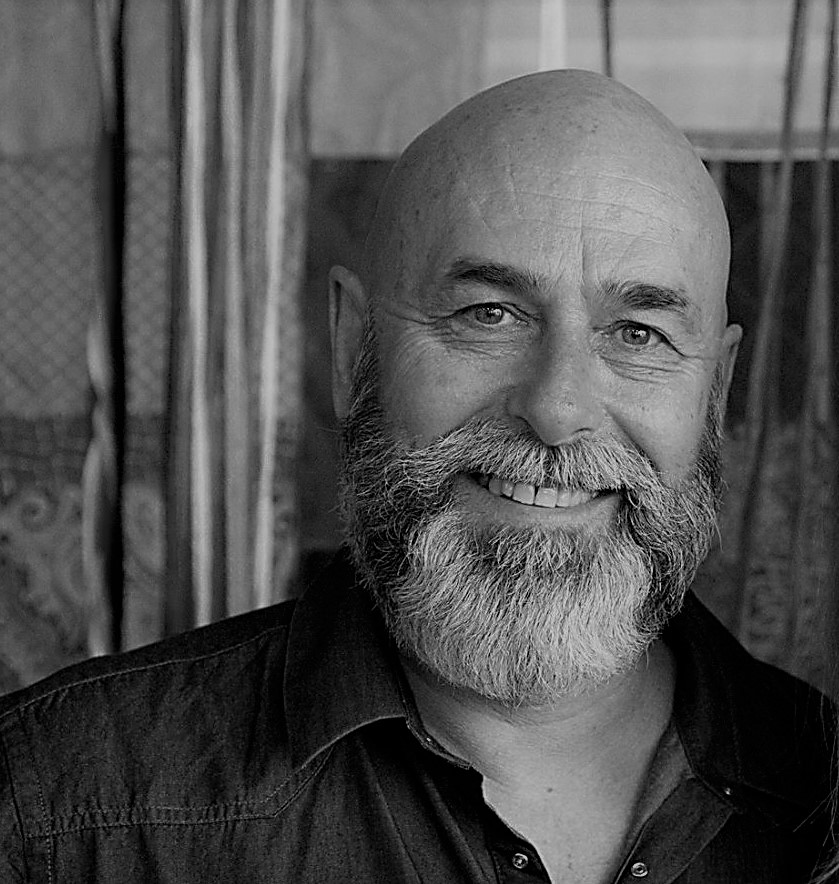
Michael Frost in 2017 at Wikimedia Commons. CC 4.0.

I want to close with a pattern of life suggested by the Australian missiologist Michael Frost. I do not live up to all these ideals, but I think he captures the spirit of the early church in a mnemonic for the Christian life called BELLS:

Bless —I will bless three people this week — at least one of whom is not a member of our church.

Eat — I will eat with three people this week — at least one of whom is not a member of our church.

Listen — I will spend at least one period of the week listening for the Spirit’s voice.

Learn — I will spend at least one period of the week learning Christ.

Sent — I will journal throughout the week all the ways I alerted others to the universal reign of God through Christ.[1]

How about we ring some bells?


[1] See Michael Frost, Surprise the World: The Five Habits of Highly Missional People.

Mission in the Bible 12: Listening with Two Ears (Acts 8:26-40)

Luke 8:26-40

If Debbie tries to speak to me about something while I am watching the television, there is more than a fair chance that I won’t take in what she’s saying. She will have to tell me to stop listening to the TV in order to listen to her. After all, as a man, I can only ever do one thing at a time. And I certainly can’t listen to more than one source simultaneously.

It makes me think of something I was told in a training session for people who were going to engage in prayer ministry. The instructor said that we had two ears, and that we had to listen to the person in need with one ear and the Holy Spirit with our other ear. That sounded tricky! It was better when they advised a team of two people to pray with whoever came forward, with one team member listening to the person and the other listening to the Spirit.

But part of our task as the church is to engage in multiple listening. The late John Stott called it ‘double listening’, where we listen to the Bible and to the world. Not that we squeeze the Bible into today’s standards and values, which happens far too often, but that we find where the Gospel speaks to today’s world.

And in our strange and wonderful Bible reading today, Philip engages in multiple listening. And it’s this multiple listening that enables him to lead the Ethiopian eunuch to faith in Christ.

Firstly, Philip listens to the Holy Spirit:

An angel (speaking on God’s behalf) directs Philip to go to the desert road (verse 26) and when he is there, the Spirit tells him to go near the eunuch’s chariot and stay near it (verses 27-29).

Well, it’s easy to say ‘listen to the Holy Spirit’, isn’t it, but harder to get to grips with it for ourselves. At one end of the Christian spectrum we have people who say they have never known God speak to them along with others who say that God only speaks to us now through the Bible.

At the other end there are Christians who, in the words of one preacher, claim to have more words from the Lord before breakfast than Billy Graham had in a lifetime. Some of these people are harmless fruitcakes, but others are manipulative and abusive leaders.

I once heard a story about a man who went to his vicar and said, ‘Wonderful news, vicar! You know that gorgeous blonde woman in the choir? The Lord has told me to marry her.’

‘No he hasn’t,’ replied the vicar.

‘Yes, he has!’

‘No, he hasn’t.’

‘Yes he has!’

‘NO HE HASN’T,’ insisted the vicar. ‘You’re already married.’

I think there’s a healthy middle path to be found here. I do believe God still speaks to us, but I also believe we test that against what he has revealed to us in the Bible.

And I would also say that some of us who think God hasn’t spoken to us are mistaken. He has told us things, but perhaps we haven’t always recognised it was him. Take the common example of feeling prompted to phone a friend or a relative, only to do so and discover they are ill or in some other predicament. We can then pray for the person or help meet their needs. Isn’t that something the Holy Spirit would do?

An Anglican priest friend of mine used to lead an organisation in London called the Christian Healing Mission. In teaching Christians about prayer, John would invite people to sit quietly and ask God to speak to them, then keep silence. He would encourage them to write down whatever impressions came into their mind, believing that God did indeed want to speak to his children. He never denied the need to be discerning about what people thought they heard, but he believed we should be optimistic about God’s desire to speak to us.

So why don’t we open ourselves all the more to the possibility of the Holy Spirit speaking to us? What adventures might he take us on for the sake of God’s kingdom advancing?

Secondly, Philip listens to the eunuch:

Here I’m thinking of where Philip enters into a conversation with the eunuch about what he is reading and what it means (verses 30-35).

When I was a child, we had a family GP who seemed to start writing you a prescription before you had finished telling him what was wrong with you. He didn’t really listen to your problems.

And we have seen something similar in the current General Election campaign. How many of our leaders, when a member of the public asks them a question, be it in a TV debate or on a radio phone-in, just launch into their prepared answer on that subject without listening to the nuances of that person’s personal concerns?

It happens in the religious sphere, too, when well-meaning evangelists splurge out the Gospel without listening to the people they are trying to reach. And while they have a point that the Gospel is unchanging, we need to find the point of contact or even perhaps the point of conflict so that we can make the Gospel connect with folk.

So Philip takes the trouble to listen to the man’s concerns. On his way back from Jerusalem to Ethiopia, a journey that would have taken a couple of months by chariot, this man is serious in his enquiring after God. He seems to think there is something in the Jewish faith and is reading the Hebrew Scriptures, but as a eunuch he will not be allowed to convert fully to Judaism. I think there is a desire for God and for belonging here, and Philip picks up on it. Philip knows this man’s deepest longings can be satisfied in Jesus.

W E Sangster, the famous minister at Westminster Central Hall in the mid-twentieth century, said that the Gospel is like a diamond with many facets. We need to discover which facet shines on a particular person in order to make the Gospel connect with them.

And the moment we understand that, we see the need to listen to people, not just regurgitate a pre-packaged version of the Gospel that we have memorised. It’s a good thing sometimes to learn summaries of the Gospel and also to be able to recount our own testimony, but we must be careful first to listen to the people we are aiming to reach for Christ so that we may share the Good News in the most appropriate way.

Thirdly, Philip listens to the Scripture:

I think the fact that the eunuch is reading this powerful passage from Isaiah 53 that we often call ‘The Suffering Servant’ means that the Holy Spirit is already at work in his life, preparing him for the Gospel and pointing him in to where he needs to ask questions. Perhaps he realises that attempts to explain this passage in terms of it merely being about the prophet himself can only go so far and are ultimately doomed to fail. There are parts of it that just don’t fit.

And along comes Philip for a meeting orchestrated by the Spirit. He listens to the Bible passage the eunuch is reading, and he responds.

But notice how he responds:

35 Then Philip began with that very passage of Scripture and told him the good news about Jesus.

Philip does what the early church did. They listen to Scripture and interpret it in the light of Jesus. The Hebrew Scriptures had pointed to a coming Messiah. Now he had come in the Person of Jesus, it made sense not just to read the holy writings to quote proof-texts out of context, but to read and understand them in the light of Jesus.

So that’s what Philip does here. He listens to these verses from Isaiah and says that ultimately they only make sense in the light of the Good News of Jesus. And as a result, this man who could not fully belong in Judaism due to his castration can fully belong to Jesus. His baptism (verses 36-39) is surely a joyful expression of that truth.

What Philip is doing is rather like Jesus on the Emmaus Road. As Jesus came alongside the two travellers, he opened the Scriptures and related them to himself. Philip comes alongside the Ethiopian eunuch and relates the Scriptures to Jesus.

This approach grounds us in the centrality of the Bible as the authoritative account of the Christian faith, but we do not act as Bible-bashers. We are not using isolated Bible texts as weapons to hurt people. There will always be the odd prejudiced person who accuses us of that and we can’t do anything about that, but our main task is to listen to the Scriptures and share how they point to Jesus. The Holy Spirit uses this to make Jesus real to people and lead them to him.

However, most of the people we encounter will not be reading Bible passages and asking us to make sense of them to them – although it might happen occasionally. We instead need to be people who are listening to the Bible ourselves anyway and looking for how it points to Christ. As we feed ourselves in this way on Jesus, the Bread of Life, we shall be more fully equipped for the conversations we have with friends and family members who don’t share our faith. Our own willingness to engage in spiritual discipline with the Bible is not only good for us, it has benefits for our witness.

Conclusion

When we consider mission and especially evangelism, we give a lot of emphasis to speaking. And the speaking is of course necessary.

But we need to appreciate the importance of listening too, as Philip knew. We need to listen to the Holy Spirit, who guides us into divine appointments. We need to listen to those we are aiming to reach, so that we may share our hope in Christ in a way that connects with them and challenges them. And we need to listen to Scripture, particularly to the way it points to Christ, because that is the truth we are seeking to share.

Thank you – for listening.

My Memory Of John Stott

Yesterday evening, reports appeared on the web that John Stott had passed away yesterday afternoon at the age of 90. (This search will take you to about two hundred stories in Google News at the time of typing.) Obituaries cover his evangelism, his leadership of All Souls, Langham Place, his key place with Billy Graham in the Lausanne Movement, his commitment to social action as core to evangelical understandings of mission, his clear Bible teaching, his concern for the Majority World, his love of birdwatching and much more. I particularly recommend Christianity Today’s obituary.
More concisely, Maggi Dawn has described him this morning on Twitter as

 The most compassionate, sane evangelical Christian I ever met.

I have read many of his books. Favourites of mine include his expositions of Acts and Ephesians (the latter is particularly worn and battered). However, I only heard him preach once. I was training for the ministry in Manchester at the time, and he came to preach one evening at the local Anglican church, which had a large student ministry. Dr Stott agreed to stay behind afterwards and field questions.
I attended that meeting. I was engaged in my postgraduate research in Theology, specialising in ecclesiology, the doctrine of the Church. I asked him a question. Why did he think Archbishop Robert Runcie had chided evangelical Anglicans at the third National Evangelical Anglican Congress in 1987 that

‘If the current evangelical renewal in the Church of England is to have a lasting impact, then there must be more explicit attention given to the doctrine of the church’?

Dr Stott gently batted the question back at me, with quiet grace and a faintly sparkling smile. “Why do you think he did?”
I had no sense that he was trying to dodge the question. Rather, like Jesus, he knew that questions could be more deeply explored by asking further questions. He wasn’t short of answers himself, and for those who want to know, it is worth reading his book The Living Church.

Farewell, then, in this life, to one of the most gracious, compassionate  and hard-thinking evangelical Christians to have come to prominence in the last century. May more of us in that tradition seek to emulate his example.

Letting Jesus Heal

Sally Coleman and I seem to be interested in much the same things right now. Not only have we both written about theology in the last couple of days, she has written about healing and now here am I doing the same.

We’ve just started running the DVD course ‘Letting Jesus Heal‘ from the Christian Healing Mission at Knaphill. Now before I go any further, I should make full disclosure and say that I have known John Ryeland, the director of the CHM, for a good number of years, and indeed went to school with his wife Gillian! So you can accuse me of bias if you like.

However, I want to commend this course enthusiastically, based on the first two weeks of the six. What I like about the teaching here is that John combines a faithful openness to the power of God to heal with a quiet, gentle approach. In style this is about as far removed as you can get from the hyped-up school of healing ministry so prevalent in some places. It is therefore both safe and ideal for introducing an expectancy that God will work in a context where people might be nervous of showmanship, noise or manipulation.

Not only that, one thing I deeply value about John’s teaching is that he opens people up to the belief and experience that God is speaking to us much more than we realise. How often do we think that God is not speaking to us, or just does not speak to us – especially in contrast to other Christians who, in the words many years ago of Gerald Coates, ‘have more words from the Lord before breakfast than Billy Graham has had in a lifetime’?

Eighteen months ago, I heard John give his teaching on ‘Encountering Jesus‘ and had a simple but profound experience of Christ in relation to some serious pain and disappointment in my life. It forms the second session of the healing course, and while I obviously cannot share any confidences, I know that a number of people heard Jesus speak to them on Wednesday night in the course.

If you are looking for something to encourage people in the area of Christian healing, then, I recommend you take a good look at this course. And if you’re not far from Knaphill, feel free to drop in on us next Wednesday at 8:00 pm.

Coins

Yesterday, I visited my parents. It was a good opportunity to see how Mum was getting on since we heard she (thankfully) had TB, not cancer. Dad has since been prescribed antidepressants: the strain of this episode, preceded by Mum’s fall last Christmas, and the prolonged saga of the house move last year have taken their toll on an eighty-one-year-old.

They treated me to an excellent lunch at a favourite pub. Then we returned to their flat for conversation, before tiredness meant they needed a rest and I made an earlier than expected departure.

During that chat, I mentioned a story from the other day. Rebekah had been looking at some coins and had noticed the date. This had fascinated her, especially a twenty pence piece from a galaxy far, far away known as 1982.

Dad got up and went out of the living room. I thought nothing of it. However, he returned with a bag. It was a collection of coins, many of them specially minted for state occasions and still in their presentation sleeves. There were crowns to mark the funeral of Winston Churchill in 1965, the Queen’s Silver Jubilee in 1977 and Charles and Diana’s wedding in 1981. There were two wallets of Britain’s first decimal coinage. Then there were assorted loose coins, including some old sixpences. One of these came from the reign of King George V in 1922. 

Dad explained that he wanted them handed down the generations of the family. He asked me to keep them safe for our children. While they would be worth more than their face value, they would not be especially valuable, because many of them had deteriorated. However, they would be a fascinating and educational possession. I was delighted, and locked them out of sight in the car boot when I drove home.

It was a joy to come home and tell the children I had a present for them from Grand-dad. In the short time before bath-time, it was impossible to explain the significance and context of these coins to Rebekah and Mark. How on earth will I explain pre-decimal currency to them? I was only a fortnight shy of my eleventh birthday when Britain was decimalised.

And if Rebekah finds 1982 hard enough to comprehend, what price 1922? George V is three monarchs before the current long-reigning Queen (I’m including Edward VIII, even though he was never crowned). 

Pounds, shillings and pence and early twentieth century kings will take a lot of patient dialogue and explanation. There are so many foreign concepts to go through in order to make sense of Grand-dad’s gift.

Is it not similar in evangelism today? With, say, three largely ‘unchurched’ generations there is a huge gulf between the Christian community and most of society. (And that gulf may go some way to explaining the misrepresentations of our faith in the media – it isn’t all wilful, much is a genuine lack of understanding.) Evangelism is about being in for the long haul to explain the faith in a context of dialogue. I see the point of those who say that a contemporary repeat of Billy Graham’s Harringay crusades in the 1950s with their remarkable levels of conversionss most likely would not happen today. It isn’t that I think God is incapable of it – of course the Holy Spirit could – but it is to recognise that Graham was able to appeal to a residual faith and call people back to it. There is hardly any such residual faith today. 

Our faith is like a 1922 George V sixpence. To most people it appears not to be legal tender.  It looks battered, but it is valuable. Nevertheless, to explain the significance takes time.

But the investment of time into relationships as we gossip the Gospel is immensely worthwhile. We are sharing treasure with people.

Create a website or blog at WordPress.com

Up ↑