A Brief Sermon For An Infant Baptism (Acts 16:25-34)

Before we read from the Bible, I need to explain the background to what we’re going to hear. The Apostle Paul and his companion Silas have been preaching in a city called Philippi, but they kept getting interrupted by a very disturbed young woman. She was a fortune-teller, but she was also a slave, and so her owners made a lot of money out of her. They exploited her.

Image courtesy Picryl. Public Domain.

So Paul cast the spirit out of the young woman that enabled her to tell fortunes, and that angered her owners, who lost a lot of money, because they could no longer exploit her. In revenge, they got Paul and Silas locked up in the local prison, and that’s where we pick up the story.

Acts 16:25-34

Now I’ve read that story largely because we read near the end that the jailer found faith, but on the basis of his faith not only he was baptised, but so was his entire household – although it must also be admitted that Paul and Silas spoke the word to the whole household.
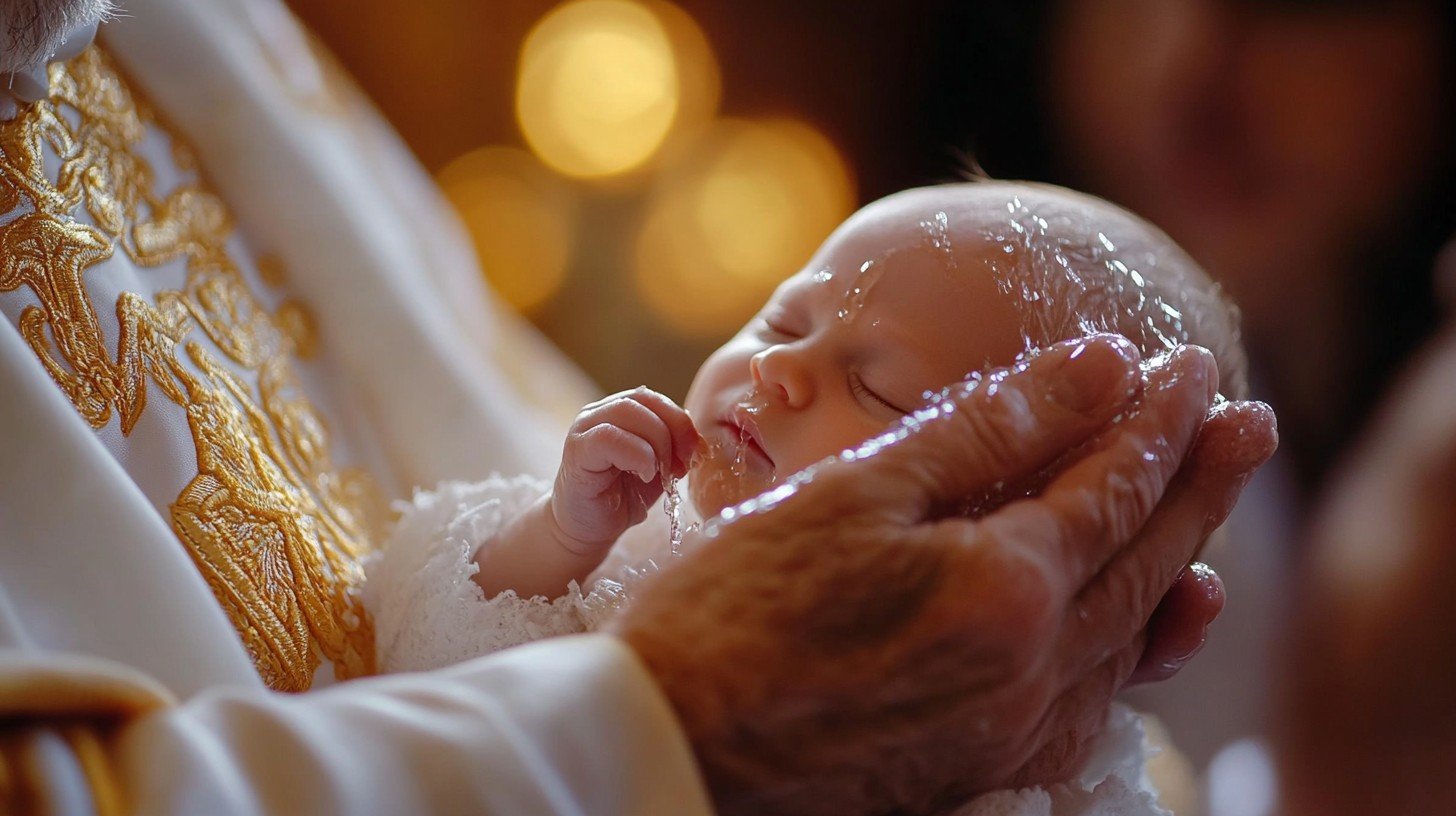
Image courtesy StockCake. Public Domain.

And today, we shall baptise [name] on the basis of [the child’s parent]’s faith. One day, [name] will have to decide for himself whether to follow Jesus.

So what does this faith look like? Well, it’s a lifetime commitment, but let me pick out two important elements from the story.

The first is belief:

Believe in the Lord Jesus, and you will be saved (verse 31)

What does it mean to ‘believe in the Lord Jesus’? It’s not simply that we believe he exists, although the historical evidence for that is extremely strong. No: we believe certain things about Jesus, and we then trust him with our lives.

We believe that Jesus is the Son of God, that he died for our sins, and that he rose again from the dead to give us new life.

Some people say that they think they are good people and that will get them into eternal life with God when they die. But none of us is good enough to meet God’s perfect standards. We all fall short. Those failures need to be forgiven.

And the thing about forgiveness is this: it hurts and it is costly. I think of a time when I was still living with my parents. A friend of mine had a broken engagement. He needed somewhere to stay while getting over it, and we invited him in. He stayed for two weeks. But he never helped with anything around the house. He seemed to expect my Mum to cook for him and do his washing. When he left, he didn’t offer any money towards all that my parents had shelled out while he was with us.

Image courtesy Picryl. Public Domain.

We had a family conference about this. I’ll never forget my Dad’s words. “We’ll put this down to God’s account.” To forgive my friend involved my parents absorbing that debt. It cost them.

Similarly, Jesus dying on the Cross shows us that it cost God to forgive our sins.

So I invite you this morning to realise that is the cost God has paid for you to be forgiven. Will you believe it? And will you then trust Jesus with your life?

The second thing that faith involves is action:

At that hour of the night the jailer took them and washed their wounds; then immediately he and all his household were baptized.

The jailer brought them into his house and set a meal before them; he was filled with joy because he had come to believe in God—he and his whole household. (Verses 33-34)

The jailer does engage in good deeds, but they are not what earn him salvation. Instead, his action is a matter of gratitude.

We are so grateful that God has loved us so much it has cost him the death of his Son, that we respond. And we do so by putting our faith into action.

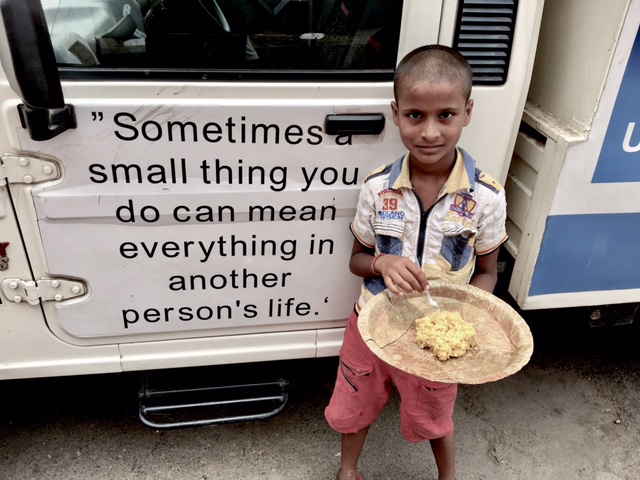
Yes, that gratitude is certainly shown in worship, but it is also shown in the world. The jailer tends to the wounds of Paul and Silas, who had been beaten and flogged before they were thrown into prison (verses 22-24).
Food drive for homeless. Wikimedia Commons. CC 4.0

So if we are grateful for all that God has done for us in Jesus, who are the wounded people we can serve and show his love? Perhaps we can think of this a little bit like the idea today of ‘paying it forward.’ Where and how can I pay it forward, because God has shown so much love to me?

The jailer didn’t have to look too far and neither do we. You will have a neighbour who needs some practical help. You will find organisations where you live that that work and campaign on behalf of those in the most desperate need, either in this country or abroad.

Conclusion

This is the faith into which we baptise [name] this morning. One that urges him to believe that Jesus died for his sins, and to trust his life to him. One that shows gratitude for God’s love in our actions, especially in the service of those in most need.

But do you know what will make the most sense of this faith to [name]? It will be when those of us in the church and in his family live out that faith ourselves before his eyes.

By Faith: Hebrews 11:1-3, 8-16 (Ordinary 19 Year C)

Hebrews 11:1-3, 8-16

What faith is

Now faith is confidence in what we hope for and assurance about what we do not see. (Verse 1)

What is faith? Silly atheists will tell you that it’s believing in something that cannot be true. They tell you they don’t have faith at all, they rely on facts. But of course, they do have faith – they have faith in human reason. And while human reason is a good gift of God, it is corrupted by human sin. That’s why good things like science have also given us bad things such as nuclear weapons and instruments of torture.

So what is faith? It’s a combination of two things: belief and trust. It’s the belief in certain things being true about God, and that leads to the trust that we put in God. So we believe that Jesus died for our sins and God raised him from the dead and declared him to be Lord. We then trust him as Saviour and Lord with the direction of our lives.

This is something we practise in everyday life. We get to know certain things about a person, and when we know them well enough to believe they are trustworthy, we then trust them. We might believe in the qualifications an electrician has and then trust them to repair our lights. We might believe in a romantic partner’s love for us and then enter into marriage with them. Both these illustrations are examples of faith that is made up of belief and trust.

The definition of faith our reading begins with is more on the ‘trust’ end. It assumes we already know things about God. Then, in the light of that, we trust:

Now faith is confidence in what we hope for and assurance about what we do not see.

Given what we know and believe to be true about God, we can be confident in our hope and sure about what we do not see.

Again, what do we know about God as revealed in Jesus? We know this is a God who even gave up his only Son for us. We know that Jesus suffered to the uttermost with us and will be alongside us in the darkest moments of life. We know that God said ‘Yes’ to all Jesus did on the Cross by raising him from the dead. We know that as God made the body of Jesus new, so he will one day make new the whole of creation.

This is the God we believe in. This is why we can have certainty about our future hope: we have seen this God in action. We know he has good plans.

And so we trust him. We trust our entire lives over to him. Even though walking with him will sometimes be difficult and painful, we know he has good purposes in mind for us and the whole world. We may not be able to see where he is leading us, but he has done enough for us to believe he is trustworthy. Therefore, we say ‘Yes’ to him.

So that’s my first point. What is faith? It is believing we know enough about God in Christ to trust ourselves to him.

What faith does

Here we’re specifically going to look at the example of Abraham in the text. We don’t know how much he knew about God, nor even how he got to know God in the first place. But we do know that he believed enough to trust God when he heard him speak to him.

8 By faith Abraham, when called to go to a place he would later receive as his inheritance, obeyed and went, even though he did not know where he was going. 9 By faith he made his home in the promised land like a stranger in a foreign country; he lived in tents, as did Isaac and Jacob, who were heirs with him of the same promise.

If you know God loves you, if you know he has your best interests at heart, and if you know that the best thing in all creation is the kingdom of God, then what do you do when God asks something of you?

Many of us say, ‘No.’ I knew someone in my home circuit who said, ‘Whenever I think God is calling me to something, I always say ‘No,’ because if it is him, he will ask me again.’

However, some of us say no, because we would rather stay comfortable, and we know that God’s call to obey him with trusting faith may lead us into situations that take us away from that comfort we crave.

Certainly, that happened in the Bible, and it definitely happened to Abraham. We just read that he obeyed and went, even though he didn’t know where he was going, and he ended up making his home like a stranger in a foreign country, even though that place would be part of the Promised Land for God’s people.

It has happened to me in following God’s call in the ministry. I wouldn’t even be in the ministry in the first place if I had limited myself only to comfortable circumstances. And when I first went to visit the circuit that would be my second appointment, I can still remember how disheartened I felt as I drove down a hill into the area. I saw how dirty and run-down the place was. Later, I would regularly walk along pavements that were covered in discarded cigarette butts and other litter.

But had I not gone, I would have missed out on serving with some amazing Christians across a variety of churches and denominations. I would not have made some lifelong friends, many of whom still live there.

And of course, it is where I was living when I met Debbie – not that she came from there. It is where we married and where we had our children.

We need to be careful about saying ‘No’ to God when he calls us to trust him and obey in faith. If we’re seeking clarification of his will, like the friend of mine I mentioned, I guess that’s fine.

But when it comes down to it, if we are people of faith and God has spoken to us about something he wants us to do, we need to say ‘Yes’, even if it’s daunting. God will be with us when we trust him and set out as Abraham did. There may indeed be some struggles ahead of us when we go, but Jesus knows what it is like to walk a dark road. He will never leave us or forsake us.

I wonder if there’s anyone here who is being prodded by the Holy Spirit. Is he prompting you to do something or go somewhere? I challenge you to say ‘Yes’ and then see God at work as you trust him in faith.

What faith sees

Believing and trusting isn’t always easy, as I’ve suggested. But there is something that keeps us going forward and drives us on. It is what faith sees. It is the vision faith gives us. Abraham had it. So did others. We can, too.

What is it?

10 For he was looking forward to the city with foundations, whose architect and builder is God.

13 All these people were still living by faith when they died. They did not receive the things promised; they only saw them and welcomed them from a distance, admitting that they were foreigners and strangers on earth. 14 People who say such things show that they are looking for a country of their own.

Even if God leads us to a place where we are not comfortable, faith tells us this is not the last stop on the journey. Faith holds before us the vision that God is making all things new, that a new creation is coming, with new heavens and a new earth. And God’s people will dwell in the New Jerusalem, the new holy city, in all its glory and splendour.

This is not just about where we go after we die. This is about what God is building in his kingdom. This vision shows us the ultimate purposes of God. We believe this by faith. We set out in trust in that direction, building for it ourselves, by what we do in our lives.

Has God led you into somewhere or something that is troubling or challenging? Be assured that it is not the last stop on the journey.

When we are in that disheartening situation, it is easy for us to look back to when times were better, but what God says to us is, don’t look back, look forward. Look forward to his great future with solid hope. As verses 15 and 16 say,

15 If they had been thinking of the country they had left, they would have had opportunity to return. 16 Instead, they were longing for a better country – a heavenly one. Therefore God is not ashamed to be called their God, for he has prepared a city for them.

We often talk about our future hope in terms of what Jesus promises in John 14 when he tells his disciples that he is going to prepare a place for them. But in these verses, the promise is much bigger than that. Not only will Jesus prepare a place for us, God is preparing a whole city for his people. Wow! We might not like the place where we are today, but one day we shall be in the City of God. That is what we look forward to by faith.

So if we are discouraged, if we wonder why on earth God has allowed us to be in some dispiriting location or circumstance, let us lift up our eyes. I know I need to do that at times, so I am preaching to myself here every bit as much as I am preaching to you.

Yes, let us lift up our eyes. Let us say, Lord, all those years ago I learned what you were like, and I believed you. And I have stepped out in trusting faith with you. It may not be great right now, but I am going to lift my vision and see something of that future hope, the City of God.

And if for you things are good right now, then I would still encourage you to lift your eyes and dwell on the future hope. For that new creation, that New Jerusalem, is the template for what we do now by faith. It shows us what we are building for. It informs our decisions and our actions now.

For all of us, let us believe. Trust. Act. And hope.

Create a website or blog at WordPress.com

Up ↑