Before we read from the Bible, I need to explain the background to what we’re going to hear. The Apostle Paul and his companion Silas have been preaching in a city called Philippi, but they kept getting interrupted by a very disturbed young woman. She was a fortune-teller, but she was also a slave, and so her owners made a lot of money out of her. They exploited her.
Image courtesy Picryl. Public Domain.
So Paul cast the spirit out of the young woman that enabled her to tell fortunes, and that angered her owners, who lost a lot of money, because they could no longer exploit her. In revenge, they got Paul and Silas locked up in the local prison, and that’s where we pick up the story.
Now I’ve read that story largely because we read near the end that the jailer found faith, but on the basis of his faith not only he was baptised, but so was his entire household – although it must also be admitted that Paul and Silas spoke the word to the whole household.
Image courtesy StockCake. Public Domain.
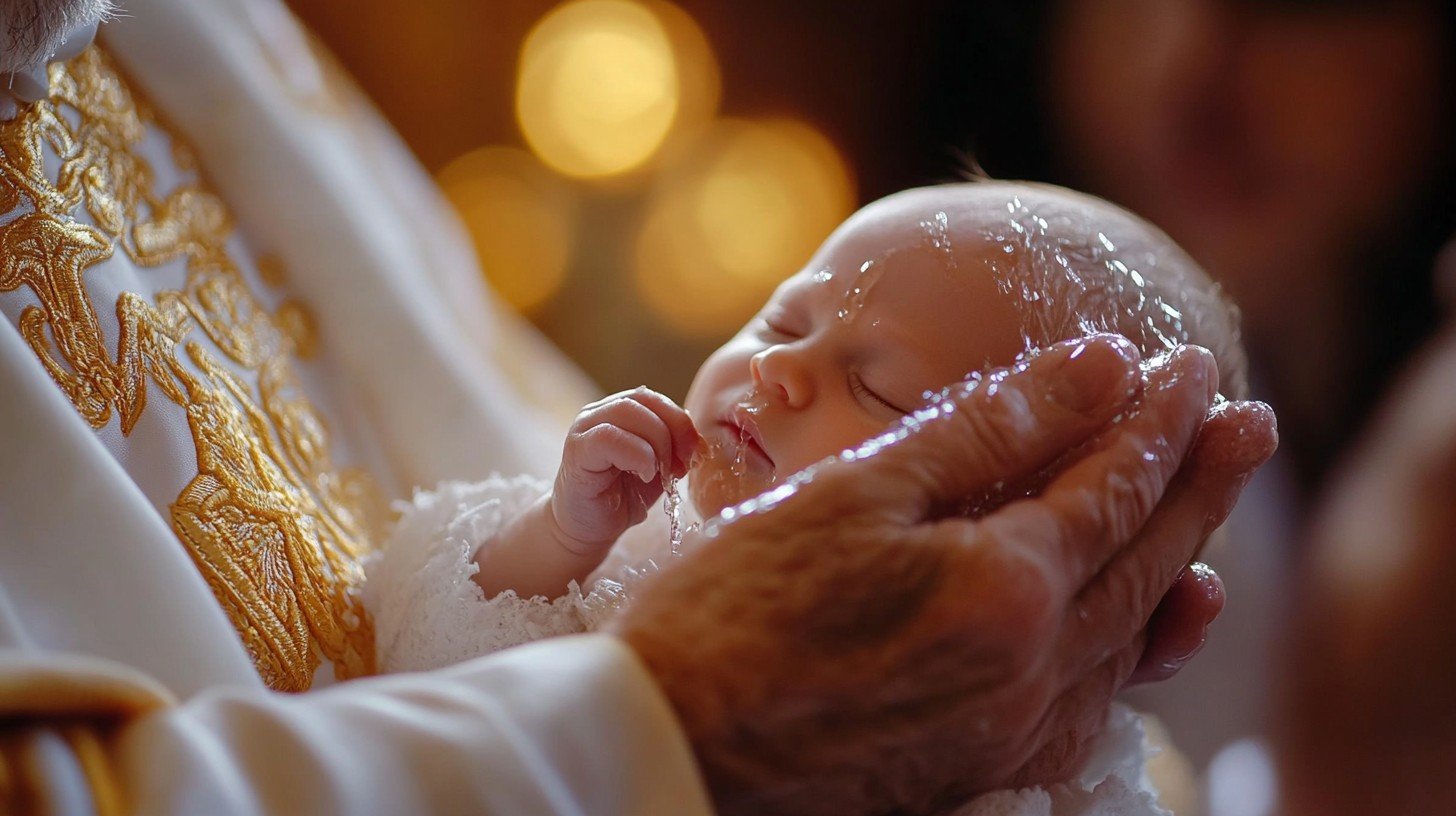
And today, we shall baptise [name] on the basis of [the child’s parent]’s faith. One day, [name] will have to decide for himself whether to follow Jesus.
So what does this faith look like? Well, it’s a lifetime commitment, but let me pick out two important elements from the story.
The first is belief:
Believe in the Lord Jesus, and you will be saved (verse 31)
What does it mean to ‘believe in the Lord Jesus’? It’s not simply that we believe he exists, although the historical evidence for that is extremely strong. No: we believe certain things about Jesus, and we then trust him with our lives.
We believe that Jesus is the Son of God, that he died for our sins, and that he rose again from the dead to give us new life.
Some people say that they think they are good people and that will get them into eternal life with God when they die. But none of us is good enough to meet God’s perfect standards. We all fall short. Those failures need to be forgiven.
And the thing about forgiveness is this: it hurts and it is costly. I think of a time when I was still living with my parents. A friend of mine had a broken engagement. He needed somewhere to stay while getting over it, and we invited him in. He stayed for two weeks. But he never helped with anything around the house. He seemed to expect my Mum to cook for him and do his washing. When he left, he didn’t offer any money towards all that my parents had shelled out while he was with us.
Image courtesy Picryl. Public Domain.
We had a family conference about this. I’ll never forget my Dad’s words. “We’ll put this down to God’s account.” To forgive my friend involved my parents absorbing that debt. It cost them.
Similarly, Jesus dying on the Cross shows us that it cost God to forgive our sins.
So I invite you this morning to realise that is the cost God has paid for you to be forgiven. Will you believe it? And will you then trust Jesus with your life?
The second thing that faith involves is action:
At that hour of the night the jailer took them and washed their wounds; then immediately he and all his household were baptized.
The jailer brought them into his house and set a meal before them; he was filled with joy because he had come to believe in God—he and his whole household. (Verses 33-34)
The jailer does engage in good deeds, but they are not what earn him salvation. Instead, his action is a matter of gratitude.
We are so grateful that God has loved us so much it has cost him the death of his Son, that we respond. And we do so by putting our faith into action.
Yes, that gratitude is certainly shown in worship, but it is also shown in the world. The jailer tends to the wounds of Paul and Silas, who had been beaten and flogged before they were thrown into prison (verses 22-24).
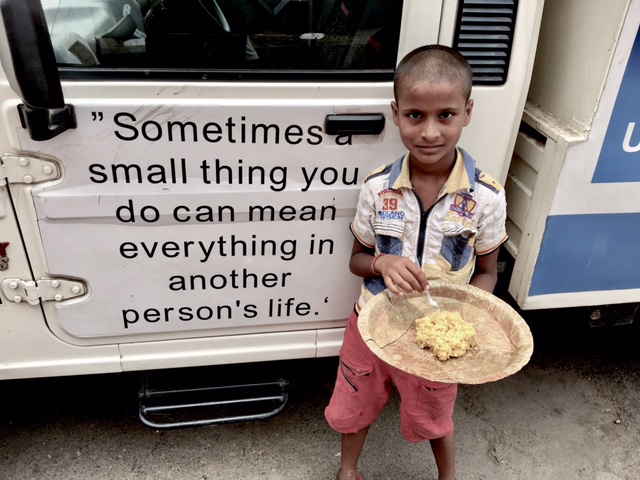
Food drive for homeless. Wikimedia Commons. CC 4.0
So if we are grateful for all that God has done for us in Jesus, who are the wounded people we can serve and show his love? Perhaps we can think of this a little bit like the idea today of ‘paying it forward.’ Where and how can I pay it forward, because God has shown so much love to me?
The jailer didn’t have to look too far and neither do we. You will have a neighbour who needs some practical help. You will find organisations where you live that that work and campaign on behalf of those in the most desperate need, either in this country or abroad.
Conclusion
This is the faith into which we baptise [name] this morning. One that urges him to believe that Jesus died for his sins, and to trust his life to him. One that shows gratitude for God’s love in our actions, especially in the service of those in most need.
But do you know what will make the most sense of this faith to [name]? It will be when those of us in the church and in his family live out that faith ourselves before his eyes.
These last couple of weeks I have been struggling to shake off a sinusitis bug I have had since just after Christmas, and I’m afraid the consequent sinus headaches have made sermon preparation difficult. Hence, this week I’m repeating a sermon from – oh my – fifteen years ago. The original text is here.
So here it is, the reading most people would have expected as the big one in this series on mission. It’s the passage often called ‘The Great Commission.’
These are the verses responsible for many Christians being called to become missionaries or evangelists. And maybe because of that, a lot of us can feel it isn’t for us. We like to lift the end of verse 20,
And surely I am with you always, to the very end of the age
and draw comfort from it, but the earlier stuff, we think, is for others.
But that won’t work. Jesus is addressing the same people throughout. In fact, this teaching is for all Christians. Why do I say that? Two reasons. Firstly, this is the incident that many scholars think the Apostle Paul was referring to in 1 Corinthians 15:6, when talking about the resurrection of Jesus:
After that, he appeared to more than five hundred of the brothers and sisters at the same time, most of whom are still living, though some have fallen asleep.
How many? ‘More than five hundred.’ So it wasn’t just the apostles.
My second reason comes more explicitly from the reading, and it’s found in verse 17:
When they saw him, they worshipped him; but some doubted.
In among the worshippers were the doubters. Whether their faith was strong or weak, Jesus included them in the call.
And as an aside, doubt isn’t the same as unbelief. Doubt means we are still in two minds but could still land on the side of faith. Unbelief is an outright rejection of faith.
Jesus’ call, then, is for all of his followers. Not just the leaders. And not just those with a strong faith. All of us.
Our question, then, is this: if Jesus is commissioning every Christian here, what is he asking of us?
Some would say there are four commands here: go, make disciples, baptise, and teach. However, it’s not as flat as that in the Greek, which is more like ‘Going, make disciples, baptising, teaching.’ In other words, the main command here is ‘make disciples’, and we make disciples by going, baptising, and teaching.
Hence, it’s a three-point sermon, all about how we are all called to make disciples. Make disciples by going; make disciples by baptising; make disciples by teaching.
Firstly, make disciples by going:
When Jesus tells us that making disciples will involve going, does this mean we all need to go abroad as missionaries? After all, the disciples are going to made from ‘all nations’, Jesus says.
Well, it does mean that for some Christians. Whatever the faults of the missionary movement, we should never throw out the idea that Christianity is a worldwide movement. And it also means we need to welcome missionaries here from nations where the faith is growing. They could reinvigorate us.
But most Christians aren’t called to go abroad, although we might easily be called to move somewhere else in general terms. If we accept that employers can move our jobs, why should we not think that God can call us to a new place to serve him?
Yet generally we will remain where we are. The word for most of us is what Paul tells the Corinthian Christians about their social status:
Brothers and sisters, each person, as responsible to God, should remain in the situation they were in when God called them. (1 Corinthians 7:24)
So how do we go? Most of us go in Christian mission by getting out of our comfortable places to show the love of God on territory where those who are not yet followers of Jesus feel at ease.
We need to ditch the idea that our mission happens on church premises. Maybe a few people will come to events and services that we host here, and perhaps the carol service is our best opportunity, but we must be realistic that fewer and fewer people feel comfortable – even safe – in a church building, and therefore it is our responsibility in the cause of the Gospel to go where they feel happy.
I suspect one of the reasons we have held onto church-based mission is that we are afraid of showing Jesus elsewhere. We end up making all sorts of excuses: a popular one I’ve heard in the Methodist church is that the groups which hire our premises are mission contacts. But they generally hire our halls as a commercial transaction: we have the facilities and a good price. By no means does it necessarily indicate spiritual openness.
Let’s see our going out into the world beyond our own private boundaries as a going with the presence of Christ to live out his way in those places where he calls us. For some, it will be a workplace. For others, it will be a social group like the U3A. Another place will be community groups that we are involved in. Many of us will go in mission in this way when we meet non-Christian relatives and friends.
In all these places Jesus calls us to live as his disciples, to radiate Christlikeness, such that our lives are an invitation or even a provocative question to others. We don’t need to harangue the people we meet, but we do need to be ready to speak about Jesus at an appropriate time.
Secondly, make disciples by baptising:
Here’s where we need to let go of all the sentimental and superstitious detritus that has clung to infant baptism. There is a place for infant baptism, because it arose in the early church when the first generation of Christians wondered about the spiritual status of their children, and they began to regard baptism rather like the way the Jewish faith sees circumcision for boys.
But all the social and superstitious accretions, like the need to be baptised as a baby if you are to have a church wedding in adulthood, or the thought that the unbaptised can’t go to heaven (which falls down the moment you think about the penitent thief on the cross) has obscured the relationship between baptism and discipleship. Baptism, says Jesus, is in the name of God, and the name of God is ‘Father, Son, and Holy Spirit.’
We are one of the Christian traditions that calls baptism a ‘sacrament’, and that’s worth thinking about. Now you hear certain definitions of sacrament as being ‘an outward and visible sign of an inward and spiritual grace’ and those are fine, but why the word ‘sacrament’? It comes from the Latin ‘sacramentum’, which was the oath of allegiance that Roman soldiers took to the Emperor. The sacraments are the Christian’s oaths of allegiance. Baptism is the initial oath of allegiance, Holy Communion is the ongoing one.
And that helps us see why baptism is linked to mission. It is the initiation ceremony where someone makes their oath of allegiance to God and his kingdom. It is a radical commitment to which we are calling people. None of this ‘Make a decision for Christ and then wait for heaven’: the early church called people to confess that Jesus was Lord, the very title the Emperor claimed for himself as a sign of divinity. In other words, it was a call to repudiate the powers that be, because confessing Jesus as Lord also meant that Caesar wasn’t Lord.
If we reduce baptism to ‘wetting the baby’s head’, we miss its fundamental message: that the Christian Gospel calls people to confess that Jesus is in charge of their lives and commands their ultimate loyalty, not the idols of our day, be they politics, technology, money, sexuality, or anything else.
This is where we have to be careful in all our talk today about inclusivity, much of which we pinch from the world rather than Jesus. Yes, Jesus wants us to invite all people, but when he welcomed people, such as the ‘tax collectors and sinners’, he did so with a view to calling them to leave behind their lives of sin and follow him.[1] Baptism should remind us of this.
Thirdly, make disciples by teaching:
Our three points are actually in a chronological sequence. Our discipling begins with going in order to reach people, it continues when they make a commitment with the oath of allegiance to Jesus at baptism, and finally the follow-up is our third point: teaching.
We need to get out of our heads the idea that teaching is filling our heads with facts and no more. It’s much more. Teaching involves getting people to learn things that they then apply in life. That is certainly true here in what Jesus says:
and teaching them to obey everything I have commanded you. (Verse 20a)
Someone who comes to faith in Christ needs to learn how to live the Christian life. In truth, we all need to learn that: to be a disciple of Jesus is to be a lifelong learner.
How does it happen? Only partly from the front on Sunday morning! I hope the sermons do some of the work of explaining what living the Christian life involves, but they are not the whole process. However much ministers should have a teaching gift, the sermon is only the start.
Small groups are a vital part of it. Bible study and fellowship groups are meant to be places where we reflect all the more on the teaching of Jesus, how we are going to put it into practice, and also to be accountable to one another about how we are living out what we have already learned. This is what Wesley did with some of his small groups in the Evangelical Revival in the eighteenth century. A church that is short on small groups, or where the small groups don’t get to grips with what it means to live as a disciple, are seriously lacking.
In one of my previous churches, we asked all the preachers to bring discussion questions based on their sermons so that the small groups could work on putting into practice. It did go a little awry in one group where an elderly man decided this was his opportunity to tear every preacher to pieces – it’s the old gag, ‘What’s the favourite Sunday dinner in a church household?’ Answer: ‘Roast preacher.’ But mostly the groups who stuck to the programme benefitted from it.
One-to-ones can help, too. Matching people together so that a more experienced Christian can nurture and mentor someone younger in the faith is valuable. I gained a lot in my early years as a Christian from the person I described as my ‘spiritual elder brother.’
I hope you can see from these examples that while the minister certainly plays a part in teaching the faith, it is an exercise for the whole church. We do not have to be theological specialists in order to help teach people how to live out the teaching of Jesus. At heart, we just need to love Jesus, want to go his way, and be willing to share our experience of that with others.
In conclusion, Jesus gives us a sequence here for our task as disciple-makers. We begin by going out of our comfort zones to live for Christ in front of the world. We call people not simply to receive the blessings of forgiveness, but to make the baptismal oath of allegiance to Jesus as Lord over all. And then we build relationships with people in the church family where we share our learning how to follow the teaching of Jesus.
It’s straightforward to describe, but we may feel nervous about putting it into practice. And I think that’s why Jesus’ final words here are
And surely I am with you always, to the very end of the age. (Verse 20b)
These are not just general words of comfort, good as they are for that. These words are Jesus’ promise that he hasn’t sent us out on the challenging task of mission on our own. Where we go, he goes. And usually, he’s even gone there ahead of us. We can count on that as we seek to make more disciples.
A favourite story I like to tell about the birth of our son concerns the first time we took him as a baby to one of the churches I was serving. One man looked at him, then looked at me, and said: “Don’t you ever bring a paternity suit against your wife over this lad, because the judge will take one look at him, then one look at you, and laugh the case out of court.”
Even now, seventeen years later, you can see the physical resemblance. You would do all the more if you’d known me at that age. We may have different colour hair, but his hair colour comes through from my father’s side of my family. He is a mathematician, as I was. He is blue-eyed, like me. He is left-handed, as I am – albeit that he is more like my father, who was a relatively ambidextrous left-hander, whereas I am much more left-handed. Like my father, he has an excellent sense of direction and is extremely good at navigating with maps.
But he won’t make his way in life based on whose son and grandson he is. That will depend more on how he uses his gifts, talents, and opportunities.
And John the Baptist is trying to get over something similar to his hearers in our passage today. He tells people who claim they are the offspring of Abraham that they are more like the offspring of snakes. You can have all the religious heritage you like, he says, but it counts for nothing if you’re not living a transformed life. Being raised in the Jewish faith won’t count for anything on its own. Being baptised won’t mean diddly-squat unless your life changes. (Verses 7-9)
It’s something that is painfully relevant to some of the pastoral conversations I have when I first meet people in Methodist churches. It’s not uncommon for people to tell me how they’ve been a Methodist for decades, maybe all their lives.
And I wonder, why is that the first thing they want to tell me about themselves? Because it won’t count for anything with Jesus – unless, of course, they are faithfully living according to the life-changing teaching and spiritual experience that John Wesley underwent and then taught to others.
So you were baptised a Methodist? Well, big deal. Actually, nobody is baptised a Methodist, they are baptised into the Christian faith.
But if you were brought to church as an infant and a minister poured water on your head in the name of the Father, the Son, and the Holy Spirit, then it doesn’t matter one bit that the Methodist Church says that any administration of water in the name of the Trinity is a valid baptism, because John the Baptist says that baptism only matters if you go on to lead a baptised life.
So enough of all this claiming of a religious heritage as if it’s a ticket to heaven. It’s nothing of the sort. Presenting your baptism certificate will not work in the way that showing your passport does at Immigration Control in a new country. All that God accepts as the passport to glory is a life of repentance and faith, a baptised life more than a baptised body.
If you want to come to a minister and start telling us that you’ve been a Methodist for fifty years, then make sure you’re actually living as a Methodist in the sense John Wesley taught. Make sure that you come to God not dependent on your own good works, but by faith in Jesus who died for you. Be thankful for his forgiveness and show it by your love for God and for other people. After all, Wesley was fond of quoting from Galatians: ‘The only thing that counts is faith working through love.’ Seek a constant renewing and reordering of your life, joining a small group of other Christians where you each hold one another accountable. Be generous and have a concern for the poor. Share your faith with others.
If you think that’s a bit strong, look at what John the Baptist required of the people who came to him for baptism. They were to share with the poor, not cheat, be truthful, and avoid greed. That wouldn’t be a bad starting place today, either! (Verses 10-14)
And if that’s the sort of person you are, then I’m highly likely to believe that you’re a traditional Methodist! That would show the kind of spiritual DNA that Wesley wanted to see replicated in people.
But if all you can do is wave a baptism certificate or produce your latest membership ticket with a flourish, well, John Wesley would have had harsh words for you and so too would John the Baptist. Both of them would have warned you about the judgement that Jesus will bring.
And so John talks about how Jesus the Messiah will come to baptise with the Holy Spirit and fire – with fire being an image of judgement. He talks about how he will separate the wheat into the barn but burn up the chaff with unquenchable fire. It’s a challenging and powerful description of Jesus. (Verses 15-17)
Of course, some people won’t have it. They will say, that can’t be Jesus, he was all about telling us to love one another. Well he was about teaching us to love, but he also had strong words for those who would not love. He had particularly harsh words for those who used their religion for their own power or to put others down. Jesus was absolutely clear in his teaching that if you claim to be a disciple of his, then it needs to be seen in the way you live.
So all the people who call him ‘Lord, Lord’ but don’t do his bidding will have a shock. All the people who can’t be bothered to be prepared for his coming like the five foolish virgins in the parable will find that their future is not what they complacently assumed.
I have to ask myself, how am I preparing for the coming of Jesus? Not in the sense of, have I bought all the presents I should for Christmas, but in the sense of, am I adjusting my life to make it more fit for the arrival of the One who is King of Kings and Lord of Lords?
Do you ask yourself the same sort of question? Because we all need to do so.
This is why historically Advent has not been a time for feasting on mince pies but rather a season of penitence, like Lent. Preparing for the coming of the Messiah is a challenging matter.
But Jesus does come with the Holy Spirit. We are not left with only our own feeble power to alter our lives. When Jesus challenges us, he also provides the strength we need to make those changes. And we find that ability and energy in the gift of the Holy Spirit.
I want to conclude by saying that all week the ending of the reading has puzzled me.
18 And with many other words John exhorted the people and proclaimed the good news to them.
Good news? It doesn’t much sound like good news, does it, all this fire and brimstone preaching?
But it is good news. It is good news in the ancient sense, in the way the term ‘good news’ would have been used in the Roman Empire. When a Roman herald arrived in a place and said he was going to proclaim good news, it would be the announcement that there was a new Emperor, or that the armies of Rome had won a great battle against an enemy.
In that respect this is good news. It is the news that the kingdom of God is arriving in the person of the King himself, Jesus. It will later become the news that the king himself has won the greatest battle of all on the Cross against all the forces of evil. And it is the good news that in the reign of King Jesus he brings love, justice, reconciliation, harmony, healing, and much more.
Therefore when we are challenged to repent and to reorder our lives, the call is to bring our lives into step with the kingdom of God – that is, to be loving, to pursue justice, to work for reconciliation, to bring harmony, to exercise healing, and so on.
If we are to prepare for the coming of Christ, then this is the kind of life to which we are called.
My ordination service was memorable for all the wrong reasons. For one thing, I never experienced the spiritual exhilaration that others report, only a sense that at last I was no longer under suspicion from the church authorities.
For another, my sister and brother-in-law weren’t there. They had been invited, they had booked into an hôtel, and they had ordered a buffet there afterwards for a family celebration. But there was no sign of them.
You have to understand that this was in a time when few people had mobile phones. So my father went outside to look for them. When they didn’t arrive for the service, we decided afterwards to find a phone box. Then we discovered that they had been to a wedding the day before, and my sister had suffered a fish bone getting stuck in her throat at the wedding breakfast. They had tried to get a message to me, but it hadn’t got through.
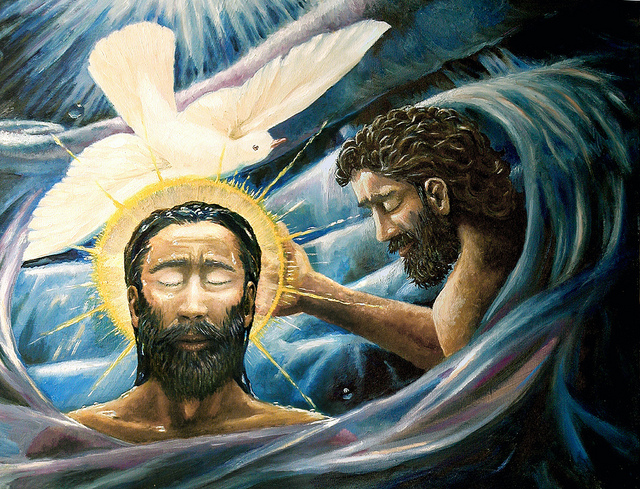
I have often viewed the baptism of Jesus as his ordination service. Here is the public confirmation and commissioning of the ministry to which he had been called since before the beginning of human history.
And like our ordination services, the place of the Holy Spirit is significant here. At an ordination, we often sing the ancient hymn ‘Veni Sancte Spiritus’ (‘Come, Holy Spirit’) and we lay hands on the ordinands, praying that the Holy Spirit will equip them for their calling.
So in this talk, I want to reflect on what the descent of the Holy Spirit on Jesus tells us about the public ministry he is about to begin.
10 Just as Jesus was coming up out of the water, he saw heaven being torn open and the Spirit descending on him like a dove. 11 And a voice came from heaven: ‘You are my Son, whom I love; with you I am well pleased.’
These words are loaded with scriptural resonances from elsewhere, and when we realise that their significance for the ministry of Jesus will become apparent.
Firstly, Jesus ‘saw heaven being torn open’ (verse 10).
When heaven is opened in the Scriptures, it usually means God is about to reveal his glory and his will. Ezekiel’s inaugural vision that makes him a prophet begins when ‘the heavens were opened and [he] saw visions of God’[i]. Stephen the martyr, on trial for his life and facing stoning, saw ‘heaven open and the Son of Man standing at the right hand of God.’[ii] The revelation Simon Peter receives to mix with Gentiles and ultimately proclaim the Gospel to them begins in a trance when he sees ‘heaven opened’[iii]. There are at least eight examples in the Book of Revelation itself[iv]. And so on.
Therefore in this incident the Father is telling Jesus that something important is about to be communicated.
We may think that such spiritual experiences are rare, unusual, or even non-existent for us. However, there are occasional times when we are conscious that the presence of God is close or even virtually tangible. It does not feel like the sky has a ceiling and our prayers bounce back down to us without reaching heaven. We have those times when we know the lines of communication are clear.
If we do, then this passage tells us to pay attention. God may be opening heaven to say something important to us, or to do something important with us.
I wonder whether we stand to attention at such times?
Secondly, Jesus saw ‘the Spirit descending on him’ (verse 10). This has echoes of the creation story in Genesis 1, where ‘the Spirit of God was hovering over the waters’[v] before the six days of creation begin.
So here too God is about to begin a work of creation. Except creation already exists! With Jesus he begins the work of the new creation. Through Jesus all things will be made new.
This shows us that Jesus is way bigger and more important than the ways in which we often treat him. For all our confessions of him as Son of God and Saviour, there are too many times when we treat Jesus as if he were someone who helps us to improve our lives, or who mentors us in good ways of living. We treat life with Jesus as some kind of deluxe addition to life.
But that is not why Jesus came, it is not why he ministered, and he will not have it. Jesus came that we might say goodbye to all that is old, decaying, and twisted due to sin and instead to welcome in a world where not only are we individually made new in our lives, but that all creation will be made new. Even our bodies will be made new at the Resurrection.
Following Jesus is not like buying a new car, where we look at the specifications and say, I’ll add on some extra features, like a parking camera to help my reversing, and a heated driver’s seat to keep me comfortable.
No: the ministry of Jesus is one where our old life is put in the grave and we are raised to a completely new life. It is one where we look forward to the old world going and living in the new heavens and new earth.
To welcome Jesus into our lives, then, requires that we are willing to sing the words to the old chorus ‘Spirit of the living God’: ‘Break me, melt me, mould me, fill me.’ When we allow him to do that in our lives, he will make us new and make his world new.
Thirdly, Jesus saw ‘the Spirit descending on him like a dove’ (verse 10, italics mine).
That the Spirit descends like a dove takes our last thought further. The most obvious biblical precedent here is of Noah using a dove to find out whether the flood waters had receded[vi].
This is an indication, then, that as Jesus comes to make his new creation, he does so as One who rolls back the damage of the past, and who shows that the judgment of God no longer pertains to all who own the name of Christ. Yes, ‘Break me, melt me, mould me, fill me’ can be challenging, disconcerting, and disturbing, but Jesus also comes as the gentle One who restores where we have been broken by the actions of others and who tells us that no longer have to live under our past, because through him God has offered us forgiveness.
If you are already broken, let Jesus put you back together in a new and beautiful way. Maybe you think that the brokenness will still show. Maybe in this life it will, but don’t let that daunt you. After all, the risen Jesus showed his scars to the disciples.
Think if you will about the Japanese art of kintsugi. This is the practice of putting broken pottery pieces back together with gold. Even the flaws and imperfections are beautified, to make a more attractive piece of art. See that as a picture of what Jesus wants to do in your life. Why not invite him to do his work of restoration in you?
Fourthly and finally, verse 11:
And a voice came from heaven: ‘You are my Son, whom I love; with you I am well pleased.’
The first thing that has always struck me here is that the Father proclaims his delight in his Son before he has even begun his ministry. It is a powerful statement of unconditional love.
But if we want to dig into the biblical background here, then the obvious stopping-off point is the so-called Servant Songs in the Book of Isaiah, especially the first of those songs[vii]. It begins with the words,
‘Here is my servant, whom I uphold, my chosen one in whom I delight; I will put my Spirit on him, and he will bring justice to the nations.’ (Verse 1)
The main difference is that whereas in Isaiah the designation ‘servant’ is used, here in Mark it’s ‘Son’. We draw the conclusion that God’s own Son came as the Servant of the Lord. The Son of God is the Servant.
Later in Mark Jesus will tell his disciples that servanthood rather than status is what matters in the kingdom of God, and that even the Son of Man came not to be served but to serve, and to give his life as a ransom for many[viii].
But it’s established right here at the beginning of the Gospel that Jesus will carry out his ministry of salvation in the form of a servant. The Son of God will bring in the new creation and all heal the broken not in the way that many assume an Almighty God will do, with force and irresistible energy, but by treading the path of servanthood.
And so he comes to serve – not in the sense that he waits on our every indulgence but that he provides our every need and he knows that the only cure for the wounds of he world lies at the Cross.
When we receive that, he then enlists us to serve him by serving others that they may see through us the nature of God’s transforming love. That is what Jesus is ordained to do. This is what all his followers, reverends or otherwise, are all ordained to do as well.
The Advent and Christmas rush means I’ve missed posting several sermons lately. Hopefully, I’ll post them soon, even though they will be rather ‘after the event’. At least they will be present here then nearer next December for those who search this blog and others for relevant sermons.
In the meantime, here is a sermon for this coming Sunday, when we mark the baptism of Jesus.
Baptism Of Christ 10 by Waiting For The Word on Flickr. Some rights reserved.
If you follow the movies, you may have noticed that in recent months Hollywood has had a bit of a religious obsession. Much of it has been poor, or at least contentious. God’s Not Dead caricatured atheists, Left Behind took up some dubious fundamentalist theories of the end times based on a questionable series of Christian pulp fiction novels, and Noah divided opinion.
Now Ridley Scott’s Exodus: Gods And Kings has caused a stir. Not just because any such film is bound to provoke polarised opinions (and that’s just in the church!), but because Scott engaged famous white actors to play dark-skinned Egyptians so as to generate box office income. And that’s before we get to the controversies about whether the script took liberties with history and scholarship.
But Hollywood hasn’t usually worried too much about the choice between truth and a juicy story. Coming from a family where my grandmother was a friend of Gladys Aylward, I am only too aware how furious Aylward was with the fictional romance that was invented for the film about her life, The Inn Of The Sixth Happiness (never mind the dubious morals of Ingrid Bergman, who portrayed her).
Let me come back to Exodus, though. Because Mark’s account of John baptising people, including Jesus, has Exodus themes in it. I’ve said before in sermons that the Jewish people of Jesus’ day commonly regarded themselves as being in a kind of exile, even though they lived in their own Promised Land, because they were occupied by Rome. So they longed for freedom. And as well as a theme that was like the liberation from Babylon, the Gospels also contain the imagery of freedom from their original place of captivity, Egypt. The Good News that Mark is beginning to tell is couched at the beginning in Exodus language.
Our problem is that we are so used to hearing these stories in the light of more recent Christian debates and themes that we miss this. Perhaps we hear the baptism stories and start thinking about what we believe about baptism. Is it for infants, or is it for committed disciples?
But we need to return to the Exodus theme. ‘Exodus’ is a Greek word. It is usually taken to mean ‘departure’, and so the second book of the Old Testament narrates the departure from Egypt. ‘Exodus’ as a word is a compound of two other words – ‘ek’, meaning ‘out of’, and ‘hodos’, meaning ‘road’ or ‘way’. This is the road or way you take out of somewhere. It is the escape route that you follow. And so an Exodus theme is a freedom theme. It is about liberation and liberty. I want to explore the baptism of Jesus, then, and its implications for us, under this theme of ‘freedom’.
Firstly, the baptism itself. It’s implicit in Mark what is made more obvious in other Gospel writers, namely that John’s baptism is a baptism of repentance. Mark simply notes,
Confessing their sins, they were baptised by him in the River Jordan. (Verse 5b)
Exodus By Giorgio Raffaelli on Flickr. Some rights reserved.
It’s therefore strange that Jesus embraces John’s baptism. Why does he need to repent? Again, the other Gospel writers are more explicit about this problem, but Mark characteristically keeps his account brief. Jesus certainly identifies with the people. He is the One who will lead people out of slavery – not, in this case, the slavery of Israel in Egypt, but slavery to sin. As the Israelites came through the waters of the Red Sea (or Sea of Reeds) to freedom from Egypt and her powers, so Jesus leads his people through the cleansing waters of baptism to freedom from sin.
This is the good news of Jesus’ baptism: the Messiah has come to lead his people to freedom from sin. It begins with confession and forgiveness, but it becomes a whole pilgrimage from ‘Egypt’ to the ‘Promised Land’, as that initial setting free becomes a journey in which God leads us into freedom not only from the penalty of sin but also into increasing freedom from the practice of sin, until one day, in the New Creation, we shall be free from the presence of sin.
For Jesus, that journey will embrace what our baptism service calls ‘the deep waters of death’. His Red Sea will not only be the waters of the Jordan at John’s baptism, but Calvary and a tomb. But he will rise to new life and ascend to his Promised Land, promising that we will one day go with him at our own resurrection.
This is Good News that says to us, life doesn’t always have to be like this. It doesn’t have to remain a catalogue of remorse and failure. There is hope. We do not have to hate ourselves, because God loves us to the point of offering forgiveness and new life.
Thus begins our transforming journey, in a baptism that calls us out of Egypt and on the road of increasing freedom. It’s worth reminding ourselves of this from time to time.
One person who did that in his life was Martin Luther. He was a man prone to mood swings between elation and darkness. He could be the wittiest person alive, but he could also plumb the depths. But he said that whenever he was most tempted to doubt or to give up, he would remind himself of one fact: ‘I am baptised.’
I am not saying that baptism is some religious magic trick, but I am saying that to remember our baptism is to remember the promises of God to forgive our sins, and the power of God to change us and ultimately all creation, too. It is a sacrament of hope, as well as of beginnings.
Secondly, the Holy Spirit. On the one hand, John promises,
I baptise you with water, but he will baptise you with the Holy Spirit (verse 8)
And on the other, we read,
Just as Jesus was coming up out of the water, he saw heaven being torn open and the Spirit descending on him like a dove. (Verse 10)
Veni Sancte Spiritus by Fr Lawrence Lew, OP on Flickr. Some rights reserved.
What does this have to do with the Exodus freedom story? It’s about the manner of God’s presence.
I’m sure you will recall that when Israel was being led through the wilderness, it was by a pillar of cloud by day and a pillar of fire by night.
But now, in the New Covenant, God’s people get an upgrade. Not only will the presence of God (cloud and fire) lead them, now that same presence will come upon all of them and dwell within them. For you frequent flyers, they have effectively gone from economy class to business class.
In Jesus’ case, there is something else. The descent of the Spirit upon him shows that he is the Messiah, for Messiah means ‘Anointed One’. He is anointed, not with the oil used to mark an earthly monarch, but with the oil of God, the Holy Spirit.
And if Jesus the Messiah is anointed with the Holy Spirit and we receive the Spirit too, then that confirms our Christian identity – we are to be ‘little Christs’. No, we are not Messiahs, and heaven deliver us from any more people in the Church with Messiah complexes, but the upgrade to the indwelling Spirit equips us for our pilgrimage to freedom. It is the witness of the Holy Spirit that confirms we are forgiven and loved. It is the work of the Holy Spirit to lead us into increasing freedom from the practice of sin, thus making us more Christ-like. (Although we may more modestly feel it’s a case of becoming less un-Christ-like!)
We need not fear the gift of the Holy Spirit. He is the Spirit of freedom. ‘Where the Spirit of the Lord is, there is liberty,’ wrote the Apostle Paul. He brings God’s freedom to us, and empowers us then to be ministers of God’s freedom in the world. Through the Spirit’s work, we offer Christ and his liberating work to those in the chains of sin – the chains of their own sin, and the chains imposed by others upon them.
And not for us the limited distribution of the Holy Spirit in the Old Covenant. Now the Spirit is given not only to a select number of God’s people, he is given to women and men, young and old, privileged and poor – anyone who desires to follow Jesus the Messiah, the leader of freedom.
Those in higher church traditions than us have a liturgical symbol for this in the way the bishop applies anointing oil (‘chrism oil’) to the foreheads of candidates for confirmation. I came to like that tradition when I used to take part in ecumenical confirmation services with Anglicans, and concluded that we were missing out on that symbolism. I can offer something ad hoc, in that I possess a bottle of anointing oil, which has a beautiful smell of frankincense, and some people find it helpful to link the fragrant aroma of the oil with the presence of the Holy Spirit, who brings freedom.
…
Thirdly, the voice of God. The terrifying thunder from the mountain on the Exodus route now becomes the voice from heaven as Jesus comes up out of the water. Heaven is ‘torn open’, the Spirit descends like a dove (verse 10), and the voice from heaven speaks:
‘You are my Son, whom I love; with you I am well pleased.’ (verse 11)
Door To Heaven by Tragopodaros on Flickr. Some rights reserved.
Tom Wright says[1] that we should not see the opening of heaven as like a door ajar in the sky, because heaven in the Bible is rather the dimension of God’s reality that is invisible to us. So instead, this is like an invisible curtain being pulled back so that we see the whole of life in the light of this different reality. And in this case, when heaven opens the curtain into our life, we hear the divine voice that addressed Jesus addressing us, too: ‘You are my child, whom I love; with you I am well pleased.’
And certainly that is a totally different reality in which to live. Think about God addressing Jesus this way. Mark hasn’t recorded any virtuous acts by Jesus yet at all. His baptism is his first action in this Gospel, and even that is done to him. There is not even a reference to the humility of the Incarnation in Mark. What, then, has Jesus done to earn his Father’s pleasure here? Absolutely nothing. But he hears the voice of unconditional love. God loves him and is pleased with him.
Those of you who are parents, recall those times when you went into your children’s bedrooms at night when they were fast asleep. They might have delighted you that day, or they might have been utter pickles. But still you gazed at them and whispered words about how much you loved them. You had unconditional love for them.
So ask yourself this: is God angry with me, or does he love me? Can I really believe the Good News that God delights in me? This is the liberating news of our New Testament Exodus.
And that is a transforming insight. If God loves us like this, why do we not love ourselves? I don’t mean in a self-centred way. Rather, I mean something that the author Donald Miller has recently written about. In a booklet available online called Start Life Over, he lists five principles towards changing our lives for the better. The second of these is that – strange as it may sound – we are in a relationship with ourselves, so we should make it a healthy one.
What he says is this. To some extent, we all seek the approval of others, but what we don’t notice is how we seek our own approval. It is as if we are two people: one doing the actions of daily life, the other watching those actions in judgement. Miller noticed that a friend whom he deeply admired was always doing respectful things. And he wondered: if I start doing more respectful things, will I respect myself more, and thus change for the better? He writes,
And it worked. I would find myself wanting to eat a half gallon of ice cream while watching television and I asked myself “if you skipped this, would you have a little more respect for yourself?” and the truth is I would. So I skipped it. And I had much more self respect.
I liked myself more.
This sort of thing translated into a whole host of other areas of my life. I started holding my tongue a little more and found I respected myself more when I was more thoughtful in conversation. I found myself less willing to people please because, well, people who people please aren’t as respectable, right? (Page 9)
I suggest to you that this kind of transformation is open to us when we embark on our baptismal journey of freedom, in the power of the Holy Spirit, and hear God’s voice from heaven telling us we are loved unconditionally. It makes change possible.
So often, the way we seek to promote change in ourselves and in others is through threat. We are no carrot and all stick. But all that produces is fear and paralysis. We might see some change, but it is the change wrought by sleeplessness and night terrors, rather than love. Ultimately, it doesn’t achieve much, and it affects us badly as people.
God chooses the way of unconditional love to lead us into freedom.
There is only one time in my life when I have eaten at a Hilton Hotel. It was after my ordination service. Well, why not do things in style on an occasion like that?
Actually, the truth was more prosaic. We had pizzas in a lounge area. Two couples from my church had booked a cheap deal at the Leeds Hilton for the weekend of my ordination at the Methodist Conference, and they invited my parents and me back as a way of fixing something that had gone wrong. My sister and brother-in-law had booked into another hotel, but never turned up at the ordination service. Only later did we discover that my sister had been in A & E the previous day, having got a fish bone stuck in her throat. In those days, few people had mobile phones, so we weren’t able to discover what had happened until after the service, when we found a payphone.
So that is my abiding memory of my ordination – pizzas at the Leeds Hilton. Well, apart from a sense of relief that all the years of testing and suspicion from the church authorities were finally over.
You might expect a group of ministers to trade ordination stories, but why raise that subject in an ordinary sermon when the Church only ordains a few of her members?
Because we are all in some sense ‘ordained’ by God to minister in his name. We call it baptism. The baptism of Jesus, which we read about today, was effectively his ordination, his commissioning. And although we seem so far removed from Jesus’ unique status as the Son of God, there are sufficient similarities between the themes of his baptismal ordination and ours. In particular, let’s think about how Jesus’ baptism equips himself for the work of the kingdom, and therefore how God equips us.
The first theme is less obvious in Luke’s account of Jesus’ baptism than the other Gospels. It’s the theme of identification with sinners. Here in Luke, John lays out clearly that his baptism is a sign of repentance, and that it must be accompanied by a lifestyle that demonstrates such a turning away from sin. It’s therefore surprising that Jesus, who is universally presented in the New Testament as sinless, desires John’s baptism. The other Gospels record a conversation where John says to him, ‘It should be the other way round: you should baptise me.’ Jesus replies, ‘Let it be so to fulfil all righteousness.’ Luke omits that conversation, but still has Jesus undergoing a baptism of repentance, despite his sinlessness.
What are we to make of this? The classic Christian explanation down the centuries has been that Jesus received John’s baptism as a sign of identifying with sinful humanity. His baptism foreshadows the Cross, when he would die, representing sinful humankind as its substitute.
Jesus’ death for sinners was, of course, unique and unrepeatable. Unique, because only he as the sinless God-man could offer it, and unrepeatable because he accomplished everything at Calvary. So how could this be a model for us, when we can’t do that?
In a lesser way, is the answer. We too are called to identify with sinners. It shouldn’t be too difficult, because we are sinners ourselves! The temptation we have as forgiven sinners who are called to pursue a holy life is to lapse into a self-righteous attitude that looks down on others, disdains them and leads to us separating ourselves from them. It leads to situations where people think they shouldn’t attend a church, because they’re not good enough.
This has application for us, inside and outside the church. Inside the church, it affects the way we care and pray. There is more than one example in Scripture of people praying for the people of God, and not saying, ‘They have sinned,’ but ‘We have sinned.’ Daniel prays for God’s people that way, while in exile in Babylon, even though he was not responsible for the exile. He identifies with sinners in the family of God, rather than staying loftily above them. His prayer makes a difference.
Outside the church, identification with sinners is critical, too. It’s no wonder that the great Sri Lankan church leader, D T Niles, defined evangelism as ‘one beggar telling another beggar where to find bread’. The Gospel is of course urgent and essential, but as fellow sinners we need to remember that we are beggars, too. It’s just that we’ve found bread.
In every aspect of ministry, then, as Christians, both within and without the church, identification with sinners is an important principle enshrined here in Jesus’ baptism.
The second aspect of Jesus’ baptism that equips him for ministry is that he receives the Holy Spirit. So often we emphasise the fact that Jesus did what he did and said what he said because of who he was – the Second Person of the Trinity, the Son of God. If that is all we do, then we create an understanding of Jesus that says, he had an unique status which enabled him to do certain things, but we don’t have that standing and therefore we can’t begin to approach doing any of the things he did.
But look what happens here. While he is praying, heaven is opened (verse 21) and the Holy Spirit descends on him in bodily form like a dove (verse 22). Only after this does his ministry proper begin. Sure, there have been signs of what is to come with the incident in the Temple when he was twelve (2:41-52), because Jesus knows who he is, but the actual ministry of good news to the poor and broken only starts after this incident. Next, the Holy Spirit will eject him into the wilderness to fast and face temptation. Then he will announce his work in the Nazareth synagogue by reading Isaiah 61, beginning with the words, ‘The Spirit of the Sovereign Lord is upon me’. Following that, he will conduct his ministry in the power of the Holy Spirit.
So whatever the difference between Jesus and us because he is the Second Person of the Trinity, eternally begotten of the Father, there is a strong connection between his ministry and ours. Jesus, for all his divine status, could not and did not begin his ministry until he had been empowered by the Holy Spirit. Jesus, the Son of God, conducted his ministry as a man in the power of the Spirit.
Exactly our call, in other words.
I find it significant that Jesus receives the Spirit while he ‘was praying’ (verse 21). As one American United Methodist minister puts it, ‘being on your knees can help you walk on air.’[1] He goes on to say:
The life and health of a church are directly proportional to the prayer life of the congregation. The praying church is the healthiest church. When parishioners spend time in prayer, they are a more compassionate and happier people. Their spirit permeates the congregation. When people spend time in communion with God, the sweetness of the Holy Spirit radiates throughout the church.[2]
Perhaps it’s no coincidence that the early Pentecostals sought what they called ‘the baptism in the Holy Spirit’ at ‘tarrying meetings’ – that is, meetings where they waited prayerfully upon God. While the gift of the Spirit is a gift of grace, and I also do not want to suggest that the Spirit is absent from us, I think it is also true that the Spirit is more manifest among those who show the greatest seriousness and passion to receive and depend upon him. Too often we operate on auto-pilot, earning the old barb that ‘if the Holy Spirit were withdrawn from the church, ninety five per cent of activities would continue just the same as before.’ Jesus didn’t operate that way. He challenges us to be prayerfully dependent upon the Spirit.
The third and final aspect of Jesus’ baptism that equips him for ministry is an affirmation of who he is. Listen to what the voice from heaven says to him:
‘You are my Son, the Beloved; with you I am well pleased.’ (Verse 22)
Both the theological colleges I attended had weekly communion services. Often we had well-known guest preachers. Yet I only remember one sermon from each college. From my time in Manchester I remember Trevor Huddleston preaching on words from Romans 12, ‘Hate what is evil.’ From my time in Bristol I remember Tom Smail preaching on … the baptism of Christ.
He came to us at around May one year, just before the end of year exams, when many of the student body were fraught over revision or leaving college and beginning ministry. He was one of the few who did not treat the congregation in the chapel as a bunch of soon-to-be-clergy; rather, he majored on this verse: ‘You are my Son, the Beloved; with you I am well pleased.’
And what he said about it was so healing I remember it to this day. He talked about being loved unconditionally by the Father as a child of God. There was no better message for a stressed group of people. You are loved. Period. It is the grace of God. You have been adopted into his family out of sheer grace. Jesus had not even begun his ministry here, but already the Father was ‘well pleased’ with him. The costliest acts of Jesus’ obedience were still to come, but here the Father is already ‘well pleased’ with him. He embarks onto his public ministry affirmed in his identity as the Son of God, who is loved by his Father and pleasing to him.
Now translate that into our lives. Could it be that God says something similar to us, and that it is the foundation of healthy ministry. If you know you are a child of God, you have an identity that will sustain you when people attack you or manipulate you, as surely they will. If you know you are loved unconditionally by the God of boundless grace, you will not measure your acceptability to that God on the basis of your performance. So if something goes well, all the glory goes to him. If you are judged a failure, by yourself or others, that makes no change to the love the Father lavishes on you.
Our security as Christians is not in our achievements or our popularity: both will wax and wane and are not to be trusted as accurate measures of our discipleship. No: our security as we launch out to serve God in Christ is in the fact that we have been adopted by the Father into his family as his beloved children, and his grace means he is pleased with us before we ever do anything for him. The call to identify with sinners is a challenging one; so is the call to depend prayerfully upon the Holy Spirit. But the security to walk this way is in the unconditional love of the Father.
Many of us will have heard all sorts of stories about baptism. A friend of mine, when he was an Anglican curate, really did baptise the wrong end of a baby! Me, I just worry about the baby grabbing the radio microphone – or, worse, my glasses. Or there’s the story of the minister telling the congregation before a baptism, “The water isn’t anything special or magic, it’s the same water we’ll use later for making the coffee.”
But what, in all seriousness, shall we say about baptism today on Holly’s big day? Early in the baptismal service, I read two passages from the New Testament. The second was from Acts chapter 2. I prefaced it with these words:
‘On the day of Pentecost, Peter preached the Gospel of Christ’s resurrection. Those who heard the message asked what they should do. Peter told them:’ (Methodist Worship Book, p89)
And then I read what he said:
‘Repent, and be baptized every one of you in the name of Jesus Christ so that your sins may be forgiven; and you will receive the gift of the Holy Spirit. For the promise is for you, for your children, and for all who are far away, everyone whom the Lord our God calls to him.’ (Acts 2:38-39)
I want to say this is all about anticipating the future. We anticipate future events. For example, later in the year we shall be conscious that Christmas is coming, and will make our plans. We shall ask people what presents they would like, buy special food, make arrangements to see family and so on – all because we are anticipating a future event. We want to get ready.
When Peter preaches ‘the Gospel of Christ’s resurrection’ he’s using that to make people think of the future. The resurrection of Jesus is a sign of the future, when God will raise everyone from the dead and he will reign unopposed over all creation. And what Peter calls his hearers to do is anticipate that future. In what ways?
Repent
Last Sunday morning I asked people how good their French was. It’s similar with the word ‘repent’. ‘Re’ means ‘again’ and ‘pent’ is from penser, ‘to think’ – like our word ‘pensive’. So to repent is to think again, and that’s what the New Testament Greek word translated here means, too. When Peter calls the crowd to repent, he’s telling them ‘think again’ – about the way you live your life, and change where needed.
I used to preach at a church that was on the ‘wrong’ side of a dual carriageway from the direction in which I lived. Every time I took a service there, I drove beyond it on my side of the road, to the next traffic light junction, where drivers were permitted to do a u-turn from the filter lane.
Repentance is like a u-turn. When we encounter Jesus, he makes us think again about the way we live our lives, and we do a u-turn in our lifestyle.
What does that have to do with anticipating the future? I think the point is this: when God raises us all from the dead, judges us and reigns without opposition, we need to be in line with his will. We need to start now – by doing a u-turn.
Be Baptized
Last month, every class from Broomfield Primary School came here during the week to look at our building and ask me questions. One of the things I showed them was the font. They were intrigued by our small, portable font, in contrast to the large stone font at St Mary’s.
We talked about what it meant. They knew we put water in the font, but not necessarily why. So I asked them what we use water for in everyday life. Some said for drinking, and I could have made something of that answer. But I concentrated on those who said that water was for cleaning ourselves. I tried to explain that the water in baptism is a symbol of God cleaning us from sin.
That’s what the symbolism of pouring water on Holly has been about today. It has been to show that God wants to clean us from every sin. Have you ever felt dirty inside after doing something wrong? God wants to remove that from us.
And it’s done, says Peter, ‘in the name of Jesus’, because these gifts come to us from God through Jesus, and especially his death on the Cross, where he died for our sins, in our place. That’s why we need faith in Jesus – to receive this cleansing from all our sins that are a barrier between ourselves and God.
What does this have to do with the future? It means that at the Last Judgment, God will – amazingly –deliver a verdict not that we are guilty but that we are in the right with him, all through Jesus.
And that leads onto the third element:
Forgiveness
I guess everybody knows that the central message of the Christian faith is about forgiveness. But what is forgiveness? Some people think it is pretending that a bad event didn’t happen. Others think it means excusing people’s actions, by explaining away their conduct. Others think it is about suppressing our anger when we have been wronged.
I don’t think it’s any of these things. True forgiveness looks the person in the wrong squarely in the eye, knowing where the blame lies, not excusing their actions, nor pretending we are not angry. But then, despite laying the blame where it rightly belongs, the one who forgives refuses to pass sentence on the wrongdoer.
And that is what God does for us in Jesus. He knows our actions are wrong, and he doesn’t pretend otherwise. He knows we are blameworthy, but he refuses to sentence us to what we deserve, which is life and eternity without him. He discards the sentence and invites us into his family, which we do but handing our lives over to him.
Again, this is about anticipating the future. Trust your life to Jesus Christ and follow him, and you need have no fear of God’s verdict on you, either now or in the future. He knows where we are in the wrong, but he refuses to pass sentence. In fact, the Greek word used for ‘forgive’ in the New Testament means ‘to set free’. We are like prisoners, expecting to be sentenced for our crimes. But instead, the Judge sets us free by forgiving us.
Our call, then, is to receive that by giving ourselves over to Jesus Christ, and then to set others free as we forgive what they have done to us.
The Holy Spirit
So far we’ve had two commands – ‘repent’ and ‘be baptized’, plus one promise ‘the forgiveness of sins’. 2-1 to commands, then. But finally, we have an equaliser from promises: all who repent, are baptized and receive the forgiveness of sins receive God’s own presence in their lives – the Holy Spirit. Why?
At the secondary school we attended in north London, my sister and I had an English teacher who worshipped at a high Anglican church in central London. My sister once asked him why he went there. “I’m just a terrible sinner and I need to feel forgiven,” he replied.
“Don’t you feel that God can change you?” my sister enquired.
“No,” he said.
But the Good News is that change is possible. It isn’t just that God forgives us and cleanses us. As the saying goes, God loves us just as we are, but he loves us too much to leave us as we are.
And that’s why Peter promises the Holy Spirit to those who become disciples of Jesus. So that not only may God forgive us in Jesus Christ, he may also start the long work of making us be more like Jesus Christ. In that sense, God is anticipating us for heaven. The Holy Spirit fits us for the life of God’s kingdom, where everything will conform to his will.
Conclusion
Two thoughts as I close. Firstly, I don’t want our regular churchgoers here to think this doesn’t apply to any of them. Remember that Peter addressed these words to devout religious Jews in Jerusalem for a major feast. Sometimes, those who have been involved in religion all their lives need to hear the call to conversion as much as anybody.
Secondly, what does any of this have to do with one-year-old Holly? She can’t repent, she can’t understand her baptism yet as washing her clean of sin, she can’t appreciate the forgiveness of sins, let alone the power of the Holy Spirit to live a new life.
But today, Ruth and Mike make the promises for her, on the basis of their own faith. They do so, because they aspire to Holly making this kind of commitment for herself, when she is old enough to do so. Today, we promise to pray and prepare so that becoming a disciple of Jesus one day seems the most natural thing in the world for Holly.
What a beautiful day! Undoubtedly the warmest of the year so far, around 15°C or more here today. I’ve been walking without a coat for the first time this year, even without a jumper. (Don’t worry. It didn’t get worse than that.) So what better day for sitting in front of the computer and garnering a few choice links?
Some atheists want to rewrite history. Makes you wonder if they understand the baptism they’re decrying. Their point might make sense if baptism works automatically (‘ex opere operato’), without the consent of the one baptised, but for those of us who don’t believe that’s what baptism is about, this is more ludicrous atheist posturing.
Other than that, not an exciting day on the sabbatical front. More a time for some domestic jobs, like taking some old toys to a council centre to see whether they could be recycled. Buying a roasting chicken and some accompaniments before a church friend comes to dinner tomorrow: she’s going to babysit while we go to parents’ evenings for both children. Getting a repeat prescription from the surgery. Mark throwing a supersized wobbly, accusing me of stressing him (yes, he is really only four) when he wouldn’t change out of school uniform to play in the garden.
So it was good to discover Graham’s blog Digging A Lot with his Lenten series on finding grace in the smallest and most ordinary of things. Without his comment today on yesterday’s post, I wouldn’t have known about this blog. What a joy it is. Recommended to all my readers.
I’ve been dilatory in ordering the books I need for the rest of the sabbatical, but I have three vouchers from W H Smith, not my usual first choice for literature. Each offers £5 off books costing £10 or more if ordered by the 29th. They might just make the difference. So I’m off to surf there now; I’ll see you tomorrow, I hope.
On Thursday, I took two assemblies at our children’s school for the first time – one with Key Stage 1 (a.k.a. ‘infants) and one with Key Stage 2 (‘juniors’ to oldies like me). I am doing this as part of a team from two or three local churches. We are taking incidents from the life of Jesus this term. Last week’s speaker, Helen, used the presentation of Jesus in the Temple. I couldn’t get anything together on the visit to Jerusalem when he was twelve. So, with the aid of Scripture Union‘s rather decent Big Bible Storybook, I looked at his baptism. I also purloined a doll of Rebekah’s, which Debbie dressed in the very christening robe she and her sister had worn as babies.
Further, I borrowed a portable font from church. It was interesting to hear the children’s answers when I asked them what I thought it was. Some thought it was an urn (wrong end of life, I guess). My favourite wrong guess was from the child who thought it contained tombola tickets.
Without going into the whole of my talk, I got to the point where Jesus asks John to baptise him and John protests, only for Jesus to say it’s what God wants. I took that as an early sign of Jesus identifying with sinful humanity (it’s OK, I didn’t use that level of language). Therefore, I said, it was a sign of what Jesus would do in his death on the Cross.
Thus I asked the children how they would feel if they had done something naughty and a friend offered to take the blame for them. In both assemblies, the answer was the same: ‘Kind.’ No worrying about whether it was just or ethical for an innocent person to be condemned in place of the guilty, they saw the heart of such an approach was love.
I couldn’t help thinking they might be further on than many of us who discuss the atonement as adults. There are crude statements of substitution that sound like Jesus was placating an angry God, that overlook the rôle of the Trinity or that forget the Resurrection. Some fail to see that the word ‘sacrifice’ is about more than a sin offering in the Old Testament. There are other images of the atonement in Scripture. (I owe use of the word ‘image’ to George Carey, who prefers it to ‘theory’.) Yet you cannot completely expunge some form of substitution.
And these primary school kids got the fact that it’s about love. Great.
For a more nuanced discussion, Tom Wright’s article for Fulcrum two years ago is always a good starting point. He is glad the church has not defined the theories of the atonement too tightly, yet he rejects both those who caricature and dismiss substitution and also those who hold onto it in a severe way.