Sermon: It’s Not The End of the World, Luke 21:5-19 (Ordinary 33 Year C)

Luke 21:5-19

Do you want to predict a date for the end of the world and the Second Coming of Christ? If so, I understand there is a website that logs all the various dates predicted by different people. You can look on that website, pick your own date, and join that happy band of heretics.

Some read Bible passages like today’s reading and assume this is about Jesus prophesying his return. They look beyond the verses we have read to verse 27, where Jesus says,

At that time they will see the Son of Man coming in a cloud with power and great glory.

They then assume this is about the Second Coming.

Having done that, they then get tied up in knots, thinking that Jesus said he was coming soon, but got it wrong.

Not so.

Because this episode is not about the Second Coming. We heard right at the beginning that it’s about the destruction of the Jerusalem Temple, which would happen approximately forty years after Jesus’ death and resurrection. That’s what the disciples asked him about in verses 5 to 7.

And that’s why the heading of this passage in the NIV is misleading. It says, ‘The destruction of the temple and signs of the end times.’ There are no ‘signs of the end times’ here.

But what about all that ‘Son of Man coming in a cloud with power and great glory’? Nope. Jesus is quoting from Daniel 7. In that passage, the Son of Man does indeed come in a cloud with power and great glory – but not to earth. He comes into the presence of Almighty God, the Ancient of Days. It is about his arrival in heaven. In New Testament terms, that’s the Ascension.

It’s not the end of the world.

What our reading today does for us is tell us how to live as Christians during difficult times in history. For sure, the destruction of the Jerusalem Temple would have felt like the end of the world to pious Jews like the disciples, but Jesus says it isn’t. And he tells them how they should live for him in cataclysmic times. Much of what he foretells here is fulfilled in Luke’s second volume, the Acts of the Apostles.

I don’t know whether we are living in cataclysmic times, but we are living in times of great uncertainty and potential peril. Therefore, we too can learn from Jesus here about how to live as his disciples when our world is being upended malicious and unstable world leaders, by economic convulsions, climate change, and more.

How might we live when things are bad, even if it’s not the end of the world? For in such times there will be serious pressures to face. Jesus here refers to opposition to our faith (verse 12), division that even extends to our families (verse 16), and outright hatred (verse 17).

Here are three qualities that stand out from Jesus’ teaching that we would do well to embrace:

Firstly, discernment:

Watch out that you are not deceived. For many will come in my name, claiming, “I am he,” and, “The time is near.” Do not follow them. (Verse 8)

How do we ‘watch out’ to avoid deception? How do we discern between what is of the Spirit of God, what is of the spirit of the age, and what is from a malicious spirit?

Well, Jesus has just spent three years grounding the disciples in his teaching, and that’s where we need to begin. Nothing less than a deep commitment to the Scriptures, remembering that their central focus is Jesus, will do. It is the sheer biblical illiteracy in our congregations that has left us so vulnerable to being blown every which way in recent times.

One of my previous congregations did a survey of everything about the Sunday morning experience, from arriving at the church building to departing. That included the worship, and one of the shocking discoveries was the number of church members who never read the Bible for themselves between Sundays, and only ever hear it once a week in the service.

Is it any wonder with practices like this that people get deceived by the world? An appealing and emotional story will tempt people away from Christian truth. Congregations that just want things kept as simple and unchallenging as possible and then wonder why they lose their young people to the YouTube videos peddled by atheists. The dilution of Christian truth leads people into error.

Only this week the Methodist Church reported about a church in Stoke-on-Trent that celebrated the Hindu Diwali festival, on the basis that Diwali is a festival of light and Christian too believe in the light and hope of God. The similarities, however, are superficial; the differences are significant. It’s honourable wanting to stand against racism. It was diplomatic of them to make it a community event and not a religious service. But it’s misleading to suggest a serious parallel between Christian and Hindu beliefs, and that the Holy Spirit was present when the work of the Spirit is to point to Jesus, not to a multiplicity of Hindu deities.

This is why I now have two of my churches starting to study a Bible Society resource called The Bible Course. It will help them see the overarching story of Scripture and help them to interpret the Bible sensibly.

Let me ask you what you are doing to get your faith rooted in the Scriptures, and focussed on Jesus? It’s something worth doing both on our own and in groups together. It’s critical to our discernment at all times, but it is all the more important in turbulent seasons.

Secondly, testimony:

12 ‘But before all this, they will seize you and persecute you. They will hand you over to synagogues and put you in prison, and you will be brought before kings and governors, and all on account of my name. 13 And so you will bear testimony to me.

Here’s one of the elements of today’s passage that was, as I said earlier, fulfilled in the Acts of the Apostles. Things got sticky for the early Christians on several occasions. They were hauled up before the authorities on trumped-up charges, much as Jesus had been.

And this pattern has continued through history. The Christian message rubs people up the wrong way, especially those who have so much to lose. And when the world is convulsing and people are under pressure, they sometimes look for scapegoats. We can’t rule that out happening to us at some time, even if we have many more freedoms than so many of our Christian brothers and sisters around the world.

Jesus says, when the pressure is on, you will bear testimony to me. Our lives will show how much of Jesus we have. Our willingness to speak for him when there is no advantage in doing so and perhaps even significant disadvantages is a commentary on our faith.

Our testimony comes not only in words in a courtroom, but in our deeds. The world will see whether our words and deeds match up.

And the focus of our testimony will not be ourselves, rather it will be Jesus. A testimony is not the preserve of those with a dramatic conversion story. Our testimony is our account of what Jesus means to us, and what he has done for us. Every Christian, whether their life has been dramatic or mundane, has something to say on that subject.

Thirdly and finally, endurance:

17 Everyone will hate you because of me. 18 But not a hair of your head will perish. 19 Stand firm, and you will win life.

Going back over thirty years to when I was a probationer minister, a report on my progress one year that my Superintendent Minister wrote about me said, ‘David needs to learn that ministry is a marathon, not a sprint.’ I had seen the need for change in the churches, and I saw it as urgent, but I was trying to rush things that would take a long time if they were to be done at a deep level and with substance. Eventually, I came to describe my work as like seeking to change the direction of an ocean liner: a task that takes time to achieve.

Likewise, over the years, I learned that the life of Christian faith itself is a marathon and not a sprint. We are in it for the long haul. ‘Stand firm, and you will win life,’ as Jesus says here.

Now I think that’s good news to us when we are seeking to live out our faith when the world is in tumult. How we would love to change things quickly.

I think we are particularly prone to that temptation in our technological society. We expect to be able flick a switch, press a button, click or tap on a link and things will change. O that it were so simple. But it’s not.

I believe that often God’s word to us in difficult seasons can be simply put: ‘Keep on keeping on.’ Remain faithful to Jesus. Obey the Word of God. Continue to do the Christian basics: worship, prayer, fellowship, discipleship, being the salt of the earth and the light of the world, speaking for Jesus, resist being squeezed into the world’s mould, be open to the Holy Spirit. And seek God that he will bring the change that is needed in his time and in his way.

It’s not glamorous, it’s not flashy, it can be mundane rather than exciting. But it’s the right thing to do. And we leave the consequences to God.

Conclusion

One time when I was young, my father said to me that there were times when he wondered what on earth he and my mother had done by bringing my sister and me into this world. There are times when I, as a parent myself, have wondered the same. COVID. A warmongering Russian President and an American President who caves into him. Will my son end up being conscripted one day?

These are the times for me to remember the Christian basics. Be discerning through fidelity to the Word of God. Maintain witness, even under pressure. And just keep on keeping on in the everyday one-foot-in-front-of-the-other tasks of Christian endurance.

May we all stand together in this calling.

Remember: it may not be the end of the world now, but we are Resurrection People. In the end, Jesus wins.

Jesus Wins! (Last Sunday Before Advent, Feast of Christ the King) Daniel 7:7-14 with Revelation 1:4-8

Daniel 7:7-14 (with Revelation 1:4-8)

World War One was called ‘The war to end all wars.’ The suffering and depravity of it shocked millions of people around the globe. Despair filled Europe. One Christian leader thought he could change the atmosphere.

That leader was Pope Pius XI. He believed people needed reminding of who was truly in charge, namely Jesus Christ. And so he proclaimed a new feast, the Feast of Christ the King. He said (and you’ll have to excuse the exclusive language of his day),

If men recognise the royal power of Christ privately and publicly, incredible benefits must spread through the civil community, such as a just liberty, discipline, tranquillity, agreement, and peace.

He directed that the feast be observed on the Last Sunday Before Advent, and that made excellent sense. It is the last day of the Christian Year. What begins in Advent with looking forward to the coming of Christ, continues with his birth, life, and ministry in Lent, marks his death and resurrection at Easter, then his Ascension, followed by the pouring out of the Holy Spirit at Pentecost, reaches a climax with Christ reigning over all things.

There was just one problem. Not everyone heeded the teaching. Governments in places such as Berlin and Moscow ensured that the rest of the twentieth century was filled up with even more unimaginable and reprehensible evil as they rejected the rule of Christ.

To explore the reign of Christ now and in the future, and the tension with the presence of evil in the world, I’m going to take the final two verses of the Daniel reading as my foundation:

13 “In my vision at night I looked, and there before me was one like a son of man, coming with the clouds of heaven. He approached the Ancient of Days and was led into his presence. 14 He was given authority, glory and sovereign power; all nations and peoples of every language worshipped him. His dominion is an everlasting dominion that will not pass away, and his kingdom is one that will never be destroyed.

I’m going to interpret this, as the New Testament does, with the ‘son of man’ (NIV) or ‘human being’ (NRSV) being fulfilled by Jesus. There is much more nuance than that involved, but that will do us for our purposes today.

Firstly, let’s consider the reign of Christ now:

You may remember that Matthew, Mark, and Luke all record a conversation the disciples have with Jesus where they are in Jerusalem in ‘Holy Week’ and they point to the beauty of the Temple. Jesus replies by telling them that not a stone of it will be left standing, because Rome will come and destroy it. The disciples then ask him when this will happen, and Jesus launches into some prophetic words about the harrowing events that will come.

In that context, he quotes Daniel 7:13, about the Son of Man coming with the clouds of heaven, and many Christians have jumped on these words to think he is now talking about the Second Coming. If Jesus is the Son of Man and he is ‘coming’ then surely this must be his return? People who believe this then get into all sorts of knots about what Jesus says regarding people alive then who will witness this.

But they forget one important detail. When the Son of Man comes on the clouds of heaven, where does he come to? In Daniel, he doesn’t come to earth: he comes to the Ancient of Days, that is, Almighty God. It is about him returning to heaven. In other words, Jesus is talking about the Ascension. Jesus is reigning at the Father’s right hand from the Ascension onwards.

However, we live in a world where not everyone accepts this. We would rather have others in charge, or perhaps run our own lives. How does that work out? The writer James Cary puts it like this:

We say things like ‘The Prime Minister is running the country’. Could this ever possibly have been true? This is not a comment on Keir Starmer, or his predecessors or successors. I seek only to point out the insanity of the notion that any one single person can run an extremely complex and diverse society of 65 million people – all of whom seek to be their own king or queen. Premiership after premiership has ended in failure with ever increasing rapidity. Keir Starmer, impressively, has saved time by starting with failure. That’s rare but, at least, efficient.

So what’s required of us? As God’s people, we are a colony of his coming kingdom. One classic definition of the church is to say that we are a sign and foretaste of God’s kingdom. It is our calling to live under that reign and seek to bring people and all of creation under that reign, too. We see the vision of that in verse 14:

He was given authority, glory and sovereign power; all nations and peoples of every language worshipped him. His dominion is an everlasting dominion that will not pass away, and his kingdom is one that will never be destroyed.

We are junior partners in God’s project to usher in the day when ‘all nations and peoples of every language’ will worship Jesus Christ.

That means first of all bringing our own lives in order under his Lordship. The very fact that we have seen safeguarding scandals where church leaders were more concerned to protect the reputation of the church than the welfare of victims and survivors has had a devastating effect on the church’s witness. In the light of the John Smyth scandal, the radio broadcaster Nicky Campbell said on air that there was no way he would now ever consider the Christian faith. Campbell is on record as saying he was abused as a youngster.

But then a Christian woman came on his show and told her own story of abuse. And she told him how the church and her faith had helped her come through the experience. With great integrity, Campbell softened his position on Christianity as a result of her testimony.

We need then both to live our lives under the reign of Christ, which includes using power when we have it in a godly way, and taking the side of the last and the least in our world, as Jesus did. We also need to be inviting others to do the same.

And this links secondly with the reign of Christ to come:

I said that the Gospels use Daniel 7:13 about the Son of Man coming on the clouds of heaven to mean the Ascension. But Revelation 1 doesn’t. John chops off the bit about coming to the Ancient of Days and puts it with some words from Zechariah 12:

‘Look, he is coming with the clouds,’
    and ‘every eye will see him,
even those who pierced him’;
    and all peoples on earth ‘will mourn because of him.’
So shall it be! Amen.

Now we do have the appearing of Christ again in view. This is the time when all nations and peoples of every language will worship him. It is the time Paul spoke of in Philippians 2 when every knee will bow and every tongue confess that Jesus Christ is Lord, to the glory of God the Father.

We may long for that day when all will be good and true, when society will be just, when darkness in all its forms will be banished. This is our great hope. Just as God remade Jesus’ body in the Resurrection, so he will remake all things. It gives us that longing to say, ‘Come, Lord Jesus.’ And when we come to Holy Communion, our sharing in a small piece of bread and a sip of wine makes us ache for the heavenly banquet, the marriage feast of the Lamb.

Our critics would say this is classic ‘pie in the sky when you die.’ But it isn’t, if we understand it properly. Because this vision makes us restless with hope now. This hope drives us to action.

On Tuesday, one of the greatest preachers of our generation, the American Baptist minister and sociologist Tony Campolo, died at the age of 89. I heard him preach a few times when I was in my twenties and his emphasis on true discipleship involving not just belief but also committed action on behalf of the poor influenced many thousands of Christians.

On Wednesday, I watched a video of an old sermon of his from Spring Harvest.

In it, he tells contrasting stories of two students he knew from the university where he taught. One went on a mission trip to a developing country and came back saying, I am going to train as a doctor and then go and serve these people. He did train as a doctor, but instead of keeping his promise he became a cosmetic surgeon. He didn’t practise the kind of cosmetic surgery that helps people who have suffered life-changing accidents: he practised the sort that only the wealthy and vain pay for. Yes, he was a lay leader at his church, and yes, he tithed his income. But in Campolo’s eyes he blew it, because he was seduced by wealth and didn’t serve the poor.

The other student went from Campolo’s university in Philadelphia to Harvard Law School, and qualified to practise law. He was offered a lucrative job with a $500,000 annual salary, but he turned it down. He moved to Alabama to defend prisoners on death row. Many of them were on death row, because they couldn’t afford good lawyers, so he didn’t charge the fees he could have earned elsewhere. For him, it was an outworking of Jesus’ Beatitude, ‘Blessèd are the merciful.’

Which one followed Jesus? Which one anticipated the everlasting dominion of Christ? I think you know.

Apart from the obvious teaching of Jesus, what motivated Tony Campolo to make this emphasis his life’s defining characteristic? He used to tell a story of how people would ask him why he was so relentlessly cheerful in a world so full of pain and injustice. His reply?

‘I believe the Bible, and I’ve peeked at the final chapter. And Jesus wins.’

In other words, his commitment to the poor of the world was driven by his vision of Christ the King. He is reigning now, but currently not everyone acknowledges it. While waiting for the glorious day, Campolo called all who call themselves Christians not to be mere believers: after all, he said, the devil believes all the right doctrines about God. Jesus didn’t say go into all the world and make believers: he said go into all the world and make disciples. And that will involve us doing Jesus-like things, such as caring and advocating for the downtrodden.

You or I may not be a lawyer or a doctor. We may not hold some socially prestigious position. But all of us have opportunities to serve the disadvantaged in some way. We do it, because on the great day when Christ rules as King without any more resistance, there will be no more downtrodden, no more disadvantaged, no more poor, no more suffering of injustice. So we prepare for it now.

Remember: Jesus wins. Let’s get ready for that day.

What Is The Ascended Jesus Doing Now? Acts 1:1-11, Hebrews 1:1-4 (Easter 7, Sunday After Ascension)

Acts 1:1-11 and Hebrews 1:1-4

When George Carey was Bishop of Bath and Wells, he was once asked to perform the reopening of the Post Office in Wells. However, they didn’t tell him all the arrangements.

He turned up, and it was Ascension Day. There he found a hot air balloon, and the plan was for him to ascend in it while the assembled throng sang the hymn, ‘Nearer, my God, to thee.’

Whether the ancient Jews believed that heaven was spatially directly above us is disputed. Some scholars believe their understanding was more akin to heaven being like a parallel dimension to our existence but usually invisible to us. Put like that, it sounds a bit like science fiction, doesn’t it?

But the key aspect in the description of the Ascension that we have in Acts chapter 1 is not simply the being taken up (which is quite a vague expression) but also that ‘a cloud hid him from their sight’ (verse 9). Yes, the ‘taking up’ is reminiscent of Enoch and Elijah going directly to heaven in the Old Testament, but the cloud also has Old Testament connotations, for clouds were sometimes a sign of God’s direct presence. Think of the Exodus, where the Israelites were led by a pillar of cloud by day and a pillar of fire by night.

So the Ascension tells us that Jesus has left this existence and is now in the direct presence of God in heaven.

But what is he doing now? I want to take you around a few New Testament references today to answer that question.

Firstly, he is resting:

After he had provided purification for sins, he sat down at the right hand of the Majesty in heaven. (Hebrews 1:3b)

He sat down. That sense of satisfaction when a job is finished. You’ve probably done that after completing something at home. Put the kettle on, make a brew, and put your feet up. He sat down. Even Jesus.

And so he should, because his mission on earth was complete. John’s Gospel records that just before he died on the Cross, he cried out, ‘It is finished!’ (John 19:30). And ‘finished’ here doesn’t mean, it’s over, I’ve failed, that’s it, it means quite the opposite. It means, ‘It is accomplished.’ Jesus has completed everything his Father sent him to do. His suffering and death opened the way to God’s presence. He was vindicated in the Resurrection. It’s done. Big tick!

When we celebrate the Ascension, we rejoice that Jesus has done everything necessary to bring us into fellowship with the God Who Is Trinity. There is nothing we can do or need to do to add to it, for we do not earn our salvation. Jesus has done it all, and now offers it as a gift, which we receive with the empty hands of faith.

I once had a couple start worshipping at a church I served, and they asked about becoming church members. I visited them, and they wanted to know if they were good enough to be accepted as members. I wish I’d picked up on that language at the time, because they turned out to be very judgmental people – especially the husband. If you’re forever trying to earn your salvation, you either become hugely self-critical, because you can never live up to your own standards, or you become hugely critical of others, always taking them to pieces.

And indeed, to try to earn salvation is effectively to say to Jesus, you didn’t need to die on the Cross. Which one of us dares to look Jesus in the eye and say that? But it’s what we do when we try to earn our own passage to heaven.

Instead, rejoice that Jesus has sat down. He has done it all. Receive his wonderful gift!

Secondly, he is sending:

‘For John baptised with water, but in a few days you will be baptised with the Holy Spirit.’ (Verse 5)

In a few days the Father would send the Holy Spirit through Jesus upon the disciples. Now of course we’ll think about that next week at Pentecost, so at this point I want to focus on the words ‘in a few days.’

Yes, it’s true that we no longer have to wait for the gift of the Holy Spirit. When we turn our lives over to Jesus Christ, the Spirit comes into our life. Indeed, even to get to that point the Spirit has already been prompting us. But again, that’s for next week.

What about those occasions when Jesus promises something good but it’s a long time coming? We’re not used to that in an instant society. We like fast broadband, Amazon Prime with next-day delivery, twenty-four hour news channels where political spokespeople are expected to react immediately to the latest gossip rather than take the time to be considered and reflective.

Is there something to be said for Jesus to temper his sending with waiting? Could it be that our demand to have everything now has made us immature, like overgrown children, saying, in the words of the Queen song, ‘I want it all, I want it all, and I want it now’?

Jesus does indeed send us good things, but he may well make us wait. For in the waiting for what he sends he has work to do in us, forming us and shaping us into more mature disciples.

Even the psychologists agree that the ability to delay gratification is a sign of maturity. But Jesus knew that long before the rise of psychology!

Is there something we have been praying about for a long time? To the best of our knowledge, does it sound like something the Jesus of the Gospels would approve of? If it is, then I encourage us to keep praying, even if we have been disheartened. Let him use the time before it is fulfilled to prepare us and shape us.

As someone who had to wait longer than most to find a wife, I speak from experience. But she was worth waiting for. And what Jesus sends to you will also be worth waiting for.

Thirdly, he is praying:

Later in the Epistle to the Hebrews we read these words:

Therefore he is able to save completely those who come to God through him, because he always lives to intercede for them. (Hebrews 7:25)

Over time, I have known a few people who promised to pray for me daily. Most of them are now dead. They included my parents, and a wonderful elderly Local Preacher. I only know of one person who prays for me daily now.

Actually, there’s a second. I know that the ascended Jesus is praying for me. He ‘ever lives to intercede for [us].’ You can’t do better than that! Jesus is praying for his people!

Someone I know once had a conversation with some Catholic friends and asked them why they prayed to Mary. They replied, ‘Because she’s human, so she understands.’

This seemed rather sad to my friend, who realised that her Catholic friends were so fixated on the divinity of Jesus that they had forgotten his humanity.

Her response to them was, ‘Why go to the mother when you can go straight to the boss?’

We can go straight to the boss. He is already praying for us.

Have we ever thought of asking Jesus to pray for us? Because his answer is ‘yes.’

What about those times when we really don’t know what to ask for in prayer? Could we pray, ‘Jesus, I have this issue, and I don’t know the right way to pray about it. I’d love you to guide me in the right way to pray and the right things to ask, but would you also pray to the Father about it for me, please?’ It seems to me that this would be a perfectly biblical approach to take and is far better than simply stating our request and just tacking on the end the words ‘If it be your will.’

Fourthly and finally, he is reigning:

‘He sat down’ not only hints at Jesus resting after completing his earthly work, it is also an act of authority. A Jewish rabbi sat down in the synagogue to teach – as Jesus himself did in the Nazareth synagogue in Luke 4. A king or an emperor would sit down on a throne. And Jesus here sits down ‘at the right hand of the Majesty in heaven’ (Hebrews 1:3).

But how do we understand him to be reigning when so much continues to be wrong with his creation? Allow me to answer that by talking about The Lord Of The Rings.

If you saw all three three-hour movies, you may remember that the final film comes to a climax with victory at the battle of Minas Tirith, and the ring that caused all the trouble being cast into the fires of Mount Doom. After that, most of the heroes board a boat to The Undying Lands, whereas Samwise goes back to the peace of The Shire. It’s just as we would want it.

But that’s not how the original trilogy of books end. There, after the battle is won at Minas Tirith and the ring is destroyed in the fires of Mount Doom, we come to a penultimate chapter, entitled ‘The Scouring of the Shire.’ In it,

the Hobbits come back to the Shire to find it under the thumb of Saruman and Wormtongue. It’s an Orwellian nightmare of jobsworths, ruffians and snitchers. Frodo, Sam, Merry and Pippin join forces with Tom Cotton and his family to throw off the Orwellian oppressors and collaborators and MtSGA (Make the Shire Great Again).[1]

The decisive victories have been won, but there are still skirmishes to be had with evil. Can you tell what I’m about to say?

For Christians, the decisive victories have been won at the Cross and the Resurrection. Christ is now reigning at the Father’s right hand. But we still have battles with evil, because not all will bow the knee to Christ in this life, even though the Father has elevated him above all earthly authorities. J R R Tolkien, a devout Catholic, knew this when he wrote The Lord Of The Rings.

Just as in the United Kingdom we have a constitutional monarch on the throne and an elected government in office yet not everyone obeys the laws of the land, so the ascended Christ is on the throne of the universe but not everyone obeys him.

The day will come when everyone will see him and all will bow the knee to him, whether willingly or otherwise. In the meantime, this truth gives us tasks to do. One is to proclaim the good news that Jesus is on the throne of the universe and call people to give their allegiance to him. The other is to demonstrate that truth as we build for God’s kingdom.

In conclusion, I hope you can see how rich and important the doctrine of the Ascension is. Although only Luke mentions the actual event, so much of the New Testament refers to it and builds on it. One scholar even called it ‘The most important event in the New Testament’[2].

But most of all, I hope we can appreciate together what Good News the Ascension is. Jesus who rests, sends, prays, and reigns is in all these things rooting for us.


[1] James Cary, The Forgotten Feast: The Ascension and The Scouring of the Shire

[2] Ian Paul, Why is the Ascension of Jesus the most important event in the New Testament?

The Importance of the Ascension (Easter 7, Resurrection People 7) Hebrews 4:14-16

Hebrews 4:14-16

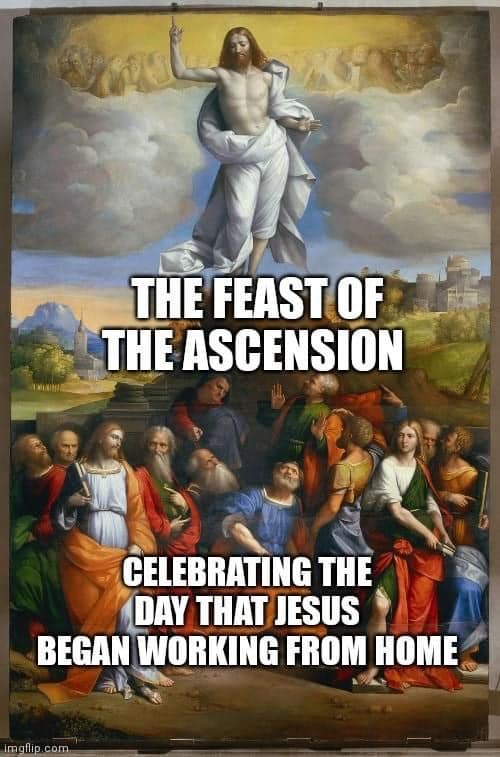
I saw this image on Facebook on Thursday, which was Ascension Day. A classic painting of Jesus ascending above the bewildered disciples has had a caption added:

The Feast of the Ascension: celebrating the day that Jesus began working from home.

I rather liked that. I wondered whether devout Catholic politician Jacob Rees-Mogg might ponder it the next time he leaves snarky notes on the office desks of civil servants who are working from home.

What do we make of the Ascension? When I try to explain the event to congregations, I usually suggest it is what John Calvin called one of God’s accommodations to us. He rose into the sky to get the message through to disciples who thought heaven was ‘up there’. Although Professor Tom Wright now says that the Jewish concept of heaven was that it was an invisible realm next door to this life and therefore the crucial part of the story is that Jesus disappears from sight.

But be that as it may, what does the Ascension mean for us? I’m going to divide that into two halves.

Firstly, it’s about the finished work of Jesus.

Hebrews 4:14 tells us that Jesus ‘has ascended into heaven.’ But what does he do there?

Two other parts of Hebrews tell us something that this section doesn’t, and they both use the same expression. In both chapter 10 and chapter 12 we read, ‘He sat down.’

It’s like he gets to heaven, he goes in the front door, finds the sofa in the living room, and takes the weight off his feet. Job done. Now he can rest.

In other words, the Ascension tells us that Jesus had completed all he was sent to Earth to do. Through his life, teaching, miracles, death, and resurrection he has achieved his goal. Salvation has been won. It is available to all. The task is being passed to the disciples and any day now the Holy Spirit will equip them for that.

Compare it if you will to the account of the crucifixion in the Gospel according to John. As he is about to die, Jesus cries out, ‘It is finished!’ (John 19:30) When he said ‘It is finished’ he didn’t mean, it’s all over, and my mission has failed, but the very opposite. For the Greek word that English Bibles translate as ‘finished’ means ‘finished’ in the sense of ‘accomplished’. Jesus is saying, ‘Mission accomplished!’ and the Ascension confirms that.

Jesus has done everything we need for salvation. The Cross is sufficient, the Resurrection proclaims it, and the Ascension ratifies it. To come into a relationship with the living God and to live as a disciple of Jesus requires only what he has done for us. At the Cross, the guilt we carry and the sentence we deserve for our sins are taken away and laid on Jesus. At the Cross, evil forces are conquered not by violence but by the suffering love of God in Christ. At the Cross we are set free.

It has all been done. Finished. Mission accomplished.

So one thing we must not do is attempt to add to what Jesus has done. Sometimes when we feel particularly guilty we think we have to do something as an act of penance to earn the favour of God. But as Martin Luther discovered when he studied the New Testament more fully than he had been taught as an Augustinian monk, the word is not ‘penance’ but ‘repentance’. And even then we do that in response to what Jesus is offering us.

Similarly, some people think they have to live a good life in order to win God’s favour. This is at heart an act of pride: ‘I did it myself’ – or even worse, in the words of the dreadful song, ‘I did it my way.’ But the fact that Jesus has done it all is meant to humble us. We cannot save ourselves. That’s the point. Everyone must come to that realisation, whether they are of high rank or low in human society, that we come in humility to Jesus and depend entirely on him for salvation.

On this day when we celebrate Jesus sitting down at the right hand of the Father, I want us all to realise afresh that our relationship with Christ is described in the words of the hymn:

Nothing in my hand I bring
Simply to thy Cross I cling.

What is faith then? It is not stretching out our hands to offer God something from our lives that we think or hope might make us acceptable to him. Instead, it is an opening out of our empty hands to be filled with all that Jesus has to give us from what he has done for us at the Cross.

John Wesley knew this. Last Tuesday was the anniversary of his conversion at Aldersgate Street, when he found that the assurance of God’s love simply came directly to him from God, not from all the labours to which he had devoted himself up until then.

Therefore, if you are ever the kind of person who says of yourself, ‘I’m trying to be a Christian,’ I want to ask you to put that language to bed from today. Either you are a Christian, or you are not. Being a Christian isn’t a boast, it isn’t a matter of personal superiority. It’s a matter of holding out those empty to hands to receive the finished work of Christ.

Secondly, the Ascension is about the unfinished work of Jesus.

Wait a minute Dave, you’ve just been at pains to say that Jesus finished his work. How can you now say his work is unfinished?

Glad you asked. And I hope this is provocative enough to keep you listening. One part of his work is finished, the work I’ve just been describing, to make salvation an offer to all.

But another part of his work is unfinished. And it’s described in our reading. Hebrews calls Jesus our ‘high priest.’ What does a priest do? A priest offers sacrifices for the people – but we’ve covered that in my first point about the finished work of Jesus in speaking about his death. Jesus our high priest offered himself as our sacrifice.

But a priest does something else for the people. A priest prays for them. This is something that Hebrews will refer to three chapters after our reading:

Therefore he is able to save completely those who come to God through him, because he always lives to intercede for them. (Hebrews 7:25)

Two circuits ago, and elderly Local Preacher prayed for me every day. But he died. My parents also prayed daily for me. But they have both died while I have been here.

However, I am not short on the most powerful prayer for me in my need, because Jesus intercedes for me. And he does the same for each of you. Be encouraged! This is his priestly work.

And furthermore, he understands, because as our reading says,

15 For we do not have a high priest who is unable to feel sympathy for our weaknesses, but we have one who has been tempted in every way, just as we are – yet he did not sin. 16 Let us then approach God’s throne of grace with confidence, so that we may receive mercy and find grace to help us in our time of need.

Don’t you find that encouraging, too? I often tell mourners at a funeral that when I am going through a bad time in my life I don’t necessarily find it helpful to have well-meaning Christians come up to me and tell me exactly what they believe about why God has allowed this. I want to lay my hands on such people – but not in the sense of healing!

The people I find most supportive when I am walking through troubles are those who have been there themselves. They understand.

One of my favourite examples of this is that about five years before I met Debbie I had a broken engagement – or, as my sister called it, a narrow escape. One day when I was grieving the break-up of my relationship, two friends called Sue and Kate turned up on the doorstep.

‘We’ve come to take you out for a pub lunch,’ they said.

I don’t remember the food from that meal. What I remember is how both Sue and Kate shared about broken engagements they had been through. They understood. They could support me.

Because Jesus has been through human weakness and faced temptation, he can do all that and more.

If you are facing sorrow or crisis right now, I encourage you to re-read the Gospels. Look for the stories where Jesus too goes through the ringer. Then recall that because he has been there too, he understands what you are facing, and can pray like no-one else to the Father for you.

This is how our ascended Lord spends much of his time. This is his unfinished work. It will continue until he appears again in glory, to judge the living and the dead, and to take us to our eternal home.

In conclusion, I’ve always been disappointed how Methodist churches treat the Ascension as a minor festival or even as a non-existent one. It is so important. It has much to teach us and encourage us.

I hope we will all leave today rejoicing in the finished work of Christ, who has sat down at the right hand of the Father, having completed everything necessary for our salvation.

And I hope we will also all leave today encouraged by the high priestly work of Christ who identifies with us and intercedes for us – his unfinished work.

May both of these great truths be strong foundations for our worship and our witness.

Seventh Sunday of Easter (Sunday After Ascension): Waiting Well

For the foreseeable future, the videos are only going to be the Bible reading and the talk. My workload at present makes it difficult to find time for sourcing and editing the music and prayers that I have been including. (On top of a full appointment, I am temporarily the Acting Superintendent of my circuit while my boss is on sabbatical.)

Luke 24:44-53

Since this video goes beyond my usual congregations via YouTube, I hope my churches will forgive me if I begin this Ascension reflection with some material they may have heard before.

At this time I always remember the story told by one famous Anglican bishop about how he was invited to perform the reopening of a local Post Office. It happened to be on Ascension Day.

When he arrived, he found a hot air balloon tethered in the field. There was also a brass band. He learned that the Post Office had planned to combine his reopening with Ascension Day. So they expected him to soar up into the sky in the balloon while the band played the hymn ‘Nearer My God To Thee’!

The idea of Jesus ascending into the sky is an intimidating story for us today. I was also intimidated one year when as a theological student the local Methodist minister invited me to fill his pulpit on the Sunday after Ascension. There in the congregation was the local university Professor of New Testament, following the Bible reading in his Greek New Testament. If ever I had to get a difficult reading right it was that morning!

I have found most help from a source not commonly quoted in my own theological tradition, indeed someone who is often reviled among Methodists. And that is John Calvin. He wasn’t all double predestination and executing his enemies, he had some good points!

One of them was his doctrine of ‘accommodation’. He said that in revealing himself and his truth to people, God often had to ‘accommodate’ the way he did that to the limited understanding of human beings.

The Ascension would be a good example of this. Jesus ‘lifting off’ like a rocket from Cape Canaveral seems strange to us, but how else was he going to show his followers that he was returning to heaven? So the Ascension story isn’t designed to tell us that heaven is literally above us, the miracle is there to communicate a theological truth about where Jesus is in terms that would have been understood two thousand years ago. How Jesus would do it today I’m not at all sure, but this is how he needed to communicate it at the time.

Now when Jesus ascends, his disciples are left waiting for Pentecost and the arrival of the Holy Spirit. He expressly tells them to wait in Jerusalem for that event:

49 I am going to send you what my Father has promised; but stay in the city until you have been clothed with power from on high.

Waiting can be an exciting time, as we anticipate something we’re looking forward to. But it can also be a difficult time spiritually. ‘Lord, when are you going to fulfil your promises? When are you going to do what we need you to do?’ Does that sound familiar to you?

I recall a time as a child of primary school age when in the school holidays I went over the park that was opposite our house to play with my schoolfriend Tony. We were set upon by bullies, and Tony ran away. I was terrified.

But a few minutes later I discovered why Tony had run away. He had gone back to our house and returned with my father. The bullies then ran away!

It was awful waiting for those few minutes and not even knowing why Tony had gone, but the wait brought a good outcome.

Unlike those first disciples, we don’t have to wait for the Holy Spirit. But those other times of waiting for the promise of God that I alluded to a moment ago are common to our spiritual experience.

And therefore a question that the Ascension helps us with is this: how do we wait well as Christians?

I see two elements in the story about how we can wait well for what God wants to do.

The first is that the disciples are blessed people.

50 When he had led them out to the vicinity of Bethany, he lifted up his hands and blessed them. 51 While he was blessing them, he left them and was taken up into heaven.

That’s how Jesus leaves them – with a blessing upon them. But what does it mean to be blessed by Almighty God?

Essentially, if God blesses you, then you receive his favour. Perhaps the most dramatic example is when the Archangel Gabriel appears to Mary to announce her pregnancy. He says she is ‘highly favoured’ and that ‘the Lord is with [her]’[1]. That’s a blessing – well, that particular one may be a blessing and a half!

When I as a minister pronounce a blessing at the end of a service, what I am praying for is that everyone in that congregation leaves knowing that they are favoured by God. This is the good news: sinners receive the favour of God.

And it forms our core identity as Christians. It’s the most important thing about us, that through no merit of our own we are blessed, we are favoured by God.

If we don’t make it our core identity, then things go awry. I had an elderly lady in one previous appointment who made the fact that she was a Local Preacher central to her sense of worthy. But the time came when her mind and body began to fail. The most telling occasion was a service where she introduced the Lord’s Prayer three times. We asked her if she would step down gracefully and we would hold an event to celebrate all her years of preaching, but she refused. I know it would have been hard for anyone in her position, but she carried that bitterness with her as her health declined, instead of recognising the unchanging fact that she was a beloved child of God.

But more positively, if we do accept that we are favoured by God as his dearly loved children, then this holds us through the waiting times. On a small scale it happened to me earlier this week when I was preparing this talk. That morning I received an email that caused me some stress. I was rather anxious as I waited some hours for the outcome of it, and in the meantime had to go off and do other things.

But then the very teaching I’m giving you here hit me. What doesn’t change is that I am a beloved child of God. I am blessed by him. Therefore I can trust God to work this thing out. And he did.

So can I encourage you, then, to live out your identity as a son or daughter of the living God? That he has adopted you into his family is a sign of the most monumental blessing you can possibly imagine. Let that truth hold you up in the times of waiting.

The second element is that the disciples are worshipping people.

52 Then they worshipped him and returned to Jerusalem with great joy. 53 And they stayed continually at the temple, praising God.

Why do they worship Jesus? For sure, one reason is the blessing they’ve just received, but there has to be more. As good Jews, they would only worship Jesus if they thought he had divine status. They know now that he is more than a prophet. At the beginning of our reading, he has taken them through the Scriptures and shown how necessary his suffering, death, and resurrection were, and how that good news must now go out to the nations. Instead of the nations coming to Jerusalem, now God’s people will go from Jerusalem to the nations. All these things are wonderful signs that God’s purposes are being fulfilled, and that God has kept his promise to Israel – just not in the way they were expecting.

And when they appreciate all that they are filled with wonder. And that wonder comes out in praise and worship.

It’s interesting to compare this with the description the crowd at Pentecost gives the disciples when they hear them speaking in tongues: they say they hear them ‘declaring the wonders of God’[2], which could be a pretty good description of worship.

Yes, they are full of wonder at what God has done. They were slow to get it during the three years that they followed Jesus around, but now the shekel has dropped and it makes sense.

How does this help us when we are waiting? It would be good for us to be reminded of the amazing ways in which God has fulfilled his purposes over the centuries, supremely in his Son Jesus. It would be good for us to recount the promises God has made to his people and kept.

Sometimes we recount them in broad brushstrokes during the great prayer of thanksgiving at a communion service. We go back to the marvels of creation. We move on to God making a people for himself and continually calling people back when they stray through patriarchs, judges, and prophets. Ultimately, we celebrate the coming of Jesus, with his birth, ministry, death, resurrection, and – yes – ascension. The next time you’re at a communion service, listen for the minister covering those great topics in the thanksgiving prayer.

These things fortify us because they remind us of the great truths relating to our God. Our faith and confidence increase. We sing his praise. And we become more certain that he will see us through the difficulties of the waiting time, because he is a purpose-fulfilling, promise-keeping God. His ascended Son is at his right hand praying for us, and his Holy Spirit is within us and praying through us.

Don’t neglect worship. We engage in it because God is worthy of our praise. But as we worship, it builds up our own faith and trust.

So there you have it – two elements from the period between the Ascension and Pentecost that strengthen us in those periods when we have to wait to see God at work. One is done to us – we are blessed, we are favoured as adopted children of God by grace. The other we ourselves do in response – we worship, because God keeps his promises and fulfils his plans, and he will do the same for us.

I hope and pray that as a result, each of us will be able to bear the waiting times with greater faith.


[1] Luke 1:28

[2] Acts 2:11

Sermon: Holy Suspense (Advent Sunday)

As with last week and throughout Advent I won’t be able to post the video of my devotional talk for the week. However, here is the text as I explore the Lectionary Gospel (Year B) and tackle that sense of suspense and tension that confronts us at Advent and throughout our Christian lives.

Mark 13:24-37 NRSV

In the lead-up to family birthdays and to Christmas, there is a noticeable difference between the males and the females in my immediate family.

My wife and daughter cannot stand not knowing what their presents will be. They want to know in advance. In particular, I often subjected to intense lobbying from my daughter to know what we’ve bought her.

My son and I are different. Both of us are content to wait and find out on the day. That’s part of the pleasure for us. If we knew in advance, it would be an anti-climax.

Advent – and particularly Advent Sunday itself – is about how you deal with suspense. That’s why this week’s theme in the series I’m following is called ‘Holy Suspense’.

We are living in between times in a sense of tension and hope about what is to come, not satisfied with life as it is and longing for it to be different.

We are in the hour before dawn, the time when the temperature is usually at its coldest, but when the complete darkness begins to be replaced by a blue light. As twilight before dawn beckons, indirect light from the Sun below the horizon takes on a blue shade. It is sometimes called ‘blue hour’.

The ancient Celts used to talk about living in ‘The time between the times’, and while some of their expressions of that would not be helpful to us, I think we can at least affirm those words.

For that is where the holy suspense of Advent, in the hour before dawn, places us: in the time between the times.

But what times are we in between? There are two in Mark chapter 13.

You may be surprised to hear that, because for a long time people have wrongly assumed this chapter is entirely about the Second Coming and the events leading up to it. However, there is a real tension between two ‘comings’ in this chapter, and the Lectionary verses we have today give us the cusp between the two.

So – what is the first coming in Mark 13?

You might assume it is Jesus’ first coming, the Incarnation, the great event to which we are building up.

But you would be mistaken.

24 ‘But in those days, after that suffering,

the sun will be darkened,

   and the moon will not give its light,

25 and the stars will be falling from heaven,

   and the powers in the heavens will be shaken.

26Then they will see “the Son of Man coming in clouds” with great power and glory. 27Then he will send out the angels, and gather his elect from the four winds, from the ends of the earth to the ends of heaven.

Now some of you will jump on that language and say it’s talking about the Second Coming. My one-word answer to that is ‘no’, but bear with me as I explain what it is.

For one thing, language about the sun being darkened, the moon not giving its light, stars falling from heaven, and powers in heaven being shaken is not to be taken literally. This is neither Carol Kirkwood giving the weather forecast on BBC Breakfast, nor is it Brian May or Brian Cox describing an astronomical event on The Sky At Night. This is special language that we call ‘apocalyptic language’, which was a veiled way of speaking so that enemies like the Romans would not understand what they were on about.

But, you say, the verses go on to speak about the Son of Man coming in clouds and sending his angels to gather his elect from the four winds. That must be the Second Coming, mustn’t it?

Only if you don’t recognise your biblical quotes, I respond. ‘The Son of Man coming in clouds’ is a direct citation of Daniel chapter 7. In that chapter the Son of Man does indeed come in clouds – but not to earth. He comes to the Ancient of Days, that is, Almighty God.

It would seem therefore that what Jesus is talking about here isn’t his first coming, nor is it his return, but his ascension to the right hand of the Father, where, as it says in Daniel 7, he receives the kingdom.

And Jesus’ statement

30Truly I tell you, this generation will not pass away until all these things have taken place

makes it quite clear he is talking about an event that is very close at hand, not in the distant future.

What then about the Son of Man sending out the angels to gather the elect? That surely is the evangelistic mission of the church that Jesus commissions his disciples to undertake. He gives that command just before he ascends, and it begins at Pentecost.

Hold onto those thoughts for a moment, while we ask – what is the second coming in Mark 13?

Well – er – it’s the Second Coming! Not that the Bible ever uses that expression. Normally it uses a word that means not ‘coming’ but ‘appearing’ or maybe ‘presence’. Jesus will appear again on earth after his ascension, and we need to be ready.

That’s why he tells the little vignette at the end of the reading about the master who goes away (the ascension again) and leaves his slaves in charge of his property. However, those slaves need to be ready for whenever the master returns. They don’t know when that will be, so they need to be ‘on the watch’ and ‘keep[ing] awake’ (verses 32-37).

That’s all rather more straightforward than what I called the ‘first coming’, isn’t it?

The only strange thing about as far as I’m concerned is that all of Jesus’ teaching in this chapter is a response to him prophesying that the Jerusalem Temple will be destroyed, and Peter asking him when this will happen and what the signs will be (verses 1-3). So why would Jesus go on to talk about his return in glory?

I think it must be something like this: Jesus has solemnly spoken about the destruction of the Jerusalem Temple as a sign of judgment. But he goes on to warn that a greater judgment is waiting in the wings for the end of time.

Right – now that I’ve outlined what I think is the right way to understand this passage, we can answer some practical questions about how we live during holy suspense.

For the suspense in which we live is this: at the ascension, Jesus sat down at the right hand of the Father and was given the kingdom of God. He reigns.

Yet not all is well, and we await his appearing (a.k.a. the Second Coming) when everything will be put under his feet.

Just as the Queen reigns but not everyone obeys the law of the land, so we live in a time like that. Jesus is in charge of the universe, but not everyone acknowledges that. Such a state of affairs creates a sense of tension for us as followers of Jesus.

Two applications, then:

Firstly, the gathering of the elect: because not everyone willingly lives under the reign of King Jesus we are given the Great Commission to proclaim the Gospel. In the Roman Empire when a herald came announcing ‘good news’ it was usually the good news of a new Emperor or of great victories.

Well, that is our message in the Great Commission. There is a new king on the throne, and his name is Jesus. What’s more, he has won the greatest victories of all time – over sin and over death.

As we live with this great tension between Jesus receiving his kingdom and it being completely fulfilled, we call more people to bow the knee to King Jesus.

Secondly, the slaves staying alert and awake in the master’s house: because Jesus will appear again and everything and everyone will acknowledge him as Lord and King, we need to be ready for that. In other words, we need to live as if that future is already here. The call to obey Jesus now is critical, because it’s the consequence of proclaiming the Good News that he is King and has won those victories over sin and death.

Now that creates more of the tension with the world we live in, where to live like that may not be popular. But discipleship is not an option. And if we proclaim to the world that Jesus is King, then a necessary part of our witness to back up our words is to live as if Jesus is King. Which he is.

To conclude: do we know what our present is on the Great Day of Christ’s Appearing? Yes and no. Yes, we know in general terms that his new creation will be full of truth, beauty, and love, and there will no longer be anything to spoil it.

But also no, because how can we imagine such a gift with accuracy and detail? We might just as well also be surprised.

What we know is that Jesus will reign without any further opposition.

Meanwhile, we live as citizens of his kingdom and proclaim his reign, even though that brings tension.

But one day, the suspense will be over and all will be well.

That is the Advent hope.

Sermon For The Sunday After Ascension

Luke 24:44-53

Ascension Deficit Disorder from inheritthemirth.com

Several of my friends were sharing this cartoon on Facebook in the last few days[1]. I think it encapsulates how we might regard the Ascension in the Methodist Church – or not regard it, as the case may be. We have an ‘Ascension Deficit Disorder.’

There are all sorts of reasons for this. I think we find the Ascension to be one of the more embarrassing miracles. Not only is it strange, it seems to offend against what we know of modern cosmology, and we find it hard to see the point of it. The healing miracles may also seem to go against science as we know it, but at least they seem to have a point – and a loving, compassionate one at that.

But the Ascension? What on earth is the use of it? Maybe we see it as some kind of divine blast-off, and we can’t get our heads around it. To us, heaven isn’t ‘up there’ in a literal sense, and so we chide those ancient people for their simplistic beliefs. For us, the Ascension is not like a 1960s episode of Thunderbirds, and Jesus’ final meetings with the disciples aren’t like Thunderbird 2 on the launchpad, ready to fly to rescue some people in terrible distress somewhere. In the past, when I have preached on the Ascension, I have explained it as what I call a ‘miracle of accommodation’, namely that Jesus had to be taken up into heaven in the sight of the disciples as the only way they would understand he was returning to heaven, even though heaven wasn’t literally up in the sky.

Thunderbird 2 mug
Thunderbird 2 mug

But Tom Wright has pointed out that the ancient Jews didn’t see the distinction between earth and heaven that way. In a sermon he preached six years ago, he said:

The early Christians, like their Jewish contemporaries, saw heaven and earth as the overlapping and interlocking spheres of God’s good creation, with the point being that heaven is the control room from which earth is run. To say that Jesus is now in heaven is to say three things. First, that he is present with his people everywhere, no longer confined to one space-time location within earth, but certainly not absent. Second, that he is now the managing director of this strange show called ‘earth’, though like many incoming chief executives he has quite a lot to do to sort it out and turn it around. Third, that he will one day bring heaven and earth together as one, becoming therefore personally present to us once more within God’s new creation.

One way and another, then, after the Resurrection, where God vindicated his Son and began his new creation, now in the Ascension we have the confirmation that Jesus is the rightful Lord of the universe. He is the Messiah, the King. And therefore when he gathers his disciples for final instructions, he does so as the one about to take his seat on the throne of creation. We should read his words as a king’s orders to his subjects. Certainly what Jesus says here can be read as decrees and requirements.

Firstly, he calls his disciples witnesses. He interprets the Old Testament Scriptures to them all here in the manner he did to Cleopas and his companion on the Emmaus Road, by showing how they pointed to his suffering, death and resurrection. But these are not just events in recent history: they have a meaning, importance and implications for all who hear. Thus Jesus goes on to say:

and repentance for the forgiveness of sins will be preached in his name to all nations, beginning at Jerusalem.48 You are witnesses of these things. (Verses 47-48)

The point is this: you have seen all this, disciples. You saw me betrayed and killed. You have met me since I rose from the dead. You know what these events mean about me. I am the true King. The world has been shown to be wrong about me. There is a question now of people showing true allegiance to me, since the Father has vindicated me and is about to enthrone me. You have seen this. You are witnesses. You have a responsibility to share what you have witnessed with others.

What kind of witnesses are we to the King? This last week, Debbie has received a letter, summoning her to jury service next month at the coroner’s court. It is clear that the jury would be sitting not on a trial but on an inquest. She is therefore likely to hear two kinds of witnesses. One is the expert witness, such as a doctor who describes the cause of death from a medical point of view. Another is the ordinary witness, who may have seen something crucial that happened.

Christian witness includes both kinds of witnesses. Not all of us are expert witnesses, and we do not all have to be. However, we are all ordinary witnesses, because we are witnesses to what he has done for us through those saving events of his death and resurrection.

You could use a different metaphor from ‘witness’, especially if you want to connect this specifically to Jesus’ enthronement as King. You could use the image Paul deploys in 2 Corinthians 5 of ‘ambassadors for Christ.’ We have a privilege and responsibility to speak on behalf of the King.

And it is significant that Jesus mentions ‘repentance for the forgiveness of sins’ as part of the message. To be a witness to the king or an ambassador for him is to be entrusted with a message that calls all creation to align themselves with Jesus. That means turning away from the kingdom to which they are currently committed – the kingdom of darkness – and turning to Christ instead. Witnesses to his death and resurrection can do no less. There is a legitimate conversation to be had about how we do this, but that it is part of the task cannot be in doubt.

Secondly, Jesus the King calls his disciples to waiting. He has just given them a tremendous briefing. They must be on a knife edge. Perhaps they cannot wait to get going, out of excitement. But although he promises to equip them for the task, he tells them to wait:

I am going to send you what my Father has promised; but stay in the city until you have been clothed with power from on high. (Verse 49)

Jesus is going to put his reign into action through the disciples at Pentecost. His personal presence will be replaced by his personal power in the Holy Spirit. They will start living as the kingdom community, doing kingdom things, just like Jesus himself had done in his ministry before his death. They must be champing at the bit.

But they have to wait for that transfer from the presence of Jesus to the power of Jesus, that change of personnel from Jesus to his Spirit. Therefore the king’s order to them is, ‘wait.’

Is that so unreasonable? Our Queen has ‘ladies in waiting’ – women who wait for whenever she issues a command. The timing of the command, as well as its content, is up to Her Majesty.

Now you may say that there is an important difference between the first disciples and us. While they might have had to have waited for the Holy Spirit, we do not, because the Spirit has now been given, and receipt of the Spirit is a sign of Christian conversion. If you say that, you would be right in that particular case. The Spirit has indeed been given, and we do not have to wait like that.

However, there are many instances where Jesus in his kingly authority calls us to wait. We are not to act without his command. We are not to presume upon him and go charging off. He calls us to wait until he gives the order.

And to wait effectively means learning to be attentive. Just as the ladies in waiting have to be attentive to the Queen, so we need to learn the spiritual disciplines of attentiveness as we wait for instructions from heaven, earth’s control room. That means listening. I am far too good in prayer in rattling through the things I want to talk about and then stopping as if that were the end of prayer. But it isn’t. Not if I am to wait upon my Lord. Silence, solitude and retreat are all disciplines we need to practise if we are to be those who wait upon the King of kings.

Thirdly and finally, disciples of earth’s true king are committed to worshipping. Worship is the natural reaction to knowing that God has enthroned Jesus. Thus the reading ends:

When he had led them out to the vicinity of Bethany, he lifted up his hands and blessed them. 51 While he was blessing them, he left them and was taken up into heaven. 52 Then they worshipped him and returned to Jerusalem with great joy. 53 And they stayed continually at the temple, praising God. (Verses 50-53)

Kingship and worship go together. The Greek word most commonly translated ‘worship’ in the New Testament is proskuneo, which literally means, ‘to move towards and kiss.’ But what kind of kiss? It is the kiss of homage. The image is the ancient one of kissing a monarch as a sign of allegiance. It is still practised in a symbolic way today when new Prime Ministers and new Anglican bishops are appointed.

Worship, then, is emphatically not in the first instance about ‘singing what I like’. I am not saying that worship should not be enjoyable, but I am saying that the focus of worship is not about whether it scratches my back, it is not about whether I am ‘fed’ (because Christians should learn to feed themselves, anyway), it is not about whether it was ‘my favourite preacher’, and so on. All those criteria and more are me-centred. Worship is meant to be God-centred. We are paying homage to God. It is about a sense of awe, wonder and devotion to him, not about spiritual entertainment. We are disciples, not dilettantes.

On Bank Holiday Monday, we decided to visit Windsor. After sitting outside in the sun eating our packed lunch, we joined the queue for the castle. Having got in after an hour’s wait, we went around and eventually decided to visit the State Apartments. While following the prescribed route around them, Becky and I suddenly heard Debbie let out a gasp, and she called us urgently to where she and Mark were. They had just seen a car arrive, and the Queen get out of it with one of the corgis. They then saw the Queen walk the corgi to her official door into her living quarters. Unfortunately, Becky and I didn’t get over to them in time, and we missed out. Becky was upset. However much I tried to say to her that the Queen is just a normal human being like the rest of us, she knew she had missed out on something special. Her mum and brother had a sense of awe that they had seen the Sovereign.

And that is what we need to long for in worship: an awe at having encountered the Sovereign of all creation. Awe that does not concentrate on the amazing experience that we had, but awe that expresses our wonder at this Second Person of the Trinity, who now reigns until every enemy will have been put under his feet. To this King who now reigns we owe our loyalty.

It is something we have a chance to affirm formally at the climax of our service this morning. For we come to the sacrament of Holy Communion. Whatever else communion is, when we respond and take the bread and wine, that action is symbolic of our oath of allegiance to him who has ascended to reign over all. In the Roman Empire, the ‘sacramentum’ was the oath of allegiance taken by a soldier to the emperor. This morning, let us take our sacramentum, too.


[1] It appears to come from the website Inherit The Mirth. However, I cannot find it on that website at present. If the owner of the site needs me either to pay for the use of this image or remove it, I would be grateful for him to contact me.

Sermon: Ascension – The Forgotten Festival

Acts 1:1-14
Like every English football fan, I turn into an amateur pundit when an England squad is announced for a major tournament. It was thus with interest and trepidation that I followed Wednesday’s announcement of Roy Hodgson’s squad for the Euro 2012 tournament. Were I a Frenchman, I would be quite pleased with the England squad. I wondered how certain players could be forgotten – notably Peter Crouch and Aaron Lennon. The fact that Lennon plays for Spurs, Crouch used to and that Spurs are my time, did not cloud my judgement at all.

And if we think about forgotten men, we come in the Ascension to the forgotten festival. For many Christians, it’s Christmas, Easter and hopefully Pentecost. Ascension gets overlooked. Whether it’s because it always happens on a Thursday, because biblically the event it marks happened ten days before Pentecost, I don’t know, but it is certainly our forgotten festival.

But perhaps there is one reason that leads to our embarrassed silence about the Ascension, and that’s all this talk about Jesus rising up out of sight in a cloud. It all sounds so primitive, so unsophisticated to our scientifically tuned ears. We make our assumptions that the ancients believed that earth was ‘down here’ and heaven was ‘up there’, whereas our knowledge of astronomy and related disciplines seems to make that unlikely.

Yet how else were ancient people going to understand that Jesus had returned to his Father’s presence? Some riding off into the sunset, like the hero of a Western movie, wouldn’t have worked. Could it be that the strange account in Acts of Jesus being taken up from the disciples and obscured by a cloud (verse 9) is the only way God could have communicated this to them? I like to think this is an example of what John Calvin called the ‘doctrine of accommodation’, that many things are just so beyond the human mind that God can only show them in any way to us by simplifying them to our terms. Some of the creation stories may do the same, taking Babylonian myths of the day but importing very different meanings into them.
So the first theme of the Ascension for me, then, is this one of divine mystery accommodated to puny human minds. Let us not think with all our additional knowledge today that we are in any less need of God accommodating himself to our own failures to understand him. As Charles Wesley put it about the Incarnation in one of his hymns,

Our God contracted to a span,
Incomprehensibly made man.

‘Incomprehensibly.’ The saving works of God are so beyond and above our thinking and our imagination that the Lord has to find ways of communicating them to us that can make some kind of sense to us.

Hence I would say that a major challenge of the Ascension for us as Christians is to embrace the mystery of God and to stop thinking that we can put him into little boxes of our own making. If God chooses to put small boundaries around his revelation so that we have some chance of comprehension, that is up to him. But it is not for us to say what the limits are. It is not up to us to say, ‘But of course God could not do such-and-such’ – unless it contradicted his character.

Therefore, at Ascension-tide, let us face the challenge that God wants us to think bigger about him than we ever have done before. We may find it hard, but it may be essential. Indeed, unless we do, how ever will we truly worship him? If we are the ones who set limits on who he can be and what he can do, then is he any longer truly God? If God contracts things to help us understand, then that is his business. But we have no business in contracting God for ourselves with the tool of unbelief.

The second theme the Ascension has for me is the joining of earth and heaven. That Wesley hymn I just quoted starts with the lines,

Let earth and heaven combine,
Angels and men agree

And the Ascension is about the uniting of earth and heaven. Jesus’ journey from earth to heaven is not a vacating of earth – after all, ten days later he will send his own Spirit. It is about the joining of earth and heaven.

Remember that this is central to Jesus himself. In Jewish thought, the Temple was the place where earth and heaven met. But Jesus presented himself as the true Temple when he said, ‘Destroy this Temple and in three days I will rebuild it,’ referring to his death and resurrection. Earth and heaven meet, and worship is the fitting response. The Ascension shows us, as does the Incarnation and other aspects of Jesus’ ministry, that he is the one where earth and heaven meet. He is the true Temple. He, therefore, is to be worshipped and adored. Ascension is a reason for worship.

And so we might be puzzled by the Ascension, but we need to get beyond the default modern reaction in order to worship the one who has brought earth and heaven together. Ascension tells us that Jesus is worthy of all our praise and honour, not only as we sing and pray but as we live for his glory each day.

That call to worship leads us neatly into a third theme, which is that Ascension shows Jesus as both Lord and king. Tom Wright tells how one of the ways in which the myth of Roman emperors becoming gods at the time of their death is that a slave was – shall we say – ‘encouraged’ to report that they saw the soul of the dying emperor flying to heaven at the moment of death.

When Luke tells us the story of the Ascension, witnessed not by conscripted slaves but willing disciples, and not just a soul but the whole raised body of Jesus, his initial audience is surely meant to understand that this is a claim that here is the true emperor of the world. Caesar may call himself Lord, but the true Lord is Jesus.

The Cross, of course, has already declared that Jesus is King. ‘When I am lifted up, I will draw all people to me,’ he had said. Pilate had put up the notice, ‘King of the Jews’, and the Gospel writers mean us to understand that this is ultimately not a criminal charge, nor a statement of irony, but the truth. Jesus is enthroned as king on the Cross. The Resurrection then sees that king’s kingdom coming in power. Now this is capped by the Ascension as a visual sign of his reign. Jesus is Lord and King of the universe.

But it all means that he reigns in a different manner. He had reminded his disciples that the rulers of the Gentiles lorded it over people, but they were not to be that way. They were to serve. His own enthronement, as I said, was to be on the Cross – in suffering. And as we bow before our ascended Lord and King, we commit ourselves to work for his kingdom in sacrificial ways. If we worship Jesus, the true Temple who brought earth and heaven together, and we should because he is both Lord and King, then that worship cashes out in costly service. Ascension, then, asks us the question: what has my devotion to Jesus Christ cost me? Because if it has cost us nothing then we may never have understood Jesus in the first place.

There is a fourth and final Ascension theme I want to share, and it’s reflected in Hebrews 10:11-18. What does Jesus do when he gets back to the right hand of the Father? He sits down. That could mean a number of things. It could be another statement about his authority – after all, a Jewish rabbi sat down, rather than stood up, to teach. Remember that is what Jesus himself did when he preached at Nazareth. He has not stopped speaking, and as we are reminded elsewhere in the Scriptures he has not stopped praying, either.
But I prefer to see the sitting down in the terms of a rest. When Methodist ministers apply to retire, we have a quaint practice of going before our Synod and ‘asking permission to sit down’. Before we retire, we are deemed to be in what is called ‘the active work’. When we retire, we ‘sit down’. It is about a sense of completion (although the church may still call on us to do certain things).

And the ascended Jesus sits down, because the main burden of his work is done:

Day after day every priest stands and performs his religious duties; again and again he offers the same sacrifices, which can never take away sins.  But when this priest had offered for all time one sacrifice for sins, he sat down at the right hand of God,  and since that time he waits for his enemies to be made his footstool.  For by one sacrifice he has made perfect for ever those who are being made holy. (Hebrews 10:11-14)

As Jesus said on the Cross, ‘It is finished’, so the Ascension confirms that fact. Everything has been done to ensure salvation. We are forgiven through his death. We have new life through his Resurrection. From the right hand of the Father he pours out the Spirit so that we can live sacrificially for his kingdom. As the ascended Jesus waits for the final destruction of death, he has given us all we need to lives as little Jesuses, to be the faithful people and new community he wants us to be.

Ascension, finally, then, says, let us rise to the task. Jesus is waiting.

Sermon: Waiting For The Holy Spirit

Acts 1:6-14

“We’re all just trash, waiting to be thrown away.”

It’s a line from Toy Story 3. I’m sure several of you have seen the Toy Story animated films. Young Andy has a collection of toys, such as Buzz Lightyear and Sheriff Woody. But in the third and final instalment, Andy is growing up and no longer needs his old toys. They end up in day care, where a bear threatens to put them out with the rubbish, and mocks them for believing in Andy’s love. He tells them, “We’re all just trash, waiting to be thrown away. That’s all a toy is.”[1]

Waiting. We see it negatively today. Waiting for something is a bad thing. That’s why we invented credit cards – to ‘take the waiting out of wanting’. Ask a child whether she likes waiting, and you can guarantee an answer beginning with ‘no’. That maybe a sign of what an immature society we now have, when that childish attitude is reproduced so frequently among adults.

In contrast, many of you from older generations know the benefit of waiting. You saved up, you waited for marriage and you stood firm in the face of pressure. You know that waiting can be a good thing.

Today, as we begin this new sermon series on the Holy Spirit, we find the disciples of Jesus waiting. In between the Ascension and Pentecost, they are waiting for the Holy Spirit. And while there is a sense in which we do not need to wait for the Holy Spirit any more, because all followers of Christ receive the Spirit when faith comes alive, we nevertheless go through periods of waiting for the Holy Spirit to work. So this morning’s theme of ‘Waiting for the Holy Spirit’ can still be relevant to our lives of faith today.

I want to suggest that when God makes us wait for the Holy Spirit, it is to focus us on what is important. How so? I find three ways in the reading.

Firstly, waiting for the Holy Spirit makes us focus on our priorities. Listen again to the opening dialogue in the story:

So when they had come together, they asked him, “Lord, is this the time when you will restore the kingdom to Israel?” He replied, “It is not for you to know the times or periods that the Father has set by his own authority. But you will receive power when the Holy Spirit has come upon you; and you will be my witnesses in Jerusalem, in all Judea and Samaria, and to the ends of the earth.” (Verses 6-8)

The disciples still think the Messiah came to sort out the land for Israel and to repel the Roman occupying forces. Jesus tells them basically they haven’t got the right priorities. Not that he isn’t interested in politics, but if their priorities are only about what’s in it for them, something is wrong. They need to wait for God’s priority of the Holy Spirit. Because living in the power of the Spirit will do more to bring in the kingdom of God than lusting after political favour.

Jesus tests our priorities by keeping us waiting. When we have nothing, know nothing, get nowhere and don’t have the foggiest reason why, he exposes our priorities and motives. They come to the fore, and Jesus says to us, “Are you concentrating on what matters for God’s kingdom?” The longer we wait for something to happen, the more we struggle with the life of faith not being full of zest, the more we find life in the church dry and difficult, the more Jesus asks questions of us. He wants to know who or what we are trusting in.

So think of those conversations we have about the decline of the church, when we reflect on the unbalanced age profile, full of older people and shorter on younger and middle-aged people. Jesus listens to those conversations where we wonder what miracle cure we might invoke. He listens when we consider trying the latest trendy religious idea that we’ve heard about.

And what does he say in reply? I think he says, you have your priorities wrong. You are not concentrating on the right things. You should be using the spiritual silence to wait and long for the Holy Spirit. He would ask us whether our priorities are to try something humanly clever, where the glory would go to us, or whether our priority is to wait in prayer, seeking the power of the Holy Spirit. Today should be a day when we decide that, however unpromising church life may be, we reject our lust for human priorities and say that we will not rush to solutions, we will wait on God for the Holy Spirit, because nothing matters more.

Secondly, waiting for the Holy Spirit makes us focus on power. Jesus tells them,

“You will receive power when the Holy Spirit comes upon you” (verse 8).

Here is a reason to wait: we don’t have the power, the Holy Spirit does. It is one of those humbling lessons for human beings.
In fact, I would say it is a much harder lesson for our generation than it was for the first disciples. Belief in God and a general dependence upon God was pretty well universal in their time. We live in the light of a western culture which over the last three hundred years or so has relegated God to the private sphere even when we do still believe in him. We have made science and reason the dominant powers and qualities. Many in our societies think they can provide the answers to everything, and this belief also infects people of faith. We come up with policies, programmes, techniques and reasoned statements.

And it’s not that science and reason are bad. We owe so much to them. Advances in medical knowledge have benefitted us all. Inventions in technology and communication have improved our lives. We should be grateful for innovations like these. We would not want to turn back the clock.

But any idea that science and reason are the answers to everything in life should be tempered by other considerations. These same disciplines have also given us the horrors of nuclear weapons and the devastation of environmental destruction.
And that is to say nothing about other aspects of power. Political power has the ability to achieve much good, but we also know its tendency towards corruption. So surely when Jesus says, “You will receive power” we should see that as good news. Because the power of the Holy Spirit is the power seen in the life of Jesus himself. It is the power best demonstrated in humility and human weakness. It is the power that works to bless the poor and needy. It is the power that raises up the humble and dethrones the proud. Uneducated fishermen lead a revolution, and the wealthy and educated establishment can do nothing to prevent them.

Now if that is the case, why on earth are we satisfied with the limited promises of human power? Why do we run the church on the same values as the rest of the world? Why in our inpatient hurry do we default to the ways of the world?

Often we take heart from the ordinariness and the frailty of Jesus’ disciples when we fail. But maybe we could see something else in their story. As well as joy and relief that we are forgiven like them, could not also be encouraged and challenged by the fact that these ordinary, mundane people were transformed by the power of the Holy Spirit?

If that is the case, then why do we keep rushing into the ways of human power? If we want to work for God’s kingdom, then we need God’s power for that. If we don’t have that power now, then we hold back. We wait. We wait on God.
Which leads me to the third theme that waiting on the Holy Spirit means: prayer. If we need to align our priorities with God’s, and if we need to seek God’s power rather than ours, then our waiting needs to be characterised by prayer. We don’t just wait: we wait on God.

That’s what we see the disciples doing:

Then they returned to Jerusalem from the mount called Olivet, which is near Jerusalem, a sabbath day’s journey away. When they had entered the city, they went to the room upstairs where they were staying, Peter, and John, and James, and Andrew, Philip and Thomas, Bartholomew and Matthew, James son of Alphaeus, and Simon the Zealot, and Judas son of* James. All these were constantly devoting themselves to prayer, together with certain women, including Mary the mother of Jesus, as well as his brothers. (Verses 12-14)

They ‘were constantly devoting themselves to prayer.’ Here is true waiting for the Holy Spirit. Prayer.

Now this needs careful handling. The moment a preacher starts to emphasise prayer in a sermon, all sorts of things can go wrong. It can turn into a guilt trip. How easy it is to say that we don’t pray enough. And of course that isn’t just the congregation: that’s true of the preachers as well. We can impose guilt without offering positive hope, because we are often not up to much in this area, either. Besides, some listeners will say, “Are you suggesting I don’t pray? Of course I pray!”

So let me say this. I recall the words of a favourite Local Preacher in the circuit where I grew up. He was regularly the most challenging preacher to fill a pulpit there. When he said something to stir us up in a sermon, he often added this comment: “I never challenge you without first challenging myself.” Hence, what I preach here I say as much to myself as to you.

What I’d like us to notice is not simply that ‘they prayed’, but that ‘they were constantly devoting themselves to prayer’ (my emphasis). We’re not talking about a few short, simple daily prayers here: those first disciples made a radical commitment to prayer.
Now that will take on different forms in our varying circumstances of life. Depending on work, family life and so on, we shall each have different ways of demonstrating our devotion to prayer. But as R T Kendall says, “If we don’t have some system, we never get around to it.”

What is certain is that our attitude to prayer cannot be perfunctory. We look down on children’s prayers that sometimes don’t get much beyond “Lord, bless me and my family,” but in truth too many of our adult prayers are no deeper. It can be very telling what requests are put in a church intercessions book – and what requests don’t make it to the book. We want prayers for ourselves and our loved ones, and there’s nothing wrong with that, but sometimes it feels little different from an adult version of that child’s “Bless me, bless my family” prayer.

The challenge is to go beyond – to be ‘constantly devoting [ourselves] to prayer’ in the waiting time. Prayer for the Holy Spirit, I would suggest. Because we recognise we cannot live by our priorities, and need to align our lives with the priorities of God. Because we also recognise the bankruptcy of depending on human power, and know that the only thing which will turn around our lives and our churches is the power of God, the Holy Spirit.

So can we make a simple commitment today? A commitment to wait for God, and to wait on God in prayer. A commitment so to pray that it is less about asking God to bless us than asking God to reorder our priorities after his, and where we ask him to help us lay down our reliance on human power in favour of the Holy Spirit’s power. Can we make a commitment to wait in prayer for the power of God, the Holy Spirit?

Because nothing less than that is needed for the health of our churches and our witness to God’s saving love in Christ.


[1] Illustration courtesy of Tools For Talks (subscription required).

Create a website or blog at WordPress.com

Up ↑