
At my first Games lesson at secondary school, our teacher Mr Rouhan said to all the boys, ‘Today, we’re going to play football, and everything you’ve been told so far about how to play football is wrong, unless I tell you the same thing. Most of you have been taught football wrongly at primary school.’
Well, wow, that was a big claim to make. Was he arrogant? He certainly commanded respect in football outside the school, because he managed to get in the former Spurs assistant manager Eddie Baily to coach at our school.
I just didn’t like Mr Rouhan, because he had no love for cricket.
But today, like him, I need to take a risk of saying to you, ‘Everything you’ve been told about the story of the sheep and the goats is wrong.’
For my guess is that you’ve been taught that in this vision (no, it isn’t a parable, by the way, it’s a vision) the hungry, the thirsty, the strangers, the naked, the sick, and the prisoners are the universal poor in general. And therefore, Jesus is teaching here that those who claim to follow him will care for the poor, and any who claim to follow him but don’t do this will suffer judgement.
You’ve probably also been told that the expression, ‘Just as you did it to the least of these … you did it to me’ shows that God lives in every human being.
All of this is wrong.[1]
None of these interpretations existed before the Second World War. That of itself doesn’t make them wrong. But if the church and her scholars have seen this differently for the great majority of church history, shouldn’t we be careful before we accept a new understanding? And shouldn’t we be suspicious of preachers and teachers who present this ‘new’ approach as the only version?
Hence, I need to do some clearing of the ground before we can get to what Jesus is actually teaching here.
Clearing the ground

I’ve already said this isn’t a parable, but a vision. I don’t like using the section headings in English Bibles, but in the NRSV that we use, this passage is not called a parable, it is correctly (as we shall see) entitled ‘The Judgement of the Nations.’ Jesus is giving a vision of that judgement. There is nothing like the typical parable introduction that says something along the lines of ‘The kingdom of heaven is like …’ and then proceeds to tell the story.
That said, one fairly uncontroversial thing in getting things clear is to say that the king in the story is Jesus, because it first of all refers to him as the Son of Man coming in his glory, a customary way Jesus speaks about himself, drawing on some verses in Daniel 7.
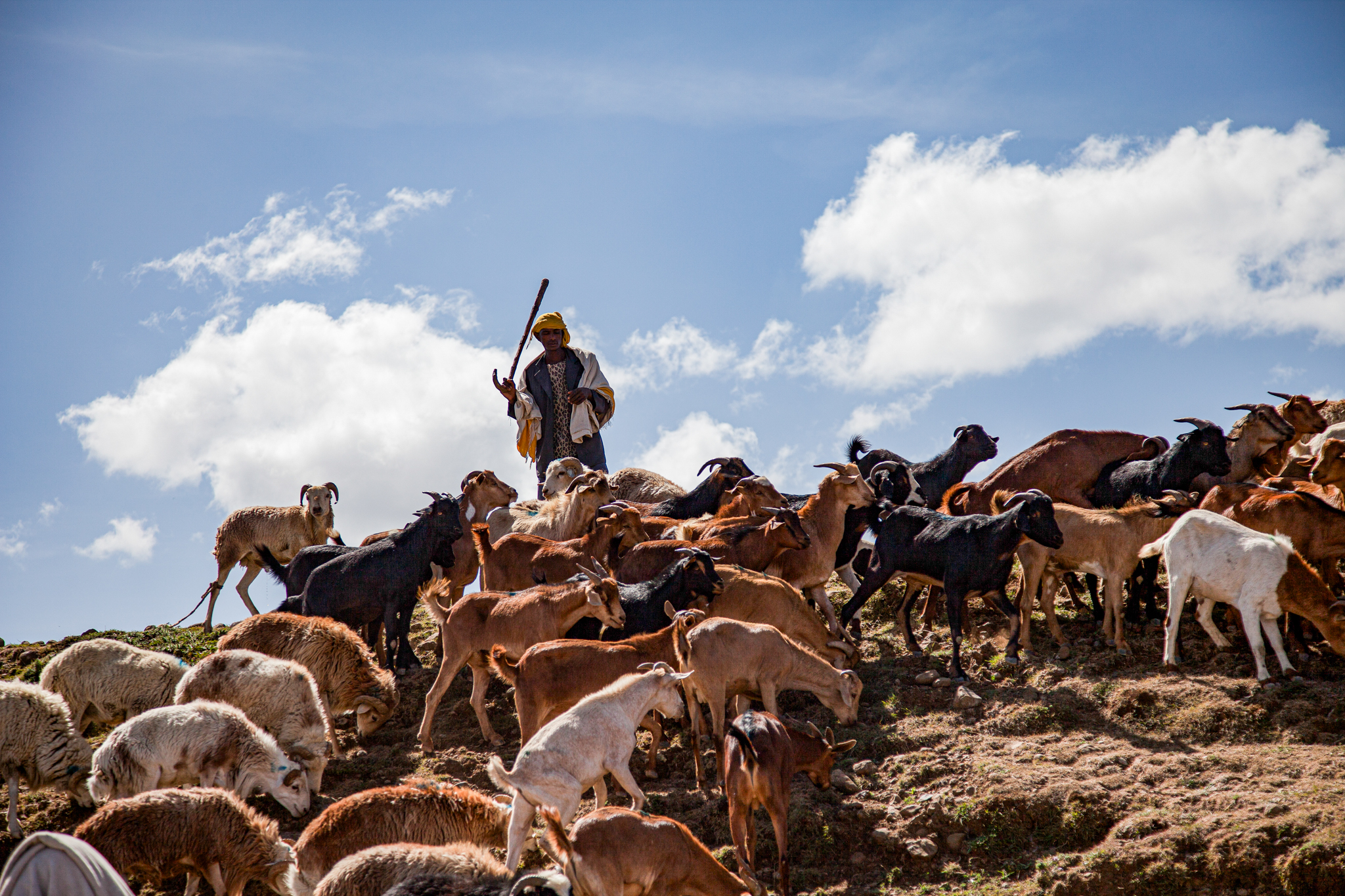
Then let’s think about the sheep and the goats. Although the king puts the sheep on one side and the goats on the other, it’s not that sheep were automatically seen as good and goats as bad. In fact, in the rougher terrain on the Holy Land, the two breeds were raised together. Goats had a higher milk yield than sheep, and may even be the source of the reference to the land as ‘flowing with milk and honey.’
However, they did need to be separated, because some of the male kid goats needed to be culled to avoid the goats over-running the sheep numerically. The point here is not, as I said, sheep good, goats bad, but simply the need for separation.
But who are the sheep and the goats? There is no indication in the passage that this is addressed to Christians. Instead, we read at the beginning that this is when ‘all the nations’ are gathered before Jesus. Those facing judgement – either reward or condemnation – are not those who claim to follow Jesus, but the nations of the world in general. There is plenty elsewhere in the Bible where God commands Christians to care for the poor, but that is not what this is about. Jesus is addressing the nations.
Next, who are ‘the least of these’? I’ve already noted that the hungry, the thirsty, the strangers, the naked, the sick, and the prisoners are these days usually thought to be the universal poor in general. But as I said, that view has only come to the fore since the Second World War. Christian history near-unanimously rejects this interpretation. Whether you read the Early Church Fathers, medieval theologians, scholars from the Reformation or the Renaissance, they all hold to a different view. ‘The least of these’ are disciples of Jesus. ‘The least of these’ is an expression Matthew uses that way elsewhere in his Gospel.[2]
Moreover, our translation emphasises this fact by saying, ‘the least of these who are members of my family’, which literally is, ‘the least of these who are my brothers.’ Those suffering are part of the family of God, the church.
And the fact that they are hungry, thirsty, strangers, naked, sick, and in prison here tells us something important for understanding what Jesus is saying here: these are Christian disciples who have suffered for their faith.
And it is the fact that they are Christians that means that whatever was done to them was done to God, for God dwells in them. We can therefore reject the modern, liberal sentimental idea taken from this passage that God lives inside every human being. It’s not true. As the rest of the New Testament avers, God comes to live in the lives of those who follow him, by the Holy Spirit. Everyone is made in the image of God, yes, but God only indwells his disciples. And here those disciples are suffering for their faith.
Having cleared the ground, I now just have time for some brief applications of the passage.
Applications

Firstly, Jesus is King. It is to him that we owe our entire allegiance. And so it is fitting that we talk about this on the Last Sunday Before Advent, the Feast of Christ the King.
But the moment we say that ‘Christ is King’, we have some uncomfortable thoughts today. For the extremes of the religious right who go marching through our towns and cities today often carry banners saying, ‘Christ is King.’ Sometimes, they are dressed up like medieval Crusaders. If not dressed up, they use images of the Crusaders as visuals on their literature and social media.
Yet Jesus Christ was not king like that. He did not lead an army to violent conquest. He did the opposite. Palm Sunday was the day when he rode into Jerusalem as the peaceful king. Five days later he would be enthroned – but on the Cross, where he suffered to bring victory.
This is the king we worship and adore.
Secondly, the cost of discipleship. Jesus assumes that not only will he suffer at the hands of the wicked, but so will his spiritual family. As we have heard, they will be hungry and thirsty, strangers, naked, sick, and imprisoned. This will be a consequence of allegiance to Jesus.
We often pray with a sense of gratitude and rejoicing that in our country we are free to worship without there being any penalty. But we might wonder whether we have been sufficiently faithful to Jesus that the forces arrayed against him have taken it out on us. I am not suggesting we do silly, provocative things, but we might ponder whether we have ever suffered because we name the Name of Jesus. If we have, what did we do? And if we haven’t, is that because we haven’t truly nailed our colours to the mast?
Further, this calls us to show a concern for other members of the Christian family who most certainly are paying a price for being disciples of Jesus. It isn’t difficult to do this. There are organisations such as Christian Solidarity Worldwide and Open Doors among others, who will provide you with literature or emails detailing the plight of our church family elsewhere in the world. We can pray for them. We can campaign and take action for them. How many of us do that?
Thirdly, the lifestyle of discipleship. Although this is, as I said, about Jesus’ judgement of the nations, we can see that he is pleased with those who care for the needy and the persecuted in the ways described. Therefore, it is a clear assumption that this is what Christians do as a matter of habit.
And therefore, let us be challenged about whether and how we are showing concern for the poor. Are we serving them? Are we praying for them? Are we campaigning for them? It is an outworking of our faith to do so. A lack of concern for the suffering is a worrying sign.
Between injuring my neck just before my A-Levels and later going off to theological college, I worked in Social Security. During that period, I went on a holiday to a Christian guest house, where another holidaymaker asked me what work I was in. When I told her I was in Social Security, her reply was, ‘Well, at least you’re on the right side of the counter.’ She was dismissive and derogatory about the poor. To her, they were all scroungers. That attitude is not worthy of Christ. What is our attitude?
Fourthly, God’s justice. One question we get worked up about as Christians is, what about those who never hear the Gospel? How will God judge them? Are they automatically damned, or does God have some other way of treating them?
I believe the vision of the sheep and the goats shows that God does indeed have another way of judging those who, through no fault of their own, have never heard the message of salvation.
For if they respond positively to the needs of God’s suffering family when they come across them, then because those Christians have the Spirit of Christ living in them, they have in some way acted according to the light they have received. Could it be that what we see here is this: that God will judge people according to how they respond to whatever light they have seen?
It is always better to hear the Good News of Jesus and respond positively to that in repentance and faith, and we have a duty, wherever possible, to put that before people, looking always for what Matthew calls the ‘worthy person’ and Luke calls ‘the person of peace’, in whom God is already at work, and who might well react positively. But if that is not possible, then it looks to me like here Jesus shows a just way in which God will judge such people.
Conclusion
Therefore, having turned this story upside-down – or, I think, right-side-up – may God give us the grace to acknowledge Jesus as King, to live faithfully and sacrificially as his disciples, to support our brothers and sisters who are suffering, to rejoice in God’s perfect justice, and take the opportunities we are given to share the Good News.
[1] All that follows is dependent on Ian Paul’s excellent blog post, What do the sheep and the goats stand for in Matthew 25?
[2] Here, Ian Paul is dependent upon Sherman Gray, The Least of My Brothers: Matthew 25, 31-46 : a History of Interpretation (Society of Biblical Literature Dissertation Series). Gray cites Clement of Alexandria, Origen, Tertullian, Chrysostom, Jerome, Ambrose, the Venerable Bede, and Augustine from the patristic period; Anselm of Laon, Bonaventure, and Aquinas from the medieval period; and Erasmus, Zwingli, Luther, and Calvin from the Renaissance and the Reformation.

