Before we read from the Bible, I need to explain the background to what we’re going to hear. The Apostle Paul and his companion Silas have been preaching in a city called Philippi, but they kept getting interrupted by a very disturbed young woman. She was a fortune-teller, but she was also a slave, and so her owners made a lot of money out of her. They exploited her.
Image courtesy Picryl. Public Domain.
So Paul cast the spirit out of the young woman that enabled her to tell fortunes, and that angered her owners, who lost a lot of money, because they could no longer exploit her. In revenge, they got Paul and Silas locked up in the local prison, and that’s where we pick up the story.
Now I’ve read that story largely because we read near the end that the jailer found faith, but on the basis of his faith not only he was baptised, but so was his entire household – although it must also be admitted that Paul and Silas spoke the word to the whole household.
Image courtesy StockCake. Public Domain.
And today, we shall baptise [name] on the basis of [the child’s parent]’s faith. One day, [name] will have to decide for himself whether to follow Jesus.
So what does this faith look like? Well, it’s a lifetime commitment, but let me pick out two important elements from the story.
The first is belief:
Believe in the Lord Jesus, and you will be saved (verse 31)
What does it mean to ‘believe in the Lord Jesus’? It’s not simply that we believe he exists, although the historical evidence for that is extremely strong. No: we believe certain things about Jesus, and we then trust him with our lives.
We believe that Jesus is the Son of God, that he died for our sins, and that he rose again from the dead to give us new life.
Some people say that they think they are good people and that will get them into eternal life with God when they die. But none of us is good enough to meet God’s perfect standards. We all fall short. Those failures need to be forgiven.
And the thing about forgiveness is this: it hurts and it is costly. I think of a time when I was still living with my parents. A friend of mine had a broken engagement. He needed somewhere to stay while getting over it, and we invited him in. He stayed for two weeks. But he never helped with anything around the house. He seemed to expect my Mum to cook for him and do his washing. When he left, he didn’t offer any money towards all that my parents had shelled out while he was with us.
Image courtesy Picryl. Public Domain.
We had a family conference about this. I’ll never forget my Dad’s words. “We’ll put this down to God’s account.” To forgive my friend involved my parents absorbing that debt. It cost them.
Similarly, Jesus dying on the Cross shows us that it cost God to forgive our sins.
So I invite you this morning to realise that is the cost God has paid for you to be forgiven. Will you believe it? And will you then trust Jesus with your life?
The second thing that faith involves is action:
At that hour of the night the jailer took them and washed their wounds; then immediately he and all his household were baptized.
The jailer brought them into his house and set a meal before them; he was filled with joy because he had come to believe in God—he and his whole household. (Verses 33-34)
The jailer does engage in good deeds, but they are not what earn him salvation. Instead, his action is a matter of gratitude.
We are so grateful that God has loved us so much it has cost him the death of his Son, that we respond. And we do so by putting our faith into action.
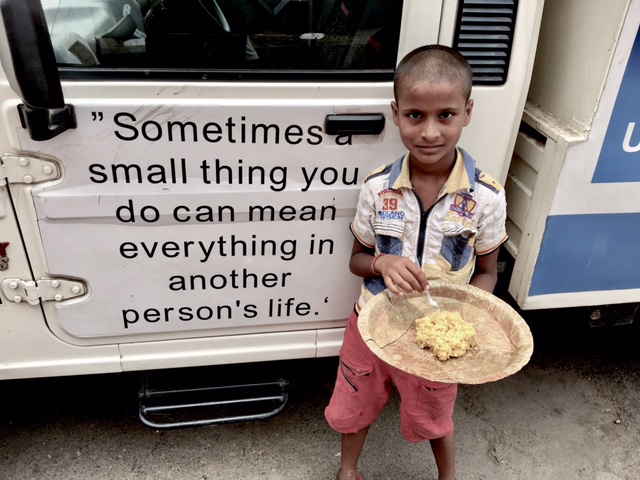
Yes, that gratitude is certainly shown in worship, but it is also shown in the world. The jailer tends to the wounds of Paul and Silas, who had been beaten and flogged before they were thrown into prison (verses 22-24).
Food drive for homeless. Wikimedia Commons. CC 4.0
So if we are grateful for all that God has done for us in Jesus, who are the wounded people we can serve and show his love? Perhaps we can think of this a little bit like the idea today of ‘paying it forward.’ Where and how can I pay it forward, because God has shown so much love to me?
The jailer didn’t have to look too far and neither do we. You will have a neighbour who needs some practical help. You will find organisations where you live that that work and campaign on behalf of those in the most desperate need, either in this country or abroad.
Conclusion
This is the faith into which we baptise [name] this morning. One that urges him to believe that Jesus died for his sins, and to trust his life to him. One that shows gratitude for God’s love in our actions, especially in the service of those in most need.
But do you know what will make the most sense of this faith to [name]? It will be when those of us in the church and in his family live out that faith ourselves before his eyes.
If I asked you to name the most influential Bible passage on the subject of mission, I think most people would plump for the one we call ‘The Great Commission’ at the end of Matthew’s Gospel. (And indeed we’ll get to that later in this series.)
I don’t think many in our churches would think of today’s passage. But in the last few decades this is one that a number of mission organisations have used for inspiration. They have each taken different ideas out of it, each amounting to very partial readings of the story. But I’d like to look at a number of helpful and challenging themes in Jesus’ instructions here to the seventy-two that will give shape to our outreach. For even though it is not our regular habit to be going out on mission teams like this, there are useful principles here for us to remember.
Firstly, prayer and action:
2 He told them, ‘The harvest is plentiful, but the workers are few. Ask the Lord of the harvest, therefore, to send out workers into his harvest field. 3 Go! I am sending you out like lambs among wolves.
Mission is based in prayer. It is not a series of techniques. It is not a programme. It is not a method. It is not even fundamentally a set of skills. It is a spiritual matter and can only come to birth through prayer.
While I am not sure about the old adage that God does nothing except in response to prayer – that seems to deny God’s freedom and sovereignty – I do know that mission is a work of the Spirit and therefore must be set out on spiritually. One of the simplest ways we can put this into practice is by having our own list of people we know and love that we want to find faith in Christ. I am sure you can instantly think of friends and family.
But it cannot solely be prayer. There has been a major trend on the internet in recent years that when some terrible disaster happens, Christians post well-meaning messages offering ‘thoughts and prayers.’ But the atheists then jump in and ask what the point of prayer is if they’re not going to take any action.
Now of course the atheists will have no time for prayer under any circumstances. But the Christian should make a link between prayer and action. I know sometimes when there’s a major disaster it feels like there’s nothing practical we can do and that we can only pray, but most of the time prayer can be linked with action, and that’s what Jesus says here. Not only does he tell the seventy-two to pray – ‘Ask the Lord of the harvest’ – he follows it up by saying ‘Go!’
We cannot divorce prayer from action. I think it was the late David Watson who used to say that we need to pray as if there is no such thing as action, and act as if there is no such thing as prayer. Sometimes, including in mission, we need, as it were, to be the answers to our own prayers. So when we are praying for God’s love to have an impact on certain people, that may also require us to be the people who carry that love to the people in question. And that may include the way we speak and show God’s love to the loved ones we are praying for.
Secondly, simplicity:
4 Do not take a purse or bag or sandals; and do not greet anyone on the road.
If I want to disabuse the church of one notion, it’s the idea that mission is a big-budget enterprise with big names, big campaigns, a huge budget, massive publicity, like the religious equivalent of the New Year’s fireworks in London with all the fancy stuff that is done with drones and the like.
Utter tosh. Show that to me in the New Testament. Oh, for sure there are some occasions where Jesus speaks to large crowds, but those incidents don’t justify the laser light show approach to mission – which actually disempowers many Christians from sharing in God’s mission.
No. Jesus says here that the enterprise of mission is simple. It’s ordinary Christians without any fancy accoutrements on the road with the love of God for people. None of us needs a big bank account in order to love people in Jesus’ name. We don’t need hi-tech equipment to tell people that Jesus loves them and wants them to turn their lives over to him. If we have that stuff then fine, but it’s far from essential.
Actually, I think some of us hide behind the big-money, big-event approach to mission. It’s too much for us, and so we think that gives us a free pass so as not to be involved.
But Jesus says, no. It just takes you and me without any fancy props, just the love of God in our hearts, to show the Gospel in our actions and speak the Gospel in our words. Let’s stop dodging the issue.
Thirdly, prevenient grace:
5 ‘When you enter a house, first say, “Peace to this house.” 6 If someone who promotes peace is there, your peace will rest on them; if not, it will return to you. 7 Stay there, eating and drinking whatever they give you, for the worker deserves his wages. Do not move around from house to house.
10 But when you enter a town and are not welcomed, go into its streets and say, 11 “Even the dust of your town we wipe from our feet as a warning to you. Yet be sure of this: the kingdom of God has come near.” 12 I tell you, it will be more bearable on that day for Sodom than for that town.
What’s all this stuff about peace? Well, the opposite is the material about not being welcomed. Do you get a welcome somewhere when you arrive with the love of God? If you do, it’s a sign that God has prepared the way for you. Remember at the beginning of this series we saw that God was the first missionary in the Garden of Eden, that mission is God’s idea, and that we simply join in. Mission is never our initiative, it is his.
And that’s prevenient grace, to use one of John Wesley’s terms. ‘Prevenient’ is to go before. So we are looking for the people and places where God has gone before, where he has prepared the ground. If someone shows signs of being receptive, then take that seriously. It may well mean that you will find evidence that the Holy Spirit is already at work there, preparing them to hear the good news of Jesus. Again, remember the beginning of the series where I quoted Chris Wright saying that it’s not the church of God that has a mission in the world, but that the God of mission has a church in the world.
And when prevenient grace isn’t there, says Jesus, move on. If all you get is hostility, leave. There are others who will willingly hear and receive. Give them your time, and leave those who reject you to God.
I know of one occasion when I experienced that. It was in a circuit appointment where my gifts had never been received and appreciated from the very first Sunday. Around the time that our re-invitation was being discussed, one week I was preaching on Mark’s equivalent passage to this one. As I got to the words about shaking the dust off your feet, I felt a small voice whisper inside me, you’ll be doing that very soon.
So share God’s love in word and deed in circumstances where it is welcomed. If people don’t want to know, move on. This is not just practical thinking. It is the teaching of Jesus himself.
Fourthly and finally, practice:
8 ‘When you enter a town and are welcomed, eat what is offered to you. 9 Heal those there who are ill and tell them, “The kingdom of God has come near to you.”
Here’s what we are to get on with: demonstrating the kingdom of God in our actions, and explaining it with our words so that people hear the call to follow Jesus.
Now you may say it’s all very well for Jesus to tell these people who were evidently almost as close to him as the Twelve just to go around healing people. Well, I believe in the healing ministry but equally I can only enunciate for sure two occasions when I believe people have been healed in response to my prayers. So I want you to know that I feel the tension, too.
I would never want in principle to discourage Christians from praying for healing. Don’t ask, don’t get! But I think it will only ever be a minority of Christians who have a healing ministry. Where does that leave the rest of us?
We may not all be able to heal others in the name of Jesus, but we all can bless other people in Jesus’ name. Because the Holy Spirit lives in us, every Christian has the capacity to show Christ’s compassion and kindness to those who need it. When God interrupts our neat lives by bringing such people across our paths, let us be ready to show the love of Jesus to them, and to explain it when they ask why we have done so.
The other evening I was not at my best on this. Just as I had dished up our dinner, the phone rang and I picked it up to hear the voice of an elderly person who lived alone, who therefore talks at length given the opportunity, and who had just had a life-changing experience that was not for the better for him. I have to tell you, I was a little too keen to keep the phone call brief. When I was praying that night, I reflected that it wasn’t my finest hour.
Better, I understand that at the community lunch some people are saying, what is the cost, or why are you doing this free of charge? This is a perfect opportunity to explain about the God who showed his love for us in Christ before we ever responded to him, whether positively or negatively.
In conclusion, I don’t have time to look at the rest of the passage, where Jesus says more about leaving those who reject the message to God for him to deal with them, and where he urges his disciples to find their identity not in the success of their mission but in their love and redemption by God.
But there has been plenty even in these first twelve verses for us to chew on. Do we marry our prayers and our actions? Do we keep mission simple and not hide behind complexity? Are we attentive to God’s work of prevenient grace, so that we know where to concentrate our energies and where we are wasting our time? And will we practice both the demonstration of God’s love and explanation of it in words with those who God brings into our lives?
All of these are basic to the way we join in with God’s mission.




 Big Circumstance