Where is the Hope in the Slaughter of the Innocents? (Matthew 2:13-23, Christmas 1 Year A)

Matthew 2:13-23

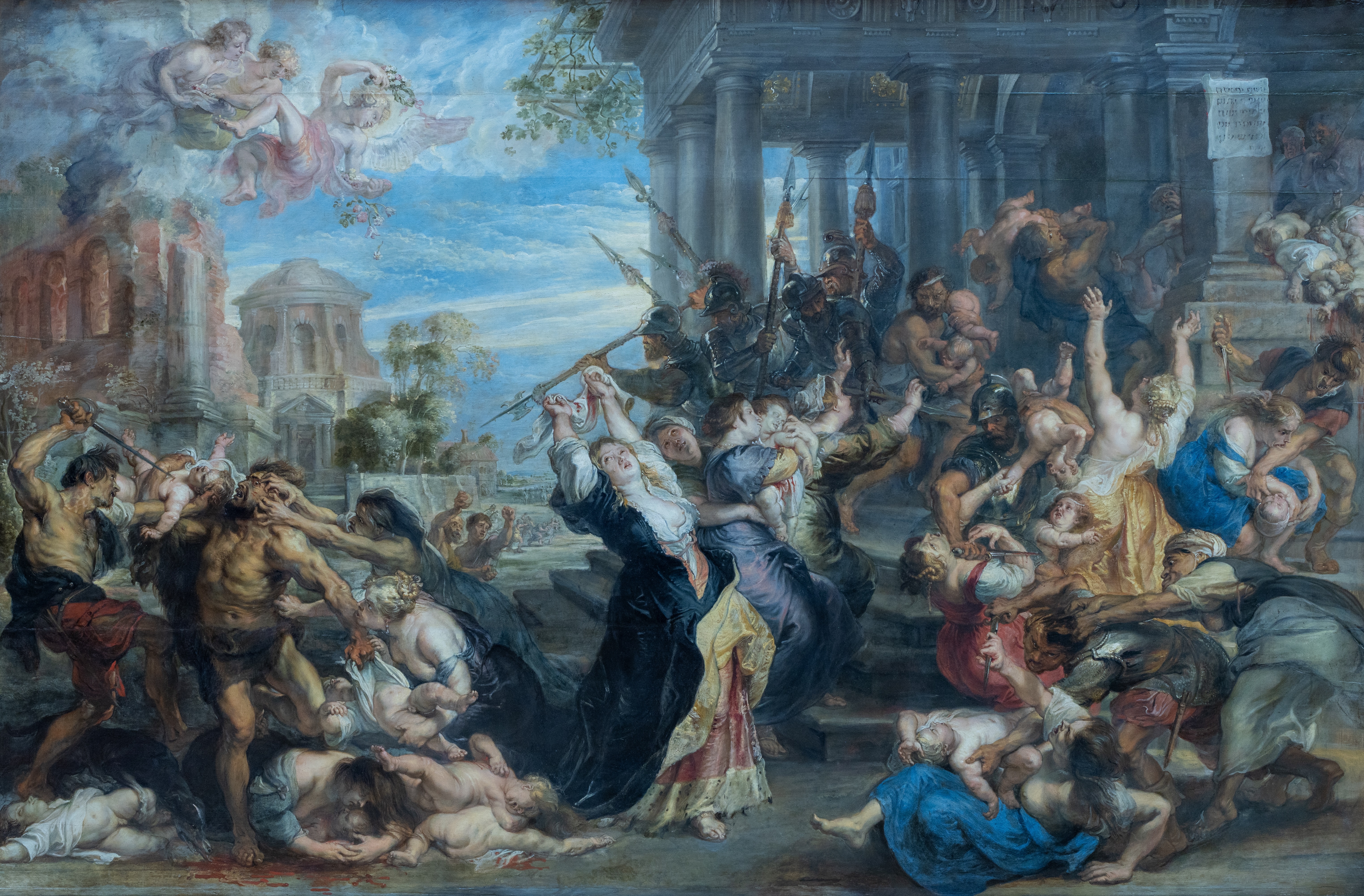
Peter Paul Rubens, The Massacre of the Innocents; Wikimedia Commons, CC Licence 4.0

Sometimes, Christians tell stories of miraculous answers to prayer where they are saved from a disaster. Around the time of 9/11, I heard one about a Christian who should have been on one of the planes that crashed into the Twin Towers, but whose circumstances changed unexpectedly and they missed the flight.

Here is one I read recently, from a respected pastor:

I remember once almost booking a trip to Prague. I’d planned it perfectly—a romantic getaway for Vicky and me. My finger hovered over the “Book Now” button, but something in my spirit said no. It didn’t feel right. I hesitated and didn’t book it. Weeks later, there was a massive explosion in the very square where we would have been staying.

Admittedly, that pastor is making a different point, about how God sometimes says ‘no’ because he is preparing something better for us. But I still read the account and wondered about who might have been present at the site of the explosion.

And something like this is one of the concerns we bring to the disturbing account of Herod the Great’s order to kill babies and toddlers in Bethlehem, whereas Jesus, Mary, and Joseph miraculously escape.

How are we going to tackle this troubling story? It naturally falls into three acts: the escape, the slaughter, and the return. These will be our guide to the flow of the story and what Matthew is saying.

Firstly, the escape:

Just as he did when Mary fell pregnant by the Holy Spirit, Joseph hears an angel of the Lord in a dream, and they escape to Egypt. That would have been financially easy for well-off Jews of their day, but it was certainly not a preferred option[1]. And while it is debatable whether Jesus’ family was poor, they were certainly not wealthy, so this was not an easy decision.

And yes, that makes Jesus, Mary, and Joseph refugees, something we might remember in today’s fevered politics of immigration. The fact they returned later does not negate that, as some have tried to claim.

Right from the beginning, then, pain and suffering cast their shadow over the life of Jesus. It will also be so for his followers.

In doing so, Jesus is like Moses, who was also rescued from certain death as a baby at the hands of Pharaoh. It is one sign that Jesus will be the One greater than Moses, who was prophesied.

That gets further underlined when Matthew, as he does so often and especially in the birth stories, quotes Scripture as being fulfilled. In verse 15 he cites Hosea 11:1,

Out of Egypt I have called my son.

In other words, he makes a parallel to the Exodus, which again was led by Moses. And just as in Old Testament texts such as this one Israel was called God’s son, so now Jesus is supremely God’s Son – not only because of the virginal conception by the Holy Spirit, but also because Jesus will fulfil all that Israel was meant to be, but failed to be, due to sin.

Even – and perhaps especially because – suffering and injustice are at work, what we see here is that Jesus’ ministry of salvation is being foreshadowed, maybe even beginning, in his infancy. The One greater than Moses, the True Israel, will lead his people through and from suffering to salvation. In the midst of the darkness, the light of Christ is shining.

Is that not reason to praise God? Even in this darkest of stories, God is working his purpose out.

And if God has preserved us through trials, are we listening to know what our place in those purposes is?

Secondly, the massacre:

There is a lot to say here. There are those who think the story didn’t happen, and that Matthew made up this story to fit with the fulfilment of a Scripture. However, if that’s what he did, then that makes Matthew a pretty awful person, and I don’t think that’s sustainable on the tone of the rest of his Gospel.

The big objection is that there is no historical record of the ‘slaughter of the innocents.’ All sides agree that it is consistent with Herod’s vile character. We know he had family members whom he regarded as political rivals killed. We know he even arranged for a number of nobles to be executed on the day of his own death, so that there would be grieving in the land. He obviously knew that few would grieve his own death.

But the reality is, horrible as it sounds, that the killing of male babies and toddlers in Bethlehem was probably political small fry in comparison to all his other atrocities. The violent acts that get reported by ancient sources like Josephus tend to be ones of national importance. This would not have been so, especially given that working from our best estimates of Bethlehem’s population at the time, probably around twenty youngsters in an insignificant town were slain[2].

That is still twenty too many, and it is still unbearably wicked. And I am working from the assumption that Matthew has given us an entirely plausible account.

Building on that, this is not the only place in Scripture where we see a juxtaposition of deliverance for some but suffering for others. To give one other example, when persecution breaks out against the early church in the Acts of the Apostles, many are imprisoned, Simon Peter is freed from his cell by an angel, but others are executed.

Many years ago, I heard a story about a massacre of some missionaries, who lived together in a compound. Many were killed, but others escaped. The survivors returned to their homeland, where a memorial service was held. As you can imagine, people struggled there with the fact that some were murdered but others were not. A speaker at the memorial service said, “God delivered all the missionaries. He delivered some of them from suffering, but he delivered others through suffering.”

The slaughter of the innocents is the most graphic telling of why Jesus needed to come. This is the level of wickedness in our world. Human sin and depravity is such that we will even not spare the most vulnerable and the most innocent for the sake of our own comfort, status, or financial gain. It is just as true today. While some abortions do happen because of serious medical complications and other distressing reasons, there are others that happen because of couples who are unwilling to make the financial sacrifices necessary to raise a child. If the Assisted Dying Bill gets successfully through Parliament, there will be elderly people in this country put under emotional pressure to end their lives so that greedy relatives can get their hands on their inheritance sooner.

Make no mistake, the slaughter of the innocents is not just something terrifying that happened two thousand years ago. Parallels are still happening today. And they will continue until people bow the knee to Jesus.

For Jesus is God’s remedy for all the violence and hatred in the world. Jesus, who escaped suffering here, would one day go to the Cross where he would absorb the sin of the world for all of us.

God had planned this from the beginning. God had created this world out of love, but love is something that takes risks, including the risk of rejection. God knew from the outset that it could and would go wrong, and that a rescue plan was needed. That is why Revelation speaks of Jesus as ‘the Lamb who was slain from the creation of the world.

Even here, there is hope. For when Matthew looks for an appropriate Old Testament text, he finds one in Jeremiah 31 that imagines the matriarch Rachel weeping in her grave as the exiles are marched off to Babylon. That sounds relentlessly bad, doesn’t it? But in that chapter, the disaster of the Exile leads to God’s rescue plan. For it climaxes in the promise of the New Covenant. And for Christians, that means Jesus.

Even in the darkness, God’s light in Christ is still shining. May we remember that.

Thirdly, the return:

Once again, Joseph has an angelic visitation during a dream. What a man Joseph was, for being open to God speaking to him. We laud Mary for her example of discipleship in agreeing to carry the Messiah in her womb, but Joseph deserves praise, too. He is an example of true faith to us as well.

When the family returns, Joseph also shows he is astute. Not Bethlehem, because although Herod is now dead, his son Archelaus is in charge of that area. He was every bit as bad, if not worse, than his father[3].

Joseph opts for Nazareth, where according to Luke he and Mary came from. It was politically insignificant, a small settlement of about five hundred people[4]. There is no way the sophisticated urban elites from Jerusalem would have ever had Nazareth on their shortlist for the upbringing of the Messiah.

But if the town was inconsequential to them, it certainly wasn’t to God. In his eyes, Nazareth was spiritually significant – something Matthew makes clear with a quotation that is a wordplay[5]. That quotation, ‘He will be called a Nazarene’, in verse 23, does not appear anywhere in the Old Testament. However, it was a common practice to make Hebrew puns by what was called ‘revocalising’ a word, which basically meant putting in a different selection of vowels. The best theory is that Matthew has revocalised the Hebrew word ‘nezer’ to make ‘Nazarene.’

If he has done that – and I think he has – then ‘nezer’ is the word for ‘branch’ in the prophecies that the Messiah will come from the ‘nezer’ or ‘branch’ of David’s line. The Messiah growing up in obscure Nazareth? Oh yes. What is insignificant in the world’s eyes is significant to God.

Now if that is true, what about those of us who do not live in our great metropolis or indeed in another major city today? Who cares about these places? God does. Let others write off the places we live in. God doesn’t. He cares about them and has plans for them.

For our part, let us be open to God’s leading in the places where he has called us to serve him. Let us be modern-day Josephs, attentive to the voice of God in our lives, especially in the Scriptures.

People who know their Methodist history should get this. We make a lot of the fact that John and Charles Wesley grew up in Epworth in Lincolnshire. For many years, we even had a publishing house named after Epworth. But who would have heard of Epworth were it not for the Wesleys? God had other ideas, just as he did for Nazareth.

What does God want to do here, and who does he want to raise up as his servants in this place, who might even go on to have a wider influence for Christ?

Let us be on the lookout.


[1] Craig S Keener, The Gospel of Matthew: A Socio-Rhetorical Commentary, p109.

[2] Keener, p111.

[3] Keener, p113.

[4] Ibid.

[5] Keener, pp113f for this and what follows.

Sermon: Born Again

John 3:1-17

Jesus answered [Nicodemus], ‘Very truly, I tell you, no one can see the kingdom of God without being born from above.’ (Verse 3)

What is it to be a ‘born again Christian’? We’ve become very used to hearing the phrase. The first time I remember hearing it was in my early teens, when a friend at school who went to a Baptist church invited me to a youth event. As my friend Andy brought me into the hall, someone greeted me and said, ‘Am I shaking hands with a born-again Christian?’ I said, ‘Yes,’ because as far as I knew I was a Christian. As I did so, Andy looked on quizzically. Clearly he doubted me. I didn’t understand at the time why he should doubt that I was a Christian. In later years, I would understand that he was right to be uncertain.

In popular parlance, we think of the phrase ‘born again Christian’ in connection with some American Christians. The first time I heard ‘born again’ used in the public domain was, I think, when Jimmy Carter ran for President in 1976. He would say, ‘My name is Jimmy Carter and I am a born-again Christian.’

Or we think that ‘born again Christians’ are those Christians we disparagingly refer to as ‘happy clappy’. I am sad when we disparage other Christians in this way, but what does remain is a sense that you can have two or more kinds of Christian: born again Christians, and other Christians.

So people have come to think that ‘born again Christians’ are one kind of Christian. But Jesus doesn’t put it like that. Either you’re born again (born from above, born anew) or you can’t see the kingdom of God. If you are born again, you are a Christian. If you are a Christian, you are born again. It’s not about the style of Christianity, it’s about the substance.

So we’d better know from Jesus what the substance of being one of his followers is. To explore what Jesus tells us, let’s look at the conversation he has with Nicodemus.

Except it’s not a conventional conversation. Three times Nicodemus asks Jesus something, or makes a statement to which he is seeking a reply. And three times, Jesus doesn’t answer him but says something else. If you’ve ever been frustrated that Jesus hasn’t answered the questions you’ve asked, you’re in good company. But Jesus has to do this here with Nicodemus, because otherwise he won’t get him to see the most important truths about the life of faith.

So let’s look at the three exchanges here, and see what they open up for us about true faith, about what it truly means to be ‘born again’.

Religion or Revelation
Nicodemus is religious. He is a Pharisee, which means at the very least he was devout and serious about following the heart of his religion. He was also ‘a leader of the Jews’, so whatever exactly that was, he held a responsible position and was probably respected for his faith (verse 1).

Furthermore, we have certain stereotypes of Pharisees from the New Testament as being regular opponents of Jesus, but it doesn’t look like Nicodemus can be lumped in with that description. He comes to see Jesus ‘by night’ (verse 2). I think that means he knew other Pharisees didn’t like Jesus, but he sincerely wanted to find out more. However, because of opposition from colleagues he comes under cover of darkness to avoid detection.

Not only that, he’s done his homework.

‘Rabbi,’ [he says,] ‘we know that you are a teacher who has come from God; for no one can do these signs that you do apart from the presence of God.’ (Verse 2)

In other words, he’s been part of a Pharisees’ committee that has looked into the early ministry of Jesus, just as we read two chapters earlier that a deputation of priests and Levites came to investigate John the Baptist (1:19). He would have been at home in the Methodist Church: working parties, committees and endless meetings would have been familiar to him!

Faithful, respected, sincere and devoted: that’s Nicodemus. Just the kind of person you want to join your church. Isn’t it?

It’s not far from the upbringing I had. My sister and I were taken to church in the womb. Our parents were active members of our Methodist church. Dad was a steward and was the Circuit Manses Secretary. Mum sang in the choir and taught in the Sunday School. You could hardly go out in the street with Mum without her bumping into someone and saying, ‘Didn’t I teach you Sunday School?’ In fact, it was so ingrained that my sister once worked out that she and I were fifth generation, same congregation.

And you know what? I wasn’t a Christian. It took a church membership class where at the last meeting our minister took us through the confirmation service when something clicked. I realised that Christianity wasn’t simply about believing in God and being good. It was about the grace of God reaching out to us, and us receiving it through repentance from our sins, faith in Christ and a grateful commitment to follow him in the world. I believe the ‘something’ that ‘clicked’ was the work of the Holy Spirit.

And Nicodemus has to learn that all his sincere religious belief and work counts for nothing. Religion gets you nowhere, Jesus says. Put in all the human effort you like, it’s a dead end. You need to hear from Jesus by his Spirit. You need to hear that it’s his work, not yours, that makes you a disciple of Jesus. It’s not what you’ve done for him. It’s what he’s done for you. That’s where the Gospel starts. Nowhere else.

Reason or Spirit
All this talk about being born again (born from above) is befuddling to Nicodemus. He can’t get his head around it:

‘How can anyone be born after having grown old? Can one enter a second time into the mother’s womb and be born?’ he asks (verse 4).

It doesn’t make sense. It doesn’t stand to reason. I don’t think he’s deliberately ridiculing Jesus, but he is saying that Jesus’ teaching makes no sense to him.

This is what happens when we privilege human reason over the work of the Spirit. There is an important place for human reason, and indeed Jesus elsewhere told us to love God with our minds. However, even the foolishness of God is wiser than our wisdom. And when we rely on our minds and our brains alone, we shall never discern the work of God and walk in the ways of Christ.

I’ve seen people do it, including in church circles. Often clever people, they ask all sorts of questions. They routinely criticise the preachers (not that we should be above criticism, mind). Unless they can intellectually justify something, they refuse to accept it. But the life of the Spirit doesn’t work like that, and I’ve seen such people make shipwreck of their lives, for all their brainpower. For it’s all very well using our minds, but even our thinking is fallen and sinful. Wernher von Braun, the greatest rocket scientist ever according to NASA, previously worked on inter-continental ballistic missiles for the USA and prior to that developed rockets such as the V2 for the Nazis.

Instead of limited and potentially sinful human intellect as our guide, Jesus calls us to follow the wild desert wind of the Holy Spirit. We must be born of water and the Spirit, he tells Nicodemus (verses 5-6). And just as you don’t know which way the wind blows, so it is with those born of the Spirit (verse 8). When we are born again, we don’t just pursue clinical logic, we submit to the Holy Spirit, who will take us into surprising places.

Being born again, then, is not just about the new birth. It is about the new life. A life empty of stale human prediction. A life where we ‘lean not on our own understanding’ but walk in obedience to the Holy Spirit, wherever we are led. Religion doesn’t understand that. Nor does reason. But the Spirit does.

Understanding or Faith
The last exchange, and Nicodemus still doesn’t get it: ‘How can these things be?’ he asks (verse 9).

Jesus replies, you still don’t understand –you, the teacher of Israel? If I talk about earthly things (birth, water and the wind), how will you ever believe in the things of heaven? (Verses 10-12) And he goes onto talk about that which most of all requires faith rather than human understanding: the Cross.

If you want to do everything by logic and understanding, you’ll never end up at the Cross. Yet Jesus knows it will be the central event in history. If you wanted good PR for a new religious movement in what we call the first century, you wouldn’t have picked the Cross. As Paul was to tell the Corinthians, it is foolishness to the Greeks and a scandal to Jews. Where is the fine-sounding rhetoric so beloved of Greeks at the Cross? Where is the wondrous miracle that conquers the enemies of God that Jews longed for?

Yet to those with faith in Christ, nothing speaks more eloquently than the agony of the Cross, where Christ dies in our place. And yes, it does conquer the enemies of God, as Jews would have hoped, but in a more radical way, dealing with the sin of the world by absorbing its cost, not lashing out.

And it’s as relevant today as it was two thousand years ago. The philosophers adored by the Greeks of the first century were the rock stars of their day. They were treated rather like the way our culture hangs on the words of celebrities. Those who are born again choose the wisdom of the Cross to guide their lives, not the vacuous pronouncements of the famous.

Likewise, those who are born again live at the Cross and are not persuaded that ‘might is right’. Killing abortion doctors – however evil abortion is – does not sit with life at the Cross. Nor do the recent statistics from America which showed church attendees as more likely to approve of torturing suspected terrorists. To be born again involves a commitment by faith to believe in the redeeming and transforming power of suffering love through Christ.

It’s not enough if we are born again to say that the Cross is where we find the forgiveness of sins – although we do. We must then allow Christ and his Cross to shape the way we live and speak.

Conclusion
We began by wondering what it means to be ‘born again’. Is it one particular style of Christian?

There is no evidence in Jesus’ teaching that this is the case. He applies the image of being born again to all who wish to be his followers. It is a challenging image.

For those who are born again reject the idea that religious devotion earns a ticket to heaven. Rather, we bow the knee and accept that God has done something for us in Christ. It isn’t about what we can offer. Is that us?

Those who are born again deny that we can proudly think our way to God. We depend, instead, on the work of the Spirit to reveal Christ and to lead our lives in unpredictable directions. Again – is that us?

Finally, those who are born again give short shrift to the empty example of the famous and the violent world of superior force. We find life at the Cross, and we continue to live at the Cross. Once more – is that us?

So: are we born again?

Election

Not being American, it’s pointless to a degree my expressing a preference between John McCain and Barack Obama. Except that the winner will be so influential on the UK and the world that it matters.

So I was pleased to read this open letter from James Emery White to whoever the victor is. It is the measure of a Christian attitude. It is so different from what I have read elsewhere from some Christians. Take Focus On The Family Action’s hysteria-inducing hypothetical letter imagining what the USA would look like in 2012 after the first term of an Obama presidency. (One reaction has been a bipartisan Facebook group opposing it.) Or whole blogs like Ohnobama. Or the incredible nonsense that Sarah Palin prophetically is Esther.

Now I’m aware that all the stuff I’ve denounced above is from one particular camp – the religious right. I know that filth exists on the left, too. Certainly Palin (while she cannot be a modern-day Esther – who was the king and who were the other concubines? :)) has been the victim of misrepresentation of her faith. One article on Huffington Post comes to mind. It is a mixture of genuine research and tangential ‘guilt by association’ insinuation.

And I know too that none of this should be surprising. It exposes the gulf between claims that people want high office in order to serve others and the reality that it is a grab for power. If you want power for yourself or whoever you support, you’ll adopt a ‘by any means necessary’ approach. 

Nor is this about a Brit wanting to have a go at Americans. Whatever our more reserved characters, we know enough about aggressive politics. PMQ, anyone? And neither Biden nor Palin have ‘done a Prescott’:

And my complaint isn’t about wanting to treat politics as if it doesn’t matter. It does. Christians can’t disregard it. Just concentrating on evangelism and dismissing a so-called ‘social gospel’ is sub-biblical.

Surely as Christians we can model something different for the world, where we are passionate about what we believe, even when we differ among ourselves, yet do so with humility and love. It seems to me that James Emery White’s tone models such a spirit.

I can sympathise with some of the reservations about Obama. I find his stance on abortion awful. (Although if I am to be pro-life – and I am – then that extends after the womb and takes in issues such as war and poverty, too.) I also have concerns about McCain. His tax proposals appear to favour the wealthy. (Yet on the other hand I think his stance as a Republican on green issues is noteworthy.) So it’s easy to see why Christians with particular areas of concern gravitate strongly for or against a particular candidate.

What, then, has made many Christian voices so indistinct in tone from secular ones? We have a regular problem in the church of being squeezed into the world’s mould, as J B Phillips put it. But are there particular factors either causing or exacerbating the situation?

I suspect that at least as far as the religious right is concerned, we ought to take a look at the ‘prophetic movement’. It’s been in play for several years, and led to the view that George W Bush was God’s anointed, and woe betide any Christian who disagreed. A British Christian friend of mine who works in the States with a charity that is developing drug treatments for people with AIDS couldn’t believe just how true the picture was of evangelical alignment with the Republican Party.

Yet that wasn’t going on so much a few months ago in this campaign, if I understand correctly. Disgruntlement with how McCain viewed certain issues dear to the Christian right’s agenda meant was surely a major reason why evangelical and fundamentalist churches weren’t holding voter registration drives with such enthusiasm this time. My hunch, watching from a few thousand miles away, is that it all changed when McCain announced Sarah Palin has his running mate. Not seeing that McCain surely thought of her for pragmatic reasons: he needed to pull a rabbit out of the hat so as to bring a major Republican constituency into the voting booth, suddenly Palin was the person God had kept everyone waiting for. No wonder ‘prophetic words’ began to flow. (And, please note, I believe in prophetic words. But I also believe in testing them.)

Is it part of a lust to believe we are living in times that are comparable to biblical ones, and therefore they have to be graded as such by prophecies? Are these things some kind of sign taken to mean that we are in some sense more faithful to biblical spirituality? Are we just not content to get on with days of small things (Zecharaiah 4:10) and be faithful in a few things (Matthew 25:21, 23)?

Put this approach together with the ‘grab for power’ I mentioned earlier and we have a flammable combination that leads Christians to spend more time ‘praying against’ rather than the ‘praying for’ which White exemplifies.

I don’t wish to make it sound like White’s is the only sane voice around. That would be arrogant and ignorant. It didn’t take too long to find this sane post from Rob Harrison, a Christian Republican, arguing moderately in favour of the Grand Old Party, expressing deep reservations about Obama and explaining why he thinks Hillary Clinton would have been a better Democratic candidate. From a different stable comes Jim Wallis’ post, ‘My Personal ‘Faith Priorities’ for this Election‘. (Wallis has also called on James Dobson to apologise for the ‘2012 letter’.) I know Wallis is technically independent, but most of his faith priorities lean in Obama’s direction.

So it’s galling to keep hearing the nonsense when there are thoughtful voices in the debate. Somewhere a big section of us in the church has lost a grip on servant leadership and that we see through a glass darkly, not clearly.

There is something to be said for Derek Webb‘s view that you’ll never find ‘A Savior On Capitol Hill’

even if I don’t share what sounds like a cynicism in the lyrics towards all politicians. Nevertheless, it is a timely warning for all those who offer Barack Obama semi-messianic adulation or who see John McCain (but really Sarah Palin?) as God’s anointed.

Is it too late to hope for more Christlike tone as well as content to Christian contributions regarding the election, both in terms of an increase in quantity and a greater prominence to the careful voices that are in danger of being drowned out? It’s so close to the end of the campaign that for anyone to say this now is humanly a forlorn hope. I’d like to think it might be different in four years’ time. For that to happen, the church will have to have been chastened. That might mean a whole run of failed ‘prophecies’, but it would take a lot for even that to lead to repentance in some circles. My fear is that even something that goes against the grain will just lead to a reframing of them.

But you never know. We might learn humility one day.

Create a website or blog at WordPress.com

Up ↑