Sermon: Holy Suspense (Advent Sunday)

As with last week and throughout Advent I won’t be able to post the video of my devotional talk for the week. However, here is the text as I explore the Lectionary Gospel (Year B) and tackle that sense of suspense and tension that confronts us at Advent and throughout our Christian lives.

Mark 13:24-37 NRSV

In the lead-up to family birthdays and to Christmas, there is a noticeable difference between the males and the females in my immediate family.

My wife and daughter cannot stand not knowing what their presents will be. They want to know in advance. In particular, I often subjected to intense lobbying from my daughter to know what we’ve bought her.

My son and I are different. Both of us are content to wait and find out on the day. That’s part of the pleasure for us. If we knew in advance, it would be an anti-climax.

Advent – and particularly Advent Sunday itself – is about how you deal with suspense. That’s why this week’s theme in the series I’m following is called ‘Holy Suspense’.

We are living in between times in a sense of tension and hope about what is to come, not satisfied with life as it is and longing for it to be different.

We are in the hour before dawn, the time when the temperature is usually at its coldest, but when the complete darkness begins to be replaced by a blue light. As twilight before dawn beckons, indirect light from the Sun below the horizon takes on a blue shade. It is sometimes called ‘blue hour’.

The ancient Celts used to talk about living in ‘The time between the times’, and while some of their expressions of that would not be helpful to us, I think we can at least affirm those words.

For that is where the holy suspense of Advent, in the hour before dawn, places us: in the time between the times.

But what times are we in between? There are two in Mark chapter 13.

You may be surprised to hear that, because for a long time people have wrongly assumed this chapter is entirely about the Second Coming and the events leading up to it. However, there is a real tension between two ‘comings’ in this chapter, and the Lectionary verses we have today give us the cusp between the two.

So – what is the first coming in Mark 13?

You might assume it is Jesus’ first coming, the Incarnation, the great event to which we are building up.

But you would be mistaken.

24 ‘But in those days, after that suffering,

the sun will be darkened,

   and the moon will not give its light,

25 and the stars will be falling from heaven,

   and the powers in the heavens will be shaken.

26Then they will see “the Son of Man coming in clouds” with great power and glory. 27Then he will send out the angels, and gather his elect from the four winds, from the ends of the earth to the ends of heaven.

Now some of you will jump on that language and say it’s talking about the Second Coming. My one-word answer to that is ‘no’, but bear with me as I explain what it is.

For one thing, language about the sun being darkened, the moon not giving its light, stars falling from heaven, and powers in heaven being shaken is not to be taken literally. This is neither Carol Kirkwood giving the weather forecast on BBC Breakfast, nor is it Brian May or Brian Cox describing an astronomical event on The Sky At Night. This is special language that we call ‘apocalyptic language’, which was a veiled way of speaking so that enemies like the Romans would not understand what they were on about.

But, you say, the verses go on to speak about the Son of Man coming in clouds and sending his angels to gather his elect from the four winds. That must be the Second Coming, mustn’t it?

Only if you don’t recognise your biblical quotes, I respond. ‘The Son of Man coming in clouds’ is a direct citation of Daniel chapter 7. In that chapter the Son of Man does indeed come in clouds – but not to earth. He comes to the Ancient of Days, that is, Almighty God.

It would seem therefore that what Jesus is talking about here isn’t his first coming, nor is it his return, but his ascension to the right hand of the Father, where, as it says in Daniel 7, he receives the kingdom.

And Jesus’ statement

30Truly I tell you, this generation will not pass away until all these things have taken place

makes it quite clear he is talking about an event that is very close at hand, not in the distant future.

What then about the Son of Man sending out the angels to gather the elect? That surely is the evangelistic mission of the church that Jesus commissions his disciples to undertake. He gives that command just before he ascends, and it begins at Pentecost.

Hold onto those thoughts for a moment, while we ask – what is the second coming in Mark 13?

Well – er – it’s the Second Coming! Not that the Bible ever uses that expression. Normally it uses a word that means not ‘coming’ but ‘appearing’ or maybe ‘presence’. Jesus will appear again on earth after his ascension, and we need to be ready.

That’s why he tells the little vignette at the end of the reading about the master who goes away (the ascension again) and leaves his slaves in charge of his property. However, those slaves need to be ready for whenever the master returns. They don’t know when that will be, so they need to be ‘on the watch’ and ‘keep[ing] awake’ (verses 32-37).

That’s all rather more straightforward than what I called the ‘first coming’, isn’t it?

The only strange thing about as far as I’m concerned is that all of Jesus’ teaching in this chapter is a response to him prophesying that the Jerusalem Temple will be destroyed, and Peter asking him when this will happen and what the signs will be (verses 1-3). So why would Jesus go on to talk about his return in glory?

I think it must be something like this: Jesus has solemnly spoken about the destruction of the Jerusalem Temple as a sign of judgment. But he goes on to warn that a greater judgment is waiting in the wings for the end of time.

Right – now that I’ve outlined what I think is the right way to understand this passage, we can answer some practical questions about how we live during holy suspense.

For the suspense in which we live is this: at the ascension, Jesus sat down at the right hand of the Father and was given the kingdom of God. He reigns.

Yet not all is well, and we await his appearing (a.k.a. the Second Coming) when everything will be put under his feet.

Just as the Queen reigns but not everyone obeys the law of the land, so we live in a time like that. Jesus is in charge of the universe, but not everyone acknowledges that. Such a state of affairs creates a sense of tension for us as followers of Jesus.

Two applications, then:

Firstly, the gathering of the elect: because not everyone willingly lives under the reign of King Jesus we are given the Great Commission to proclaim the Gospel. In the Roman Empire when a herald came announcing ‘good news’ it was usually the good news of a new Emperor or of great victories.

Well, that is our message in the Great Commission. There is a new king on the throne, and his name is Jesus. What’s more, he has won the greatest victories of all time – over sin and over death.

As we live with this great tension between Jesus receiving his kingdom and it being completely fulfilled, we call more people to bow the knee to King Jesus.

Secondly, the slaves staying alert and awake in the master’s house: because Jesus will appear again and everything and everyone will acknowledge him as Lord and King, we need to be ready for that. In other words, we need to live as if that future is already here. The call to obey Jesus now is critical, because it’s the consequence of proclaiming the Good News that he is King and has won those victories over sin and death.

Now that creates more of the tension with the world we live in, where to live like that may not be popular. But discipleship is not an option. And if we proclaim to the world that Jesus is King, then a necessary part of our witness to back up our words is to live as if Jesus is King. Which he is.

To conclude: do we know what our present is on the Great Day of Christ’s Appearing? Yes and no. Yes, we know in general terms that his new creation will be full of truth, beauty, and love, and there will no longer be anything to spoil it.

But also no, because how can we imagine such a gift with accuracy and detail? We might just as well also be surprised.

What we know is that Jesus will reign without any further opposition.

Meanwhile, we live as citizens of his kingdom and proclaim his reign, even though that brings tension.

But one day, the suspense will be over and all will be well.

That is the Advent hope.

Sermon: The Sheep And The Goats Revisited

There is no video version of the sermon this week, and probably no more video before Christmas. I’ve begun a series that uses some copyright material I’ve bought but I think I would infringe that copyright if I shared it here.

So it’s back to the old ways and a text-only version of the sermon this weekend.

I might be able to separate out my talk and just post that part of the video, I’m not sure (I’ll need to check what my WordPress account allows.) But I can’t do that this week, as I’d deleted that video before thinking of that possibility!

Anyway – here is what I hope to be a fresh take on Jesus’s story about the sheep and the goats.

Matthew 25:31-46

This is one of those passages where we think we know what it means, but the popularly accepted meaning is a bit off-kilter.

We’re used to hearing that this is about how at the end of time Jesus will judge everyone on the basis of their treatment of those in need, and that this is important because Jesus is present in every human being.

Unfortunately, there are a lot of misconceptions in that summary, and the popular interpretation needs a fair bit of tweaking.

I’m not about to say that we’re going to be let off treating the poor and the suffering with dignity – nothing of the sort! – but just as your car may need tuning up and cleaning at its MOT and annual service, so there are some things to clear away and see better in this story.[i]

Firstly, let’s not call this a parable. This isn’t the most important point I’m going to make, but just to clear this up at the outset: we often call this ‘the parable of the sheep and the goats’, but there is no parable language here. Jesus’ characteristic expression, ‘The kingdom of God/heaven is like …’ is absent. There is nothing ambiguous here about the meaning. The meaning is not hidden from the hearers.

Some writers have called this a ‘vision’. What we can be sure of is it’s not a parable. For simplicity, I’ll call it a ‘story’.

Secondly, when is this happening? We are used to saying that this is a scene of the Last Judgment. It’s certainly true that this leads to eternal consequences, for the story ends with the goats going away to eternal punishment and the sheep to eternal life (verse 46).

However, we also need to pay attention to the beginning of the story:

When the Son of Man comes in his glory, and all the angels with him, he will sit on his glorious throne. (Verse 31)

We have assumed that this means the Son of Man (Jesus) coming again. But this is language based on Daniel 7 where the exalted Son of Man comes not to earth but to the Ancient of Days (Almighty God). It is language not about the Second Coming but the Ascension. Jesus is already reigning from heaven.

You may think that is just a technicality, but it has an important application. Yes, there are eternal consequences to people’s actions, but know that even at this moment Jesus is watching and judging. The Last Judgment is merely the climax of the judging Jesus is doing even now.

So that means – well, what specifically? Hang on while we clean up a few more parts of the story, and eventually we’ll have a fuller picture.

Thirdly, who is being judged?

All the nations will be gathered before him (verse 32a)

We assume from an expression like ‘all the nations’ that this means everybody. This is how everyone will be judged.

But not so fast. ‘The nations’, or ta ethne in the Greek, is a technical expression. The Greek translates from Hebrew the way in which Jews talked about everyone who was not part of Israel. It’s close to saying, ‘The Gentiles.’

That would mean that here we have in view how Jesus will judge those who are not part of the People of God. And when we put that in the context of Jesus’ whole teaching, it would mean not so much ‘The Gentiles’, that is, all non-Jews, but rather, those who are not a part of his reconstituted Israel, namely, his disciples.

If that is true, then this story is about how Jesus judges those who are not his disciples.

How is he going to judge them? Let’s keep going, and things will become clearer.

Fourthly, who are ‘The least of these brothers and sisters of mine’? We have commonly taken ‘The least of these’ to mean all the global poor and suffering.

But that is to wrench these words out of the context of Matthew’s Gospel. For this is an expression Jesus uses more than once to refer to his disciples. He expects that his followers will end up as hungry, thirsty, strangers, naked, ill, and imprisoned. He has a lot to say about the cost of discipleship.

If you doubt that, come back from here, which is the climax of the fifth and final teaching block in Matthew’s Gospel, to the beginning of the first teaching block, namely the Sermon on the Mount. There, where Jesus addresses his disciples, he describes them in the Beatitudes as poor in spirit, mourning, meek, hungering and thirsting for righteousness, merciful, pure in heart, peacemakers, and persecuted. (Matthew 5:1-12)

The way of Jesus is not easy. It has a price.

Hence, when Jesus says to the sheep,

Truly I tell you, whatever you did for one of the least of these brothers and sisters of mine, you did for me. (verse 40)

he is saying, ‘you did this to my people’. That’s what ‘you did for me’ means – not that Jesus lives in all human beings, but that he is with his people.

So the nations here are being judged by how they treat the disciples of Jesus.

It’s consistent with what Jesus says elsewhere in Matthew’s Gospel:

And if anyone gives even a cup of cold water to one of these little ones who is my disciple, truly I tell you, that person will certainly not lose their reward. (Matthew 10:42)

Of course, it all rather assumes that we Christians are actually living as disciples of Jesus, proclaiming the kingdom of God, calling people to repentance, ministering to the sick, the demonised, the poor, and so on. The nations are being judged on how they respond when they see the People of Jesus living like that.

This is not about whether the Church is accorded political privilege. It is not about Western Christians rushing to scream ‘Persecution!’ the moment we don’t get our way. Nor is it about the world legitimately criticising the Church when she has done wrong, such as with child-abusing clergy and officers.

The point is: when Christians act like Christ, how do the nations respond? Because Jesus is watching and judging.

Right, I think we’ve tuned up our understanding of the passage now. Where does this leave us?

We have a picture where the Last Judgment has begun, even now. Jesus is watching and judging from his heavenly throne. What people do now will seal their fate for eternity.

The story emphasises how he is watching those outside his disciples for how those nations treat his followers. Perhaps these include those who – despite, perhaps encountering Christians – never really hear the good news. They will be judged on the light they have received, seen in how they respond the disciples of Jesus.

We can be sure that Jesus is watching as China under President Xi arrests and unjustly imprisons Christians. He is doing the same as North Korea persecutes and often kills Christians. He is watching as the Iranian regime locks up Christians, and as Christians in Pakistan are subjected to spurious charges of blasphemy against Islam, while Imran Khan’s government does nothing. However much these nations get away with their violence now, Jesus is sealing eternal judgment for them at this very moment, if they do not repent.

But Jesus is also blessing those who stand up for his people, especially the suffering church. And on this front, it is worth us praying and campaigning that Boris Johnson will replace Rehman Chishti MP, who resigned as his Special Envoy on Freedom of Religion or Belief in September. So far, there is no known movement. Under Theresa May’s premiership, her Foreign Secretary Jeremy Hunt received the Mountstephen Report on the persecution of Christians and started to act on it. How will Jesus judge our nation?

All that said, although there is a specific focus of this story, that doesn’t mean I’m saying Christians don’t have to care for the poor. There are plenty of Bible passages to make it clear that’s a priority for us. What I’m saying today isn’t a ‘Get out of jail free’ card on that one.

In our case, Jesus calls us into his kingdom through repentance and faith in him, based on his work at the Cross. Then, having received his free grace, we respond in gratitude by aligning our lives more closely with his kingdom. And that includes our care for the poor, the sick, the hungry, the thirsty, and the imprisoned.

So even as we learn that Jesus has a way of judging those who are not part of his people, it is also worth us reflecting on whether we are showing our gratitude for the love of Christ by living in his kingdom ways, giving prime concern to the last and the least.


[i] My sources this week include Michael Green, Matthew For Today; Tom Wright, Matthew For Everyone Volume 2; G R Beasley-Murray, Jesus and the Kingdom of God; Ian Paul, The ‘parable’ of the sheep and the goats in Matthew 25.

Video Sermon: What Is Your Verdict On God? (Joshua 24:1-28)

We’re jumping from Joshua 3 a week ago to the final chapter today. Why? I suspect it’s because many people are uncomfortable with the Book of Joshua.

I offer some brief responses to those concerns in this video, and then I go on to the way in which Joshua prosecutes for a verdict from Israel in favour of renewing their covenant with God.

Joshua 24:1-28

Finally, there are some prayers for Remembrance Sunday.

Video Sermon: You Have Never Been This Way Before – How To Face New Challenges

I wrote and recorded this week’s video a week ago, so it was before last night’s announcement by the Prime Minister that England is being placed in another lockdown from Thursday coming.

Joshua 3 has been significant for me for a long time as a guide to how we face new challenges in life. And we certainly need that help right now.

I hope this helps you, too. If it does, please share this on your socials.

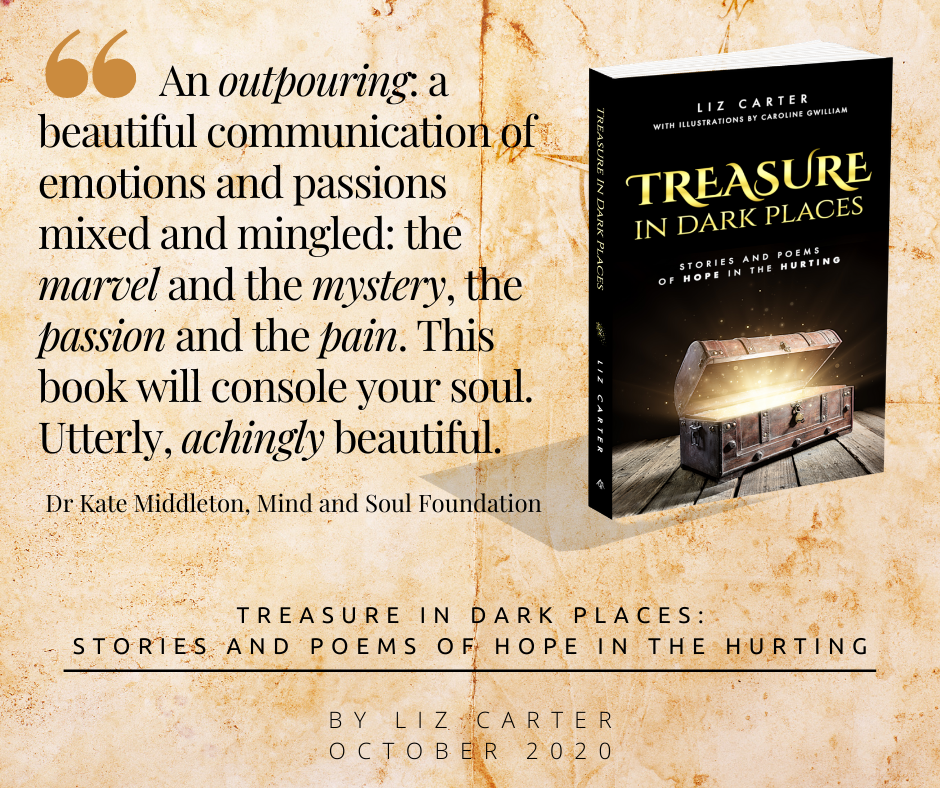
Treasure in Dark Places: Interview with Liz Carter

Two years ago, I read Liz Carter‘s stunning and challenging book ‘Catching Contentment: How to be Holy Satisfied‘. Her insights into finding peace and joy in God with no help from life circumstances made it my book of the year. It found an instant place in a collection of books I dub my ‘Pastoral First Aid Kit.’

Now Liz is back with a new title, ‘Treasure in Dark Places: Stories and Poems of Hope in the Hurting‘. Written mainly during lockdown and enforced shielding, and my copy arrived on publication day, last Saturday.

I’ve had the pleasure of interviewing Liz by email about her life situation and her writing. Enjoy.

Tell us a bit about yourself.

I live in Shropshire with my husband Tim, a vicar, and my two young adult children. I’ve been writing for most of my life – from a young age I knew it was what I wanted to do.

How long and in what ways has chronic illness affected your life?

I’ve been ill since infancy with a rare lung disease. I was the sickly child, the one always missing school. The disease is degenerative, so over years has taken more room in my life than I would wish. As a youngster I often felt different; a weakling, an object of scorn when I struggled once again in a PE lesson, someone who simply wasn’t trying hard enough, according to some of my reports. As an adult my illness arrested a teaching career after only five years, leaving me unable to work outside the home at a fairly young age. I was left feeling as if I had nothing to give, as if I was a failure, at life and at faith – surely, I thought (and some people said), I should have been healed, by now? I’d had enough prayer for healing through my lifetime – but it hadn’t happened. I’d only got sicker. Nowadays, I am often hospitalised with pneumonia, and struggle with multiple infections a year, leaving me in a constant state of fatigue and often breathlessness and pain.

Self-isolation during the COVID-19 lockdown must have been distressing. What was it like for you, and what got you through it?

When I received the shielding letter in March I was shocked and fearful. The words haunted me: I had been identified as someone at risk of severe illness if I caught the virus. I had to go into extreme shielding, away from my family, cut off in my room. I did not hug another human being for almost five months, and it was tough. I thought at first I would be okay with it, being used to some periods of isolation due to the infections I catch. But I wasn’t really okay at all, I found. Days were long and nights were sleepless, I was sad and I was scared. I’d been writing a book I thought I would finish, but the words stopped coming. I knew I needed to stop, to allow myself to admit this experience was painful, to sit within it a while. As I did so I found other words beginning to flow; words of honest poetry and re-imaginings of encounters with Jesus, words that took me closer into the depths of God when my own depths seemed fathomless. As I wrote, I found that God’s depths were even deeper still, and more than that, God was abiding there in those depths with me, holding me, in a way no other could.

Your first book, ‘Catching Contentment’, was about being content in Christ regardless of whether someone’s life circumstances were favourable. How did you first learn that for yourself?

To be honest, I’m still learning it – definitely a work-in-progress! It’s been a long journey over years, but the last few years in particular has led me to a greater peace in who I am and my situation, as I’ve delved deeper into what the Bible says about contentment – and how it doesn’t promise a pain-free life for those who follow Jesus. I loved reading more deeply around the words of St Paul, who said he’d found the secret to contentment, and wrote so profoundly of the truths he had discovered, of dying to self and rejoicing in all circumstances, of setting his mind on Jesus and living in the glorious hope we have been given. The more I read of scripture the more I can catch hold of the contentment not found in my wholeness, but in God’s holiness.

In your new book, ‘Treasure In Dark Places’, you are also tackling the question of suffering, but using other modes of creativity, such as poetry. How did you decide to approach this important theme from such a different angle?

I think that sometimes it’s difficult to capture something of the depths of pain and the breadth of hope in prose alone. The book of Psalms is my favourite book of the Bible because it expresses in such beautiful poetry something of the truth of who God is and how God loves, and I think that we need such forms today, as well. Often words of poetry will resonate and comfort deeper places where other words might not reach.

Can you share a short piece from ‘Treasure In Dark Places’ with us, please?

Yes, of course!

I wrote this one early on in the pandemic, when there was much talk of how the vulnerable and shielded would be placed at the bottom of the list for treatment when healthcare became overwhelmed. It was a response born of emotion but also of lament for all those who are suffering through illness or disability, and have been made to feel lesser in these times:

#SHIELDED

So what am I worth

in this scourge of the earth

it seems I am cursed

as my body is worse

than the young and the fit

I’m a number, an it

I know I’d be missed

but I’m on The List

condemned in a letter

until the earth’s better

I’m measured as less

in infirmity’s mess

But my value’s in more

than my CFS score

worth beyond age

or words on a page

more than a look

at lines in a book

a flawed reflection

of holy perfection

a new creation

of glory’s narration

loved beyond measure

in deep sacred treasure.

You’ve written these books despite the tremendous difficulties of your personal circumstances. Are people with chronic illness undervalued by the church, and if so what can we do to put that right?

Sometimes, yes, I’m afraid so. The undervaluing is expressed in 3 different ways, in general:

1. Sick people who have not been healed do not show enough faith, and therefore we should invest more in those who do.

2. People with chronic illnesses often cannot come to church, or to meetings, or can be ‘flaky’ and drop out far too often, therefore can be difficult to involve fully in the life of the church.

3. People who are long-term ill can be incredibly inspirational and brave, but we shouldn’t ask them to do anything because they probably don’t have enough energy.

All of these make assumptions: unless we are asked, we do not have the choice to say yes or no. Unless we are invited, we cannot grow into the calling God has upon us – for ministry, or hospitality, or anything else. Unless reasonable adjustments are made for our mobility needs and also for the fact that we do ‘flake out’ a lot, we are left on the edges, looking in to where it’s all happening without us.

I think that the pandemic has exposed something of this and many churches have responded so well, offering more and more content online to those who are housebound, and involving these people in leadership more. Churches will do well to keep up online worship when everyone else goes back to normal and sick people are left back in their isolation – I’m so glad my own church is being very pro-active about doing this.

With regards to those churches who assume lack of faith, that’s a simple case of re-examining some of the theology and bringing more compassion and understanding to the table. I’d love to see more of that!

Do you have any particular words of hope or encouragement for others who, like you, are enduring chronic illness or a life-limiting condition?

I find such great hope and glimpses of light when I reflect upon Jesus’ own life, suffering, death and resurrection. The more I think upon it, the more I am amazed at his outrageous and astonishing love for me, and the more this hope shines through the darkness. I would also want to add that it’s okay to release yourself from the bonds of feeling as though you have let God – or others – down, by continuing to be ill, whether physically or mentally. We must find space to be honest before God and others, to share our lament and our sorrow, and it’s in that place of honesty God so often does his redemptive work in our lives.

What is the main message of ‘Treasure in Dark Places’ and who should buy it?

Treasure in Dark Places is a collection of poetry and short stories that point towards hope, especially when it hurts. Its message is a reminder of God’s grace, love and supernatural peace, and a call towards the heart of God, to encounter more of God in our own depths and to lay out our own pain in candour and relief, as God meets us within our own dark places. It’s for everyone who sometimes finds life tough going – not only for those who live with illness, but for people who struggle in any way – I think that’s all of us, really.

Thank you so much, Liz.

I warmly encourage you to buy Liz’s books, Treasure in Dark Places and Catching Contentment.

You can also follow her blog and her YouTube channel.

Finally, here’s another poem from Treasure in Dark Places:

Video Sermon: How Do We Understand The Presence Of God?

Continuing with the story of Moses and the Israelites, this week we arrive at Exodus 33:12-23.

However, rather than explore this story, I’m taking up one important theme in it – the presence of God – and giving a sketch of that subject as it appears through Scripture.

I hope you find these thoughts helpful in your own life.

Forthcoming: Interview with Liz Carter

I know I’m largely only posting video devotions every Sunday morning at present, but I have in the pipeline an interview with Liz Carter about her new book ‘Treasure in Dark Places‘.

Two years ago, IVP published Liz’s book ‘Catching Contentment‘, a biblical look at how to be content when no life circumstances can provide that contentment.

Liz knows what she’s talking about, as she has had a serious chronic degenerative lung condition since her youth. ‘Catching Contentment’ was my book of the year two years ago.

Here’s a flavour of what’s coming. The interview is planned to appear on 21st October.

Create a website or blog at WordPress.com

Up ↑