Sabbatical, Day 54: Clay Shirky, Chapters 9-10

Fourth instalment from Shirky below.

Chapter 9 The Small World principle: when two strangers meet and find they know someone in common, it’s because within each different circle there is a small number of people who are highly connected. These people are the ones who are known by the two strangers. Social networking sites work on this principle: the sharing of a common interest (amplification) on the one hand and those who don’t share the interest (filtering) on the other. Today, software such as IRC, wikis or web forums can provide bridging capital and bonding capital more easily and cheaply than institutional methods.

Which is good reason for moving from institutional approaches to the new social tools.

Chapter 10 How do we tolerate failure and use it creatively? The open source movement isn’t necessarily more successful than the commercial realm, it just has a better way of tolerating failure. Not owning the source code means lower overheads. The ‘long tail’ of the ‘power law distribution’ also means that the single contribution made by the thousands are as valuable as the many contributions made by hundreds of programmers. 

Activists in the church often complain about those who seem to do little. Does the ‘long tail’ validly challenge this attitude or not?

Sabbatical, Day 53: Shirky, Chapters 7-8

Here is the next instalment from Clay Shirky.

Chapter 7 The key battles in protest movements are the ability to grow protests without state clampdown and documenting any opposition to cause an international outcry. That was true before the advent of contemporary social tools; now those same tools that can be used for fun can be used for political campaigning, even apparently banal tools like Twitter. They have shifted the ground from advance planning to real-time co-ordination that cannot be anticipated by opponents.

This of course is what terrorists have done, too. Hence government desires to see the electronic records of ISPs. But as the church moves more to the margins of society, this means we have just as much opportunity to influence and campaign as ever, just in very different ways.

Chapter 8 Social capital has been declining, but social tools make it possible to build it up again. Services such as Meetup.com make it possible for new groups to gather, existing groups whose transactional costs had soared can meet again, and latent groups can now set up without worrying abotu social disapproval.

Professionals lose out due to mass amateurisation. Existing social bargains (e.g., ‘who are the media?) are called into question. Networked organisations are more resilient, even the more objectionable ones.

Social capital and small groups should surely be central to church life rather than institutionalisation. Is this not a way forward, especially if we need to transition into ways naturally used by generations largely missing from traditional churches? 

Sabbatical, Day 52: Clay Shirky, Chapters 4-6

A few more thoughts from Shirky today.

Chapter 4 Economically, old media filtered information, and then published. Social media does the reverse: the process is now ‘publish, then filter’. And whereas one could do small things for love and big things for money, it’s now possible to do big things for love. People are no longer passive consumers, they are symmetrical producers. 

‘Publish, then filter’ has enormous implications for our instinctive desire to want things we don’t like banned. How do we cope if things we don’t like are already out in the wild?

How might we ‘do big things for love’?

It’s easy to treat church members and others with whom we ministers come into contact as passive consumers. Some are happy to be treated that way (especially in a consumerist culture). But what about those who want to be symmetrical producers? 

Chapter 5 Wikipedia works on the ‘publish, then filter’ principle. Hence criticism of errors, but Wikipedia is a tool (wiki) plus community, and it ‘self-heals’ on this ‘publish, then filter’ basis. It is a process, not a product. There is an unequal distribution among the contributors – a ‘power law distribution’ whre a few make a lot of contributions, and most people only make one contribution. This works, because people have a non-financial motive for contributing.

Often we complain about the ‘power law distribution’ in churches, where a small group of people do most of the work. But in the world of social media, this isn’t a bad thing. Discuss!

Chapter 6 Social tools and the Internet have made it easier for protest groups to assemble and campaign. It’s not so much about the latest technology, but about using that which has become commonplace.

This should be good news for the Church. TEAR Fund deploys its SuperBadger campaigns this way, but they are centrally driven. Maybe more might rise up from the margins.

Sabbatical, Day 51: Clay Shirky Chapters 1-3

Not being sure how much chance I’ll get to be in range of wifi or mobile broadband signals this Monday to Friday while I’m at Lee Abbey, I’m preparing a few short posts on Clay Shirky‘s book Here Comes Everybody.

Chapter 1 We now have what Tim O’Reilly calls ‘an architecture of participation’. Human tendency to work in groups plus new social tools means vastly reduced overhead costs. Institutions won’t disappear, but their role as a barrier to group action has collapsed.

So why do we still bother putting so much energy into church as institution?

Chapter 2 Social networking sites like Flickr have reversed the old principle of ‘gather, then share’ into the much more inexpensive ‘share, then gather’, thanks to tagging. The old state versus commerce choice assumed people couldn’t self-assemble. Now through social tools they can. They can 1. Share; 2. Collaborate; 3. Take Collective Action.

This has the potential to launch a new Reformation, undermining not just the Catholic priests of 500 years ago but all authority/institution figures today.

Chapter 3 Today’s social tools with their ‘mass amateurisation’ attack professionalism on two fronts. First of all, professionals control access to scarce resources. Blogs and the like mean that in the media, resources are no longer scarce. Secondly, professional depend on the recognition of fellow professionals. That too is blown apart when everybody is a media outlet. 

What implications might this have for the professionalism we cherish in the church?

Sabbatical, Day 50: On Not Taking Family For Granted

So today is Mothering Sunday – ‘not to be confused with Mother’s Day’, as Wikipedia says at the top of its entry. A time to remember our mother the Church, the Bride of Christ, as well as a time to honour those in our families who often more than anyone else have epitomised the selfless and sacrificial characteristics of love.

Today in the UK it is poignant to do so, given the death last night of Jade Goody, leaving her two small boys to remember Mothering Sunday as the first day of their bereavement each year. I imagine that if Jade could have hung on through today, she would have done. It is popular to talk of terminally ill people hanging on through certain events and then giving up. My father-in-law said he never wanted my wife and her sister to witness him die, and he slipped away just after they left visiting him at the hospital. Somebody else I know died thirty minutes after the midnight that signified the end of her husband’s eightieth birthday. 

But it is not always possible, and Jade Goody was taken from her sons at a most cruel time. When I heard of her death this morning, I had a deep sense that our children should never take their mother for granted. Right now, in their young ways, they don’t. I hope they never do. 

It has been hard to focus on Debbie today, because it is also Rebekah’s sixth birthday. And in a true sign of motherly love, although we gave her some presents and cards, Debbie has deferred the attention and focus of the day to our little girl. 

Rebekah with her '6' balloon for her birthday

Here she is, taking great delight in the balloon we bought to mark the occasion. She derived pleasure from all her presents, large and small. She is still at the age where the cost of the gift is not the issue. Long may it last! 

Several relatives and friends sent money for her, so we put that inside another present, a purse, and rather naughtily took her Sunday shopping. Now that she is doing some basic addition and subtraction at school, we hope it will be an early lesson in financial management!

We allowed Rebekah to choose the venue for lunch out. To our relief, she didn’t opt for the children’s interminably regular haunt of Pizza Hut, but another low-cost venue, Wetherspoon’s. Student friends of ours see it as a great place for low-cost booze (surely a curse in our society), we see it as a good venue for cheap meals. OK, you can tell they’re not prepared from fresh on site, but when funds are limited, a location where the four of us can feed for £20 is welcome. We have developed a family grace for mealtimes where we thank God for each member of our family, as well as the food. We then amend it when there are particular things to be grateful for: today was one of those days.

Back home now, Rebekah is enjoying the first High School Musical film on DVD. She had acquired numbers 2 and 3 as presents, and is watching the first one again to get back into the story. I’m going to wrap up the blog post a little early today, because this evening I shall be packing for tomorrow’s drive to Lee Abbey, and helping Debbie sort one or two domestic issues before leaving. 

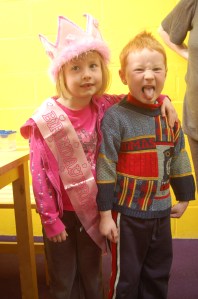
dsc_0041So I’ll just close with this picture of Rebekah from yesterday. Here she is, in her birthday sash, and wearing a princess crown, waiting with Mark to greet her guests at her pottery party at The Glazed Look.

Happy Birthday, little girl – it’s been six amazing years since that foggy morning when you came into the world courtesy of an emergency Caesarean when induction drugs were sending your heartbeat all over the place. Look at you now – kind, clever and fun!

Mum and Dad love you so much.

Sabbatical, Day 49: Rebekah’s Party

I didn’t think I’d keep up my record of daily sabbatical blogs today. By tea-time, I was in bed, exhausted and with a dreadful headache. Several bad nights’ sleep had taken their toll, and adrenaline had kept me going until finally I kept dropping off on the sofa to the embarrassment of the family.

Tomorrow is Rebekah’s sixth birthday, and today was her party. She had chosen a pottery party with ten friends at local studion The Glazed Look. That was going to make for a quiet celebration, rather than exuberant running around and noisy games. When Debbie booked his for her at her request, we didn’t know how significant that was going to be.

Because, just after 6 am, Debbie woke me to say Rebekah had been awake three times in the night with ear pain. (I may be having trouble getting to sleep at present, but once I do, there’s little that would wake me.) She also had a discharge from her right ear. By 6:30, I was on the phone to the out of hours doctors’ service, getting an appointment at their clinic for 8:10 am. Just as I had taken Mark there a couple of weeks ag on a Saturday night, now I was taxi for my daughter.

With nobody in the queue, she was seen on time by a lovely, gentle Indian doctor, and out came the usual prescription for amoxicillin – just what we expected. The nearest pharmacy open at that time on a Saturday was at Tesco, so we drove there. Knowing Rebekah doesn’t like the usual banana flavour of amoxicillin, he prepared an orange version. However, that didn’t make any difference to her dislike. But with alternating doses of calpol and calprofen, at least she got through her party and crashed out a little bit this afternoon. How devastated she and we would have been, had she not been able to. So it’s a big thank you today to the NHS staff who coped so kindly and efficiently with a little girl’s distress.

And with that I’m going to sign off, finishing some supper and watching Tottenham’s glorious victory over Chelsea today on Match of the Day.

Sabbatical, Day 48: Gambling, G20 And Our Children

Our belovèd government promises concern for problem gamblers and all affected by their habits. Which is why they are doubling the minimum stake in fruit machines to £1 and the jackpot to £70. So that will help.

If you are as offended by this foul act as I am, there is an online petition here and you can also visit Fruitless.

Thanks to today’s monthly e-news email from the Methodist Church for this, which also plugs the Put People First march for Saturday week. 

…………

Having kept Mark at home today due to his mystery rash (which has again disappeared), fine weather meant some time outside. He played with some chalk near on our drive and near the front door for most of the morning. He rather got ahead of himself:


Come to Mark's house it's Easter today

Below this first picture, however, you will be able to see that he is aware that Easter is not just for us. It is for everyone. No ‘This is my truth, tell me yours’ approach here!


It's Easter in the world


However, as the next picture shows, I eventually convinced him he was being proleptic and would have to ditch his realised eschatology for a ‘not yet’ approach to the kingdom of God:


3 weeks until Easter

The poor little lad will have to wait like the rest of us. He’s looking forward to chocolate and to the annual Easter party Debbie organises for him, Rebekah and a few of their friends. She started this our first Spring here as a way of trying to help our two make friends in the area. It has worked well. We now have the pleasures of egg rolling competitions on the drive, Easter bonnet-making (no, the boys never gravitate to that) and sundry other fun activities. The invitations have been going out in the last couple of days, not just to established little friends but to some other children whom we’d like encourage our pair to befriend.

We’ve also had further reason to take pride in Rebekah today, when she was moved up again to another level in the school reading scheme. She is delighted, too, but she doesn’t make a big deal about it and put down other children who haven’t reached her standard.

It was such a contrast this morning when I went to give my weekly twenty minutes of reading help in another class. I think they like me, because inevitably they get very few offers of help from men, although they’ll miss me next week when I’m at Lee Abbey. Each week I am given a different group of children. The groups are streamed, so from one Friday to the next I can get a vast contrast in ability. Today, I had three lads who were struggling. One in particular still can’t make the connection between the phonetic sounds of letters and the word he is trying to read. He should have known this a year or two ago, poor lad. The other two boys kept jumping in when this one didn’t know, which did nothing for his confidence.

So it was important this morning to have a simple rôle as an encourager. That was a privilege, just to try and boost the boy a little bit. I wondered how much encouragement he received. Certainly he gets it from the staff, who provide extra help, but clearly he suffers at the hands of other children, in the classic way in which youngsters are so cruel to each other. Some carry the scars for years. Occasionally, we ministers pick up on it decades later.

Sabbatical, Day 47: How Could I Forget My Daughter?

Pressed for time in blog writing last night, I made an unwise choice. Yes, I enjoyed writing about the bozos in the High Street, but how could I overlook the achievements of our wonderful daughter?

Yesterday was a terrific day for her. We saw her take the lead when her class led school assembly, sharing on a trip they’d had to Braintree Museum to explore Victorian life a couple of weeks ago. All the class said something, but Rebekah had to kick it off. Clear voice, good projection, nicely paced. Could  make a preacher of her yet.

Later in the assembly, the Deputy Head presented her with a certificate to mark the Maths test she passed last week. She looked so proud, in the right way. At the autumn term parents’ evening, her teacher had told us that Maths was her weakness. No longer, it seems. Not only did she pass this test, we had the spring term parents’ evening on Tuesday night, and she is attaining standards in numeracy ahead of her age now. So there has been a real turnaround. She has worked hard, and the teacher has done well with her.

Meanwhiles, Mark, according to his teacher, ‘can do everything’, and she’s having to hold him back on his reading because he’s so far ahead of the others. On its own, this would have worried us, but she discussed strategies with us for making a bit more of the books they’re expecting him to read that they know are below his capabilities. The real concern is his lack of socialising with children of his own age. 

Collecting the children from school yesterday, we were greeted with a very red Mark. Not only his hair, but blotches on his skin. We kept him off his swimming lesson. This morning, he was much better and we sent him in. However, by morning break the school had phoned me and I went in armed with Piriton. That did little, and at the beginning of lunchtime came the second phone call. We brought him home, and with the school anxious that he might be infectious with something like slapped cheek, Debbie took him to the doctor, where they had to wait alone in a side room before seeing a GP who wasn’t sure what it was, but said just to keep him off school tomorrow. Poor lad, ever since going full time at school in January, he’s struggled to do a full week any week.

Meanwhile, back at yesterday afternoon, Rebekah was fit for her swimming lesson. Once a term, the swim school tests the children. Yesterday, she passed her 20 metres badge, so great elation and more reason to eat chocolate!

Today, she is happy too, because another milk tooth fell out, thanks to a cherry cake that was served for dessert at school dinners. It has been irritating her for days. Tonight, it was not difficult to persuade her to sleep, because she is anticipating a nocturnal appointment with the Tooth Fairy. And in the tradition of a children’s book we once read about the dental sprite, she is sincerely hoping this tooth was clean and sparkling enough to find a home in The Hall Of Perfect Teeth. Our next door neighbour told her there would be an extra reward for such teeth.

Fat chance. The standard £1 coin is in the envelope with the TF’s letter. We’re not getting stung again.

Meanwhile on the sabbatical front, I still haven’t ordered any more books, but having a Myers Briggs personality type that likes to keep my options open, it was fatal today to receive a catalogue for church leaders from Wesley Owen. As I flicked through, hoping not to be tempted and take it on an early trip to the paper recycling sack, I was accosted by a few titles that could have something to do with my research. Not the ministry and personality type stuff, but the dialogue between traditional understandings of ordination and our contemporary missional context. 

So step forward Ministry By The Book by Derek Tidball. Prepare for Exile: A New Spirituality and Mission for the Church by Patrick Whitworth sounded interesting. And Evaluating Fresh Expressions:explorations in emerging church: Emerging Theological and Practical Models edited by Martyn Percy and Louise Nelstrop sounded like it might be useful as a critical voice from outside my tradition to ask hard questions about new forms of church. If anyone reading this has read any of these books, please let me know what you think in the comments below.

Sabbatical, Day 46: Bozos In The High Street, Hope In The Papers

If yesterday was St Patrick’s Day, I hereby declare today Bozos In The High Street Day. Two visits to major stores convinced me of that. In both cases, centrally decided policies or actions crippled the ability of those ‘on the ground’ to help. 

First, I visited W H Smith to pick up the copy of Mission-Shaped Questions I had ordered from them with a gift token. Having also received vouchers for £5 off books costing £10 or more, I wanted to order one or two more titles. However, there had been a power cut in the centre of town. Smith’s had lost electricity twice. As a result, their barcode scanners still weren’t working, even though power had been restored to the shop. This meant that if I ordered a book, they wouldn’t be able to give me the £5 discount. For gone are the days when you could order something and leave a deposit: now they insist on full payment upfront. As a result, ordering the book without the discount meant they were no longer competitive and they lost my business. I have no quibble with the young woman who served me: she spoke to her supervisor to see if there might be a way around it, but there wasn’t. At a time when they have lost so much to online stores like Amazon and when the recession is making life even harder, their inflexibility lost another sale.

Second candidate for Bozo status: Staples. I make occasional visits to this overpriced store that claims to price-match its rivals. Usually, it’s when I desperately need an inkjet cartridge, I’ve forgotten to order online and I am humiliated into paying their prices. Other times, it’s to get craft resources for Sunday School. 

Well – one day last summer, I was in there on one of my desperate inkjet missions and I couldn’t find my Staples Reward Card. (Not that it had rewarded me then, nor has it since.) A helpful assistant said, “Don’t worry, I’ll issue you with a new one. Ring the number on the accompanying leaflet and head office will combine your two accounts into one.”

That made sense. Except head office refused to do anything. Today, I finally remembered to take all the paperwork back when I called to buy some coloured card for an Easter party. The local people are bemused by their head office. Rightly so, in my opinion. I can’t see how a local shop would have the resources to amalgamate accounts. All they can do is scan the cards and issue new ones. Someone somewhere else just can’t be bothered. If they can’t be bothered … 

…………

From today’s Guardian: why the World War Two poster ‘Keep Calm And Carry On‘ has become popular again. Two quotes from the article:

Alain Samson, a social psychologist at the London School of Economics, says that in times of difficulty, “people are brought together by looking for common values or purposes, symbolised by the crown and the message of resilience. The words are also particularly positive, reassuring, in a period of uncertainty, anxiety, even perhaps of cynicism.”

Dr Lesley Prince, who lectures in social psychology at Birmingham University, is blunter still. “It is a quiet, calm, authoritative, no-b*llsh*t voice of reason,” he says. “It’s not about British stiff upper lip, really. The point is that people have been sold a lie since the 1970s. They were promised the earth and now they’re worried about everything – their jobs, their homes, their bank, their money, their pension. This is saying, look, somebody out there knows what’s going on, and it’ll be all right”.

These seem reasons worth pondering from a Christian perspective. People want to hear a message that – in the words of Bob Marley – is “Everything is gonna be all right”, but there needs to be substance and reason behind such claims. Otherwise it’s wishful thinking. The Christian claim is that we do have substance behind our hope, and it comes in the Resurrection of Jesus. However, with such claims ruled out on principle, our society is left without substance at a time when hope is needed.

The common values and purposes our culture cherishes still remain those of economic idolatry. It seems to be taking someone of simple intellect like poor dying Jade Goody to be putting spiritual issues in the centre of the news. And yes, some of what she is reported to say or long for does sound like folk religion, but she knows she has such little time left and spiritual claims are clearly featuring highly in her concerns.

Sabbatical, Day 45: The Gospel At The Post Office

You don’t go to our local Post Office when it opens on a Monday at 9 am. Not unless you need your benefits payment. The queue slithers out of the door and along the street. You’d better have something to occupy your mind.

For although our manse is on a prosperous estate, the nearest Post Office is across the park in a deprived area of town. It’s the only part of Chelmsford to have a tower block.

And, it turns out, you also don’t go there on a Tuesday at 9 am for the same reason. I know, I did that today. To keep things manageable in our small manse, Debbie sells toys, books and clothes the children have grown out of on eBay. She has sold about two dozen items in the last ten days, and I have been taking most of them to the Post Office for her. 

As I waited today, distracting myself with music on my MP3 player, I looked at the variety of people waiting. The tracksuited teenage couple with their toddler. Already, the mother was getting irritated by the child’s independent exploratory jaunts. The mother and adult daughter. Was one of them long term sick? The short, elderly lady immaculately turned out in a red coat far cleaner than any garment most other people were wearing. It was her public signal of dignity. The preponderance of up-to-date mobile phones, clutched by people whose demeanour suggested they couldn’t afford them.

And I thought, what is good news in a culture like this? I lived in such a place for eight years before moving here. Often, there was terrible low self-esteem there. People had been  rejected, dismissed and ignored by governments and commerce. You would have thought it were a simple case of ‘good news for the poor’.

But it wasn’t. For just as the good news is preceded by bad news as Wesley put it (preach law and then preach grace), there was the attitude that society owed them a living. 

Somewhere in between those two attitudes locally is something my local vicar friend Paul has described to me. His parish strides across half of our middle class estate and half of the deprived area. In one half, he has competent, educated, professional people who will volunteer for activities and get things done. In the other, he has people who either cannot or will not take the initiative to do things, because they swim in a culture where everything is done for them. Either they are disabled by that, or they have reason never to grow as people by taking more responsibility.

So what is the shape of the Gospel in such a place? I’m still wondering.

…………

This made me laugh: British nurse told to ‘take English test’ before she can work in Australia. The Daily Mail has gone all morally superior over another easy target case of ‘political correctness gone mad’ (™) but it is crazy. However, it does make a change from the Mail criticising people in this country who can’t speak English. 

Anyway, Happy St Patrick’s Day to you. I commend May We All Be Irish by James Emery White as a suitable Christian reflection for the day.

Create a website or blog at WordPress.com

Up ↑