Today, I start a new series of videos produced by Damaris Trust for Holy Week. In the first one above, Richard Collins talks about Jesus’ rather unusual entrance into Jerusalem. He discusses the significance of this event in terms of what it tells us about the kind of king that Jesus is, and the kind of kingdom into which he calls us.
Palm Sunday can be taken as a joyful day. We think of the crowds waving their palm branches, welcoming Jesus into Jerusalem. Yet as we know, pain is in the background. ‘Bow thy meek head to mortal pain, then take O Christ, thy power and reign,’ we sing in the hymn ‘Ride on, ride on in majesty’, which is laced with the anticipation of the Passion.
Right now, Debbie and I feel pain for friends. In the last few months, three Christian couples we know have separated. All have children. Sometimes we think we might know a partial truth of what has happened, but we have been careful to keep quiet and definitely not to extrapolate a small amount of data on its own to form conclusions. Our rôle is to be available if wanted, and most of all to pray.
I think each time the two of us talk privately about these tragedies, we give each other a certain look. It says, ‘There but for the grace of God we go.’ Not that God’s grace isn’t available to our friends – of course it is – but the sense that things can start sliding from small things, or something from the past we thought was buried might boomerang back from over the horizon and hit us, or we might make an uncharacteristic slip.
Not that I’m saying this is what happened with any of our friends, because we simply don’t know, and we don’t want to speculate. Rather, it’s that sense that we all need the mercy of God. We also need to keep that fine balance between the sense of security in mutual love and yet not allowing ourselves to take things for granted.
I think that’s all I want to say tonight. Say a prayer for these couples, for us, and for yourselves, whatever your domestic and family circumstances. May God guard us all. May we do our part in response. And may God work in the lives of our wounded friends.
With the school holidays kicking in today, Debbie has been planning all sorts of activities for our pair. Swimming, sleepovers, an Easter party and a trip to London (because Rebekah wants to see ‘the Queen’s house’) all feature.
Last night, she suggested I research the Wat Tyler Country Park on the web, with a view to visiting it today. Like Joshua and Caleb’s colleagues who reported on the existence of fearsome giants in the Promised Land, I told her after some surfing that by all means let’s go, but be prepared for a possible short trip, because our children were too young for much of what was mentioned on the website. What would a motorboat museum mean to them? A scuplture trail? Somewhere else I saw mention of bird hides – again, not something they would be ready for: how would they stay quiet and still? I didn’t mind trying it and admitted that the train sounded good, but I was pessimistic.
And this is where Debbie and I are so different. I have the kind of personality that looks for the problems. I figure you have to be ready for them before you leap in. Debbie, though, is a ‘can do’ person. She ploughs into something and worries about obstacles if and when she encounters them. When I foresee trouble, she hears that as me not wanting to get on with the task, and it frustrates her. It then frustrates me that she thinks I’m trying to find excuses! It happened yesterday when we were clearing out the garage. She kept giving me more things to cram in the car for the trip to the dump. I was worrying how I’d get them all in a small car safely; she saw no issue with just for once driving with restricted mirror vision.
It’s hard for each of us to cope with the other’s different approach at times. Each of us has to compromise and show an appreciation of the other’s strengths and concerns. It doesn’t come naturally, but it’s something to work on.
Such differences aren’t limited to married couples, they occur everywhere that human beings have to work together, churches included. We are under some illusion if we think it was all rosy in the apostolic Church, for example. Arguments over provision for widows, the place of the Gentiles, whether John Mark should get a second chance at mission, whether Paul should heed a prophecy about imprisonment – all these conflicts appear in the Acts of the Apostles. We need a lot of grace.
What happened in the end today? Setting out while there were still clouds in the sky, gradually God Photoshopped them out and revealed blue heavens. It was one of those beautiful Spring days that foretold the coming summer. We weren’t short on things for the children to do, because there were plenty of things at the park not mentioned on the website. Adventure playgrounds, craft shops, an ice cream kiosk. And the train was free today, because they were testing it before the summer season starts properly. The RSPB might well have hides on the marshes, but they also had activities for younger children. Our two decorated egg cups, and Rebekah was disappointed we didn’t have time for her to have her face painted as a princess.
Because we ended up spending so much time there. The motorboat museum can wait. And next time, I’d like to carry my camera bag there, as well as our picnic in my rucksack.
We spent this morning clearing out the garage. In this small manse, we need all the spare capacity we can get. So my little Renault Clio was filled with cardboard for recycling (the council only collects that monthly), along with other items that can’t be collected from the kerbside.
It’s made the hoped-for huge difference to the garage. We can walk around it freely now! Clear-outs are something we need not only physically, but sometimes also spiritually. I’m always struck by that verse at the beginning of Hebrews 12 where the writer calls his readers not only to to be free from ‘the sin that so easily entangles’ but also from ‘everything that hinders’. The latter might not be sin, but might be good things we have allowed to clutter our lives. Good things we have received with thanksgiving convert stealthily into idols we worship.
It was also the last day of school term today. Debbie and I were both in the school this morning, helping children with reading. Debbie was in Rebekah’s class and heard the teacher helping them to understand something about Easter. Apparently she said, “Rebekah knows about Easter, don’t you?”
We learned the truth of this when we opened her school bag after collecting the monkeys this afternoon. There in her bag was a sheet of white paper with the shape of an egg. The children had been asked to draw images of Easter. Rebekah’s said at the bottom, ‘Jesus’. In the centre was a drawing of him on the Cross. To the right she had drawn a little box containing the words, ‘Jesus is Lord.’ She may not know the deep implications of that confession, but she’s on the right track. It thrilled me.
Over the next fortnight of the holiday, we’ll have lots of fun with her and Mark. But I’m glad she’s heading into Easter with her spiritual orientation on track – however much she loves chocolate!
I’m going to raise a theological issue in a moment. Please don’t go away. It doesn’t require (many) long words, and it’s about an important issue in Christian life and witness. It’s something I’ve had in the back of my mind for a year or two, but never thought a lot about. But it has come up again today while I’ve been reading Tim Keller‘s ‘The Reason for God‘, and it’s rather more important than the continued slow broadband speeds I’m trying to diagnose here. (Something like 200k speed instead of our usual 1.8 meg or so. I’m currently running a full virus check as part of PlusNet‘s faults procedure.)
So here’s the issue. What do we expect of Christian behaviour? Twenty years ago at theological college, I was in conversation with a tutor. I don’t remember the topic, but I must have expressed some disappointment about church life in a placement. He replied, “David, never forget that the church is a company of sinners.”
And I wanted to reply, “Yes, but …”. We are a company of sinners, but I don’t like that most cheddary of Christian slogans, ‘Christians aren’t perfect, just forgiven.’ It seems to be an excuse for all sorts of unacceptable conduct. (Says he who is the chief of sinners. But I don’t want to excuse myself, either. I’m too good at rationalisation.)
The difficulty surfaced again when I read Eugene Peterson‘s book ‘The Jesus Way‘ in 2007. Much of that book is routine wonderful Peterson, but I found one part awkward. In using the example of King David’s life, he rightly trumpets the extraordinary grace of God in bringing forgiveness after forgiveness. And again, I thought, “Yes, but?” The grace of God is truly astonishing. How he picks up people like me, dusts us down and sets us on the road again is staggering. My ‘but’ was that I wanted to read something about transformation. If it was there, I missed it.
And that is the one area where I have struggled with Keller. There are so many riches in ‘The Reason for God’. I loved the passage on page 57 where he said that the problem with Christian fanatics isn’t that they are too serious about the Gospel, it’s that they aren’t serious enough, because they act like Pharisees rather than those who know grace. I also appreciated the fact that he tackles so many of the popular objections to faith, including the one where people rightly say that the behaviour of Christians doesn’t always compare favourably to that of non-Christians.
Now Keller rightly says that Christianity isn’t about moralism. It is – again – about grace. He also says the Christian faith has theological resources for understanding, if not expecting this dilemma. We can expect non-Christians to live outstanding lives, because (using the Calvinist term) he bestows ‘common grace’ on all. We all have the image of God in us, however damaged, is how I would put it. On the other hand, Christians are still sinners. So in believing the best about non-Christians and the worst about Christians (something we rarely do in the church), we need not be surprised if people who do not share our faith outshine us at times.
I am refreshed by the way he consistently goes back to grace. I think he is a shining example of not shooting down those he disagrees with in some crude culture war. Yet I think non-Christians have a point about expecting Christian conduct to be better, even without misunderstanding our message as one of moralism.
I have wondered whether Keller and Peterson’s Presbyterian traditions have anything to do with this. I’m thinking of the debates at the Reformation about justification. Essentially the Reformers separated justification and sanctification, whereas the Catholics conflated the two. Thus the Reformers, in emphasising their difference from Rome, stressed justification as being by the free grace of God through faith in Christ. Sanctification, in the sense of holy living, is also by grace through faith, but the Reformers wanted to separate it out as clearly as possible in order to deny any possible thought that good works merited salvation. So I would suggest it’s possible for someone in a strongly Reformed background to end up emphasising justification (in a Protestant sense) and underplaying sanctification. Might this explain Keller and Peterson?
The weakness I can immediately see in my argument is that the theological college tutor I mentioned was a Methodist. For Methodism has a subtly different tradition here, as I understand it. Wesley was with the Reformers in preaching that sinners were saved entirely by grace through faith in Christ and his atoning work on the Cross. But he moved onto sanctification much more quickly than the classical Reformers did. If you had faith, then (as in Galatians 6), that ‘faith worketh by love’: it was evident in a new lifestyle. The new lifestyle did not save you, but it was the evidence of having received salvation. It was gratitude for salvation, not the cause of it. It was a sign of the Spirit’s work of assurance, which was more than the objective promises of Scripture that the Reformers had stressed. With a theological heritage like that, then whatever one might think about Wesley’s controversial doctrine of Christian Perfection, you will not settle for ‘Christians aren’t perfect, just forgiven.’
So do the likes of Keller and Peterson allow us to be too easy on ourselves, or is that just the wonder of grace? Does Wesley lead us into moral self-flagellation, or is he simply calling out the cost of discipleship? And for those of you who might know Keller, Peterson, Presbyterianism in general or Wesley better than me, have I misread them at any key point? I would be very interested to read your comments, because – as I said in the opening paragraph – this is an important issue in Christian life and witness. For it is about the nature of salvation and a proper portrayal of Christianity to the world.
This morning before school, we tried to explain April Fool’s Day to the children. They got the hang of it to a certain extent, and much enjoyed the collective prank played on all the pupils at their school today when staff told them they had to hop everywhere.
Elsewhere, The Guardianclaimed it was giving up ink and instead would entirely be published in sub-140 character messages on Twitter. Some might be concerned about dumbing down, I’d be concerned for the spelling – anyone remember the days of the Grauniad? I also received a Facebook message from the We’re Related application, claiming that one Barack Obama of Washington, DC had added me as his fourth cousin, once removed. I’ve never heard of him, so it can’t be true.
Staying in the realm of truth, it’s been a bit of a techie day. I finally uploaded the Lee Abbey photos to my Flickr account today. I’ve organised them into three sets, all under one collection.
I’ve also been looking at some of the popular online music services in the last twenty-four hours. Yesterday, I downloaded the software for Spotify, but have been hampered by slow connection speeds. Some artists also had far fewer tracks available than I had hoped. I have also signed up for a free trial of emusic. I thought the offer of fifty free MP3 downloads was generous, but soon realised it would be easy to exceed that.
However, the emusic download manager has crashed tonight – whether that’s due to our slow connection as well, I don’t know. Certainly the problem isn’t limited to Spotify: YouTube videos only play a bit at a time, and the Flickr upload I mentioned in the previous paragraph took three attempts to complete. I’ve tried the usual tricks of rebooting and disconnecting the router for thirty seconds, but so far to no avail.
But if all the above sounds like trivial fluff, I have done some serious things today. Most notably, I have read three chapters of Tim Keller‘s ‘The Reason for God‘. To date, I’m impressed with the way he graciously exposes the weaknesses in contemporary objections to faith, especially Christianity. He manages to do so intelligently, without coming on like an intellectual warmonger. The book is definitely for people of a certain academic ability, and while I have the odd query about what he thinks everyone can agree on (immediately after he has exposed fundamental differences), I think this looks like one of the best works of apologetics I have read in years.
And here is a great article from Sojourners, about the increasing involvement in social justice issues by American Christian musicians.
Finally, just to say that Debbie is getting better today. Still washed out, but the fever has subsided and she has not been in bed. I’m relieved she’s improving.
Given that tomorrow is April Fool’s Day, here is a record of Google hoaxes in past years.
I find it a useful practice to read an evangelistic book every now and again. However, it’s a long time since I read one. Last week at Lee Abbey, I noticed they had cheap copies of Tim Keller‘s books ‘The Reason for God‘ and ‘The Prodigal God‘. I haven’t yet read the former, which is a book of apologetics, but I have completed the latter this morning.
It is a winsome and powerful meditation on what Keller calls ‘The parable of the two lost sons’, for both the younger and elder brothers in the famous parable are are lost. The younger is lost in devotion to selfish pleasure, and the elder is lost in self-righteousness. God is the true Prodigal, being reckless with generous love and grace. Only that unconditional grace changes people, and only that gives a healthy motivation for sacrificial service and a life of justice. I warmly recommend it.
Since finishing it today, I have begun to read ‘The Reason for God’ in between clearing down some of last week’s accumulated four hundred plus emails and – more seriously – a poorly wife. Last night, Debbie struggled with a vicious headache. This morning, she was washed out and has spent much of the day in bed. Tonight, she took her temperature at 39.5°C, so we’ll hit that with Paracetamol and keep an eye on it. At bedtime this evening, Rebekah said to her, “I wish I had a wish, because I would wish you back to normal.”
I’m opening up today’s post with a few final photos from last week’s photography course at Lee Abbey. All of these were taken last Thursday, on the final full day of the course. This is Lee Bay from the rear of Lee Abbey. It’s wonderful to look out on this view every day when you come down for an early morning cuppa.
Seat in the grounds of Lee Abbey
Here is a seat in the grounds of Lee Abbey, where you can relax. They chose the right email address for general enquiries: it’s relax AT leeabbey DOT org DOT uk. (I am not being paid for all this promotion of the place! I have simply been there five or six times over the years, and it is one of my favourite ‘thin places‘ in the world.)
Lynton and Lynmouth Cliff Railway
I spent Thursday afternoon in Lynton and Lynmouth. I took the Cliff Railway down from the former to the latter. It is another reason why I would like to take Debbie and the children there. We did visit the area for a few hours one day some years ago when Rebekah was tiny and we were on holiday elsewhere in North Devon, but I think the kids would love an attraction like this. Especially since at the bottom in Lynmouth there are some great shops for clotted cream (Debbie would love that) and clotted cream ice cream (we’d all love that). Not only that, there is a fish restaurant that sends the most wonderful aroma into the local atmosphere.
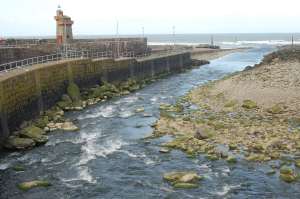
River and Bristol Channel at Lynmouth
Lynmouth itself is small, but pretty. There is a river which runs through the town and out into the Bristol Channel, as depicted here. I also caught various scenes of the river flowing under bridges and houses and hôtels built on the steep bank between the river at the bottom at Lynton at the top.
But at this point, I think I’m going to leave my memories of the Lee Abbey trip, at least so far as the blog is concerned. I might have wished for further ‘input’ on the course in terms of some theological reflection or some further inspiration on technique (although it was specifically advertised as not being a ‘technique’ course), but overall I am glad I went.
…………
On finally tonight to some personal news from today. I wrote in January about an out-patient appointment regarding my nose and sinuses, then earlier this month about the CT scan I subsequently had. Well, today was the follow-up appointment. I agreed to have the surgery, called septoplasty. It will happen some time in the next three months, involve an overnight stay in hospital and two weeks off work. The scan also showed some information I need to relay to my dentist, because the surgeon quite thought my sinuses were being interfered with by a tooth on the right of my mouth!
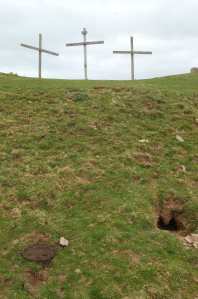
Wednesday’s expedition in search of photos saw me consulting a map of the Lee Abbey estate in order to find the location of the famous three crosses the community erected many years ago. They were not difficult to find. Unsurprisingly, several of us on the photography course took pictures of them, although nobody was there at the same time I was. I simply needed to let a group of pilgrims who were following some guided prayers around the land finish ahead of me.
For this first shot, I deliberately took the image from below, in order to include in the foreground the cow pat on the left and the treacherous hole in the ground on the right. Crosses are ugly and dirty, not shiny happy jewellery.
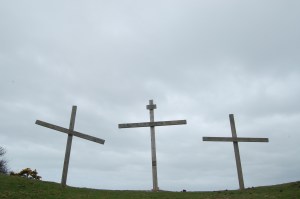
The Three Crosses at Lee Abbey set against a background of sky
For the second photo I have included here, my aim was a little more pragmatic. You will see that again I am below the crosses with a wide-angle lens, but I have included a large amount of featureless cloudy sky. This was one of several pictures I took, thinking they might be useful as backgrounds for PowerPoint or SongPro slides. On the surface, that may not be the most spiritual reason, although I would like to think that if this is used in public worship, it will play a small part in enhancing people’s devotion. However, I castigated myself for moving on all too quickly from the crosses in order to take more images. I think I share the general weakness for moving on as quickly as I can from the foot of the Cross. I certainly did so last week.
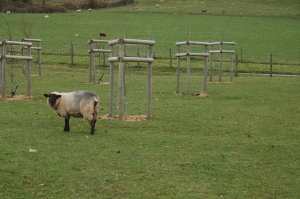
Lost sheep among saplings in putative orchard
This third shot is one I might use as a metaphor sometime. The sheep shown should not be in this field. It has escaped from the rest of the flock, and is roaming in a field planted with saplings that will eventually become an orchard. Next time I want a ‘lost sheep’ image, I may pull this one out.
The week was not all about the photography, though. On Thursday morning, one of the host team, Chris, recognised my name on my badge. I had thought he looked familiar, but he didn’t prove to be who I thought he was. Chris turned out to be the son of two people I had known in an ecumenical church in my last circuit. When I knew him, he was about eleven. Now he was eighteen, and spending a year in community while offering for the Anglican ministry. I must say, he looked a natural up in front of a large group of people from different backgrounds and generations. I gave him my email address before leaving, and asked him to tell me how he gets on.
I got back from Lee Abbey last night. As I expected, there was no Internet access, let alone wifi, for guests, but the place is as beautiful and spiritual as ever.
Setting off on Monday morning after the school run, the weather got progressively poorer the further west I drove. The most direct approach to Lynton and the Valley of the Rocks where Lee Abbey is situated requires slogging along the A39 and tackling two 25% (1 in 4 in old money) hills, one at Porlock, the other at Lynmouth. The latter is also combined with a hairpin bend. I chickened out, looking forward to a drive instead across the rugged beauty of Exmoor.
What a mistake. As the rain increased, I found myself driving through low cloud, in fog-like conditions. The 1 in 4s would have been less problematic!
After an initial welcome on Monday night (and my by now customary poor first night’s sleep – this time waking at 4 am and not slumbering again), the course kicked off on Tuesday morning. Our leader was Paul Judson, communications officer for Durham Diocese and editor of their online newspaper. A trained artist and photographer, he is ordained and married to a vicar. His theme, based on the Emmaus Road story, was ‘And their eyes were opened’. Each day, he took a theme from a Paul Gauguin painting and gave us just a few thoughts to set our fingers twitching on our shutters.
So it was that on Tuesday I walked down from the back of Lee Abbey to the rocky cove at Lee Bay, shooting whatever I fancied, and inspired to look more closely at some features. I found some surprising features.
Stones at Lee Bay
Here, for example, is a collection of stones I liked on the beach. I didn’t move them about or do anything fancy with filters either on the camera or in software, they just looked like this and I found the arrangement appealing. I hope you do, too.
Colourful branch washed up at Lee Bay
And I liked the colours here, too. This branch and the green net appeared to have been washed up in the bay. What had made the wood go orange, I wondered? I’m sure there is a simple answer, but again, I have applied no digital trickery to the shot. This is more or less just how I saw it.
But whatever I say about the lack of any software manipulation, I hit a severe problem that night when I reviewed my shots for the day on the laptop. A couple of marks that I could see in the viewfinder, and which I had thought were just dirt there, appeared in every photo. I didn’t have any blower, brush or lens cloth with me (and I knew it wasn’t a lens issue, because they appeared regardless of the lens I was using). I borrowed a blower and a brush from someone else the next day, but didn’t think I’d got rid of them. Someone else kindly offered to lend me his laptop that had the latest and greatest Photoshop CS4 on it.
I was rather nervous about playing with such high powered and exalted software, and explored other solutions – although I felt at one point like jacking in the course and coming home, because I thought all my pictures were going to be ruined. I thought that especially when I also noticed that shots from Rebekah’s birthday party last Saturday had also been afflicted. Debbie suggested on the phone that since that party had been at a pottery painting studio, maybe clay dust had got into the camera. That would have explained the difficulty in removing the dust, because it would have been more moist. Worse, given the lime component in clay, such dust could have been a nasty irritant inside the camera. The friend who loaned me the blower and brush found an advert in a magazine for Colchester Camera Repairs, and suggested I visit them on my return.
Meanwhile, leafing through my Nikon manual, I thought I had found a solution. I had never installed the accompanying Nikon Capture software. The manual said that if I took a reference shot of white in RAW format and took all other shots in RAW, then the software could compare the two and remove the blemishes. It wouldn’t solve Tuesday’s photos, which I had shot as JPGs, but I could prevent problems with future pictures. So I installed it onto the laptop from the CD. Problem: it needed to be version 4.3 or later, and Nikon had kindly only given me 4.2.
So I thought that on Wednesday, I would drive into Lynton with the laptop, install mobile broadband and download an update. Problem – big one: mobile broadband was so slow that the update would never have completely downloaded before my laptop battery would have expired. I gave up, and decided I’d download when I got home.
Meanwhile on Wednesday afternoon, Paul gave a lecture on using Photoshop. Now Photoshop is far too expensive for us, although we have Photoshop Elements 6 on the desktop here at home. I didn’t have the latter on my laptop for licensing reasons, but as Paul talked about the ‘clone tool’ that will take a colour from somewhere in a photo and apply it over something you want to remove, I wondered whether I had anything like that in any of the free or open source software I had put on the laptop.
Step forward to the rescue, The GIMP 2.6.4 and IrfanView 4.23! Both have such a tool. I removed the marks from all of Tuesday and last Saturday’s images. You wouldn’t know now they’ve had a problem. And although I said I hadn’t engaged in digital trickery for the photos above, both of them were doctored with The GIMP’s clone tool to remove two blemishes.
Maanwhile, none of Wednesday’s pics seemed to have the marks on them at all. So maybe my friend Sedge’s blower and brush had worked, after all.
Chapter 11 Successful social tools have a complex interaction of promise (why), tools (how) and bargain (rules). There are various ways in which the promise can be attractive and workable. The tools must fit the job and what people want, so need not be the latest technology. The bargain may be offered initially by one side, but modified by the users.
Dilemmas often centre on whether and how much governance is put in place. Do we use contracts, for example?
Do we have a tendency in the church to jump to governance before going through the other stages?
Epilogue The new tools don’t create new motivations, they amplify existing motivations. Once people have used them in extremis, they will use them in ordinary day to day life. They are adopted one person at a time.
Activists who have tended only to protest rather than be constructive may need a form of ‘incorporation’ (embodiment) that is different from current corporate law, by allowing gatherings in the virtual world, not just face to face.
The future belongs to those who work with the present, where these changes have happened.
If this is the new and coming reality, how serious are we about adapting to it in a Gospel way?








 Big Circumstance