The Lord’s Prayer: Who Is The God We Pray To? Luke 11:1-13 (Ordinary 17 Year C)

Luke 11:1-13

The late Rob Frost used to run a Christian conference after Easter every year, called Easter People. I don’t know whether any of you went to it. Some people described it as Spring Harvest for Methodists who were too scared to go to Spring Harvest. That’s a little harsh, but for some people there was some truth in that!

One year, I was asked to be a speaker at a set of seminars where a team of us was going to teach on the meaning of the Lord’s Prayer. Each of us had a section of the prayer to expound – one each morning for the week. It is so rich as a prayer that explaining and applying the entire prayer in one talk or one sermon fails to do it justice.

Indeed, when I have taught on it in churches before, I have taken a series of sermons to explore it.

But I don’t have that luxury today. So rather than go through the entire prayer at breakneck speed, I want to explore the teaching Jesus gives here immediately after the Lord’s Prayer. For it’s all very well knowing what to pray, but it helps to know who we are praying to, which is what that teaching is about. It’s no good using the right words or formula if we have a distorted picture of God.

Firstly, God is a friend. This is the theme of verses 5 to 8, where Jesus tells the story of the man who needs to disturb his friend at night for bread. And it’s no coincidence that Jesus mentions bread in this story after the petition in the prayer for ‘daily bread’ (verse 3). When we need our daily bread, God is our friend.

Jesus tells the story on the assumption that friends are bound together by honour or obligation. This wasn’t discussed much in Judaism, but the pagan philosophers of his world certainly explored this, and if we remember that Luke was a Gentile, then we see here some teaching that will make some immediate sense outside of Judaism among the new Gentile converts.

And in fact that is made all the clearer when we look at a difficult part of these verses. The latest version of the NIV translates verse 8 this way:

I tell you, even though he will not get up and give you the bread because of friendship, yet because of your shameless audacity he will surely get up and give you as much as you need.

Did you expect those words ‘your shameless audacity’? Aren’t you used to hearing ‘your persistence’, with the preacher then calling you to persistence in prayer?

The trouble is, the old ‘persistence’ translation is almost certainly wrong. An American scholar, the late Kenneth Bailey, who lived most of his life in the Middle East and who studied the ancient texts, the early translations into other Middle Eastern languages, and the local culture concluded that ‘persistence’ was wrong. It was wrong as a translation and it was wrong in the culture of hospitality in Palestine.

In fact, Bailey linked it to this concept of honour that I mentioned. The friend would not want his honour to be questioned, however grumpy he was for being woken up at midnight. That desire to maintain his honour would motivate him to answer the request for bread.

And so I go with the alternative translation that is a footnote in the NIV: not ‘because of your shameless audacity’ but ‘to preserve his good name’. God is an honourable friend, so much more honourable than the grumpy friend in Jesus’ story. He does not want the honour of his name to be called into question, because it is so important to him that his position as our friend is maintained.

So I wonder what ‘daily bread’ needs you bring to God? It may literally be daily bread, especially with the problems our world is having with supply and inflation. We now know that Jesus’ expression ‘daily bread’ was one that was in everyday use in his day, because some years ago archaeologists found an ancient shopping list which specifically mentioned daily bread.

If you are bringing your basic needs to God, know that you are bringing them to an honourable friend. And that is not just a formal expression in the way that Members of Parliament refer to MPs of the same party as ‘my Honourable Friend’, this is real and deep with our God. For the honour of his name as our friend, he will make sure our needs are met. He will not do so miserably or reluctantly, because he cares for us.

I urge you to put aside any thought that it’s unworthy to bring your basic needs to God in prayer. As your friend, he cares about the food you eat, the income you have, the energy you need for your home, the clothes you wear, and many other things, too. As Jesus reminded us in the Sermon on the Mount, he does not want us to worry about these things. Why? Because as an honourable friend, he will see to it that we have enough.

Do not view God as an ogre, says Jesus, view him as your caring friend. He is so much better than that. He is not cruel. He is caring. He is not indifferent and asleep but ready to be asked. Bring him your needs without shame.

Secondly, God is our Father.

Now in recognising God as Father, I am of course aware that there are people who have had bad experiences of a human father. That’s not something I can say. When my father died five years ago, I wrote on Facebook that a light had gone out of my life.

But what I experienced was growing up in a family where money was tight. Often I tell the story of being a small boy and overhearing my parents talking one evening about how they were going to manage all the bills, so I went into the front room where they were and offered to give up my pocket money. So I didn’t have an abusive father like some, but I had an experience of finding it hard to believe that a father could provide everything I asked for.

Things improved as I got older, but the key for me was slowly absorbing the biblical picture of God as a caring, concerned, compassionate Father, who had all the resources of creation at his disposal:

for every animal of the forest is mine,
    and the cattle on a thousand hills (Psalm 50:10).

So for those who do not have a good image of the word ‘father’ I do not take the route of dispensing with it and just using feminine language for God, I prefer over time to rehabilitate the notion of fatherhood, because its use for God is a good and nourishing one.

This is what Jesus basically says to his listeners. Paraphrasing, he says, you know that human fathers want to give what is good to their children, so how much better is your heavenly Father? Scorpions for eggs? No! In the Holy Land, scorpions are common and I read the other day of someone who camped on a beach there and found a small scorpion had crawled into his sleeping bag.[1]

But no loving father would do that to their children. And neither will our heavenly Father with us. He will only give us what is best for us.

Now ‘what is best’ is naturally not necessarily what the world considers ‘best’. It is not necessarily the best of material possessions, the highest of incomes, and the most desirable of homes.

Rather, you may have noticed that Luke’s account of these words differs in one important way from Matthew’s. Here, Jesus does not say, ‘how much more will your Father in heaven give good things to those who ask him,’ he says, ‘how much more will your Father in heaven give the Holy Spirit to those who ask him’ (verse 13).

The very best is God’s own presence with us for ever, the Holy Spirit. Can anyone beat such a gift? No!

As parents, Debbie and I will give to our children so that they may make the best of their lives, and we keep savings in order to do that. We do not give to them in order to indulge them, but so that they can have the best we can provide for them to make something worthwhile with their lives.

Well, it’s all that and much, much more with God. We can confidently ask him for the good things we need, and because not only is he an honourable friend, he is also a loving Father, he will provide for us. But he will set us up for the life of serving and loving him in his kingdom – the best life of all, even if it is costly – by the gift of his Spirit.

Would it not be the most natural thing of all, therefore, for Christians regularly to be praying for more of the Holy Spirit in their lives? It seems logical to me if we have such a loving and caring Father in heaven.

I know that we still go through hardships. I know that we still face trials. I know that we still face life situations where we do not know why certain things are happening to us. But through all that I am still convinced of God’s fatherly goodness to us. Let me tell you one final story about that goodness as I have experienced it.

Much earlier in my ministry, and a little while before I met Debbie, I was considering whether to buy a new computer for my work. I really liked the look of one particular model, and I wanted to buy it.

But I was hesitant. As you know, I like computers! And I didn’t want just to kid myself that this was God’s will to spend this large amount of money. So I prayed and left it with God.

In my main church was a woman called Mandy. One night at the church prayer meeting she had had such a powerful experience of the Holy Spirit and afterwards she discovered that she had received the spiritual gift of prophecy. Not prophecy in the sense of foretelling the future, but prophecy in the sense of being able to bring direct and relevant messages from God to people.

One Saturday morning she had gone to the church premises to pray on her own. Walking around, she came to the front of the sanctuary, near the communion table and the lectern, and in that area she felt prompted to pray for me.

While she was praying there, she heard God say to her, ‘Tell Dave he can have what he wants.’

She relayed that to me sometime in the succeeding days and I knew instantly this referred to my dilemma about the computer. My prayer was answered by a loving Father.

In conclusion, I don’t want to harangue you about the need for prayer, it’s too easy to do that. Instead, I want you to hear just how good and loving our God is. He is the friend who will maintain his honour by providing what we need. He is the Father in heaven who provides the good and the very best for his children.

Let us be confident in this God of love when we pray.


[1] https://www.psephizo.com/biblical-studies/how-can-we-pray-like-jesus-in-luke-11/

A Meze Meal of Mission, Luke 10:1-20 (Ordinary 14 Year C 2022)

Luke 10:1-20

The first time I was invited to a meze meal at a Greek restaurant, I was daunted when I saw the menu. Twelve courses? How on earth would I get through all that?

But I need not have worried. For if any of you have had a meze meal, be it Greek or Turkish, you will know that the many courses are small in size. They are more like taster menu size.

And not only that, they arrive thick and fast. So if you try one thing and don’t like it, then you don’t have to worry, because in a few minutes another dish will be served and you may well like that better.

Today I want to give you a meze sermon. My thoughts on this passage have turned into a series of several short reflections. There won’t be twelve, though!

And while I don’t want you to sit in judgment on the Word of God, I do encourage you to see as we go along which points nourish you, which themes are relevant and challenging to you, and which ones are of lesser importance to you now.

As you will have realised, the overall subject of the reading is the mission of Jesus.

Firstly, mission is about partnership:

After this the Lord appointed seventy-two others and sent them two by two ahead of him to every town and place where he was about to go. (Verse 1)

No big names here. We don’t know the names of the seventy-two. And they don’t go alone, they go in partnership.

There is no need to wait for the next big evangelist to come along and hire a huge venue in which to preach if we want to reach out to the community with the love of God.

I have nothing at all against the Billy Grahams of this world. They have had a good effect on millions of people. But they were of their time, when radio and television were exploding. They may no longer be of our time now, either.

And Jesus didn’t use this method much. Yes, there were a few times in the Gospels when large crowds gathered to listen to his teaching, but mainly he sends his disciples into the world with his message.

Wherever we go in the world, we have opportunities to speak about Jesus. It’s important that we cultivate our relationships in the world for this sake.

I talked about this in a meeting when I was at theological college, and afterwards one of the lecturers came to me and confess, “I don’t think I have any friends outside the church.” How sad. We will never make an impact on the world if we don’t have non-Christian friends.

Where are your non-church friends? Could you and a fellow Christian build a relationship with them and support each other through the challenges of outreach?

Secondly, mission is about prayer.

 He told them, ‘The harvest is plentiful, but the workers are few. Ask the Lord of the harvest, therefore, to send out workers into his harvest field. (Verse 2)

I think you know by now that one of the things I am tired and despairing of in the church is the attitude that says we can correct all the things that are wrong in the church or the world with the right techniques or money or publicity. Some have called this ‘the technological fallacy’, because it forgets the supreme rôle of people.

But above all human beings is Almighty God, and it is to him we must turn if mission is going to make a difference. When we have realised that all the technology and the latest fads and fashions will not rescue us, perhaps we will remember that our primary task is spiritual, and it requires a spiritual approach.

We can pray in a number of ways as part of God’s mission. We can pray for those we know and love who do not yet know God’s love in Christ. We can pray that our church will be led by the Holy Spirit in what we do to bring God’s love to our community. We can pray for the wider church in our nation and around the world: what might she be doing to proclaim God’s redeeming love and to demonstrate it?

So who are you praying for? And how are you praying for the church’s involvement in mission?

Thirdly, mission is a priority.

Go! I am sending you out like lambs among wolves. Do not take a purse or bag or sandals; and do not greet anyone on the road. (Verses 3-4)

Look at how Jesus doesn’t want the seventy-two to be distracted. Minimal money and possessions. No distracting conversations on the way that will delay you.

Do we really make mission a priority in the church today? What do the agenda of our business meetings tell us about what we consider important? How much time and money are we spending on showing people outside the church the redeeming love of God in Christ? And how much time and money is going on keeping ourselves comfortable?

So now that we are living without COVID restrictions (would that we were also living without COVID itself) what are the activities we can undertake that will provide a bridge to those who need Christ? The more we go on the more we shall have to do things beyond the boundaries of the church building, because this is an alien and unsettling place for members of the unchurched generations.

But we may also be able to remain invitational to some extent. David Voas, Professor of Population Studies at the University of Essex, wrote this in an Anglican document:

Inviting friends to church does not come easily to most English people, which is partly why it is helpful to have non-threatening halfway house events like carol services as a draw. A corollary of the social difficulty of extending invitations is the reluctance to refuse them. Ours is a culture in which asking is a powerful act: it is hard to do but correspondingly hard to decline.[i]

Fourthly, mission is about prevenient grace.

When you enter a house, first say, “Peace to this house.”If someone who promotes peace is there, your peace will rest on them; if not, it will return to you. Stay there, eating and drinking whatever they give you, for the worker deserves his wages. Do not move around from house to house. (Verses 5-7)

The Gospel is a message of many blessings. It includes peace with God and one another. It includes healing of every kind. So if we want to know whether it is worth giving our time to a particular place or person or family, we look for signs of responsiveness to that good news. Is that something these people desire? Is it something they would love to emulate? If so, then it is worth our time.

Why? Because these are signs that God has been at work before we got there. God is now bringing us in to use us in finishing the job.

Last week we talked about moving on when people reject Jesus, and he still allows for that here in what he goes on to say about those who are unwelcoming and the prospect of judgment. But since we majored on that last week, let’s concentrate more on the idea that we look for signs that God has already prepared people for his Good News.

It’s what John Wesley called ‘prevenient grace’. It is grace that comes before anything we do. God always acts first in salvation, we only respond. If someone finds faith it will not be our doing. Instead, God will have been at work in them before we show up and do our part.

So we bless people with peace. We seek healing and all other kinds of blessings for them. If God has been preparing them we will see some evidence and then we should remain and persist. If there is hostility, we move on and warn them of the consequences if they do not repent.

Fifthly and finally, mission is about peace.

I’ve just said that peace is part of the Gospel. In fact, it’s pretty central. The wonder of the Gospel is that God gives to us before we give to him. He even gives before we are worthy – if ever we are, anyway.

But for all that, it’s easy to get wrapped up with what we have done – especially when things are going well, as the seventy-two found out here.

The seventy-two returned with joy and said, ‘Lord, even the demons submit to us in your name.’

He replied, ‘I saw Satan fall like lightning from heaven. I have given you authority to trample on snakes and scorpions and to overcome all the power of the enemy; nothing will harm you. However, do not rejoice that the spirits submit to you, but rejoice that your names are written in heaven.’ (Verses 17-20)

Just as we proclaim a Gospel that is about God’s grace and mercy rather than human merit, so we need to keep within that. It is dangerous to rejoice in anything other than that, says Jesus. If you start rejoicing when everything is going well, you will falsely attribute success to yourself, rather than to God using you. And if you do rejoice when things go well, what will you do when things go wrong? The sense of your value and worth to God will oscillate. You will be unstable.

No, says Jesus, rejoice that your names are written in heaven. This is what anchors us – the grace and mercy of God to us in making us his own, despite our sin. It’s what we proclaim as the Gospel. And it’s what keeps us on an even keel.

Never lose the joy and wonder that goes with that. It will make people wonder about you – in a good way!


[i] From Anecdote to Evidence: Findings from the Church Growth Programme 2011-2013, quoted at https://www.paulbeasleymurray.com/2022/06/30/develop-an-invitational-culture-or-die/, accessed 1st July 2022.

When Someone Says No To Jesus, Luke 9:51-62 (Ordinary 13 Year C, 2022)

Luke 9:51-62

What should we do when people say ‘No’ to Jesus? Or maybe they don’t say a clear-cut ‘Yes’?

It’s a question that troubles many Christians. Sometimes that is because the person saying ‘No’ is a loved one.

Our reading from Luke today deals with that issue. Both parts of the reading are relevant to this question, both the Samaritan villages that do not welcome the disciples, and the three people who in Jesus’ eyes display inadequate commitment. Each of the two parts says something distinctive about how we respond.

Part 1: Judgement Is Above Our Pay Grade

As Jesus sets out for Jerusalem, he sends messengers ahead of him, but despite this in one Samaritan village they do not welcome him (verses 51-53). Imagine civil servants and royal equerries being sent to a town ahead of a visit by the Queen, doing all the donkey work, then the Queen arrives and people throw bad eggs and rotten tomatoes at her. It’s a bit like that.

You can understand James and John asking Jesus, ‘Lord, do you want us to call fire down from heaven to destroy them?’  (Verse 54)

You can understand their reaction all the more when you remember that elsewhere in the Gospels Jesus had a nickname for those two. In Mark 3:17, he called them ‘sons of thunder.’ What does that say about them? Were they like first century Hell’s Angels, riding into the village in their leathers and on their Harley Davidsons? Were they more like punks, spitting at people they didn’t like? It’s not a flattering nickname, and a desire to call down fire from heaven on an unwelcoming village seems perfectly in step with the name.

So if you thought of John as the gentle apostle who wrote about love, think how much he was transformed over the years!

And surely to reject Jesus is to reject salvation? So isn’t judgement the natural corollary? Wasn’t there a logic to what James and John suggested?

Perhaps we can identify with them more than we might easily admit. Think of a time when you were rejected. Did you have unworthy thoughts inside you about the people who did that to you?

Or remember a time when one of your children was treated badly by someone. What did you want to do to the perpetrator? You might not have said it out loud, but somewhere inside you there was probably a rage against that person, and you began to imagine what you would like to do to that person if you have the guts and if you thought you could get away with it.

I will confess to you that I am like that. You may have me down as a placid character, but don’t anyone dare mess with my children, even though one is now an adult and the other will be in a matter of weeks. I sometimes think I could write the script of an 18-rated film if I followed all my darkest imaginings.

But Jesus rebukes them (verse 55) and he and the disciples move on to another village (verse 56). We don’t know what Jesus says in his rebuke, but we can probably infer.

We know that Jesus spoke clearly about God’s judgement at the end of time. If I recall correctly, all but two references to Hell as a consequence of judgement in the Bible are on the lips of Jesus. He didn’t mince his words. Yet he didn’t endorse what James and John said. Instead, he moved his disciples on elsewhere.

I think the inference is very clear. We may indeed be upset, but let us leave judgement to God and move on. This is not a way of making excuses for people, but it is to say that judgement in the hands of God will be righteous and holy. In our hands it is imperfect at best, and at its worst descends into naked revenge.

Think for a moment: we know that God is holy and God is loving. What better character could there be to exercise judgement than the One who perfectly embodies those qualities? Do we measure up? No.

When someone we know rejects Jesus, or rejects us because of Jesus, then we leave the judgement to God. We pray a prayer of relinquishment, handing them over to God, who is best placed to deal with them in righteousness and love. ‘Lord,’ we say, ‘ will you please deal with this person? You will do what is wisest and best.’

And then, like Jesus with his disciples, we move on. We may or may not move on geographically, we may simply move on emotionally. But to move on is healthy. Leave the situation behind with God. He knows best what to do so that person might find him, or if their heart has become hardened towards him.

So concentrate on someone or something else. There are so many people who need to come into contact with the love of God, and he uses us to do that. He may have a new challenge for us.

Part 2: Don’t Lower Your Standards

When we get on to the brief exchanges Jesus has with three people who apparently do want to be his followers but whose offers he does not take up (verses 57-62) it’s important to remember that Jesus often teaches by saying extreme things to make a point. In English we call this ‘hyperbole’, and it was very common in Jewish teachers.

So when he tells the first enquirer that the Son of Man has nowhere to lay his head (verse 58) he is making a big, cartoon-like statement to make that person realise that following him risks involving considerable inconvenience and discomfort. Don’t come this way if you just want life’s creature comforts, says Jesus.

And when we look at the life of someone like the Apostle Paul, we see someone for whom that was profoundly true. Paul talked about physical danger, imprisonment, threats to his life, being stranded at sea, sleeplessness, hunger, and thirst all in one passage, for example (2 Corinthians 11:23ff). It’s not exactly the way to the good life as is commonly conceived by people today!

If you follow me, says Jesus, you’re not signing up for an easy life.

Then when the second person wants to bury his father, Jesus says that the man cannot put social norms and expectations above following him. The man can’t have been talking about the actual burial of his father, because that happened within twenty-four hours of the death. This was necessary in a hot climate, and to this day Jews and Muslims bury their dead much quicker than we do.

So the only burial the man can be thinking of is what happened later when the bones of the deceased were transferred from their own grave to a communal ossuary in the village. There was no requirement in the laws of Moses for a son to do this, it was a matter of social custom. Jesus says you can’t elevate that over following him. He is Lord.

The third person makes what also sounds like a reasonable request, to say goodbye to his family, but Jesus’ response about not looking back when you have put your hand to the plough (which was a well-known ancient proverb) indicates that Jesus thought this person was easily distracted from the cause of God’s kingdom. And you can’t do that. You can’t be half-hearted. You can’t say, well I’ll come to church when I feel like it. Or, I’ll do what Jesus wants when it doesn’t get in the way of what I want to do.

I want to suggest to you that Jesus’ approach is the opposite of what we typically say today. We are so desperate about our declining and aging numbers that we say Jesus welcomes all, but we drop the obligations that Jesus puts on disciples.

But here’s the paradox: the grace of God is free, but it costs us all we have. A church that preaches free grace but not discipleship is not preaching the Gospel.

Hear it again: the grace of God is free, but it costs us all we have.

John Wesley knew this, and he structured the early Methodists accordingly. We have heard a lot about the small groups he set up, but he set up more than one kind of group, and they had different purposes. So the class meeting was the one open to all, including those enquiring after the faith – or, as Wesley put it, ‘Those who desire to flee from the wrath to come.’

But the band meeting was for those who were seriously committed to Christ. In the band meeting members held one another accountable for their Christian lives each week. They did so in a confidential relationship. Even to this day Methodist ministers will sometimes say to each other, ‘I want to speak in band.’ This means they want to speak confidentially.

When someone is unwilling to accept Jesus’ challenging standards for discipleship, it is the wrong response to lower the bar. Jesus never did that. When the rich young ruler walked away, Jesus didn’t chase him and say, I didn’t really mean you had to give up all your possessions. Just ten per cent will do.’

When people are reluctant to follow Jesus, yes of course we remember that God’s grace is freely offered to all, but we must also remember it will cost us everything.

If someone says no to that, we leave the judgement to God and we move on.

Defeating Evil, Luke 8:26-39 – Jesus and the Gerasene Demoniac (Ordinary 12, Year C)

Luke 8:26-39

We had hardly passed the worst of the COVID-19 pandemic when Vladimir Putin began his invasion of Ukraine. For our world, it has been one storm, closely followed by another.

You could say that is what Jesus and his disciples face in this story. From the storm on the lake to the storm in an individual’s life, a storm so violent that he has effectively been put in an outdoor solitary confinement by his society.

Yet as Jesus stilled the storm on the lake he now stills the storm in this man’s life. Surely this story, then, is good news for a world facing its own storms.

We might think that a story of someone infested by many demons is far from our experience and beliefs today, but the themes of the story are in fact profoundly relevant to us.

Yes, it is remote in one sense, even for someone like me who does believe in the existence of the demonic, because even I don’t see demons under every bed. I can only think of one or two cases where I am certain I have encountered them. And in my opinion only a few Christians are called to confront them as Jesus does here.

But I still find relevant themes here for our life and mission today. Luke himself certainly didn’t see this as purely confined to the ministry of Jesus. You can see that in the use of one particular expression that occurs elsewhere in his writings. The man addresses Jesus as ‘Son of the Most High God’ (verse 28). Not only was this a title that the Archangel Gabriel used twice when telling Mary about the child she would conceive (Luke 1:32, 35) it is also a title that pops up in Luke’s other book, the Acts of the Apostles, when Paul is faced by a demonised girl (Acts 16:17). Now if that is the case, Luke must have assumed that this kind of ministry was not unique to Jesus, but it continues with his followers.

Firstly, the story reminds us we are in a spiritual battle.

Where did Jesus fight his initial great spiritual battle? In the wilderness, and the Holy Spirit led him there (Luke 4:1). Note the contrast with the afflicted man in this story:

Many times it had seized him, and though he was chained hand and foot and kept under guard, he had broken his chains and had been driven by the demon into solitary places. (Verse 29b)

The man has not been led by the Spirit but driven by the demon – to where? Solitary places. The Greek word translated ‘solitary places’ is the same one used for the desert where Jesus faced his three temptations.

What are the differences? Jesus is led by the Spirit, the man is driven by the demon. Jesus resists temptation, but the man does not or cannot resist the forces of evil.

We know only too well our own battles with evil and temptation, especially when we are in solitary places, isolated from the support and encouragement of others. How ashamed we feel when we realise yet again that we have not conquered sin and temptation like Jesus did in his earthly life.

But the key to winning the battle is Jesus. When we have failed and need forgiveness again, we remember that he has won the battle against evil not just on his own but on our behalf. Ultimately, he conquered it at the Cross. When we have faith in him and are united with him, then we are clothed in his victory, not our failure. The Father looks at the repentant sinner, united with Christ, and sees the victory over sin of his Son. This is Good News!

And not only that, Jesus gives us hope for our future battles. For just as he was led by the Spirit, so since Pentecost he promises the Spirit to us, too. We can be led by the Spirit as well. When we are faced with temptation, then we can call on the Holy Spirit to strengthen us in resistance and holiness. That’s why Paul writes these encouraging words on temptation in 1 Corinthians 10:

No temptation has overtaken you except what is common to mankind. And God is faithful; he will not let you be tempted beyond what you can bear. But when you are tempted, he will also provide a way out so that you can endure it. (1 Corinthians 10:13)

Secondly, this is a story about power.

I’m sure you will remember from other biblical stories that in ancient times there was something powerful about a person’s name. You will recall stories where people are given particular names with certain meanings, because these indicate the kind of person or life they are going to lead under God.

But the ancients also believed that if you knew someone’s name, you had power over them. So the demons try this on early in the story, even though there seems to be a note of fear in what they get the man to say:

‘What do you want with me, Jesus, Son of the Most High God? I beg you, don’t torture me!’ (Verse 28b)

They know who Jesus is. And they know what he can do to them.

Jesus, though, shows no fear. He asks the name and takes control.

Jesus asked him, ‘What is your name?’

‘Legion,’ he replied, because many demons had gone into him. And they begged Jesus repeatedly not to order them to go into the Abyss. (Verses 30-31)

Jesus has authority as Son of the Most High God, and he knows all about the demons controlling this man. Who is in charge here? Jesus.

Again, this is good news for us. Jesus knows the names of those who oppress us. He has power over the forces of darkness that make our lives miserable. He is coming for them.

Sometimes, that means quite a wait. We don’t know how long this man had been afflicted by demons. Sometimes it is quicker. In other cases they will be dealt with at the Last Judgement.

I believe that Jesus is coming for Vladimir Putin. There will be a dreadful price for him to pay if he does not repent. So too will there be for the monsters in power in Beijing, who persecute Christians, Uyghur Muslims, and others. I think this is part of what we call ‘Good news for the poor.’

One of my favourite Psalms for appreciating this is Psalm 73, where Asaph the Psalmist begins by talking about how the wicked have everything their own way and the righteous suffer (verses 1-16). But then he enters the sanctuary of God (verse 17), the place of worship, where God is acknowledged as King , and he sees things differently:

Surely you place them on slippery ground;
    you cast them down to ruin.
How suddenly are they destroyed,
    completely swept away by terrors!
They are like a dream when one awakes;
    when you arise, Lord,
    you will despise them as fantasies. (Psalm 73:18-20)

God places the wicked on slippery ground. Don’t just look for instant obliteration: watch the unfolding of history, and pray. The power of God will prevail one day, and especially at the Last Judgement.

Thirdly and finally, this story is about restoration.

Contrast the man at the beginning of the story and at the end. At the beginning he has not worn clothes for a long time (verse 27) but after the demons are expelled he is ‘dressed’ (verse 35). I wonder where the clothes came from. Did Jesus send the disciples to get some?

At the beginning of the story he is shouting in a loud voice (verse 28) but afterwards he is ‘in his right mind’ (verse 35).

At the beginning of the story he has been living in tombs, not a house for a long time (verse 27) but at the end Jesus sends him back to his community, and he returns as a witness to Jesus (verses 38-39).

He is restored in so many ways. The physical and material restoration of clothing. The restoration of his mind. The restoration of relationships with his fellow villagers. And key to all this is that after Jesus’ powerful intervention the man is ‘sitting at Jesus’ feet’ (verse 35). This is the power of the Gospel.

And therefore this is what we are called to proclaim and to show. We proclaim restoration of relationship with God through Jesus Christ. We show it in material provision – and the clothes here inevitably made me think of the Knaphill clothes bank.

Yes, we who benefit from the victory of Jesus and his power in the battle against evil now need to share this with others. Like the man, we are to ‘Return home and tell how much God has done for [us]’ (verse 39). Alongside it, Jesus calls us to demonstrate all the ways in which his restoring love works: in feeding the hungry, clothing the naked, offering healing love to the disturbed, and reconciliation of relationships.

The only question is, when are we going to start?

Understanding and Experiencing The Trinity, Romans 5:1-5 (Trinity Sunday Year C)

Trinity Introduction

Knaphill friends have heard me tell the story before about how I was once visited by a pair of Jehovah’s Witnesses and when they knew I was a Christian, they pointed out that the word ‘Trinity’ is not in the Bible.

“Neither is the word ‘trousers’,” I replied, “but I’m not about to take mine off!”

My point was that we needed to invent a word like ‘Trinity’ to describe what underlies the biblical teaching.

Because the Christians of the first few centuries were faced with a dilemma. Their faith clearly originated in Judaism, which emphasises that there is but one God. However, Jesus appeared on the scene doing things only God was allowed to do. For example, do you remember how the religious leaders criticised him when he pronounced the paralysed man lowered through the roof as forgiven? They said only God could do that. They were faced with two alternatives: either condemn Jesus as a blasphemer, or rethink.

And this was further complicated after Pentecost, when the Spirit came, also doing divine work. So how do you account for a God who is one but who is revealed as Father, Son, and Spirit?

Muslims and others will tell us this is just plain nonsense: three persons cannot be One. However, the tribes Muhammad encountered and condemned for this reason were probably ones who were actually ‘tritheists’ – people who believed in the three gods. And there is a genuine difficulty with the word ‘persons’ that we use in connection with the Trinity. It’s the nearest English word we have, but it’s not exactly the same.

And so eventually, after three centuries or so of wrestling with these questions, the Church promulgated the doctrine of the Trinity. And we should think of that doctrine not so much as a tight definition but rather a set of boundaries: while you stay within the boundaries, you are describing the true God; go outside the boundaries, and you are not.[1]

Essentially, those boundaries are three lines of a triangle and we need to hold all three lines. Erase one of the lines, and we fall into heresy.

The three boundaries are that there is one God, eternally in three Persons, who are equal. What happens if you remove one of the three lines?

If you keep one God and three Persons but remove the equality, you get the ancient heresy promoted by a man called Arius, called ‘subordinationism’, where Jesus and the Spirit are subordinate to the Father – they are less than him. This is what Jehovah’s Witnesses believe.

If you keep one God and the equality but rub out the idea that God is eternally three Persons, then you get another ancient heresy, this time called ‘modalism’, which was advocated by a man called Sabellius. He said that God was the Father in the Old Testament, Jesus in the Gospels, and the Spirit from Acts onwards. God changed his mode. You can see it in poor sermon illustrations that compare the Trinity to H2O, saying that it can be ice, water, or steam. But Jesus addresses the Father in prayer and promises the Spirit, so this cannot be right.

Finally, if you keep the three persons and the equality and but remove the ‘one God’ line, then you end up with what I said I think Muhammad encountered, not trinitarianism but tritheism, a belief in three gods, contrary to our Jewish heritage.

Now you may say this is thoroughly brain-bending, and perhaps it is! But why should we expect our understanding of the Almighty to be simple? When Albert Einstein’s theories became popular a century ago and they replaced much of Isaac Newton’s thinking, some commented that God would not have had to have stretched himself that much to come up with Newton’s equations. There was something appropriate, if you believed in God, that Einstein’s work was so complex.

Perhaps that is a principle worth bearing in mind when we find the doctrine of the Trinity difficult.

I could say more, and in the past I once preached a series of five sermons to explore the Trinity. If you want any reading on the subject, I particularly recommend ‘Experiencing the Trinity’ by Darrell Johnson.

Romans 5:1-5

I said the Trinity underpinned the biblical witnesses to the one God, eternally and equally subsisting in three Persons. Here I’m going to look at their various rôles once – as Paul says in the context – we have been justified by faith.

Firstly, God the Father brings peace.

Therefore, since we have been justified through faith, we have peace with God through our Lord Jesus Christ (verse 1)

Living under the Roman Empire, Augustus Caesar had established peace, the so-called Pax Romana, and he claimed to have done so by the principle of Iustitia, or justice. His successors had taken titles such as ‘Lord’ and ‘Saviour’.[2] Does any of this sound familiar?!

Paul takes this language and utterly transforms it. God the Father, not Caesar, has brought justification, treating people as if they had never sinned, through a Lord and Saviour not called Caesar but Jesus Christ.

And from that he had given the gift of peace, not peace brought through the sword and jackboots of an army but by Jesus suffering on the Cross.

It is peace with God. The barriers are broken down, and the relationship of peace between God and humans is now possible.

Moreover, that peace between God and people leads to peace between people in the community of the kingdom that we call the church. And so the church witnesses to God’s alternative kingdom that is so strikingly different from the Roman Empire. Instead of peace by subjugation, we have peace by suffering. Instead of peace by force, we have peace by putting others’ needs ahead of our own.

It becomes a question for us as a church: not only have we individually found peace with God through Jesus justifying us at the Cross, but also do we live out God’s life of peace together in fellowship? Are the quality of our relationships a sign of God’s kingdom, in contrast to the ways of empire that surround us?

Secondly, Jesus brings grace.

Therefore, since we have been justified through faith, we have peace with God through our Lord Jesus Christ, through whom we have gained access by faith into this grace in which we now stand. And we boast in the hope of the glory of God. (Verses 1-2)

‘Gaining access’ and ‘standing’ are clues that what Paul has in mind here is a room that Jesus has brought us into with the Father. It’s like coming not just generally to the Temple but specifically to the altar with a sacrifice. But that sacrifice is of course Jesus himself and we now stand in a place where we experience ‘grace’ not as a one-off encounter with the forgiveness we don’t deserve but more as an ongoing expression of God’s continuing love.[3]

Just think of that for a moment. The grace that Jesus brings us into is so vast that we stand and remain in it – well, we do, unless we choose to walk out on it.

That is why Paul says ‘we boast in the hope of the glory of God’, because God’s intention is to have us in his temple of grace for all time. We have something to enjoy now and to look forward to. This gives us hope. It’s based on God’s enduring love.

When things get bad in ministry, I sometimes look forward to retirement – perhaps more and more as I get older! The knowledge that we have a house in Sussex is something that tells me life will not always be like this in the bad times.

The followers of Jesus celebrate the good news that he ushers us into the presence of a God who has not promised to love us ‘until we are parted by death’, as the marriage service says, but ‘for ever and ever.’

Be encouraged! Jesus gives us a firm foundation by grace in the love of God.

And from that firm foundation let us be prepared to take risks in his name, rather than forever playing it safe.

Thirdly, the Holy Spirit helps us to love.

Not only so, but we also glory in our sufferings, because we know that suffering produces perseverance; perseverance, character; and character, hope. And hope does not put us to shame, because God’s love has been poured out into our hearts through the Holy Spirit, who has been given to us. (Verses 3-5)

As I said, things may be tough, but with the enduring presence of God’s love and grace, we have hope. And so Paul goes on to explain how we are enabled to endure, because we have hope.

And so we come to the point where Paul says that the hope we grow into does not disappoint us, ‘because God’s love has been poured out into our hearts through the Holy Spirit, who has been given to us.’

‘God’s love.’ The Greek literally says, ‘the love of God’, and most translators, like the NIV, take it that way. But it could be translated ‘our love for God’, and given that the context is things we do, such as suffer and persevere, I (following N T Wright on this point[4]) favour that translation.

This would mean that what Paul is talking about here is that the Holy Spirit enables us to love God, especially during those times when we persevere and suffer, leading to the formation of our character and hope.

For in the difficult times it is often harder to love God. When we are up against and we want to complain, love is farthest from our minds. Yet we are called to love the Lord our God with all our heart, all our soul, all our mind, and all our strength, and there are no get-out clauses.

Loving God does not always come naturally or easily. But the good news Paul tells us is that this is one reason the Holy Spirit is sent to us: to help us to love.

And that takes us full circle. The peace of God is not just a personal gift but something we live out in community as an alternative kingdom, doing so reassured that Jesus has brought us into the place of God’s enduring grace and love. But living out that love is difficult. We cannot do it alone. For this we receive the Holy Spirit.

Thus the Trinity is intimately involved in the whole life of Christians, and the Christian community.


[1] What follows is based on Darrell W Johnson, Experiencing The Trinity; Vancouver: Regent College Publishing, 2002, pp 41-45.

[2] N T Wright, ‘Romans’ in The Interpreter’s Bible Volume X; Nashville: Abingdon, 2002, p 515.

[3] Wright, p 516.

[4] Wright, p 517.

The Importance of the Ascension (Easter 7, Resurrection People 7) Hebrews 4:14-16

Hebrews 4:14-16

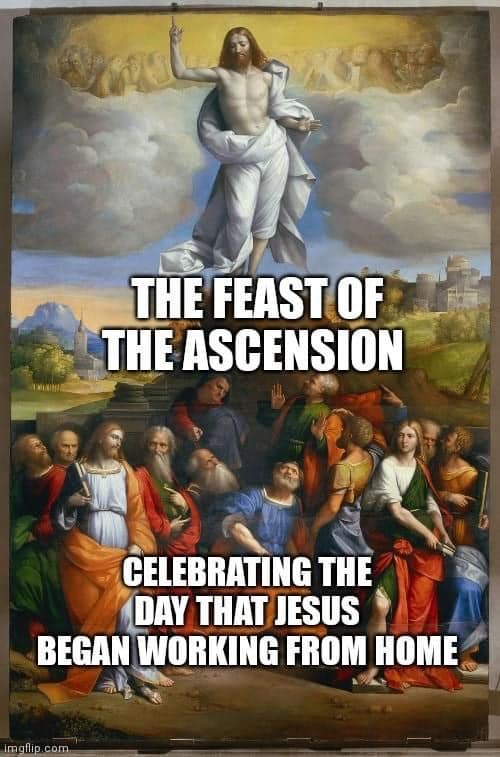
I saw this image on Facebook on Thursday, which was Ascension Day. A classic painting of Jesus ascending above the bewildered disciples has had a caption added:

The Feast of the Ascension: celebrating the day that Jesus began working from home.

I rather liked that. I wondered whether devout Catholic politician Jacob Rees-Mogg might ponder it the next time he leaves snarky notes on the office desks of civil servants who are working from home.

What do we make of the Ascension? When I try to explain the event to congregations, I usually suggest it is what John Calvin called one of God’s accommodations to us. He rose into the sky to get the message through to disciples who thought heaven was ‘up there’. Although Professor Tom Wright now says that the Jewish concept of heaven was that it was an invisible realm next door to this life and therefore the crucial part of the story is that Jesus disappears from sight.

But be that as it may, what does the Ascension mean for us? I’m going to divide that into two halves.

Firstly, it’s about the finished work of Jesus.

Hebrews 4:14 tells us that Jesus ‘has ascended into heaven.’ But what does he do there?

Two other parts of Hebrews tell us something that this section doesn’t, and they both use the same expression. In both chapter 10 and chapter 12 we read, ‘He sat down.’

It’s like he gets to heaven, he goes in the front door, finds the sofa in the living room, and takes the weight off his feet. Job done. Now he can rest.

In other words, the Ascension tells us that Jesus had completed all he was sent to Earth to do. Through his life, teaching, miracles, death, and resurrection he has achieved his goal. Salvation has been won. It is available to all. The task is being passed to the disciples and any day now the Holy Spirit will equip them for that.

Compare it if you will to the account of the crucifixion in the Gospel according to John. As he is about to die, Jesus cries out, ‘It is finished!’ (John 19:30) When he said ‘It is finished’ he didn’t mean, it’s all over, and my mission has failed, but the very opposite. For the Greek word that English Bibles translate as ‘finished’ means ‘finished’ in the sense of ‘accomplished’. Jesus is saying, ‘Mission accomplished!’ and the Ascension confirms that.

Jesus has done everything we need for salvation. The Cross is sufficient, the Resurrection proclaims it, and the Ascension ratifies it. To come into a relationship with the living God and to live as a disciple of Jesus requires only what he has done for us. At the Cross, the guilt we carry and the sentence we deserve for our sins are taken away and laid on Jesus. At the Cross, evil forces are conquered not by violence but by the suffering love of God in Christ. At the Cross we are set free.

It has all been done. Finished. Mission accomplished.

So one thing we must not do is attempt to add to what Jesus has done. Sometimes when we feel particularly guilty we think we have to do something as an act of penance to earn the favour of God. But as Martin Luther discovered when he studied the New Testament more fully than he had been taught as an Augustinian monk, the word is not ‘penance’ but ‘repentance’. And even then we do that in response to what Jesus is offering us.

Similarly, some people think they have to live a good life in order to win God’s favour. This is at heart an act of pride: ‘I did it myself’ – or even worse, in the words of the dreadful song, ‘I did it my way.’ But the fact that Jesus has done it all is meant to humble us. We cannot save ourselves. That’s the point. Everyone must come to that realisation, whether they are of high rank or low in human society, that we come in humility to Jesus and depend entirely on him for salvation.

On this day when we celebrate Jesus sitting down at the right hand of the Father, I want us all to realise afresh that our relationship with Christ is described in the words of the hymn:

Nothing in my hand I bring
Simply to thy Cross I cling.

What is faith then? It is not stretching out our hands to offer God something from our lives that we think or hope might make us acceptable to him. Instead, it is an opening out of our empty hands to be filled with all that Jesus has to give us from what he has done for us at the Cross.

John Wesley knew this. Last Tuesday was the anniversary of his conversion at Aldersgate Street, when he found that the assurance of God’s love simply came directly to him from God, not from all the labours to which he had devoted himself up until then.

Therefore, if you are ever the kind of person who says of yourself, ‘I’m trying to be a Christian,’ I want to ask you to put that language to bed from today. Either you are a Christian, or you are not. Being a Christian isn’t a boast, it isn’t a matter of personal superiority. It’s a matter of holding out those empty to hands to receive the finished work of Christ.

Secondly, the Ascension is about the unfinished work of Jesus.

Wait a minute Dave, you’ve just been at pains to say that Jesus finished his work. How can you now say his work is unfinished?

Glad you asked. And I hope this is provocative enough to keep you listening. One part of his work is finished, the work I’ve just been describing, to make salvation an offer to all.

But another part of his work is unfinished. And it’s described in our reading. Hebrews calls Jesus our ‘high priest.’ What does a priest do? A priest offers sacrifices for the people – but we’ve covered that in my first point about the finished work of Jesus in speaking about his death. Jesus our high priest offered himself as our sacrifice.

But a priest does something else for the people. A priest prays for them. This is something that Hebrews will refer to three chapters after our reading:

Therefore he is able to save completely those who come to God through him, because he always lives to intercede for them. (Hebrews 7:25)

Two circuits ago, and elderly Local Preacher prayed for me every day. But he died. My parents also prayed daily for me. But they have both died while I have been here.

However, I am not short on the most powerful prayer for me in my need, because Jesus intercedes for me. And he does the same for each of you. Be encouraged! This is his priestly work.

And furthermore, he understands, because as our reading says,

15 For we do not have a high priest who is unable to feel sympathy for our weaknesses, but we have one who has been tempted in every way, just as we are – yet he did not sin. 16 Let us then approach God’s throne of grace with confidence, so that we may receive mercy and find grace to help us in our time of need.

Don’t you find that encouraging, too? I often tell mourners at a funeral that when I am going through a bad time in my life I don’t necessarily find it helpful to have well-meaning Christians come up to me and tell me exactly what they believe about why God has allowed this. I want to lay my hands on such people – but not in the sense of healing!

The people I find most supportive when I am walking through troubles are those who have been there themselves. They understand.

One of my favourite examples of this is that about five years before I met Debbie I had a broken engagement – or, as my sister called it, a narrow escape. One day when I was grieving the break-up of my relationship, two friends called Sue and Kate turned up on the doorstep.

‘We’ve come to take you out for a pub lunch,’ they said.

I don’t remember the food from that meal. What I remember is how both Sue and Kate shared about broken engagements they had been through. They understood. They could support me.

Because Jesus has been through human weakness and faced temptation, he can do all that and more.

If you are facing sorrow or crisis right now, I encourage you to re-read the Gospels. Look for the stories where Jesus too goes through the ringer. Then recall that because he has been there too, he understands what you are facing, and can pray like no-one else to the Father for you.

This is how our ascended Lord spends much of his time. This is his unfinished work. It will continue until he appears again in glory, to judge the living and the dead, and to take us to our eternal home.

In conclusion, I’ve always been disappointed how Methodist churches treat the Ascension as a minor festival or even as a non-existent one. It is so important. It has much to teach us and encourage us.

I hope we will all leave today rejoicing in the finished work of Christ, who has sat down at the right hand of the Father, having completed everything necessary for our salvation.

And I hope we will also all leave today encouraged by the high priestly work of Christ who identifies with us and intercedes for us – his unfinished work.

May both of these great truths be strong foundations for our worship and our witness.

Raising Doubts (Easter 6 Resurrection People 5) John 20:19-31

John 20:19-31

‘Doubting Thomas.’

In all the years I’ve preached on this story, I’ve encountered people with a variety of reactions to Thomas. There are those whose faith is so serene that they find it hard to comprehend someone with doubts. To them, faith is as natural as breathing.

There are others who quite understand him having questions, because although they believe, they too have plenty of questions for God.

Finally, there are those who think Thomas isn’t militant enough, and who would say it’s all a sham. They defer to outright unbelief.

To explore this today, I am not so much going to expound the passage as use it as an example of this theme about faith, doubt, and unbelief.

And that is going to require me to explore the subject in four phases.

Firstly, there is a difference between doubt and unbelief.

To help us see the difference between doubt and unbelief, consider the story in Mark chapter 9 when Jesus and his three closest disciples come down from the Mount of Transfiguration and encounter a father with a demonised son, whom the other disciples have not been able to heal.

Do you remember the exchange between Jesus and the distraught father?

21 Jesus asked the boy’s father, “How long has he been like this?”

“From childhood,” he answered. 22 “It has often thrown him into fire or water to kill him. But if you can do anything, take pity on us and help us.”

23 “‘If you can’?” said Jesus. “Everything is possible for one who believes.”

24 Immediately the boy’s father exclaimed, “I do believe; help me overcome my unbelief!”

I do believe; help me overcome my unbelief. He has both belief and unbelief. This is doubt. A famous Christian thinker called Os Guinness wrote a book on doubt, and he defined doubt as ‘Faith in two minds.’

If we are doubting, we are struggling. We are being pulled both ways. We may want to believe but are finding it hard. It’s not that we refuse to believe.

Now while being in two minds is not a great place to be – the apostle James says that the one who doubts ‘is like a wave of the sea, blown and tossed by the wind’ (James 1:6) and ‘unstable’ (James 1:7). But Jesus wants to bring stability and faith, so if we find it easier to believe, let us offer kindness and gentleness to those who doubt and give space for Jesus to bring them through to faith.

Secondly, some doubt or disbelieve because they positively believe something else.

This is a simple point to remember. If somebody says they don’t believe something, it’s because they actually believe something else that contradicts it or rules it out.

Thomas was a bit like that. He didn’t immediately accept that Jesus had risen from the dead, because like most Jews apart from the Sadducees he didn’t believe there would be a resurrection of the dead until the end of time. The Sadducees didn’t think there would be any resurrection at all!

If someone today says they don’t believe in the Resurrection, it may well be because they believe something else. That belief may be grounded in the idea that scientific laws are unchanging and unchangeable, and that resurrection is scientifically impossible.

If you tell some such people that their position is a ‘belief’, they may react negatively! For they tend to believe it’s a fact. ‘Beliefs’ are only for those deluded religious people. But it is actually an act of faith to say that you think the whole of life can be lived on the basis of scientific discoveries.

They tend to say that we can’t prove our faith beliefs, but I would say they can’t prove theirs, either. There is more to this world than science, much as we welcome its discoveries. Not everything can be tested by science. We need other disciplines, like history, which works differently from science.

There is a lot of life where we need trust and faith as well as proof. None of us goes into a marriage with the complete proof that the one we love is going to be kind, loving, and faithful to us for the rest of our lives. Instead, we enter into marriage on the basis that we have learned enough about that person to believe we can trust them.

Finally, on the specific issue of believing in unchanging scientific laws, of course it’s helpful to know that laws make for predictable behaviour. Imagine if gravity varied massively all the time.

But perhaps there is another way to see this consistency and reliability of scientific laws if you allow for the existence of God. And that is to see them, as I heard one preacher put it, as ‘descriptions of God’s habits.’ They tell us how God usually does things. The Letter to the Hebrews tells us that Jesus ‘sustains all things by his powerful word’ (Hebrews 1:3). But perhaps on rare occasions and for reasons known to his sovereign will the Lord occasionally changes his habits. That would permit the possibility of miracles. And if so, then we  have to be careful about making scientific laws the ultimate standard by which we judge the truth and falsehood of other claims.

Thirdly, some disbelieve for other motives that are not logical.

I can understand someone who has been brought up on the idea of unchanging and unchangeable scientific laws using that as a test for truth, although as I’ve just said I don’t think it’s as watertight as some think it is.

But we need to recognise that some people choose unbelief for other reasons. For some it is because they believe their faith in God let them down. They wanted God to do something in their lives or in the life of someone they love but it didn’t happen. Sometimes it’s because they had a rather Sunday School image of God, even in adulthood. Sometimes it’s the fault of the church that has told them that God will always heal.

It’s tragic, really. If people reject Christianity because they think it can’t explain suffering, they miss the fact that atheism can’t explain love and purpose in life. If all we have is evolution, then life is just continued incidents of purposeless survival.

We could help people grow into a mature faith if instead we encouraged a church where we believe in ‘the now and the not yet’, that Jesus may heal in this life but he may not. And if we combine that with learning from the Psalmists about the possibility of believing in God but still bringing our darkest problems and emotions to him, instead of having to prettify everything, and make faith always neat, tidy, and clean. It isn’t.

Another reason for disbelief, though, can be what amounts to outright rebellion against God. Certain atheists are on record as saying that not only do they not believe in God, moreover they do not want to believe in God.

Why? Because they want to be in charge of their own lives. They do not want to be answerable to someone else.

The thing is, belief in God can strike against personal pride. Whose life is it anyway? It’s my life. Except it isn’t.

In the same way, I’ve been told that surveys show that the more intellectual someone is, the less likely they are to believe in God. But this assumes that belief or unbelief is only a matter of reason and knowledge. When pride comes into play, everything gets distorted – just as Christians would expect, because it’s sin. And so the cleverer someone is, the more at risk they are from taking pride in their intellectual abilities.

And the Gospel strikes against that. They don’t like the call to repentance. We need to model what Paul said in Romans that it is God’s kindness that leads to repentance (Romans 2:4).

Fourthly, the ultimate solution is an encounter with Jesus.

What changed Thomas? It was an encounter with the risen Jesus. He appears again behind locked doors, this time with Thomas present.

And he shows himself sympathetic to Thomas’ concerns, inviting him to examine his wounds as he had requested.

But the encounter is enough. Thomas doesn’t even get as far as exercising his demands. He says, ‘My Lord and my God!’ (Verse 28)

Sometimes we come to realise that all the logical arguments, important as they are for buttressing our faith, are insufficient on their own. We need an encounter with Jesus. OK, it won’t be exactly the same as Thomas had, for we are among those ‘who have not seen and yet have believed’ (verse 29).

But he met us. That’s what matters.

It’s something to pray for when we know friends and loved ones who don’t believe. Pray that Jesus will meet them in a grace-filled holy ambush.

I was talking with an experienced evangelist about a teenage boy we both knew who felt he had intellectual reasons for unbelief. She said, ‘What he needs is an encounter with Jesus.’ I think she had a point.

I remember a story told by Bishop Festo Kivengere, one of the courageous Christian leaders who stood up to President Idi Amin of Uganda in the 1970s. Kivengere told how he was called to a football stadium where some prisoners were going to be publicly executed by firing squad. He was allowed to meet with the prisoners and pray with them.

‘But,’ Kivengere cried out to God, ‘what do I say to them? What will make sense to these men who are going to be executed at the whim of an evil dictator?’

‘Tell them about me. I’ll make sense,’ were the words he heard back from Jesus.

So that’s what he did and many of those men went to their unjust deaths knowing their eternal destiny was secure.

‘Tell them about me. I’ll make sense.’ That’s our calling.

Restoring Work (Easter 5 Resurrection People 6) John 21:1-14

John 21:1-14

Christians are a little too good at times at keeping God in a box. One of the ways we do that is we put him in a church box. The only place we think we’ll encounter God is in a church setting.

But people who do that haven’t read the Gospels very carefully. Much more of the action with Jesus is not at the synagogue or the Temple but in daily life.

And if the Resurrection (and the Ascension) make Jesus present everywhere then we can meet him at the breakfast table, at the shops, and at our place of work, as the disciples did here.

How do we feel about that? Are there times when we would rather he wasn’t there? I remember a Christian businessman saying, ‘On Sundays, my priorities are first, God, second, my family, and third, my work. On Mondays, those priorities are reversed.’

Does this truth make us feel uncomfortable, or is it good news? If, like that businessman, we’re clearly uncomfortable with the prospect, reflect with me now, because actually, it’s good news that the risen Lord is present everywhere, including work.

Firstly, the risen Lord is present to guide our work.

Peter and the lads are experienced fishermen. By going fishing at night they have opted for the time commonly accepted to be the most productive for fishermen on the Sea of Galilee. Yet they catch nothing. Not even some plankton.

Why on earth – apart from desperation – would they take instructions from Jesus, who had been a carpenter, not a fisherman? What does he know?

Well, he must know something, because one of those little unexplained details of the story is that he has already got some fish and is cooking them on the beach!

Of course, as readers of the Gospel, we know he’s more than a carpenter, he’s the Risen Lord. Those pesky fish that Peter and his friends are trying to catch are part of the creation he oversaw.

And furthermore, in that creation the human race was assigned work as a good thing, for it was part of the stewardship of creation under God which is the human calling.

So it makes complete sense that the risen Lord is interested in the disciples’ fishing work. It isn’t inferior because it’s not overtly religious. It isn’t inferior because this is what several of them left to follow Jesus. It’s still valuable as part of what makes for a flourishing world as God designed it.

The same is true for us, whether we do paid work or whether we volunteer, whether we need the income, or whether in retirement we are free to dedicate our time to other causes.

Therefore our risen Lord has a genuine interest in our work, and that involves him guiding us in that as much as in any church decision. Our work is to be a matter for prayer as much as any other aspect of our lives.

Are there areas of our paid work or our volunteering where we are struggling? Have we thought that this was secular and not religious, and therefore not brought it to God? That would be a sad mistake.

You may be an employee or self-employed. You may be a business owner. Or you may be a student. Or you are using free time to make a difference as a volunteer. Jesus is risen and alive and cares about what you are doing. Don’t be afraid to involve him. He wants to be involved.

So bring him that staffing decision. Bring him that knotty problem your lecturer set. Bring him the moral issue you’re wrestling with. He is interested, and he is present to help.

Secondly, the risen Lord is present to give purpose to our work.

I once had a manager who was the sort of person who lived to work. This was a problem for most of her staff, who generally worked to live. The office was everything to Mrs Freeman, and she couldn’t understand those who didn’t see it that way.

Why were the rest of us different? Well, for a few, they had spouses who earned a lot more and so their earnings weren’t a life and death issue. But for many, it was because work was not a place of fulfilment but of frustration or tedium. It certainly wasn’t a fulfilling experience.

I think many people would identify with the latter group. We’ve replaced the Seven Dwarfs’ song ‘Hi ho, hi ho, it’s off to work we go’ with ‘I owe, I owe, it’s off to work I go.’

And as I’ve said to you before, I’ve had that same experience of frustration and tedium in the ministry just as I did in the office. Those who romantically look on at my work and think it must be some kind of uninterrupted heavenly bliss have never got close to a manse family.

I have also testified before that the Bible verse which just about kept me going during the worst of times was 1 Corinthians 15:58, the climax to Paul’s great chapter on the Resurrection, where he says that a great consequence of Christ being risen from the dead is that our labour is not in vain.

If you remember the sin of Adam and Eve in Genesis 3, you will recall that when God finds them he pronounces various curses on them and the snake. One of those curses is that Adam will find work to be frustrating. The Good News of salvation in the Resurrection reverses this curse, just as it reverses our separation from God by sin.

We heard that promise when we also read Isaiah 65:17-25 in the service:

21 They will build houses and dwell in them;
    they will plant vineyards and eat their fruit.
22 No longer will they build houses and others live in them,
    or plant and others eat.
For as the days of a tree,
    so will be the days of my people;
my chosen ones will long enjoy
    the work of their hands.
23 They will not labour in vain,
    nor will they bear children doomed to misfortune;
for they will be a people blessed by the Lord,
    they and their descendants with them.

Surely Peter and his colleagues in the boat had a sense of this when they dragged their huge catch to shore. After the fruitlessness of the night, now their purpose was fulfilled. They had fish. They could sell fish. They could make a living.

Not everything will be put right now. The vision of complete fulfilment awaits the ‘new heavens and new earth’ of which Isaiah 65 and Revelation 21 speak. (Which implies, by the way, that there will be work to do in the life to come – but it will be fulfilling work.)

However, we can ask the risen Lord whose resurrection promises that coming new heavens and new earth to help us find purpose and meaning in what we are doing now. It may be the chance to serve. It may be creative management of the earth and its resources.

Sure, while sin lasts there will still be frustration. But as the new creation begins to poke through, the risen Lord will bring purpose and meaning to what we do. Let us ask him to make that clear for us.

Thirdly and finally, the risen Lord is present to bless our work.

One hundred and fifty-three fish! Bulging, over-filled, and heavy nets! This is clearly way more than a normal catch!

Over the centuries, various scholars have tried to find symbolic meaning or significance in the number 153, and maybe that’s not surprising, given the many layers of meaning we often find in John’s Gospel. However, those attempts have largely failed, and perhaps we just need to default to a simple explanation.

Somebody counted the fish. The risen Lord had blessed the work of his disciples’ hands.

In Ephesians 3:20 the Apostle Paul tells that prayer can lead to God doing

Immeasurably more than all we ask or imagine, according to his power that is at work within us.

There is no reason to confine that promise to church work. Paul places no such limit. And this story shows that we can seek God’s blessing through the risen Christ in every part of life, including work such as paid employment, studies, and volunteering.

How significant might that be in the economic situation we are now facing? As prices increase at a rate we haven’t seen for thirty years, as manufacturers’ costs go up, and as household budgets get squeezed to the point where more families are having to make impossible choices, would this not be a great time to ask the risen Lord to bless our work?

So what are the needs of your employer, your educational institution, or your charity? Pray that the risen Lord will be present to bless.

Yes, let’s increase the range of people and causes that we pray God will bless. Not churches and the sick, but all sorts of elements in society. As you walk along the high street in the village, why not pray a blessing on the businesses? OK, there will be one or two whose business you will consider inappropriate for blessing, such as the betting shops, but why not pray that blessing?

The prophet Jeremiah told those Jews who were forcibly taken into Babylonian exile that they should ‘seek the peace and prosperity of the city to which [God] has carried [them] into exile’ (Jeremiah 29:7).

This makes for an interesting challenge: instead of complaining about our society, why don’t we instead pray blessing upon it through the risen Christ?

In conclusion, because the risen Christ is present everywhere to bless we need to get rid of our old sacred/secular divide. Jesus doesn’t see things like that. As one preacher once put it, ‘The only thing that is secular is sin.’

No, see the whole creation as the arena for our risen Lord to be at work, because his Resurrection is the first sign of him making that entire creation new.

And let that vision of the Risen One who transformed the fishing expedition of his friends be one that inspires us to pray and to believe that he also wants to transform our work, our studies, our volunteering, our work in our homes and families.

Because all of those are part of the creation he is renewing. Let’s join him in his work – in prayer and in action.

Forming The People Of God (Church Anniversary Sermon) Genesis 28:10-22

Genesis 28:10-22

The other day our cat got trapped in Mark’s bedroom and weed on his duvet. Going up to the loft to find a spare duvet for him, I had to fight past a couple of blankets and several pillows. Thankfully, none of those pillows was a stone like Jacob uses in our reading (verse 11). Unlike him, I don’t think I would fall asleep easily on a stone pillow. Just how tired was he?

Now you may wonder why Jacob’s dream is a suitable reading for a church anniversary, and the answer comes in his naming of the place as Bethel (verse 19), for that means ‘house of God.’

Yet this is no house of God in the sense of a permanent building structure where God’s people gather to worship. Rather, it’s a site where God is at work in the formation of a people for his praise through the patriarchs.

And what we learn here about God’s formation of Israel applies in New Testament terms to his formation of the church.

Firstly, the people of God are formed by God’s initiative.

I am the Lord, the God of your father Abraham and the God of Isaac. I will give you and your descendants the land on which you are lying. (Verse 13)

It’s God’s idea to form a people for himself. The people of Israel were not just another nation that emerged from ancient history, and the Christian church is not merely a human institution. God took the initiative. Why?

For the salvation of the world. God’s choice of Israel and his election of the church is not just a case of choosing people for their own salvation whereas he doesn’t choose others. No! He chooses and makes his people for a purpose: we are chosen so that we are a light to the nations. God chooses us so that we reflect his light in the world and that others might be attracted to the Light of the World, Jesus himself.

Now we are used to understanding that in an individual way. Each one of us is a witness to Christ. But we also need to understand it together as the fellowship of the Church. As the community of Christ we are called to be a light to the nations, beginning in our local area and spreading as far as we may be sent by God.

The Christian Church is not an accident. An individual congregation like this is not an accident, either. God made the first move to create this community and call it according to his purposes, of shining his light in the darkness.

So if we are here by God’s initiative, it’s an important question to ask how we are shining the light of Christ here and beyond our walls.

If we can identify how we are shining the light of Christ to the wider world, then we are at least in some respects fulfilling our purpose as a church. But if we realise we are not doing so, then we have some hard considerations. Either we must find ways, or we must close, because we’re only a pretend church.

Secondly, the people of God are formed by God’s promise.

Your descendants will be like the dust of the earth, and you will spread out to the west and to the east, to the north and to the south. All peoples on earth will be blessed through you and your offspring. (Verse 14)

There are things we need to do for the growth of God’s people to come. We cannot be passive. We must have intent if we are to grow. But before all that, the growth of the church is about God’s promise. He will make Israel ‘like the dust of the earth’, and Jesus famously promised that he would build his church. It all starts with God’s promise.

So are we seeing the growth of the church? Are people around the world hearing the Gospel through the Christian church? The answers to such questions are a very certain ‘yes’.

But what about us? So many of our churches are declining and aging drastically. Churches are closing all over the country. That doesn’t sound like God’s promise of a growing church, does it?

I think the fairest summary of the overall situation would be to say that in some places we are losing many of the battles against the spirit of darkness, but overall we are winning the war.

But even if that’s the case, we still have to grapple with our decline in contrast to God’s promise of growth. There are many reasons throughout history why churches decline and close. Sometimes, it’s because they are not sharing the Good News. Other times, it’s due to hostility in wider society against the Gospel. In some cases, it’s a bit of both. Or it could be something else, like being disunited so that we can’t demonstrate the love of God to the world.

If we are declining when God’s promise is for growth, we need an honest examination of why that is so. When we have identified why, we need to ask whether that reason can be reversed. If we are not sharing the Gospel, will we learn to do so? If we are disunited, will we be reconciled so that we can show God’s love to others? If we are in a hostile society, can we find ways of being a winsome witness to Christ despite that?

How we answer these questions help us decide what to do if – like many traditional churches in our culture – we are not seeing God’s promise of growth.

How will we respond in our churches?

Thirdly, the people of God are formed by God’s grace.

I could have begun with this point. But it’s also the theme behind the two other points about God’s initiative and God’s promise. The formation and development of God’s people is a matter of God’s grace.

After all, this is a story about Jacob. How come he’s travelling? He’s on the run after deceiving his twin brother Esau out of their father Isaac’s blessing. Esau wants blood. Jacob is hardly saintly.

Yet for all that, as the patriarch of the next generation, God is using him in his long term plans to form the people of God. Yes, this scheming, self-centred man! He’s not exactly the ideal material, is he?

However, when God intervenes in his life here via the dream at Bethel, Jacob responds with a vow that if God will provide for him and protect him, then the stone he lays will be the house of God and he will give a tenth of all he has back to God (verses 20-22).

In other words, grace transforms sinners.

One of my college lecturers said to me once, ‘Never forget that every church is a company of sinners.’ And when we look deeply at ourselves, isn’t that true? Like Jacob, we are unpromising material. We are not obviously saints in the making – at least not when left to our own devices.

But isn’t it also true that over the years we have seen God work changes in our lives as we have responded to all he has done for us in Jesus Christ? Has not the life, ministry, death, and resurrection of Jesus coaxed out a response from us to God’s grace?

No, we are not the finished article. We are not people who have got it all together. We are like broken pieces, glued together with gold, like the Japanese art of Kintsugi – and that’s what makes us beautiful.

For the world isn’t always attracted to the smooth operators who seem to have got it all together, whereas broken, fallible people like us who are utterly dependent on the grace of God are a more welcome proposition. We are more relatable.

So for all the challenges that this story is to us, ultimately it’s good news. As God’s initiative in forming the people of God calls us to be a light to the nations and as God’s promise of growth challenges us to face difficult questions if we’re not growing, in the final analysis it all comes down to grace.

And God’s grace is the most remarkable and wonderful thing, making beautiful creations out of broken people. While we believe that, and live out that truth, there is always hope.

Resurrection People: Restructuring Imagination Luke 24:13-35 (Easter 3 Year C)

Luke 24:13-35

How do you see the world? For me, it’s through a pair of glasses.

In my case, the menu for a new pair of glasses contains a number of elements. The lenses are varifocal, so I can have distance vision through the top, I can read through the lower part, and I can do middle distance vision such as computer work through the middle. Sometimes I need an astigmatism correction. Then there are the helpful additions such as anti-reflective coatings and anti-scratch, since I rely on them everywhere except bed and the shower.

But there’s one other element I always pay for. I am a blue-eyed boy – literally – and like all blue-eyed people I am more sensitive to bright light. In my case, I’m particularly sensitive to things like bright sunlight. And so I have photochromic lenses, the ones that darken in bright light.

Now one of the things about photochromic lenses is that whether you have them in their grey version or their brown, they make the colours you see more saturated. If I take off my glasses, the world looks rather washed out in comparison to the way I am used to seeing it.

I even process my photos according to this way of seeing the world. Their colours are brighter and punchier than other photographers would make them.

What about Cleopas and his companion (who may well have been his wife and may have been called Mary)? How did they see the world? Well, they had been seeing it through the lens of believing that Jesus, whom they took to be a prophet (verse 19), ‘was the one who was going to redeem Israel’ (verse 21), but he has been crucified by the authorities (verse 20) so that’s all gone by the board. And now they are confused by reports from women friends that his body is no longer in the tomb (verses 22-24).

They don’t know how to see the world anymore. And that’s a bleak place to be.

All their hopes for this miracle worker from Nazareth had come to a climax when he had ridden into Jerusalem a week earlier signalling himself to be the Messiah, and acclaimed like a new King David, yes, surely he would set Israel free from the Romans and she would no longer be an exile in her own land.

And that hope, that imagined future, that vision of how things were to be, came crashing down in a matter of days. No wonder they’re despondent.

Sometimes we allow ourselves to see life through a vision that appears good and honourable, but which lets us down. It might be about our aspirations for our career, our family, or our children, only for work or a family member to take a wrong turn. I wouldn’t be the first minister to enter this calling with a vision for renewed and growing churches, only to be disappointed.

But the encounter that Cleopas and Mary have on the Emmaus Road with Jesus gives them a new way of seeing life. It’s a vision that won’t let them down. It’s a vision that will sustain them through joy and sorrow. It’s a vision that will inspire them as disciples of Jesus.

Firstly, we see life beating death. The ultimate enemy of the human race and indeed of all beings is conquered. We believe the gospel promise that Christ’s conquest of death in the middle of history guarantees ours at the end of history.

For Christianity, the essence of death is separation. The separation of the deceased from the living; the separation of the soul from the body. The essence of resurrection is reunion: the reunion of the soul with a new body animated by the Spirit of God, and the reunion of those previously parted by death.

That’s why at the funeral of a Christian we have this mixture of grief and hope, not just grief. We grieve our separation from the deceased, but we anticipate resurrection where we will be reunited and our bodies healed as the Spirit of God gives life to them. When we commit that person’s body at the funeral to be cremated or buried ‘in sure and certain hope of the resurrection to eternal life’, this is what we are anticipating. Not just life after death, but a a new quality of life after death.

In this life, it means we face the darkest of challenges with hope. Not that we go rushing after death and martyrdom, but we know that sickness, injustice, and tyranny will not have the final word.

So we don’t become cavalier about Covid, because this life God has given us is precious, but we do know that at its worst it cannot wreak  ultimate destruction.

And right now our Ukrainian Christian brothers and sisters do not become reckless about their lives for the same reason, but they face the shameless violence of Vladimir Putin in the knowledge he cannot ultimately win. Either the events of this life or the resurrection of the dead will mean final defeat for  account to Almighty God for his deeds.

So that’s our first new way of seeing that the resurrection brings, and it’s utterly transformational: we see life and death in a new way.

Secondly, we see hope beating despair.

In 1984, a painter named Gottfried Helnwein created a piece of art called ‘Boulevard of Broken Dreams.’ It depicts four famous people in a diner. Marilyn Monroe and Humphrey Bogart are a flirtatious couple, James Dean is another customer, and Elvis Presley is the bartender. The theme is ‘emptiness’, because all four could have been said to have died senseless deaths: Presley from alcohol and prescription drugs, Bogart from alcohol, Monroe from drugs, and Dean from a tragic motoring accident. If the sort of dreams I described earlier have let you down and you feel empty, then the victory of hope over despair in the resurrection is for you.

We’ve talked a lot about the need for hope in our society over the last couple of years in the wake of the Covid pandemic. To a large extent millions of people have put their hope in science, and we are grateful for the remarkable work on vaccines. I certainly am: I am sure my recent bout of Covid would have been far worse without my three vaccinations.

Yet the hope our society has clung to in the face of the virus, while good, has not been ultimate hope. For that we need the resurrection, which shows that even death, the strongest of all the forces arrayed against us, does not have the final word.

And whether it’s Covid assailing us or the visions and dreams we’ve lived by letting us down, the only ultimate antidote to the despair they bring is the hope of the resurrection.

As I said earlier, I have known broken dreams as a minister. Church life has not generally become what I hoped and prayed it would. I guess my dreams were about some form of religious ‘success’, but of course that is not guaranteed to us and it is therefore not the solid hope that the resurrection is. Indeed, we might say that putting our hope in any vision and dream that is less than the resurrection is some kind of idol.

So what has kept me going when the experience of my calling has been dark? One Bible verse. It’s a verse that Tom Wright keeps coming back to in his wonderful book ‘Surprised By Hope’, and it’s the final verse of the Apostle Paul’s great chapter on the resurrection, 1 Corinthians 15. The climax of his argument about the resurrection is to say this:

58 Therefore, my dear brothers and sisters, stand firm. Let nothing move you. Always give yourselves fully to the work of the Lord, because you know that your labour in the Lord is not in vain.

The resurrection means that our labour in the Lord is not in vain. In the eternal economy of God, all that we do in the Lord’s service counts. We may not be able to see how it does right now, but the resurrection means those acts of faithfulness are not wasted. They are invisible building blocks in the cause of God’s kingdom.

So the resurrection says to us, keep going! Keep doing the Christian thing. One day we will see what God has built with it.

Thirdly and finally, we see the kingdom of God beating the empires of this world.

When God made Jesus’ body new in the resurrection, it was the sign that one day he would make all things new. It was the promise of the new creation, the new creation we begin to experience in ourselves when God begins to make our lives new when we come to him. And it climaxes in the great promise of Revelation 21 that God is making a new heaven and a new earth, with a new Jerusalem at the centre.

So that is where all this is heading. A new creation where there will no longer be any suffering. There will be no sickness, there will be no sin, whether personal immorality or social injustice. Relationships will be whole. There will be harmony among people. Everyone will have enough. This is the new order promised by the resurrection.

But what are we supposed to do? Some Christians particularly of past generations would have simply seen us as rather passively waiting for it to come about at the end of time. No wonder Christians were accused of ‘pie in the sky when you die.’ That is not the way.

No, this great vision of the fulness of God’s coming kingdom that we see in the resurrection inspires us to act now. Of course the kingdom of God has not yet come in all its completeness, but it is coming. It is on the way. Jesus said it had arrived with his coming.

And this is why it’s important to keep doing the faithful stuff, as I said in the last point. Each prayer for healing, each act of care for the sick, each action in support of transforming the lot of the poor, each act of reconciliation, each deed of compassion, each drawing of someone into the love of Christ is all part of the coming kingdom and a pointer to it.

It’s the resurrection and all that it promises that is our inspiration to live this way.

So – like Cleopas and Mary – may we allow the resurrection to change the way we see life. May we then live by that vision – where life beats death, hope beats despair, and the kingdom of God conquers the empires of this world.  

Create a website or blog at WordPress.com

Up ↑