Sabbatical, Day 71, Easter Sunday: Jesus Returns To Life

Vodpod videos no longer available.
more about “Damaris Trust Holy Week 2009, Easter …“, posted with vodpod

Christ is risen! He is risen indeed! In this final Damaris Trust video for Holy Week, Krish Kandiah and Peter May talk about how Jesus’ resurrection from the dead gives us hope when considering what happens when we die.

…………

A great service for Easter Day at St Andrew’s this morning. ‘In a packed programme tonight’, as the Two Ronnies used to say, we had the Easter liturgy, renewal of baptismal vows, Holy Communion (of course) and people invited from the community to remember deceased loved ones.

In the middle of all that, there were two highlights for me. Firstly, the worship band shrank at one point to the younger members only. So Emily on vocals , Dan on guitar, Bradley on keys  and the drummer whose name I don’t know – they’re all round about thirteen years old – led us in Tim Hughes‘ ‘Happy Day‘. Here’s a version by the original artist:

Emily is a great singer, Dan a quiet and efficient bandleader, Bradley filled in subtly and the drummer guy is top drawer.

The other highlight was Lee’s sermon. Taking Mark 16:1-8, he made a virtue of the strange and sudden ending to Mark’s Gospel. He said we have to write our own ending to the Easter story in our lives. I thought that was great. 

For all that, it’s been quite a mixed day emotionally. On the one hand, I have entered Easter with a renewed confidence in the truth and importance of the Resurrection. Not that I ever lost my belief in the bodily Resurrection of Christ for one moment, but sometimes when life or circumstances aren’t the most encouraging, it can feel far away. Reading Tim Keller (sorry to mention him again!) and Tom Wright (see this excellent article from The Times yesterday) has done much to fortify my faith.

But other things have been weighing me down. My friend Will says today, in talking about his service this morning, 

Before the prayers of intercession, I reminded our congregation that for many the joys of Easter are still crowded out by their own personal Good Fridays. I know I have friends who will this week spend more time agonising in the Garden of Gethsemane (Jen and Mike, we are praying for you and Luke). For some, Easter is more like the women in Mark who hid when afraid.

And as he mentions his friends Jen, Mike and Luke, so I have been thinking about the three couples I mentioned last Sunday who have separated. Some events today have reminded me of them. Debbie and I feel such pain for them. And if that is how we feel, how do they?

More trivially, our eighteen-year-old cat is suddenly looking old, frail and weak. We are beginning to think the end might be near. The children realise, and on top of the fact that they have been asking questions about death as we’ve come through Holy Week, Good Friday and today. Mark in particular keeps asking whether he will die on a cross like Jesus.

I’m also starting to get more regular questions about how much longer the sabbatical has to go. The answer is that – with having tacked a week’s leave onto the end – I shall be back on duty four weeks today. The official Methodist literature on sabbaticals talks about planning your ‘re-entry’, which rather makes ministers feel like Apollo astronauts. The idea is that there should be a managed, phased re-introduction to active ministry.

Which makes me think of two words: ‘fat’ and ‘chance’. At least I hope it won’t be like my last sabbatical, when the superintendent asked me to come back early due to a crisis with the circuit treasurer. However, a sabbatical grants you new vision in all sorts of ways. It is then a huge challenge to share that vision with churches that are used to things being a long way different from such visions. I’ve always been a restless traveller on the outer fringes of Methodism: right now I feel somewhere out beyond Pluto.

Of course, it may just be a version of what anyone feels when a good holiday is coming to an end and they have to return to work. (Not that I’m suggesting the sabbatical is a holiday!) Time will tell.

Sabbatical, Day 57: Lee Abbey Photography Course, Part 2


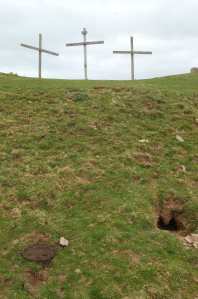
The Three Crosses at Lee Abbey: view from below

Wednesday’s expedition in search of photos saw me consulting a map of the Lee Abbey estate in order to find the location of the famous three crosses the community erected many years ago. They were not difficult to find. Unsurprisingly, several of us on the photography course took pictures of them, although nobody was there at the same time I was. I simply needed to let a group of pilgrims who were following some guided prayers around the land finish ahead of me.

For this first shot, I deliberately took the image from below, in order to include in the foreground the cow pat on the left and the treacherous hole in the ground on the right. Crosses are ugly and dirty, not shiny happy jewellery.


The Three Crosses at Lee Abbey set against a background of sky

For the second photo I have included here, my aim was a little more pragmatic. You will see that again I am below the crosses with a wide-angle lens, but I have included a large amount of featureless cloudy sky. This was one of several pictures I took, thinking they might be useful as backgrounds for PowerPoint or SongPro slides. On the surface, that may not be the most spiritual reason, although I would like to think that if this is used in public worship, it will play a small part in enhancing people’s devotion. However, I castigated myself for moving on all too quickly from the crosses in order to take more images. I think I share the general weakness for moving on as quickly as I can from the foot of the Cross. I certainly did so last week.


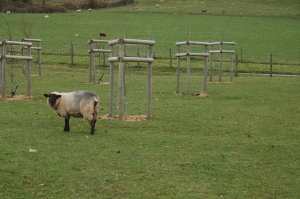
Lost sheep among saplings in putative orchard

This third shot is one I might use as a metaphor sometime. The sheep shown should not be in this field. It has escaped from the rest of the flock, and is roaming in a field planted with saplings that will eventually become an orchard. Next time I want a ‘lost sheep’ image, I may pull this one out.

The week was not all about the photography, though. On Thursday morning, one of the host team, Chris, recognised my name on my badge. I had thought he looked familiar, but he didn’t prove to be who I thought he was. Chris turned out to be the son of two people I had known in an ecumenical church in my last circuit. When I knew him, he was about eleven. Now he was eighteen, and spending a year in community while offering for the Anglican ministry. I must say, he looked a natural up in front of a large group of people from different backgrounds and generations. I gave him my email address before leaving, and asked him to tell me how he gets on.

Sabbatical, Day 55: Shirky, Chapter 11 And Epilogue

Final instalment from Clay Shirky today.

Chapter 11 Successful social tools have a complex interaction of promise (why), tools (how) and bargain (rules). There are various ways in which the promise can be attractive and workable. The tools must fit the job and what people want, so need not be the latest technology. The bargain may be offered initially by one side, but modified by the users.

Dilemmas often centre on whether and how much governance is put in place. Do we use contracts, for example?

Do we have a tendency in the church to jump to governance before going through the other stages?

Epilogue The new tools don’t create new motivations, they amplify existing motivations. Once people have used them in extremis, they will use them in ordinary day to day life. They are adopted one person at a time. 

Activists who have tended only to protest rather than be constructive may need a form of ‘incorporation’ (embodiment) that is different from current corporate law, by allowing gatherings in the virtual world, not just face to face. 

The future belongs to those who work with the present, where these changes have happened.

If this is the new and coming reality, how serious are we about adapting to it in a Gospel way?

Sabbatical, Day 54: Clay Shirky, Chapters 9-10

Fourth instalment from Shirky below.

Chapter 9 The Small World principle: when two strangers meet and find they know someone in common, it’s because within each different circle there is a small number of people who are highly connected. These people are the ones who are known by the two strangers. Social networking sites work on this principle: the sharing of a common interest (amplification) on the one hand and those who don’t share the interest (filtering) on the other. Today, software such as IRC, wikis or web forums can provide bridging capital and bonding capital more easily and cheaply than institutional methods.

Which is good reason for moving from institutional approaches to the new social tools.

Chapter 10 How do we tolerate failure and use it creatively? The open source movement isn’t necessarily more successful than the commercial realm, it just has a better way of tolerating failure. Not owning the source code means lower overheads. The ‘long tail’ of the ‘power law distribution’ also means that the single contribution made by the thousands are as valuable as the many contributions made by hundreds of programmers. 

Activists in the church often complain about those who seem to do little. Does the ‘long tail’ validly challenge this attitude or not?

Sabbatical, Day 53: Shirky, Chapters 7-8

Here is the next instalment from Clay Shirky.

Chapter 7 The key battles in protest movements are the ability to grow protests without state clampdown and documenting any opposition to cause an international outcry. That was true before the advent of contemporary social tools; now those same tools that can be used for fun can be used for political campaigning, even apparently banal tools like Twitter. They have shifted the ground from advance planning to real-time co-ordination that cannot be anticipated by opponents.

This of course is what terrorists have done, too. Hence government desires to see the electronic records of ISPs. But as the church moves more to the margins of society, this means we have just as much opportunity to influence and campaign as ever, just in very different ways.

Chapter 8 Social capital has been declining, but social tools make it possible to build it up again. Services such as Meetup.com make it possible for new groups to gather, existing groups whose transactional costs had soared can meet again, and latent groups can now set up without worrying abotu social disapproval.

Professionals lose out due to mass amateurisation. Existing social bargains (e.g., ‘who are the media?) are called into question. Networked organisations are more resilient, even the more objectionable ones.

Social capital and small groups should surely be central to church life rather than institutionalisation. Is this not a way forward, especially if we need to transition into ways naturally used by generations largely missing from traditional churches? 

Sabbatical, Day 52: Clay Shirky, Chapters 4-6

A few more thoughts from Shirky today.

Chapter 4 Economically, old media filtered information, and then published. Social media does the reverse: the process is now ‘publish, then filter’. And whereas one could do small things for love and big things for money, it’s now possible to do big things for love. People are no longer passive consumers, they are symmetrical producers. 

‘Publish, then filter’ has enormous implications for our instinctive desire to want things we don’t like banned. How do we cope if things we don’t like are already out in the wild?

How might we ‘do big things for love’?

It’s easy to treat church members and others with whom we ministers come into contact as passive consumers. Some are happy to be treated that way (especially in a consumerist culture). But what about those who want to be symmetrical producers? 

Chapter 5 Wikipedia works on the ‘publish, then filter’ principle. Hence criticism of errors, but Wikipedia is a tool (wiki) plus community, and it ‘self-heals’ on this ‘publish, then filter’ basis. It is a process, not a product. There is an unequal distribution among the contributors – a ‘power law distribution’ whre a few make a lot of contributions, and most people only make one contribution. This works, because people have a non-financial motive for contributing.

Often we complain about the ‘power law distribution’ in churches, where a small group of people do most of the work. But in the world of social media, this isn’t a bad thing. Discuss!

Chapter 6 Social tools and the Internet have made it easier for protest groups to assemble and campaign. It’s not so much about the latest technology, but about using that which has become commonplace.

This should be good news for the Church. TEAR Fund deploys its SuperBadger campaigns this way, but they are centrally driven. Maybe more might rise up from the margins.

Sabbatical, Day 51: Clay Shirky Chapters 1-3

Not being sure how much chance I’ll get to be in range of wifi or mobile broadband signals this Monday to Friday while I’m at Lee Abbey, I’m preparing a few short posts on Clay Shirky‘s book Here Comes Everybody.

Chapter 1 We now have what Tim O’Reilly calls ‘an architecture of participation’. Human tendency to work in groups plus new social tools means vastly reduced overhead costs. Institutions won’t disappear, but their role as a barrier to group action has collapsed.

So why do we still bother putting so much energy into church as institution?

Chapter 2 Social networking sites like Flickr have reversed the old principle of ‘gather, then share’ into the much more inexpensive ‘share, then gather’, thanks to tagging. The old state versus commerce choice assumed people couldn’t self-assemble. Now through social tools they can. They can 1. Share; 2. Collaborate; 3. Take Collective Action.

This has the potential to launch a new Reformation, undermining not just the Catholic priests of 500 years ago but all authority/institution figures today.

Chapter 3 Today’s social tools with their ‘mass amateurisation’ attack professionalism on two fronts. First of all, professionals control access to scarce resources. Blogs and the like mean that in the media, resources are no longer scarce. Secondly, professional depend on the recognition of fellow professionals. That too is blown apart when everybody is a media outlet. 

What implications might this have for the professionalism we cherish in the church?

Sabbatical, Day 48: Gambling, G20 And Our Children

Our belovèd government promises concern for problem gamblers and all affected by their habits. Which is why they are doubling the minimum stake in fruit machines to £1 and the jackpot to £70. So that will help.

If you are as offended by this foul act as I am, there is an online petition here and you can also visit Fruitless.

Thanks to today’s monthly e-news email from the Methodist Church for this, which also plugs the Put People First march for Saturday week. 

…………

Having kept Mark at home today due to his mystery rash (which has again disappeared), fine weather meant some time outside. He played with some chalk near on our drive and near the front door for most of the morning. He rather got ahead of himself:


Come to Mark's house it's Easter today

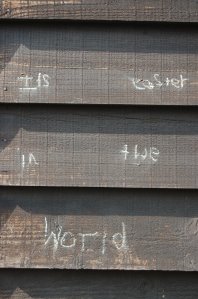
Below this first picture, however, you will be able to see that he is aware that Easter is not just for us. It is for everyone. No ‘This is my truth, tell me yours’ approach here!


It's Easter in the world


However, as the next picture shows, I eventually convinced him he was being proleptic and would have to ditch his realised eschatology for a ‘not yet’ approach to the kingdom of God:


3 weeks until Easter

The poor little lad will have to wait like the rest of us. He’s looking forward to chocolate and to the annual Easter party Debbie organises for him, Rebekah and a few of their friends. She started this our first Spring here as a way of trying to help our two make friends in the area. It has worked well. We now have the pleasures of egg rolling competitions on the drive, Easter bonnet-making (no, the boys never gravitate to that) and sundry other fun activities. The invitations have been going out in the last couple of days, not just to established little friends but to some other children whom we’d like encourage our pair to befriend.

We’ve also had further reason to take pride in Rebekah today, when she was moved up again to another level in the school reading scheme. She is delighted, too, but she doesn’t make a big deal about it and put down other children who haven’t reached her standard.

It was such a contrast this morning when I went to give my weekly twenty minutes of reading help in another class. I think they like me, because inevitably they get very few offers of help from men, although they’ll miss me next week when I’m at Lee Abbey. Each week I am given a different group of children. The groups are streamed, so from one Friday to the next I can get a vast contrast in ability. Today, I had three lads who were struggling. One in particular still can’t make the connection between the phonetic sounds of letters and the word he is trying to read. He should have known this a year or two ago, poor lad. The other two boys kept jumping in when this one didn’t know, which did nothing for his confidence.

So it was important this morning to have a simple rôle as an encourager. That was a privilege, just to try and boost the boy a little bit. I wondered how much encouragement he received. Certainly he gets it from the staff, who provide extra help, but clearly he suffers at the hands of other children, in the classic way in which youngsters are so cruel to each other. Some carry the scars for years. Occasionally, we ministers pick up on it decades later.

Sabbatical, Day 47: How Could I Forget My Daughter?

Pressed for time in blog writing last night, I made an unwise choice. Yes, I enjoyed writing about the bozos in the High Street, but how could I overlook the achievements of our wonderful daughter?

Yesterday was a terrific day for her. We saw her take the lead when her class led school assembly, sharing on a trip they’d had to Braintree Museum to explore Victorian life a couple of weeks ago. All the class said something, but Rebekah had to kick it off. Clear voice, good projection, nicely paced. Could  make a preacher of her yet.

Later in the assembly, the Deputy Head presented her with a certificate to mark the Maths test she passed last week. She looked so proud, in the right way. At the autumn term parents’ evening, her teacher had told us that Maths was her weakness. No longer, it seems. Not only did she pass this test, we had the spring term parents’ evening on Tuesday night, and she is attaining standards in numeracy ahead of her age now. So there has been a real turnaround. She has worked hard, and the teacher has done well with her.

Meanwhiles, Mark, according to his teacher, ‘can do everything’, and she’s having to hold him back on his reading because he’s so far ahead of the others. On its own, this would have worried us, but she discussed strategies with us for making a bit more of the books they’re expecting him to read that they know are below his capabilities. The real concern is his lack of socialising with children of his own age. 

Collecting the children from school yesterday, we were greeted with a very red Mark. Not only his hair, but blotches on his skin. We kept him off his swimming lesson. This morning, he was much better and we sent him in. However, by morning break the school had phoned me and I went in armed with Piriton. That did little, and at the beginning of lunchtime came the second phone call. We brought him home, and with the school anxious that he might be infectious with something like slapped cheek, Debbie took him to the doctor, where they had to wait alone in a side room before seeing a GP who wasn’t sure what it was, but said just to keep him off school tomorrow. Poor lad, ever since going full time at school in January, he’s struggled to do a full week any week.

Meanwhile, back at yesterday afternoon, Rebekah was fit for her swimming lesson. Once a term, the swim school tests the children. Yesterday, she passed her 20 metres badge, so great elation and more reason to eat chocolate!

Today, she is happy too, because another milk tooth fell out, thanks to a cherry cake that was served for dessert at school dinners. It has been irritating her for days. Tonight, it was not difficult to persuade her to sleep, because she is anticipating a nocturnal appointment with the Tooth Fairy. And in the tradition of a children’s book we once read about the dental sprite, she is sincerely hoping this tooth was clean and sparkling enough to find a home in The Hall Of Perfect Teeth. Our next door neighbour told her there would be an extra reward for such teeth.

Fat chance. The standard £1 coin is in the envelope with the TF’s letter. We’re not getting stung again.

Meanwhile on the sabbatical front, I still haven’t ordered any more books, but having a Myers Briggs personality type that likes to keep my options open, it was fatal today to receive a catalogue for church leaders from Wesley Owen. As I flicked through, hoping not to be tempted and take it on an early trip to the paper recycling sack, I was accosted by a few titles that could have something to do with my research. Not the ministry and personality type stuff, but the dialogue between traditional understandings of ordination and our contemporary missional context. 

So step forward Ministry By The Book by Derek Tidball. Prepare for Exile: A New Spirituality and Mission for the Church by Patrick Whitworth sounded interesting. And Evaluating Fresh Expressions:explorations in emerging church: Emerging Theological and Practical Models edited by Martyn Percy and Louise Nelstrop sounded like it might be useful as a critical voice from outside my tradition to ask hard questions about new forms of church. If anyone reading this has read any of these books, please let me know what you think in the comments below.

Sabbatical, Day 44: Link Love

What a beautiful day! Undoubtedly the warmest of the year so far, around 15°C or more here today. I’ve been walking without a coat for the first time this year, even without a jumper. (Don’t worry. It didn’t get worse than that.) So what better day for sitting in front of the computer and garnering a few choice links?

Allan Bevere is celebrating Lent with some jokes. Here is The Man Who Orders Three Beers and here is You’re Not A Monk. Special words for Allan – not only does he produce the weekly Methodist blogs round-up on a Saturday, he was also the first person to join my Facebook group, Christian Ministry And Personality Type. Thank you, Allan.

Some atheists want to rewrite history. Makes you wonder if they understand the baptism they’re decrying. Their point might make sense if baptism works automatically (‘ex opere operato’), without the consent of the one baptised, but for those of us who don’t believe that’s what baptism is about, this is more ludicrous atheist posturing.

If this doesn’t move, you nothing will: The 7 Life Lessons Of Craig Wong, 1972-2009.

Ben Witherington interviews Tom Wright.

Other than that, not an exciting day on the sabbatical front. More a time for some domestic jobs, like taking some old toys to a council centre to see whether they could be recycled. Buying a roasting chicken and some accompaniments before a church friend comes to dinner tomorrow: she’s going to babysit while we go to parents’ evenings for both children. Getting a repeat prescription from the surgery. Mark throwing a supersized wobbly, accusing me of stressing him (yes, he is really only four) when he wouldn’t change out of school  uniform to play in the garden.

So it was good to discover Graham’s blog Digging A Lot with his Lenten series on finding grace in the smallest and most ordinary of things. Without his comment today on yesterday’s post, I wouldn’t have known about this blog. What a joy it is. Recommended to all my readers.

I’ve been dilatory in ordering the books I need for the rest of the sabbatical, but I have three vouchers from W H Smith, not my usual first choice for literature. Each offers £5 off books costing £10 or more if ordered by the 29th. They might just make the difference. So I’m off to surf there now; I’ll see you tomorrow, I hope.

Create a website or blog at WordPress.com

Up ↑