Being A Blessing

At a recent all age worship service, we were looking at what the Book  of Proverbs says about riches. At the end of our ‘AAW’, we like to give the congregation a take-away to remind them of the theme. This time, one of our team suggested we give everybody a small amount of money – 50p – and invite them to use it in a Christian way. If people were badly off and needed it for themselves, they could keep it. However, we hoped that many would do some good with it. Hopefully we’ll hear some good stories in due course.

Well, one vicar in North Yorkshire has done the same thing on a much larger scale. I don’t often say the words, ‘Here is an inspiring story in the Daily Mail’, but on this occasion read this and enjoy.

April Jones And A Nation Afraid

I haven’t kept refreshing a news story so frequently for ages. But the story of five-year-old April Jones’ abduction chills me like nothing in ages, even in our information-saturated culture.

I’m a Dad. I have a nine-year-old daughter who wants to walk home from school alone. Sensible as she is, the answer is no. While I was coming home from school on my own at that age, I don’t feel it’s safe in our society. Yes, I know an argument will rage about whether these incidents are more prevalent or simply more reported, and yes as a Christian I am not to be ruled by fear, but I have a parental duty of protection to my children.

The fear is coming out socially in other ways. Many have already assumed that the arrested man is guilty of the abduction (and maybe much more). But we don’t know yet. We can’t allow fear to launch vigilante groups. Our craving for safety could create a new Wild West if we were to follow all the populist cries. There is a danger that some people will do anything or vote for anyone they think will bring peace and safety. That anything or anyone could bring greater trouble, though.

Meanwhile, I see many messages on social media from Christians who are praying for the safe return of April. I find myself adding the qualifier, ‘if she’s still alive.’ Since  little April wasn’t with the arrested man and they are searching in the area of a river, I feel sick about the prospects of finding the poor girl still breathing.

How, then, do Christians model living free from fear and full of compassion? Because right now, that could be a central part of our witness in the UK.

A Christian Letter To A Politician

Can I live up to this?

Dear Politician:

I’m writing to let you know that I will not attack you personally if you run for office.  I will not make disparaging remarks about you or your family.  I will not call you names.  I will not put bumper stickers on my car that insult you.  I will not attack your supporters and label them as one thing or another.  And even if you attack an opposing candidate personally because he disagrees with your stance on a particular issue, I will not do the same.  Even if you disparage, stereotype, or categorize me because I vote for your opponent, I will not trade you insult for insult.  Instead, I will choose to bless and pray for you and your family.  I will choose peace, encouragement, and building up instead of war, insult, and tearing down.  I will extend grace, love, and mercy.  I know that you are someone who matters to God and for whom Christ died on the cross.  In this regard, you are just like me.  God seeks after your heart just as he does mine.  These are just some things I needed you to know.

Kellye Fabian

Via Scot McKnight; originally appeared at Kellye Fabian.

Guest Post: Andy Mellen, Facing A Different Future?

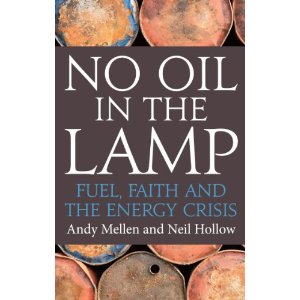
I can’t recall ever hosting a guest post before, but this approach seemed both worthwhile and important. Andy Mellen is the co-author with Neil Hollow of ‘No Oil in the Lamp‘, a Christian response to the Peak Oil crisis. About three years ago, I heard Sam Norton give a theological lecture on Peak Oil in Chelmsford, and his blog Elizaphanian is a useful source of informed comment on the problem. Because I had had my eyes opened by that experience, and because I am not myself a scientific specialist in this area, I was only too willing to host a piece on this subject.

Over to you, Andy:

Our ideas about the future tend to be conditioned by our experience of the past, so if you were born in a developed country sometime in the last sixty years, it’s likely that you have experienced a rising standard of living, with increasing comfort and convenience.  Yet we only need to look back a few generations to see how much has changed, and how much we take for granted:  We flick a switch, assuming that electricity will be there to light up the bulb.   We expect to be able to travel long distances quickly, in comfort and at reasonable cost.  We think nothing of sitting down to a meal whose ingredients have been transported across the globe to our table.  These things and many more besides have become basic expectations – and as Christians living within a modern, developed country, we share them.  Whilst we may bow our heads and give thanks for God’s provision at the start of a meal, in many other ways we take the conveniences of modern life for granted.

We might expect the future to look something like a continuation of the past, but what if that isn’t possible?  It takes an enormous amount of energy to make the modern world work.  The average household is using more energy today than at any time in the past.  Globally, use of oil, coal and gas has at least almost doubled since 1970.  The unfortunate thing is, there aren’t unlimited amounts of these commodities to fuel our lifestyles way into the future.  In fact the most critical energy source – oil, which provides 90% of all transport, is already beginning to decline.  So what does this mean?  Well, it’s complicated, but also surprisingly simple:  The good news is that nobody is saying we are going to suddenly run out of oil.  The bad news is that declining oil production will cause us a host of difficulties in the years ahead.  Experts predict a two-stage process: firstly high energy prices (which we are already experiencing) and eventually actual physical shortages.  High prices are already giving the global economy a headache, and straining the finances of households.  Actual shortages would provide an enormous challenge for society, the economy, food supplies and much more.  A smooth transition to green renewable energy is what some people are hoping for – others are looking to science for the answer – new forms of energy, maybe hydrogen?  Unfortunately, no technology is in a position to do for us what oil does today.

So what can we do?  Is it a case of waiting for the Prime Minister, the UN, or someone else to take action?  So far, despite credible voices speaking up, very little attention is being paid to this problem at Government level.  However, at the grass-roots, in communities across the UK and increasingly across the world, something very interesting and exciting is happening.  It is something called Transition.  You may not have heard of it unless it is happening in your area, but the Transition movement is fast becoming the most positive response to the problems of resource constraints and climate change.  Although it may sound a bit wacky and alternative, the heart of Transition is a very simple idea:  we need to move away from oil dependence and instead build resilience into our households, communities and the local economy.  Just how this plays out is different in every community, but the places which have embraced the concept are already starting to reap the benefits in terms of a more vibrant local economy, stronger community and reduced energy use.  So far, I know that many Christians are individually involved in these initiatives, though I have not heard of any church becoming directly linked to Transition.  Yet many of the qualities of the Transition movement overlap with what we might call “kingdom values” – concerns we see in the Bible.  Three spring immediately to mind:  Stewardship of the earth (humankind is given responsibility for the earth in Genesis 1), the principle of justice is seen throughout the Bible, (and particularly in the writings of the prophets, from Amos to Zechariah) and the principle of simplicity as espoused by Jesus, (most tellingly in Luke 17: “A man’s life does not consist in the abundance of his possessions.”).  The church in the past has shied away from engagement with environmental issues for fear of contamination with “new age” philosophies.  But it seems to me that the Transition movement offers an opportunity for Christians and the church to engage with something good, wholesome – and urgent.

Andy Mellen

(For much more detail on this whole area, see my book ‘No Oil in the Lamp‘ published last month, or check out the ‘No oil in the lamp’ page on Facebook)

How To Remember Neil Armstrong

When Neil Armstrong, the first man to set foot on the Moon, died yesterday, I remembered being a nine-year-old boy in a primary school hall. The whole school was assembled to watch a small black-and-white television that had been perched on the stage for us all to watch recorded footage of the momentous event.

After Apollo 11, Armstrong was famously reclusive. Not for him the celebrity circuit. In one of his rarer excursions into public, he sued a barber for selling some of his hair.

And so it was fitting to read the Armstrong family statement. Their idea about how to remember the great man seems so fitting:

“For those who may ask what they can do to honour Neil, we have a simple request. Honour his example of service, accomplishment and modesty, and the next time you walk outside on a clear night and see the moon smiling down at you, think of Neil Armstrong and give him a wink.”

O that others would seek a similar remembrance. ‘Honour his example of service, accomplishment and modesty’ indeed.

Joel Versus Poverty

I have told a story on here somewhere before about making a visit to a school with our children, where we witnessed a display in the entrance hall about a link the local community had with a Ugandan village. The local people there relied on growing and selling chillis to eke out a meagre existence. Our kids were 7 and 5 at the time, and we had to explain huge issues, because they couldn’t initially believe that people lived in such desperate straits in our world.

Later, when we got home, Mark (then 5) announced at the dinner table: “I’ve changed my mind about what I’m going to do when I grow up. I’m not going to become an author, I’m going to save Africa.”

Trying not to show considerable surprise, nor wishing to pour cold water on his noble ambition, and secretly pleased, we asked him how he proposed to do this.

“I’m going to open supermarkets all over Africa where people can buy the food they need to live.”

“But where are they going to get the money to buy the food? The people you want to help don’t have much money.”

“That’s easy,” he replied – as only a child could. “I’ll open money shops as well.”

Mark retains his passion for Africa. He still doesn’t spend much of his pocket money or other gifts he receives.
Why am I retelling this story? Because another young boy in a Christian household is doing the same. Read Joel Vs Poverty. The difference is, Joel is getting into fundraising for TEAR Fund as a result. Not only has he written ‘Poor Box’ on an old cardboard Frubes container, he has decided to do a sponsored run on 23rd June. He has a page on Virgin Money Giving where you can donate to the cause.

There is a hashtag on Twitter to help you follow what’s happening, and it’s #TeamJoel. However, the important thing is not only to do clever social media things, but to use them in the service of giving and of changing our world.

An Appeal To Both Sides Of The Christian Debate About Gay Marriage

I have changed my views in the sexuality debate.

If you’ve known me for many years, this post might surprise you. If the 1993 Methodist Conference debate on sexuality had approved of homosexual relationships, I would have resigned as a probationer minister. Had our Pilgrimage Of Faith report in the mid-2000s approved the blessing of civil partnerships on Methodist premises, I would have had a serious problem of conscience. I would have regarded such decisions as tantamount to apostasy.

So I’m now supporting the gay rights agenda? No.

Are you confused? Join the club, and read on.

The more I watch the debate among Christians since the Government announced its consultation on gay marriage, the more I am concerned about the tone we are setting. Honourable exceptions granted, this post is an appeal for the exercise of Christian love and respect between those of opposing opinions. This is the area where I am working hard to change, not least by spending much more time reading different opinions and befriending people with opposing views. There are several areas where both sides need to listen to each other.

Petitions

Both parties have launched petitions in support of their causes, and neither one deserves my support. Can we get past the sloganeering, please? The ‘traditional’ Coalition For Marriage begins with sloppy language:

Throughout history and in virtually all human societies marriage has always been the union of a man and a woman.

So they haven’t heard of polygamy, even where kings of Israel take multiple wives. I agree with them that marriage is the exclusive life-long union of one man and one woman, but it hasn’t always been like that, and a campaign that can’t get its facts right from the outset is dodgy. The Coalition For Equal Marriageis equal in sloppiness. It starts,

I support the right of two people in love to get married, regardless of gender. It’s only fair.

They don’t answer the traditionalist point about the legal equality to marriage that civil partnerships give. They don’t say why ‘it’s only fair’. The Reformed theologian Mike Bird, in commenting on the similar debate in Australia, wonders what distinctions rule gay marriage in and polyamory out. Please, then, can both parties think harder? Clear thinking and expression are important here.

Bible

In my native Methodism, the debate is tainted over thirty years by the ‘Issues in Human Sexuality’ report that reached Conference in 1982 (I think). It listed six grounds on which Christians discerned truth, ending notoriously with ‘The spirit of the age’, which was then used to trump traditional interpretations of biblical teaching. It gave the evangelical movement in Methodism (and please note in the current debate it isn’t as simple as evangelicals versus liberals any more) fuel to claim that support for homosexual practice was opposition to Scripture. Therefore anyone who takes such a view is heretical. Still it is assumed by the great majority of evangelical Methodists that the Bible is clear on human sexuality: one man and one woman exclusively for life, and chastity outside of such relationships.

More widely, the public split ten years ago between the Evangelical Alliance and Courage made it look like the only ‘biblical’ position on this was opposition to homosexual practice.

However, what is different in the debate now is that those in favour of committed gay relationships are interacting much more seriously with the Scriptures. In this I include Christians of various denominations. Twenty years ago I don’t think you would have had an organisation like Accepting Evangelicals, founded by Anglican priest Benny Hazlehurst. He won’t remember me, but we crossed over at theological college by a year. If you want charismatic evangelical credentials, Benny can supply them: he was not long back from serving in Hong Kong with Jackie Pullinger when I met him in Bristol. But he believes that support for gay marriage can be held with integrity alongside a commitment to the authority of the Bible.

However, in my assessment there are strengths and weaknesses in both sides’ biblical interpretation. The traditional view states that every scriptural reference to homosexual practice is negative (quite true), but those campaigning for change say that these reflect particular circumstances, such as abusive relationships and gay prostitution (as in the unusual Greek words used by Paul in 1 Corinthians), and that none of them reflects the contemporary notion of committed homosexual relationships.

I have to say I think that’s (only) partly right. For example, go to a moving website such as Reluctant Journey, run by George Hopper, an elderly Methodist Local Preacher who became persuaded of the case for change, and who has sought to become a Christian friend to gay people. In his analysis of the biblical material, he argues that the centurion’s servant who was healed by Jesus was most likely his master’s gay partner. That suggests some level of commitment, and therefore unwittingly contradicts the pro-gay stance.

At this point my personality traits kick in, hoping to resolve the problem, but they don’t help. You see, I’m one who goes for the wood not the trees, the big picture not the fine details – I’m ‘N’ not ‘S’ in Myers Briggs terms. So rather than get caught up in atomistic discussions of individual verses or even words, I ask where the overall trajectory is leading us. Even then I can’t resolve it. The foundational principle for the biblical discussion in both Jesus and Paul is Genesis 2:24, which grounds everything in heterosexual terms:

For this reason a man will leave his father and his mother and be united to his wife, and they will become one flesh.

On the other hand, Jesus – who makes no comments about homosexuality – shows radical inclusion to social outcasts. You could argue it either way. Perhaps what we need is for people from both groups to sit down together rather than throw theological grenades.

Science

I suspect science is becoming less relevant to the debate. Every now and again the media will publicise some story about a scientific basis for sexual orientation. This seems to have some populist appeal on the naïve ‘If it’s scientific it must be true’ basis. None of these has ever convinced traditionalists. A doctrine of original sin is usually deployed to this effect. Moreover, as the American Baptist theologian Roger Olson recently argued that a scientific ‘is’ doesn’t make for a behavioural ‘ought’.
Until recently such scientific evidence has been used in support of gay rights.

However now even such a vocal campaigner as Peter Tatchell has admitted that the evidence is rather more fluid. I think I am right in saying (but have not found the link) to say that his line has become ‘Never mind science, this is a human right’. Please either correct me if I am wrong or let me know where he said this.

All of which makes some of the arguments over Anglican Mainstream’s use of controversial psychiatrists to oppose homosexuality rather irrelevant. And besides, even if they were to host a conference with a psychiatrist whose reputation could not be argued to be tarnished by their opponents, essentially their position in using psychiatry seems to be that homosexual orientation is a disorder. If it is, then it is a medical issue, not a moral one.

Epistemology

So what is the basis for deciding what’s right and wrong in sexuality? What it all comes down to is, ‘How do we know that we know?’ In other words, to give it its technical word, epistemology, that is, the study of knowledge.

The traditional view takes the teaching of Scripture and makes the case I have described. Those seeking change used to put human reason more highly but that is now vulnerable. Some of the argument in the church is about differing interpretations of Scripture, particularly about which of the diverse elements of the Bible take priority, as well as the questions of translation and context.

Beyond that lies the ‘secular’ argument of human rights that is such a strong narrative in society. It seems to be based on an assumption that what two consenting adults do in private is nobody else’s business, just so long as it is not harmful. Furthermore, it is influenced by a society that has downgraded the notions of responsibility and duty in favour of personal fulfilment.

And I do believe it is correct to call this a ‘secular’ argument. It is essentially premised upon the ideas of personal sovereignty and consumerism. Whatever view we take as Christians, we cannot get sucked in by these. Personal sovereignty contradicts the notion that Jesus is Lord. The consumerist attitude of personal fulfilment stands against sacrifice. And in passing, I note that the Church has not only asked homosexual people not to fulfil their feelings, she has asked many single women to do the same. For given both the teaching that Christians should only marry within the faith and the fact of female predominance in Church, many single women, not finding a life partner in Christian circles have seen it as their duty to stay celibate. Whether you agree with the teaching or not, at heart both parties have been called to make difficult and painful sacrifices.

Ours should be a conviction based on the big themes of the Gospel – a good Creator, who begins to make all things new in the wake of fallenness and brokenness, One who is seen supremely in his Son, a God of grace, truth and love. Which leads to my final thought.

Ethics
A story: I used to take some students on placement with me from a Bible college. One team led a midweek discussion group based on Nicky Gumbel’s book ‘Searching Issues’, which he wrote in response to the most commonly raised objections to Christianity raised on the Alpha Course. One of those topics was homosexuality, and the original chapter is now available as a separate booklet. Gumbel takes a traditional view of the subject.

During a debrief, I asked the students how they got on. ‘We told them the biblical view,’ said one. And I thought, ‘Oh no, you didn’t.’ Because by ‘the biblical view’ I knew they only meant, ‘what actions are right and wrong’. I said, ‘You didn’t give them a full biblical view if you didn’t start from the position of God’s unconditional love for all people.’

My spontaneous reaction that day is still a touchstone for me, especially because I am aware there are people on both sides (sorry to keep using that language, but I fear it’s true) who are hurting. I have gay friends who have suffered hurt, rejection and bullying. I have theologically conservative friends who are worried that the Gospel and mission are at stake here. Add to them the single women I mentioned above, of course.

The Christian Church, then, needs a huge dose of love to work through this matter, and I expressed my concern about the tone of the debate in my introduction. That’s the essence of my appeal here. I don’t know, but I wonder whether we will work ourselves through to the kind of place that James Jones, the Bishop of Liverpool, described a few years ago, to the consternation of many fellow evangelicals. His Presidential Address of March 2010 calls for ‘diversity without enmity’. He believes that the differing convictions on this subject are analogous to the differences Christians hold on subjects such as the just war and pacifism.

Is his proposal possible or desirable? What do you think? Or should the Church stick to one particular position? Indeed, would Jones’ proposal itself lead not to co-existence but to a singular conclusion?

Just one final word. I am happy to have comments from people of whatever persuasion, but in the spirit of this post I will watch for the tone of comments. Please, no labelling of people as homophobes or unbelievers. Let’s see if we can demonstrate love in the tone of our contributions.

The Archbishop’s Sermon At The Diamond Jubilee Service …

was online within moments of the service ending.

Now, I’d disestablish the C of E tomorrow were that feasible, because  I believe the church is meant to be a radical counter-cultural kingdom community. The consorting with power leaves me uncomfortable. All the pragmatic arguments about privilege leading to visibility don’t chime with the Gospel for me. (Besides, what kind of publicity does the Church of England get? You can’t tell me the reporting of Synods, debates and arguments advances the kingdom.)

But I rather liked the way the ABC used that in a subversive way in his sermon. Whatever the Queen’s wealth and privilege, I think ‘dedication’ is a decent word for her. Whatever happens to my pension, I don’t want still to be working at the age of eighty-six.

Then, after all the effusive words, he aims, fires and hits the target in the final two paragraphs:

This year has already seen a variety of Jubilee creations and projects. But its most lasting memorial would be the rebirth of an energetic, generous spirit of dedication to the common good and the public service, the rebirth of a recognition that we live less than human lives if we think just of our own individual good.

Listen again for a moment toSt Paul. ‘We have gifts that differ according to the grace given us … the giver, in generosity; the leader, in diligence; the compassionate, in cheerfulness … Outdo one another in showing honour … extend hospitality to strangers … Rejoice with those who rejoice, weep with those who weep. Live in harmony with one another … take thought for what is noble in the sight of all.’ Dedication to the health and well-being of a community is all this and more. May we be given the grace to rediscover this as we give thanks today for Her Majesty’s sixty years of utterly demanding yet deeply joyful service.

At last, someone who understands that Jubilee goes beyond red, white and blue. Dr Williams, I never thought I’d say this when you took up office, but I’m going to miss you when you step down.

The Diamond Jubilee And Living On Past Glories

So I flitted between repeats of Have I Got News For You on the Dave Channel and whatever was happening at the Diamond Jubilee Concert. It was altogether too ‘mainstream’ in its musical tastes for me (as I would expect). But here’s what struck me: you have the extraordinary visuals for Madness‘ wonderfully cheeky rendition of Our House:

Stevie Wonder got a bit confused between the notion of birthday and Jubilee:

And Paul McCartney certainly gave the gig a spectacular ending, not least with Live And Let Die (no, HRH, don’t take that literally about your mother):

But, but, but. What an embarrassment Elton John was. And I say that as someone who liked his early music. Well, the Seventies stuff, up to about the Blue Moves album. While I’ve posted the full performances above of Madness, Wonder and McCartney, I can’t bear to do that for Elt. The nadir, which epitomised the whole sorry performance, was Crocodile Rock, and it’s telling there are no decent quality clips of that track on YouTube this morning. I have a fondness for that shallow little song, because it brings back certain teenage memories. I used to co-edit a satirical school magazine in Sixth Form, and when our Physics teacher turned up one day in glasses for the first time, we ran posters around the school about Elton Vine and rewrote this song as Crocodile Clip. (I’ll pass on our deeply unChristian rewrite of Your Song as My Song.)

Crocodile Rock last night showed what has been obvious for years whenever Sir E H John has sung in public (at least, going on TV performances). He can’t reach the high notes any more. He tacitly admitted it by delegating the falsetto part not even to backing vocalists but to the crowd. McCartney and Wonder hit some bum notes, but they still had some decent range.

At the end of the set, the compère said Elton was someone who certainly knew how to put on a show.

He does. He just can’t sing anymore. Which is inconvenient but doesn’t get in the way. He’s living on past glories.

And we got something similar with the video montage of the Queen’s reign, set to the orchestral version of U2’s Beautiful Day. It all reinforced the ridiculous ‘Sixty Glorious Years’ slogan that has been repurposed from a 1930s film about Queen Victoria. Not that you’d expect an event like this to highlight Princess Margaret’s wild life, Randy Andy’s supposedly secret trysts with Koo Stark, the annus horribilis or the effect of Diana’s death on the royal family. There, too, like Reginald Dwight Esquire, we can live on past glories.

Not that we’d know anything about putting on a good show and living on past glories in the church. Oh, no.

Create a website or blog at WordPress.com

Up ↑