A Harvest Festival Sermon: As Long As The Earth Endures (Genesis 8:15-22)

Genesis 8:15-22

A week ago, I got a new mobile phone. When I saw that I could get an up-to-date model on a cheaper contract than I had been paying, it was a no-brainer. Save money, get newer model with extra whizzy features: easy decision.

iPhone 17 family from heute.at CC 4.0

To save money, I had to change to a different phone network, and it took a few days to move my number from EE to Vodafone. However, when I then tried to make a phone call once that had all been done, I kept getting the message ‘Call failed.’

The nice AI robot I spoke to at Vodafone told me that what I needed to do was restart the phone. Then I should be sorted.

And a restart is what we have in our passage from Genesis. God reboots creation after the Flood. You can tell that from the way these verses restate things from the original creation stories. For example, the humans and the animals are to ‘multiply on the earth and be fruitful and increase in number on it’ (verse 16), just as it said in Genesis 1.

So what do we learn when we apply this notion of the restart (or reboot) to the words we read about harvest? Here they are again from verse 22:

 ‘As long as the earth endures,
seedtime and harvest,
cold and heat,
summer and winter,
day and night
will never cease.’

The rhythms of the world that we mark at a time like harvest remind us of God’s original good intentions for his creation. When seeds are planted and they ripen at the right time, this is a sign that what God built into his creation is working. The same goes, says the writer, for the rhythms of day and night, and of cold and heat – although as a true Brit I really don’t like it when the days get shorter, and I would happily settle for a climate that had no extremes of cold and heat.

Cosmic waves dancing at Stockcake CC 1.0

God’s intention was always to build a reliable rhythm into his creation. It fits with the notion of there being scientific laws that tell us how the universe behaves. A certainty and a reliability in how something behaves or operates is good and helpful. And because God has not simply created but continues to uphold the universe by the word of his power, as the Letter to the Hebrews says, one preacher was confident to say that scientific laws are a description of God’s habits.

Miracles, by the way, then become those occasional times when God in his sovereign will chooses to change his habits temporarily.

Therefore, one of the things we celebrate at a festival such as harvest is this rhythm and reliability that God has built into his creation. It is out of his goodness that he has built a predictability into our world. This is what he does as a good and benevolent Creator. Hence, the first thing we are doing at harvest is lifting our voices in praise to a trustworthy God who has made his creation reflect that nature of his character.

But when I say this, some of you have questions in your mind. Some of you are saying an inward ‘No’ or at the very least a ‘Yes, but.’ You are probably protesting, ‘But it isn’t always as good and as nice as that.’ We need to observe a second attribute of God when we consider harvest and creation.

Allow me to talk about my new phone again. Part of the process of setting it up involved restoring all my apps, text messages, photos, and so on to the new device so that when I wiped the old one I didn’t lose them. Thankfully, there is a simple way of doing this. Since I was moving from one iPhone to another, I logged into my Apple account on the new phone, and it began a process of downloading everything I needed to my shiny new model. I had always kept the old one backed up, so it went smoothly – although it did take time, and I still have to log into apps again when I first use them.

Why tell you this? Because the God we praise at Harvest is the God who restores. We are used to talking about God restoring broken people through the Cross of Christ, when he heals and forgives broken sinners, bringing us into that knowledge that he loved us before we ever considered him. We may also talk about a God who restores broken relationships, as he teaches us to forgive one another, just as God in Christ forgave us.

National Trust for Scotland Work Party restoring House 15, built in 1860 at Wikimedia Commons CC 2.0

But when we celebrate Harvest, we mark a God who also longs to restore his creation. He put things back together after the Flood, and I therefore believe he also wants to see the healing of creation in our day.

That’s why denominations and church leaders increasingly say that creation care is a Christian duty. We don’t do this out of fear that the world is about to burn, as many do, but out of trust in a God whose desire is to restore. It is an urgent task, but Christians can be hopeful about it.

Those decisions we make when shopping for small things or when considering large purchases like what kind of car we will buy are not just private financial matters. They are questions of discipleship. Do we truly believe in a God whose desire is to restore creation?

It is also our Christian duty to call out those who are banging the drum for policies that will blatantly damage God’s good creation. This week, we have witnessed what one environmental expert dubbed ‘The stupidest speech in UN history’. I am, of course, talking about President Trump’s address, where he falsely claimed that clean energy sources don’t work and are too expensive, and advocated a return to coal (or ‘clean, beautiful coal’ as he has mandated it be called in the White House) and North Sea oil.

Now you may so there is little chance of Mr Trump taking heed, and sadly I think that is right. But it is still our responsibility to declare God’s truth. That way, he – and his acolytes in this country and around the world – will be without excuse on the Day of Judgment.

For most of us, though, we won’t be operating in the political sphere. It will be about standing up for truth when friends pass on misinformation on social media or from extreme political parties.

Finally, there’s a third element I want to bring into this, and it requires us to interpret Genesis in the light of the New Testament.

I want to pick up on the words, ‘As long as the earth endures.’ The Old Testament doesn’t have much to say about the life of the world to come. There are a few glimpses, but for most of what the Bible says about that, we have to go to the New Testament.

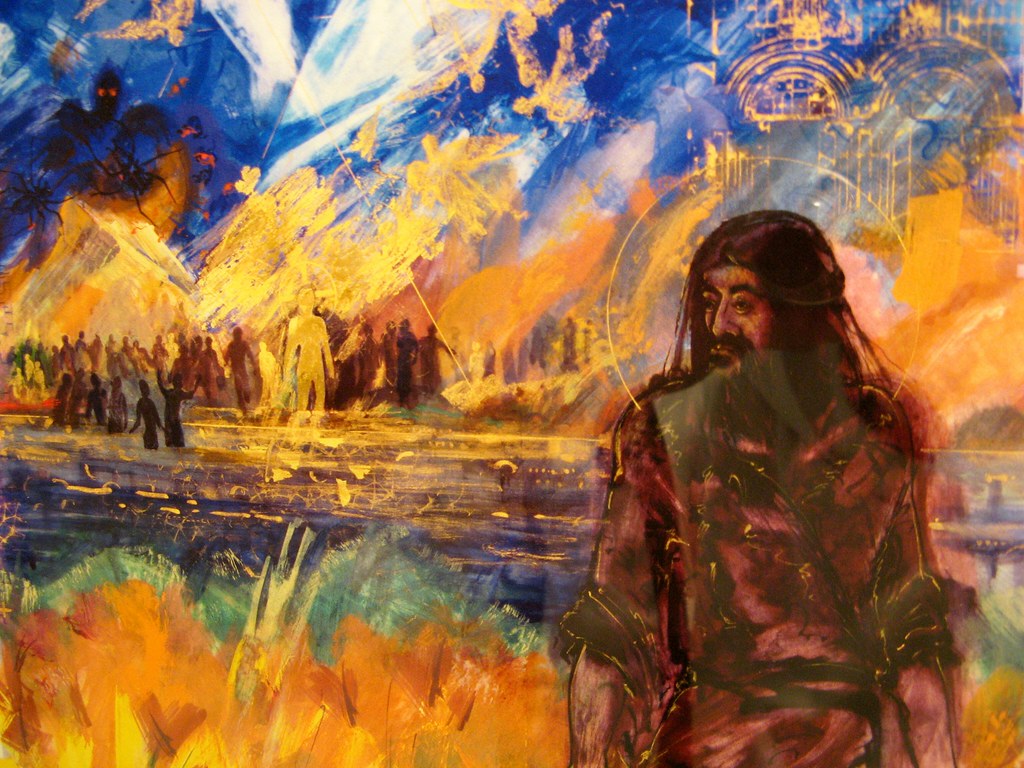
The New Testament talks about the destruction of the earth in 2 Peter 3, which is what environmentalists worry about, and which climate-sceptic Christians take as a reason not to worry about the earth’s future.

End Of The World (El Fin Del Mumbo) at Wikimedia Commons CC 4.0

But what both miss is the greater promise of the New Testament that God is making all things new, that there will be a new creation, with new heavens and a new earth. God is the God of resurrection, and resurrection is bodily and material. Our eternal destiny is not to be disembodied spirits, but to be raised with a new body, just as Jesus was.

And therefore, our eternal home is also physical and material. Could it be that there will be harvests too in the life to come? I don’t see why not. John’s vision of the New Jerusalem in Revelation includes trees, and while Revelation is more symbolic than literal, it indicates to me a physical place.

What does that mean for us now? Given that, as Paul tells us, our ‘labour in the Lord is not in vain’ (1 Corinthians 15:58), can we assume that God takes what we do for his kingdom in this world and mysteriously builds it into his coming kingdom? Can it be that nothing we do for God’s creation is ever in vain?

If so, then this reinforces why as Christians we approach harvest and creation with a sense of hope. Yes, there are serious and dangerous issues to face in the world. Harvests do not always happen at their proper time. They do not always yield all that we need. And much of this is down to the way the human race has damaged the planet.

Let us not lose heart when we see the dreadful effects of climate change on our world, with its extreme temperatures, storms, and shortages. It’s not a case of just piously saying, everything is going to be all right and abdicating our responsibility, we still need to take these things seriously and act appropriately. But when we do so, and when we do so in faith that God in Jesus is making all things new, we know that we contribute will count, because God will make it so.

When we make that lifestyle change – it’s worth it. When we raise funds for people suffering in the developing world – it’s worth it. When we write to our MP about government policy – it’s worth it. When we refuse to be taken in by the conspiracy theories our friends are spreading – it’s worth it.

I invite you to ask yourself a question that I see posed in a Christian Facebook group every Friday: what have you been working on this week to help make the world a little more beautiful?

Isn’t that a fitting thing to do? After all, we have a trustworthy God who has made a good creation. He is worthy of our praise, both in gathered worship and in making what is good in the world ourselves.

Not only that, but our God is also a God who restores what is broken, and therefore we can sing his praise for his restoring work and show it by the beauty we create in the world.

And finally, he is a God whose restoring work extends into the life to come, and so it is worthwhile praising him now in anticipation of that new world, and in crafting things that are valuable and praiseworthy.

Let us rejoice in the harvest and build for God’s kingdom.

A Brief Sermon For An Infant Baptism (Acts 16:25-34)

Before we read from the Bible, I need to explain the background to what we’re going to hear. The Apostle Paul and his companion Silas have been preaching in a city called Philippi, but they kept getting interrupted by a very disturbed young woman. She was a fortune-teller, but she was also a slave, and so her owners made a lot of money out of her. They exploited her.

Image courtesy Picryl. Public Domain.

So Paul cast the spirit out of the young woman that enabled her to tell fortunes, and that angered her owners, who lost a lot of money, because they could no longer exploit her. In revenge, they got Paul and Silas locked up in the local prison, and that’s where we pick up the story.

Acts 16:25-34

Now I’ve read that story largely because we read near the end that the jailer found faith, but on the basis of his faith not only he was baptised, but so was his entire household – although it must also be admitted that Paul and Silas spoke the word to the whole household.

Image courtesy StockCake. Public Domain.

And today, we shall baptise [name] on the basis of [the child’s parent]’s faith. One day, [name] will have to decide for himself whether to follow Jesus.

So what does this faith look like? Well, it’s a lifetime commitment, but let me pick out two important elements from the story.

The first is belief:

Believe in the Lord Jesus, and you will be saved (verse 31)

What does it mean to ‘believe in the Lord Jesus’? It’s not simply that we believe he exists, although the historical evidence for that is extremely strong. No: we believe certain things about Jesus, and we then trust him with our lives.

We believe that Jesus is the Son of God, that he died for our sins, and that he rose again from the dead to give us new life.

Some people say that they think they are good people and that will get them into eternal life with God when they die. But none of us is good enough to meet God’s perfect standards. We all fall short. Those failures need to be forgiven.

And the thing about forgiveness is this: it hurts and it is costly. I think of a time when I was still living with my parents. A friend of mine had a broken engagement. He needed somewhere to stay while getting over it, and we invited him in. He stayed for two weeks. But he never helped with anything around the house. He seemed to expect my Mum to cook for him and do his washing. When he left, he didn’t offer any money towards all that my parents had shelled out while he was with us.

Image courtesy Picryl. Public Domain.

We had a family conference about this. I’ll never forget my Dad’s words. “We’ll put this down to God’s account.” To forgive my friend involved my parents absorbing that debt. It cost them.

Similarly, Jesus dying on the Cross shows us that it cost God to forgive our sins.

So I invite you this morning to realise that is the cost God has paid for you to be forgiven. Will you believe it? And will you then trust Jesus with your life?

The second thing that faith involves is action:

At that hour of the night the jailer took them and washed their wounds; then immediately he and all his household were baptized.

The jailer brought them into his house and set a meal before them; he was filled with joy because he had come to believe in God—he and his whole household. (Verses 33-34)

The jailer does engage in good deeds, but they are not what earn him salvation. Instead, his action is a matter of gratitude.

We are so grateful that God has loved us so much it has cost him the death of his Son, that we respond. And we do so by putting our faith into action.

Yes, that gratitude is certainly shown in worship, but it is also shown in the world. The jailer tends to the wounds of Paul and Silas, who had been beaten and flogged before they were thrown into prison (verses 22-24).

Food drive for homeless. Wikimedia Commons. CC 4.0

So if we are grateful for all that God has done for us in Jesus, who are the wounded people we can serve and show his love? Perhaps we can think of this a little bit like the idea today of ‘paying it forward.’ Where and how can I pay it forward, because God has shown so much love to me?

The jailer didn’t have to look too far and neither do we. You will have a neighbour who needs some practical help. You will find organisations where you live that that work and campaign on behalf of those in the most desperate need, either in this country or abroad.

Conclusion

This is the faith into which we baptise [name] this morning. One that urges him to believe that Jesus died for his sins, and to trust his life to him. One that shows gratitude for God’s love in our actions, especially in the service of those in most need.

But do you know what will make the most sense of this faith to [name]? It will be when those of us in the church and in his family live out that faith ourselves before his eyes.

Keeping The Wrong Company, Luke 15:1-10 (Ordinary 24 Year C)

Luke 15:1-10

Back in prehistoric times when I was training for the ministry, one of our tutors told us that we should be at our desks every morning at 9 am with our shoes on. I’m sure I wore out some carpet by wearing shoes rather than slippers in my first manse.

I used to follow that pattern at first. But in one appointment, I was rarely (if ever) at my desk at 9 am. For at this point, we had young children going first through pre-school and then on to primary school. These were at the top of our road, and Debbie and I made a point of building relationships with the other parents.

We didn’t always make it back by the sacred hour of 9 am, and sometimes there would be phone messages from church members who had an expectation of me being there for them at that time.

Christ and a Pharisee. Wikimedia Commons CC 1.0

I think of those church members when I read about the Pharisees and teachers of the law in today’s reading. They thought I was mixing with the wrong people, because to them I was their private chaplain, just as the religious leaders thought Jesus was mixing with the wrong sorts, and that this reflected badly on his character. Their attitude was rather like the saying that you know a person by the company they keep.

Yet it was Jesus’ vocation to be with ‘tax collectors and sinners’. He uses the two parables we heard (plus what follows – the Parable of the Prodigal Son) to lay out why this was so important.

And if it were important for Jesus, it is also important for us. If we are to renew our commitment to following him, then we need to understand why he did this, and then get on with doing it ourselves.

Now the parables have a lot in common. They both (all) speak about finding what is lost and rejoicing. Bringing, or bringing back those who are lost from the love of Jesus into that love and into his family is a high priority for Jesus.

It is not always a high priority for us. We like to run our Sunday services, have a few nice midweek activities, make sure there’s enough money in the kitty to keep the building in good order, and that’s quite enough.

But not for Jesus. Each of these parables has something important to tell us about why he spends so much time outside the synagogue with ordinary (and even disreputable) people for the sake of God’s kingdom. So let’s look at what we pick up from the Parable of the Lost Sheep and the Parable of the Lost Coin.

Firstly, the lost sheep

As you know, we were proud as anything a couple of months ago when our son graduated with a Maths degree from Cambridge. And when people asked us where he got his love of Maths from, I said that it had always been my subject at school. It was later that I developed my interest in Theology.

I have always loved numbers, even if I have not concentrated on Maths for decades now. And there is something about numbers in these parables. A hundred sheep, ten coins, and two sons. In relation to the lost sheep parable, I was reading the New Testament scholar Ian Paul this week, and he cited another scholar, Mikeal Parsons, from whom he learned this:

Counting on one’s fingers (flexio digitorum) was very commonplace in the Roman world, and was in fact seen as an indispensable skill for the educated (See Quintilian Inst 1.10.35). Up to 99, you would count on the left hand, but for three-digit numbers from 100, you would count on the right hand. In an age that preferred the right to the left, Luke’s Jesus is telling us that the whole flock is out of kilter as long as the one is missing—and the whole flock is ‘put right’ when the one returns. No wonder there is so much rejoicing!

The flock is not complete and whole while the lost sheep is missing. And we, the church, are also not whole and complete while there are lost people still to be brought into the orbit of God’s love in Christ, or former sheep to be coaxed back.

Lost Lamb by Roberto and Bianca on Flickr. CC 2.0

To put it another way, the Body of Christ is missing a limb while a lost person is still lost. We cannot stay as our own private association, just enjoying one another’s company or even saying dreadful things like, ‘As long as this church sees me out I’m happy.’ That is to take the opposite attitude to Jesus. The church was not founded by Jesus to be a religious club. It was founded to be his junior partner, working for the kingdom of God. It has an outward focus.

A few years ago, I saw a job advertised for a chaplain at an Army rehabilitation centre for soldiers who had lost limbs in military service. An admirable organisation, I am sure, helping soldiers to adapt and to get on with the fitting of prosthetic limbs.

I fear, however, that the church has spent too much time simply adjusting to living without certain limbs and to be content with the absence of many people. Certainly, much of the institutional leadership has set an agenda which is little more than the management of decline.

You may have come into the church because someone invited you to try it. I can think of someone I know who now attends church because she was invited by her elderly neighbour to try it when she was heartbroken over a relationship breakdown. The elderly neighbour said, I think Jesus might be able to help you in your sorrow.

All this requires us to have friends and relationships outside the church. And it means loving those people. It means being ready for the appropriate time to say something gentle and clear about our faith to them.

I am not asking anyone to go door-knocking. But I am asking that we look for those moments when we need to take a little bit of courage and speak about our faith to people outside the church. Jesus is missing them, and the church will be more complete when they find faith.

Secondly, the lost coin

Ever since the Covid pandemic accelerated the move in our society towards cashless ways of making payments in shops, our family has been divided in our attitudes. One of us occasionally pays by a contactless method but really regards cash as king. Another usually pays by contactless on their phone but keeps a small amount of cash. Another pays by contactless on their phone, and a fourth pays by contactless on their watch. I’ll leave you to guess who’s who!

You might think that in Jesus’ time cash was king when you hear the Parable of the Lost Coin, but actually coins were less common in their use. Kenneth Bailey, a New Testament scholar who spent most of his life in the Middle East, said this:

The peasant village is, to a large extent, self-supporting, making its own cloth and growing its own food. Cash is a rare commodity. Hence the lost coin is of far greater value in a peasant home than the day’s labour it represents monetarily.[i]

Ian Paul suggests that the woman’s ten coins in the parable are either family savings or possibly the dowry her husband gave her on marriage. Dowry coins were often worn by the wife either around the neck or on the forehead.

When you understand this, you realise that the loss of this coin is a catastrophe. She hasn’t mislaid a 5 pence piece. Something profoundly valuable has gone.

The Lost Coin by On Borrowed Time on Flickr. CC 2.0

What would it be like for me? It would be like me losing my wedding ring. It is not the most expensive item I own, but I do regard it as my most valuable possession, for what it represents. Earlier this week, when our elderly and grumpy cat bit my hand and I had to have a tetanus shot and strong antibiotics, I was told at the Urgent Treatment Centre that I had to remove my wedding ring in case my hand swelled up. I was careful to put the ring somewhere safe.

Those who are lost from the church and faith in Jesus are therefore to be seen as immensely valuable to Jesus. It doesn’t matter whether they are former Christians or never-been Christians, Jesus values them hugely. Sometimes we are very dismissive of judgmental of people outside the church, and of course some of them can be hostile to us, but the Jesus who tells us to love our enemies puts a high value on them. They are precious to him.

Like us, they are made in God’s image. Like us, they are loved so much by God that Jesus died for their sins. They are treasured by God.

Before he wrote worship songs, Graham Kendrick was a Christian folk singer. One of his most popular songs from that period of his life was called, ‘How Much Do You Think You Are Worth?

The first verse says this:

 Is a rich man worth more than a poor man?
A stranger worth less than a friend?
Is a baby worth more than an old man?
Your beginning worth more than your end?

It goes on to consider various ways in which we might or might not value human life highly. Then it comes to a climax with these words:

If you heard that your life had been valued
That a price had been paid on the nail
Would you ask what was traded,
How much and who paid it
Who was He and what was His name?

If you heard that His name was called Jesus
Would you say that the price was too dear?
Held to the cross not by nails but by love
It was you broke His heart, not the spear!
Would you say you are worth what it cost Him?
You say ‘no’, but the price stays the same.
If it don’t make you cry, laugh it off, pass Him by,
But just remember the day when you throw it away
That He paid what He thought you were worth.

Every single person outside the church is valuable to God. The neighbour who annoys you. The child who keeps kicking his football at your fence. The greedy businessman. The politician whose policies you hate. The sex worker. The drug dealer. All these, as well as the ones we find it easy to like! The Cross tells us how much God values them.

And – while they are missing from God’s family, not only are they incomplete, so is the church.

It’s time to expand our networks, increase our love, and let faith prompt our courage.


[i] Kenneth Bailey, Poet & Peasant and Through Peasant Eyes: A Literary Cultural Approach to the Parables in Luke, 1983, p 157

Jesus The Extremist? Luke 14:25-35 (Ordinary 23 Year C)

This is a sermon I wrote in 2007. When I deliver this live on Sunday morning in worship I shall of course be amending some of the references. For example, at the time both my parents were alive, we and my sister’s family were living somewhere else, and our children were small. The iPod reference will be changed to the upcoming iPhone launch. And so on. So this is not the exact script, although it is close.

Luke 14:25-33

1. Family
It was an interesting week to read Jesus’ words in our Gospel reading today:

Shoe Family III by Sami Taipale CC Licence 2.0

‘Whoever comes to me and does not hate father and mother, wife and children, brothers and sisters, yes, and even life itself, cannot be my disciple’ (verse 26).

You see, on Thursday, my parents moved house. Having moved after retirement from London to Hertfordshire, they have now reached an age where they need to be nearer family. Moving near us is not practical, because who knows where we shall be living in a few years’ time? So they decided to move near my sister and her family in Hampshire. I spent Thursday and Friday helping them move in.

How do you read my actions in the light of Jesus telling me I should hate my parents? How do you interpret their decision that it was more realistic to move nearer their daughter than their minister son? Did I fail to hate my parents as Jesus instructed, by giving them some time I should perhaps have devoted to ministry? Or did they recognise that I should put following my call first by moving near my sister? Is the church right to think she can send me anywhere, while expecting my sister to be the one who cares for our elderly parents? If so, then my calling also affects my sister, brother-in-law and nephews.

So how radical should I be? If I am also to hate my ‘wife and children’, then should I do what some Methodist ministers in earlier generations did, and send my children to boarding school? Some missionaries in the developing world still do that – either sending their kids back to the UK or locating them at a school provided by the missionary society. Or should I even be like some radical missionaries who left their wives at home? The cricketer turned missionary C T Studd did that. And these issues are not limited to ministers and missionaries. Many people have to move with their job. If they have felt the call of God into their career, then similar questions arise.

And other questions pop into my mind. Should we take what Jesus said literally? If we do, what does that make us? If we don’t, do we dilute what he said and compromise our discipleship? How do we relate Jesus’ words here to other parts of Scripture that seem to contradict them – ‘Honour your father and mother’, for starters? Isn’t that commandment all the more relevant today in an age of family breakdown?

I think it starts to resolve not simply around the words Jesus uses, but the way he speaks. Like the Jewish and Semitic people of his time, he would speak in extreme terms to make a point, as we do sometimes. It’s like drawing a cartoon to emphasise certain things. Fact fans will like to know it’s called ‘Semitic hyperbole’, but most of us just have to know it’s this blunt and exaggerated form of speech in order to get a message across.

That doesn’t mean we dilute it, but we do look for the meaning underneath it. Jesus honoured his own mother at the crucifixion, when he arranged for John to look after her. But he also said that those who followed his teaching were his mother, brothers and sisters. So I think he calls us to honour our parents and care about our families, but he won’t allow us to make an idol of them.

There are ways in which the Christian church has made an idol of family life. Single adults, divorcees and widow(er)s in the church will have ready examples. I did when I was single. When moving on from my first appointment, I came across a circuit that only wanted to engage a married minister with children. I’ve seen ‘family service’ leaflets with logos featuring two parents and two children. Widows and divorcees tell stories of being under suspicion after they lost their loved ones from members of the same sex in the church: people assumed they were sexual predators.

Now obviously, as someone who is now married with two children, I don’t mean to demean family life, the importance of marriage vows and the like. But I think he envisages the possibility of obedience to him conflicting with the demands of family. While we mustn’t neglect our families, we can neither use them as an excuse for disobedience to Christ’s call. Family might even call us to do things that are displeasing to Christ, and we have to resolve who will direct our lives, Christ or others. We did not sign up for a hobby when we joined the church, but for the daring and costly life of faith.

And that takes us to two other challenges Jesus makes in this passage.

2. Life
Listen again to Jesus’ words in verse 26 – and on into verse 27:

Life And Death by Scott Law CC Licence 2.0

‘Whoever comes to me and does not hate father and mother, wife and children, brothers and sisters, yes, and even life itself, cannot be my disciple. Whoever does not carry the cross and follow me cannot be my disciple.’

Hate your life. Carry the cross. Those two things go together. To carry the cross was not to bear a burden of the general suffering life dishes out to all without discrimination. To carry the cross was to be a condemned person, on the way to execution. In his extreme language here, Jesus surely speaks of discipleship being something where your own life is of no matter to you. It is the willingness to risk. It is being prepared to follow him, knowing that the consequences may involve suffering. That is, suffering inflicted on us by the world, because we have faithfully, humbly and lovingly pointed to a different way, the way of Christ.

Well, this too touches a raw nerve with Christianity as we have conceived it. Just as Jesus makes obedience to him more important than our families (even though a certain strong kind of family life would be a good witness today), so he also calls us to hang loose to life itself. Yet we often talk in the church about the ‘sanctity of life.’ Probably the great majority of Christians generally oppose abortion, euthanasia and infanticide, just as we believe murder is wrong.

Now again, I hold traditional views about those subjects. Life is a gift of God. We should not take it away. However, if it is a gift of God, it may be that he asks for it back. He may ask us to give it up. Whose life is it anyway? It is God’s, and we are only looking after it for him.

But holding lightly to life is not something that comes naturally. Several of you know that at the beginning of this year, I had a health scare. During a routine medical, blood was discovered in my urine, and I was referred urgently to hospital for tests. During the two weeks between seeing my GP and going to the hospital where I got the all clear, I was terrified – not least, because of our young children. Giving up life, had I had to face it, would have been appalling to me.

Yet older generations of Christians have much to teach us about this. In a day of medical advances and increased life expectancy, some of us (not all) have become rather detached from death. But the stories about heroes of our faith challenge us to see this differently. Here is just one story:

When James Calvert went out to Fiji in 1838, he was told by the captain of the ship on which he sailed that he was going to a land of cannibals. The captain tried to dissuade Calvert from going by saying, ‘You are risking your life and all those with you if you go among such savages. You will all die.’

Calvert replied, ‘We died before we came here.’[1]

They had died to sin. They had resolved to risk their lives for the Gospel. Dare I say they were closer to the classical belief in the resurrection from the dead than we sometimes are? They hadn’t been shaped by the practical atheism of our day that thinks this life is all it is. Nor were they so consumed by the vision of heaven that they were no use on earth. Their vision of heaven and the resurrected life was so vivid they could take this attitude to physical death. What would happen to today’s Church if we adopted their robust Jesus-centred faith?

3. Possessions

To The Top And Over by Ed CC Licence 2.0

Well, if Jesus hasn’t already attacked two sacred cows in the Church – family and life – he goes for a third at the end of the reading:

‘So therefore, none of you can become my disciple if you do not give up all your possessions’ (verse 33).

Hold on, you say, possessions are the big thing in the world. We know we live in a consumer society. Aren’t we in the church different?

If only we were. Last night I watched an Internet video created by a Microsoft employee, which showed a woman demanding a divorce from her husband. The punch line was that it wasn’t a real marriage; he had a t-shirt on saying, ‘advertiser’, and she wore one saying, ‘consumer.’ Some Christian commentators are saying it’s uncomfortably like the church.

We have made church into a consumer exercise. Listen to the way some people hop from church to church and their reasons for doing so. We make decisions about finances and purchases in ways that are not radically different from the world. Was I the only one in the Christian church taking an unhealthy interest in the launch of new iPods this last week? We teach it to our kids. Recently I read about the Christian couple who read a Bible story at dinnertime with their children. One night they read the story of Jesus and the temple tax, where Jesus sends Peter fishing, and he catches a fish with a coin in its mouth. Their son was impressed. He asked to go fishing with his Dad and catch a fish. ‘Yours can have a computer in its mouth and mine can have a new toy’, he declared. Can it really be that surprising if Jesus wants to say some hard things about possessions?

Again, isn’t he being extreme? Give up all your possessions to follow him? Even Jesus at his death still owned some clothing for which the soldiers cast lots (Luke 23:34). He hadn’t turned down the support of some wealthy women who had provided for him and his disciples (Luke 8:3).

Maybe we get a clue to our response not from Luke’s Gospel, but from Luke’s sequel, the Acts of the Apostles. There we see how the Early Church put this into practice. They had all things in common and would sell possessions to help those in need (Acts 2:44f; 4:32). Ananias and Sapphira were not condemned for failing to sell all their possessions, but for being dishonest about their actions (Acts 5:3f).

I believe Jesus challenges us to put our money and goods at one another’s disposal. I believe he calls us to model a radically different lifestyle from the world around us, rather than just being religious consumers. The world rightly expects from what it knows about us that we will help the needy. What it doesn’t always know is that we base that on such a sense of belonging to one another as well as belonging to Christ. We may express it in a community gathered in a particular geographical location, from a monastery to a group of Christians moving into the same neighbourhood to an extended household. But we need not. What matters is holding of things in common. What matters is the willingness to help those who need it. What matters is the holding together, rather than the sitting apart as isolated individuals, which is one symptom of chronic consumerism.

Conclusion

Believe by Matthew CC Licence 2.0

What’s at the heart of all this? Probably what’s at the heart of this passage – the two parables about counting the cost. Following Jesus is not an easy option. I had a chat with one of the men from the removal company my parents used. On discovering my profession, he said it must be nice to be able to believe what I did in such a wicked world.

Actually, it isn’t the easy option to believe. Because Christ-followers don’t simply believe certain things to be true. Christ calls us to live what we believe. And what Jesus calls us to live out if we believe in him touches such basic values as family, the sanctity of life and material possessions. It would be wise to count the cost before believing, rather than thinking it’s a nice way to feel good in a bad world.

It’s about following someone who himself counted the cost – and paid it. In incarnation. In crucifixion. But who did it ‘for the joy that was set before him’ (Hebrews 12:2). May we see the joy set before us, count the cost, and follow his example.


[1] Stephen Brown, Don’t Let Them Sit On You, p 140.

Watching You, Watching Me: Jesus and the Pharisees at Dinner, Luke 14:1-14 (Ordinary 22 Year C)

Luke 14:1-14

Surveillance Society - Halsted and Division Edition (C) Seth Anderson on Flickr, CC Licence 2.0

We live in what some have called ‘the surveillance society.’ Everywhere you go, you are on camera. Never mind the old ‘Smile, you’re on Candid Camera’ TV catchphrase, in our society you can hardly move without being captured on CCTV.

Not only that, we have the increasing use of video doorbells. We fitted one at the manse soon after coming, because we discovered that on our estate parcels left by delivery companies were frequently stolen from doorsteps. We also had to deal with a stalker.

At the beginning of our reading, we hear this:

One Sabbath, when Jesus went to eat in the house of a prominent Pharisee, he was being carefully watched. (Verse 1)

Jesus was being carefully watched by the Pharisees and other religious leaders. He was under suspicion. They wanted to clock any incriminating move.

But the shock of the story is that in fact Jesus was also watching them. Listen again to verse 7:

When he noticed how the guests picked the places of honour at the table, he told them this parable.

When he noticed. It’s a two-way mirror. It’s a dose of their own medicine, to mix the metaphors.

What does Jesus notice? I’m going to divide up the story into three to answer that question. Spoiler alert: we’re going to see how Jesus’ values clash with those of his society, and also with ours.

Firstly, the sick man:

This week’s Lectionary doesn’t include verses 2 to 6. Perhaps it’s because last week’s Gospel reading also included Jesus healing someone on the Sabbath. There are certainly some similarities with last week’s episode where Jesus healed a crippled woman in the synagogue. Jesus provokes confrontation with the religious establishment and the way he asks them a question about what constitutes work on the Sabbath what constitutes good deeds is very similar. So perhaps the compilers of the Lectionary thought that if they included this story this week congregations would end up with two similar sermons on consecutive Sundays.

However, these are not the only two examples of Jesus healing on the Sabbath in Luke’s Gospel. There is another one in chapter 6, for example. And while there are clear similarities, this week’s story has at least one unique application, and it’s to do with how the ancient world interpreted the medical condition he had.

The NIV says he was ‘suffering from abnormal swelling of his body’ (verse 2). Other translations use the old word ‘dropsy.’ It’s an excess of fluid that indicates something else is wrong. A few years ago, I went to the doctor because my legs were swelling. The first thing the GP did was send me for a blood test to make sure I didn’t have an issue with my heart, because congestive heart failure can cause this. So can kidney disease.[i] In my case, it was nothing so disturbing, but rather a side-effect from a blood pressure tablet, and I just needed a different drug.

But the ancients saw those with dropsy as people who had insatiable thirst, and metaphorically as those who were greedy, loved money, and were rapacious[ii]. And which group of people was accused of these very sins in Luke’s Gospel? Oh yes: the Pharisees[iii], the very people who are condemning Jesus’ action of healing.

Hence, when Jesus heals the man of his abnormal swelling, he is not just continuing his war on those who interpret God’s commands in a cruel way, he is also putting them on notice about their greed. He has noticed this too about them.

Are we in danger of crossing a line from enjoying good things that God has provided to being greedy? We so often go along with our consumer society and get sucked into the idea that we need to fill our lives with more stuff. Could there be a surprising, maybe shocking message in the reading for us today that in the eyes of Jesus we are bloated, and that we need his healing? Is this something that any of us needs to pray about and act on?

Secondly, the wedding invitation:

In verses 7 to 11, Jesus imagines invitations to a wedding being sent out and people jostling for position at the banquet to be seen as having more honour and prestige. He has noticed it at the meal he is attending. Like I said, it’s not just the Pharisees doing the watching, Jesus is watching them.

This is an attitude that will be familiar to us. Were you ever in a work situation where someone was doing their best to ingratiate themselves with senior leadership to get promotion? Back in the days when I did a more conventional job, I saw that. There was an ambitious man who discovered that he shared a love of cricket with the office manager, and he used that to curry favour. It certainly got him one promotion.

We sometimes see attitudes like this in the church. Somebody wants to be a big fish in a small pond. But it goes against the teaching of Jesus.

And he tells his hearers to take the lowest place at the banquet. The host may invite them to move up to a more honoured seat, and that is better than the humiliation of having thought too highly or themselves and having had to be relegated. In a culture where issues of honour and shame were prominent, this was radical teaching from Jesus.

Even then, some people manipulate Jesus’ teaching here. Some of what masquerades as ‘servant leadership’ in the church is actually a way of exercising influence and gaining power through the back door.

But if we follow Jesus, we shall be content with the seat to which he appoints us. If he puts us in a prominent position, all well and good – although we shall have to guard ourselves against pride. If we remain in an obscure or insignificant place, that is fine, too. After all, Jesus himself in taking on human flesh took the nature of a servant[iv].

In my early years as a minister, I had a couple of incidents where people foresaw me rising to positions of prominence in the church world. Not least was the time when I ended up as a seminar speaker at Spring Harvest, and one or two people said that I would then be among the movers and shakers of the evangelical world. It never happened. I have remained an obscure minister, and over the years have learned to be content with that.

When it comes down to it, no Christian can be seeking to make a name for themselves. That is not consistent with the call to humility and servanthood that Jesus makes. The only fame we seek is the fame of Jesus. And we let Jesus appoint the places where he wants us to do that.

Thirdly, the dinner invitation:

In the final part of the reading, verses 12 to 14, Jesus asks his listeners to imagine themselves not as the recipients of an invitation but as the givers of one. Who will you invite to dinner, he asks? And in one sweeping move he undermines the entire social fabric within which his hearers are happily living. Is it just to have a go at them, and enjoy seeing them squirm? I’m sure they did, but Jesus’ real concern here is for the poor and the excluded.

It’s almost topical. This week, we’ve heard the news that the Liberal Democrat leader Sir Ed Davey has declined his invitation to the banquet the King will be hosting next month for Donald Trump’s state visit in protest at Trump’s apparent support for the Israeli government’s state-sanctioned violence in Gaza. Davy even said that as a Christian this was something he prayed about before confirming his decision.

But if Ed Davey’s decision is a negative one as a protest, what we have from Jesus here is a positive step on behalf of the poor. First of all, he blows away all the conventional wisdom of his day about patronage, mutual back-scratching, and reciprocal arrangements so that people can engage in social climbing. It’s not the way of the Christian, he says. I wonder whether it says anything to today’s practices. What would it say, for example, to the way people today go along to ‘networking’ events to promote themselves?

No, says Jesus, invite people who can’t offer you an invitation back. Don’t see this as a way of getting something in return. There’s nothing particularly Christian about that. The Christian approach is to be a giver, whether or not people give back to us.

I mean, doesn’t this model the Gospel and God’s giving to us? What God gives to us in his grace and mercy, forgiving our sins, wiping the slate clean, and giving us a fresh start is way beyond what we can offer back to him. ‘What shall we offer our good Lord, poor nothings for his boundless grace?’ as the hymn puts it.

I want to challenge us all to consider this question: who can I bless this week who cannot necessarily bless me back? Who, among the poor, excluded, and marginalised in our society can I give to or serve?

We refer today to the idea of ‘paying forward’: when someone has given to us and we cannot give back, we give to someone else instead. It would be within the spirit of what Jesus teaches here for us to ‘pay forward’ the grace, mercy, and love we have received from him to others as a sign of our gratitude to him.

So, why not look for an opportunity this week? And come back next Sunday to tell your friends what happened.

Conclusion

The Pharisees were watching Jesus. Unbeknown to them, Jesus was watching them. He called them to replace greed with kindness, pride with humble service, and social climbing with giving.

And surely Jesus is watching us, too. He is longing to see us display these qualities as a witness to him.

What will he see us do this week?


[i] Joel B Green, The Gospel Of Luke (NICNT), p546.

[ii] Op. cit., p547.

[iii] Luke 11:37-44 and 16:14.

[iv] Philippians 2:7.

The Answer Should Be Jesus But It Sounds Like A Squirrel, Luke 13:10-17 (Ordinary 21 Year C)

Luke 13:10-17

You’ve probably heard the story about the preacher who begins a children’s address by asking, ‘What’s grey, furry, has a tail, and runs up trees?’

After an embarrassed silence, one of the children says, ‘I know the answer should be Jesus, but it sounds like a squirrel to me.’

Grey Squirrel
Courtesy Wikimedia Commons, CC Licence 3.0

The answer should be Jesus. Well, in today’s reading the answer definitely is Jesus. He is the central figure in the story. Everything revolves around his interactions with people and their responses to him.

Firstly, Jesus and the crippled woman:

There is widespread agreement that the physiological condition the woman was suffering from was ankylosing spondylitis, which is an arthritic condition affecting the vertebrae. It leads to curvature of the spine and an inability to flex the joints. The condition is well-known today – I’m sure you know or have seen people with it – and to this day is still incurable.

But what about all that ‘spirit’ and ‘Satan’ language attached to it? The NIV says the woman was ‘crippled by a spirit’ (verse 11), and other translations say, ‘a spirit of weakness.’ Then, when Jesus argues with the synagogue ruler, he says that Satan had kept her bound for the eighteen years she had had the condition (verse 16).

Ankylosing spondylitis
Courtesy Wikimedia Commons, CC Licence 3.0

So is Jesus performing an exorcism here? Was the woman possessed? No. Luke doesn’t use that language. There is no ‘casting out’ or ‘delivering’. Jesus puts his hands on her (verse 13), which doesn’t usually happen in an exorcism.

What is this language, then? It is a recognition that the whole of creation is disordered due to sin. Not that the woman’s ill-health is a result of her personal sin, but that everything in creation is broken and needs healing and restoring. God’s mission in Jesus is to put the whole world to rights. It is why the mission of God’s kingdom that Jesus announces includes so many things: the forgiveness of sins, the healing of sickness, good news for the poor, releasing people from evil spirits, and so on.

It is therefore understandable that when the woman is healed, Jesus says to her, ‘Woman, you are set free from your infirmity’ (verse 12). No wonder she straightens up and praises God (verse 13).

Here we find the mission that the church is called to continue. If you want to know what we are about, it is this. We are called to set people free from all the brokenness in creation. We bring people to faith in Jesus through the forgiveness of their sins. We bring healing and restoration in every sense: physically, emotionally, relationally, socially, and spiritually. And all in the Name of Jesus.

We are not a religious social club, set up for us to enjoy the Sunday meetings, and perhaps the midweek ones too if we’re keen. We are not on mission just to fill church jobs so that the institution can continue.

We are here to proclaim the kingdom of God, where Jesus is on the throne, and his will is to be done on earth as it is in heaven.

We are here to proclaim that kingdom so that more people, like the crippled woman, will praise God as they experience this good news.

Or maybe you are here today as one of those who in one way or another has been crippled in the brokenness of our world. Then may it be that here in this community you find the Jesus who can straighten you and make you whole.

Secondly, Jesus and the synagogue leader:

When I went to my first appointment as a probationer minister, it wasn’t long before some people sidled up to me quietly and asked me rather hesitatingly a question that began with the words, ‘Do you drink?’ I thought the sentence would be completed with ‘Do you drink alcohol?’ but in fact it was ‘Do you drink tea?’ It turned out that not only was my predecessor teetotal, he also did not drink tea or coffee. Well, I say he was teetotal: there was one occasion when he accidentally and unknowingly ate trifle that had sherry in it and then asked for seconds.

Being teetotal was for many years an ‘identity marker’ for a high number of Methodists. If you knew one thing about Methodists, it was generally that they didn’t drink.

The dispute between Jesus and the synagogue leader is a power battle. It centres on two things. One is about identity markers to show who are truly God’s people. For in Jesus’ day, Sabbath observance was one such marker of a true Jew. The synagogue leader clearly thinks this is under threat, and so he accuses Jesus of breaking the Sabbath by healing the woman.

Shabbat (Sabbath)
Courtesy Wikimedia Commons, CC Licence 2.5

But Jesus’ words and actions show that you have to go beyond wooden interpretations of the Scripture to find the true identity markers of God’s people. There is something wrong with coming up with an understanding of Scripture that prevents God’s people from doing good.

Jesus still believed in the Sabbath, but not in this crude, wooden way. If you asked him about an identity marker for God’s people, he would talk about loving God with all our heart, soul, mind, and strength, and loving our neighbour as ourselves. The identity marker is that we love God and love people.

All of which means there is another battle going on here between Jesus and the synagogue leader. It’s about who is the authoritative interpreter of Holy Scripture. Jesus exposes the hypocrisy of someone who is happy to see animals set free from their tethering on the Sabbath, but who is not happy to see a woman set free from infirmity to take her full place among the People of God at worship again.

It’s worth asking what our identity markers are, and how we have interpreted the Bible to come to those conclusions. What are we known for, and why? Are we known as hypocrites, or as people who love?

The Christian church has a particular problem with this in our society, not least due to all the sex abuse scandals. Only this last week we’ve seen the conviction of Chris Brain, the former leader of the Nine O’Clock Service in Sheffield. Most men outside the church think that clergy are either child sex abusers or ripping off the flock financially.

It’s an urgent task for us as Christians to make sure we are known as those who love God and love people. How are we doing that? How are we going to do that? It’s why I often encourage church members to pray a simple prayer each day: ‘Lord, who can I bless today?’

But that prayer is also worth extending corporately to the church. What if we asked together at our committees and other meetings, ‘Who can we bless as a church?’

Let’s make sure we share the same identity markers of God’s People as those Jesus advocated: loving God and loving people.

Thirdly and finally, Jesus and the congregation:

When he said this, all his opponents were humiliated, but the people were delighted with all the wonderful things he was doing. (Verse 17)

The crowd is on their feet, cheering. ‘Go, Jesus!’ It’s like he’s scored a goal and the stadium has erupted.

What does it mean for us today to take delight in the wonderful things Jesus does? It is about more than being the Jesus Fan Club. We are the supporters of Jesus, I suppose, but we are more than that.

When we take delight in the wonderful things Jesus does, we erupt in praise and worship. The best hymns and songs of worship are those that describe the amazing things God has done in Christ. It’s like the disciples on the day of Pentecost, when the assembled crowd of many nations observes, ‘We hear them declaring the mighty deeds of God in our own tongues.’

Courtesy StockCake, CC Licence 1.0 (Public Domain)

Declaring the mighty deeds of God. That is the Christian calling in a nutshell. Declaring the mighty deeds of God is both praise and mission. In worship, we tell God of our delight in his marvellous works. In mission, we declare those works to the world.

Let us dwell on the wonderful things Jesus has done and is doing. Let us rejoice in what he did two thousand years ago, from healing a crippled woman to dying on the Cross for our sins. Let us also rejoice in what he is still doing today. Who here knows that Jesus has done something special for them? Have you shared it with any of your church family here?

I am sure there will be some of you here today who know that in the last seven days since we gathered together for worship, Jesus has done something for you. It might be big, it might be small. If you haven’t already told someone since arriving this morning, then I encourage you to mention it as you chat with your friends over tea and coffee after the service.

Don’t be shy about this! We are family. We accept one another. We love to hear each other’s good news. And what could be better than to talk about the work of God in our lives and celebrate together.

Why do this? Well, for one thing it has an effect upon the atmosphere here. Imagine what it would be like for a stranger or a newcomer to walk into a community that was full of joy because of what God has done.

For another, if we know God has done something for us then that can be an encouragement to others. There will be people among us who are struggling or discouraged, and for whom it could be a tonic to hear that God has not retired but is still active.

Further, talking together about our delight in what Jesus has done is good practice for those times when we take a bit of courage to tell our friends and family outside the church about our faith.

And most important of all, should not God receive the glory due to his Name for all his amazing works?

I love the story in the Old Testament where the Temple is dedicated, and the cloud of God’s glory comes in such overwhelming power that the priests cannot even remain standing to do their duties. What would it be like if our joy and thanksgiving for the work of God were so tangible that a visitor would spontaneously say, ‘Truly God is among you?’

The Future Of My YouTube Channel

As the short video above explains, I’ve decided to put my YouTube videos on hold for now. Viewing figures have dropped to such a low level that I can hardly justify the time spent.

However, I shall continue to post regularly here on the blog, and the main part of them will continue to be written forms of all my messages, whether sermons, talks, or Bible studies.

If you have not signed up for regular updates from this blog, can I encourage you to do so? A ‘Subscribe’ button appears near the bottom right of your screen when you are on the home page. Thank you.

By Faith: Hebrews 11:1-3, 8-16 (Ordinary 19 Year C)

Hebrews 11:1-3, 8-16

What faith is

Now faith is confidence in what we hope for and assurance about what we do not see. (Verse 1)

What is faith? Silly atheists will tell you that it’s believing in something that cannot be true. They tell you they don’t have faith at all, they rely on facts. But of course, they do have faith – they have faith in human reason. And while human reason is a good gift of God, it is corrupted by human sin. That’s why good things like science have also given us bad things such as nuclear weapons and instruments of torture.

So what is faith? It’s a combination of two things: belief and trust. It’s the belief in certain things being true about God, and that leads to the trust that we put in God. So we believe that Jesus died for our sins and God raised him from the dead and declared him to be Lord. We then trust him as Saviour and Lord with the direction of our lives.

This is something we practise in everyday life. We get to know certain things about a person, and when we know them well enough to believe they are trustworthy, we then trust them. We might believe in the qualifications an electrician has and then trust them to repair our lights. We might believe in a romantic partner’s love for us and then enter into marriage with them. Both these illustrations are examples of faith that is made up of belief and trust.

The definition of faith our reading begins with is more on the ‘trust’ end. It assumes we already know things about God. Then, in the light of that, we trust:

Now faith is confidence in what we hope for and assurance about what we do not see.

Given what we know and believe to be true about God, we can be confident in our hope and sure about what we do not see.

Again, what do we know about God as revealed in Jesus? We know this is a God who even gave up his only Son for us. We know that Jesus suffered to the uttermost with us and will be alongside us in the darkest moments of life. We know that God said ‘Yes’ to all Jesus did on the Cross by raising him from the dead. We know that as God made the body of Jesus new, so he will one day make new the whole of creation.

This is the God we believe in. This is why we can have certainty about our future hope: we have seen this God in action. We know he has good plans.

And so we trust him. We trust our entire lives over to him. Even though walking with him will sometimes be difficult and painful, we know he has good purposes in mind for us and the whole world. We may not be able to see where he is leading us, but he has done enough for us to believe he is trustworthy. Therefore, we say ‘Yes’ to him.

So that’s my first point. What is faith? It is believing we know enough about God in Christ to trust ourselves to him.

What faith does

Here we’re specifically going to look at the example of Abraham in the text. We don’t know how much he knew about God, nor even how he got to know God in the first place. But we do know that he believed enough to trust God when he heard him speak to him.

8 By faith Abraham, when called to go to a place he would later receive as his inheritance, obeyed and went, even though he did not know where he was going. 9 By faith he made his home in the promised land like a stranger in a foreign country; he lived in tents, as did Isaac and Jacob, who were heirs with him of the same promise.

If you know God loves you, if you know he has your best interests at heart, and if you know that the best thing in all creation is the kingdom of God, then what do you do when God asks something of you?

Many of us say, ‘No.’ I knew someone in my home circuit who said, ‘Whenever I think God is calling me to something, I always say ‘No,’ because if it is him, he will ask me again.’

However, some of us say no, because we would rather stay comfortable, and we know that God’s call to obey him with trusting faith may lead us into situations that take us away from that comfort we crave.

Certainly, that happened in the Bible, and it definitely happened to Abraham. We just read that he obeyed and went, even though he didn’t know where he was going, and he ended up making his home like a stranger in a foreign country, even though that place would be part of the Promised Land for God’s people.

It has happened to me in following God’s call in the ministry. I wouldn’t even be in the ministry in the first place if I had limited myself only to comfortable circumstances. And when I first went to visit the circuit that would be my second appointment, I can still remember how disheartened I felt as I drove down a hill into the area. I saw how dirty and run-down the place was. Later, I would regularly walk along pavements that were covered in discarded cigarette butts and other litter.

But had I not gone, I would have missed out on serving with some amazing Christians across a variety of churches and denominations. I would not have made some lifelong friends, many of whom still live there.

And of course, it is where I was living when I met Debbie – not that she came from there. It is where we married and where we had our children.

We need to be careful about saying ‘No’ to God when he calls us to trust him and obey in faith. If we’re seeking clarification of his will, like the friend of mine I mentioned, I guess that’s fine.

But when it comes down to it, if we are people of faith and God has spoken to us about something he wants us to do, we need to say ‘Yes’, even if it’s daunting. God will be with us when we trust him and set out as Abraham did. There may indeed be some struggles ahead of us when we go, but Jesus knows what it is like to walk a dark road. He will never leave us or forsake us.

I wonder if there’s anyone here who is being prodded by the Holy Spirit. Is he prompting you to do something or go somewhere? I challenge you to say ‘Yes’ and then see God at work as you trust him in faith.

What faith sees

Believing and trusting isn’t always easy, as I’ve suggested. But there is something that keeps us going forward and drives us on. It is what faith sees. It is the vision faith gives us. Abraham had it. So did others. We can, too.

What is it?

10 For he was looking forward to the city with foundations, whose architect and builder is God.

13 All these people were still living by faith when they died. They did not receive the things promised; they only saw them and welcomed them from a distance, admitting that they were foreigners and strangers on earth. 14 People who say such things show that they are looking for a country of their own.

Even if God leads us to a place where we are not comfortable, faith tells us this is not the last stop on the journey. Faith holds before us the vision that God is making all things new, that a new creation is coming, with new heavens and a new earth. And God’s people will dwell in the New Jerusalem, the new holy city, in all its glory and splendour.

This is not just about where we go after we die. This is about what God is building in his kingdom. This vision shows us the ultimate purposes of God. We believe this by faith. We set out in trust in that direction, building for it ourselves, by what we do in our lives.

Has God led you into somewhere or something that is troubling or challenging? Be assured that it is not the last stop on the journey.

When we are in that disheartening situation, it is easy for us to look back to when times were better, but what God says to us is, don’t look back, look forward. Look forward to his great future with solid hope. As verses 15 and 16 say,

15 If they had been thinking of the country they had left, they would have had opportunity to return. 16 Instead, they were longing for a better country – a heavenly one. Therefore God is not ashamed to be called their God, for he has prepared a city for them.

We often talk about our future hope in terms of what Jesus promises in John 14 when he tells his disciples that he is going to prepare a place for them. But in these verses, the promise is much bigger than that. Not only will Jesus prepare a place for us, God is preparing a whole city for his people. Wow! We might not like the place where we are today, but one day we shall be in the City of God. That is what we look forward to by faith.

So if we are discouraged, if we wonder why on earth God has allowed us to be in some dispiriting location or circumstance, let us lift up our eyes. I know I need to do that at times, so I am preaching to myself here every bit as much as I am preaching to you.

Yes, let us lift up our eyes. Let us say, Lord, all those years ago I learned what you were like, and I believed you. And I have stepped out in trusting faith with you. It may not be great right now, but I am going to lift my vision and see something of that future hope, the City of God.

And if for you things are good right now, then I would still encourage you to lift your eyes and dwell on the future hope. For that new creation, that New Jerusalem, is the template for what we do now by faith. It shows us what we are building for. It informs our decisions and our actions now.

For all of us, let us believe. Trust. Act. And hope.

Living A Life Worthy Of The Lord, Colossians 1:1-14 (Ordinary 15 Year C)

Colossians 1:1-14

When I decided I wanted to learn photography, I asked my Dad to take me to his favourite camera shop in London. There, we met a remarkable salesman who had had one hand amputated. Think about that: how do you manipulate something like a camera without one hand? He did.

He sold me a rudimentary 35mm SLR camera. The idea was that I needed to learn the basics first before I ever considered a more complicated beast. That’s what I did.

I even had to repeat the exercise when I moved from 35mm film to digital.

The nature of Paul’s thanksgiving for the Colossians is that they have learned the basics. Now they can go deeper.

What are the basics?

we have heard of your faith in Christ Jesus and of the love you have for all God’s people (verse 4)

Faith in Jesus and love for his people. Faith and love. These come from the gospel and the hope it gives us (verses 5-8).

Now it’s time to build on the basics and go deeper in their faith. Specifically, he wants them to know God’s will (verse 9) so they

may live a life worthy of the Lord and please him in every way (verse 10).

I’d like us to look at these next steps for the Colossians today. If the basics are in place for us – that we have faith in Jesus Christ for salvation and we love God’s people – then what qualities are our next steps? Paul lists four:

Firstly, good works:

bearing fruit in every good work (verse 10)

We know that good works don’t earn us salvation. That is a free gift of God that we receive by putting our faith in Jesus and his death for us on the Cross.

Instead, good works in the Christian life are a grateful response to God, once we know salvation by faith in Jesus. As I’ve said before, remember that God only gave the Ten Commandments to Israel after he had saved them from Egypt. It’s similar for us.

How might we approach this, then? We have just completed the Bible Society’s study course on Paul’s letter to the Romans. In the final session on Thursday, we were challenged as part of our mission to pray a prayer every morning: ‘Lord, who can I bless in your name today?’ I think that would be a helpful approach in knowing at least some of the good deeds God is calling us to do as our thankful response to salvation.

I have encouraged other people to consider the question: how can I make a difference for good in the world? It might be through pursuing a particular career. It might be in other ways. We might seek to live less extravagantly and give more to those who are doing things we aren’t able to do. This might involve our support for organisations working to transform things in the developing world, for example. Or we might cut back our own spending in order to give to those who are bringing positive change for those in poverty in the UK. Where can we make a difference for good in our deeds and in our giving?

Another way to approach this is found in a favourite quote of mine. It comes from the American Christian writer Frederick Buechner, when he was writing on the subject of vocation. Now you may hear me say the word ‘vocation’ and think, this doesn’t apply to me, I’ve retired from paid work. But vocation is about everything we are called to do and to be in response to God’s love.

So here are Buechner’s words:

Your vocation is where your deep gladness meets the world’s deep need.

In other words, is there something you are passionate about that can be set to the purpose of making a difference in the world?

Secondly, knowing God:

growing in the knowledge of God (verse 10)

Now before anybody gets worried, I’m not suggesting we all need to go off and study for a Theology degree! I enjoyed the two I took, but they’re not for everyone.

We do however all as Christians need to know more about God’s character, God’s plans, and what God loves. If we know God more in these ways, we shall want to love God more deeply. It seems strange to me that some Christians just want to stop at the bare minimum knowledge of God. Surely, given all he has done for us in Christ, we would want to know more about him and his amazing love.

And that’s why I’m always banging on about not simply coming to worship on Sunday, although that’s a good start. It’s why we need to read the Bible daily for ourselves and also meet with others to study it so that we can learn from each other. I was so pleased that everyone who filled in a feedback form at the end of our Romans course was looking in one form or another for us to keep meeting and looking at the Bible together. That’s encouraging.

It’s why we need to pray regularly, because prayer is not just us talking to God, it’s about waiting and listening to him.

Also, sometimes we get to know God better merely by doing what he says, even when we don’t understand it. Because in the doing of his will we get to know him better. Jesus said,

Anyone who chooses to do the will of God will find out whether my teaching comes from God or whether I speak on my own. (John 7:17)

So – how are we getting to know God better?

Thirdly, endurance:

being strengthened with all power according to his glorious might so that you may have great endurance and patience (verse 11)

Often when we read words like ‘strengthened’, ‘power’, and ‘might’ in the New Testament, we think it’s going to be about the dramatic or miracle-working power of the Holy Spirit, and I’m not about to poo-poo that.

But here, Paul prays that God will strengthen the Colossians so they ‘may have great endurance and patience.’

We need those qualities in the Christian life. To follow Jesus is not a spectacular 100-metre sprint, it is the endurance of the marathon. And over the marathon course of our lives, there will be ups and downs, joys and sorrows, peaks and troughs. The early Christians got to realise that quickly, through their experiences of suffering and persecution. Many – if not the majority – of Christians around the world today are familiar with this, too.

When we are finding it tough to follow Jesus, we can ask the Holy Spirit to help us. Sometimes, that will be an individual experience. God will give us an inner resilience that we didn’t know we had – perhaps because we didn’t have it before – and he will help us to keep on keeping on, even if it is just tenaciously putting one foot in front of the other, or living day to day or even hour to hour.

Sometimes, God will strengthen our endurance through the help of our sister and brother Christians. I had a couple in one church who underwent five bereavements in a year. Both of them lost both of their parents, and a beloved uncle died as well.

The wife of the couple said, ‘At times like these I find it hard to pray. But I am encouraged to know that the church family is praying for me when I can’t pray.’

Is life and faith difficult for us at present? Let us ask God to strengthen us in patience and endurance, just as Paul asked God to do that for the Colossians.

Fourthly, joyful thanksgiving:

and giving joyful thanks to the Father, who has qualified you to share in the inheritance of his holy people in the kingdom of light (verse 12)

This is remarkable, coming straight after the prayer to have the strength to endure. If our situation is such that we need the gifts of patience and endurance, then presumably life is not easy. And if that’s the case, how are we going to give ‘joyful thanks to the Father’?

Paul says it’s all because it’s a response to what God has done for us. Paul tells the Colossians it’s all because the Father

has qualified [them] to share in the inheritance of his holy people in the kingdom of light.

It’s a case of remembering and rehearsing all the wonderful things God has already done for us, and all the amazing things he is promising to do for us. When we ponder these things in our hearts and minds, isn’t ‘joyful thanksgiving’ the natural reaction?

On Thursday morning, I paid my monthly visit to a local Christian care home. In alternate months, I either lead devotions for the residents and staff, or I bring Holy Communion. This time, it was a Holy Communion month.

So, I led a short service in the lounge, and then Deborah and I took the bread and wine to those residents who had not been able to make it to the service. We offered the elements in each room where someone was, because all the residents are Christians.

Entering one room, we found a lady who had lost most of her sight and a lot of her hearing. But in her adversity, this beautiful saint had still found a way to give thanks and praise to her God. She had an A4 notepad and a Sharpie pen. In her large handwriting (due to her sight loss) she was writing out on one sheet after another the opening verses of her favourite hymns. This was how she expressed her devotion despite her limitations. She presented me with a sheet on which she had written the first verse of ‘Come, Thou Fount Of Every Blessing.’

That lady’s witness was a challenge to me.

How is each one of us growing in our faith? Are our good works making a difference? Are we growing closer to God? Do we know his strength enabling us to endure in faith even in difficulty? Do our hearts leap with joyful praise?

We have every good reason:

13 For he has rescued us from the dominion of darkness and brought us into the kingdom of the Son he loves, 14 in whom we have redemption, the forgiveness of sins.

Living As A People Of Blessing, 2 Kings 5:1-27 (Ordinary 14 Year C)

2 Kings 5:1-27

How shall we sing the Lord’s song in a strange land? The words of the Psalmist have echoed throughout history. Most Christians live as the minority in their society. We have had to cope with a transition from being the majority culture to being the minority, seen in so many ways and not least the way recent decisions in Parliament trampled on the sanctity of life.

But the problem goes back to before the Psalmist. In today’s passage, we have a young Israelite girl taken captive by raiders from Aram (verse 2). It’s not the full exile of many centuries later, but it still poses the question of how to live out your faith as a good witness when your beliefs are not the dominant ones. Even those still living in the Promised Land know the threat of the King of Aram and his army, as the King of Israel makes clear by the fear he displays when he assumes his opposite number wants to pick a quarrel with him (verse 7).

The story of Naaman’s healing shows several Gospel values we would do well to emulate in our witness. Sometimes they are displayed by God’s people, sometimes by those receiving blessing, and sometimes they are the opposite of the behaviour that is condemned in the passage.

Firstly, love

Don’t you think the attitude of the young girl in forced slavery is remarkable? Separated from her parents, much like the dreaded ICE officers are doing to immigrants in the USA at present, surely she is living in fear.

And what does she do? She loves her enemy. She shows concern for Naaman’s condition and knows how he might be healed. No resentment gets in the way. Instead, she blesses a man who doubtless was significant in causing her plight.

In the later history of God’s people, when many had been taken into exile in Babylon, and the Psalmist had voiced their feelings with those words with which I began, ‘How shall we sing the Lord’s song in a strange land?’, the prophet Jeremiah had an answer for them. In his famous letter to the exiles in chapter 29 of his prophecy, he tells them to ‘seek the welfare of the city to which they have been taken’. It’s similar. And people notice it.

To whom can we show love, despite the fact that they may be opposed to our most cherished beliefs and values? It may be a family member who has rejected the way we brought them up. It may be a political representative who stands for a party or policies that we believe are harmful to us and to others.

Think of the ways in which our society is becoming more divided and ask where we can show love to all parties. The algorithms of social media promote the viewing of content that is negative and causes anger, thus contributing to division and even violence. We have seen the consequences at the ballot box and on the streets. Imagine what we could do if we brought love into those situations.

Secondly, grace

The King of Aram thinks that Naaman’s healing can be bought. He tries to buy favour with his opposite number in Israel by sending Naaman with ten talents of silver (that’s about 340 kilograms), six thousand shekels of gold (around 69 kilos), and ten sets of clothing (verse 5). It’s so over the top that the King of Israel thinks it’s a trick to provoke conflict.

It’s a common attitude. We think we can buy the favour and blessing of God. Some of us do it by trying to be good enough (whatever that is) in our lives. Some of us try, in the words of Kate Bush, to ‘make a deal with God.’

But it doesn’t work. God rejects these approaches. He gives freely to the undeserving. We cannot make ourselves deserving of his blessing, but he still gives. And here he heals way before Naaman professes any faith in him. It is undiluted grace.

It is our calling to be grace-bearers in the world, even to those opposed to us. It’s very easy for us to call down fire and brimstone on the enemies of God, and we are altogether rather too practised in the art of cursing others, but God in Christ calls us to a different approach. The Christ who prayed, ‘Father, forgive them, they don’t know what they are doing’ is our Lord. It may go against the grain for us, but how else are people going to be opened to the possibilities of redemption?

You may want to write to your MP. It may be something you feel passionately about, and you may think the MP is likely to disagree with you. Write with grace. Bless them. Tell them you are praying for them. So many Christians write letters and emails to their MPs in such a hostile spirit that we have a pretty terrible reputation in Parliament. Speak grace. Build a relationship, if you can. You never know what opportunities that might create in the long run.

Thirdly, humility

I see this in two ways in the reading, and it’s all to do with the central encounter between Elisha and Naaman. For Elisha’s part, he does not have to come out to Naaman and do something spectacular that will build his brand or his platform, as we would say today. He just sends his messenger with the instructions Naaman needs (verse 10). It’s not about show. Elisha only cares about the exalting of the name of the Lord, not the exalting of his own name. If that means staying in the shadows, then fine.

For Naaman’s part, he must put aside his pride to wash himself in the waters of the Jordan, not in the apparently superior rivers of Abana and Pharpar in Damascus (verse 12).

Humility in pointing to our God and not to ourselves, and humility in that we must put aside our pride to meet with the one true God. That is central. What else could be our response when the Gospel is about grace and mercy?

It is not that we want to do the exaggerated ‘very ‘umble’ Uriah Heep-type routine, nor is it that we want to dress up low self-esteem in some ‘I am a worm’ attitude, but it is to say that we want to deflect all the glory from ourselves to where it belongs.

You may recall Corrie ten Boom, the Dutch Christian of ‘The Hiding Place’ fame. She and her sister Betsy were imprisoned by the Nazis for hiding Jews as an expression of their faith. Betsy died in the concentration camp. After the war, Corrie exercised a remarkable ministry of compassion and reconciliation at no small cost to herself.

After she had given a talk or a sermon at an event, she would often have people come up to her and thank her for what she said. How did she handle the compliments? She said she thought of them as like a bouquet of flowers. She would smell the beautiful scent and then say, ‘These are really for you, Lord.’

Is that an attitude we can cultivate? A humility that gives glory to God?

Fourthly, thanksgiving

After he is healed, Naaman wants to offer Elisha a gift. But the prophet declines it. This is not about him. It was God who healed Naaman (verses 15-16).

But Naaman still wants to show his gratitude, and he wants to do so by transferring his allegiance to the Lord who had healed him. He does so, following the pagan belief of many cultures in Old Testament times, that the gods were limited to certain geographical areas, and so he asks to take some of the Promised Land home with him to the land where the idol Rimmon (whom he now probably realises is a false god) is worshipped (verses 17-18).

The measure of a true response to a genuine encounter with the Lord is simply this: thanksgiving. Remember when Jesus healed ten lepers, and just one returned to give thanks. That was the one who truly knew and appreciated what Jesus had done for him.

There are a couple of sides to this for us. For one, while we shall be unconditionally blessing people with grace and love in all humility, we shall be praying that some will respond with thanksgiving and encounter God in Christ. Our blessing is never conditional upon a person responding in a particular way, but it is a witness, and we put prayer behind that witness that people will respond in thanksgiving to God.

The other side for us is that we ourselves, as those who have already discovered the God of grace and love in Jesus Christ, are seen to be thankful people, too. At the graduation service for our son on Wednesday, the Dean spoke on Paul’s words in Colossians 3, ‘And be thankful.’ She quoted the famous words of Dag Hammarskjöld:

For all that has been, thank you. For all that is to come, yes!

How revolutionary would a thankful lifestyle be in an acquisitive society?

Fifthly, generosity

So the last part of the story is the dark episode that ends it, one that we often don’t read. Gehazi, the servant of Elisha, is scandalised that his master lets Naaman go without him leaving a gift. He says these chilling words to himself:

“My master was too easy on Naaman, this Aramean, by not accepting from him what he brought. As surely as the Lord lives, I will run after him and get something from him.” (verse 20)

‘My master was too easy on Naaman.’ Here is someone who does not understand grace. ‘I will run after him and get something from him.’ It’s all about getting, not giving. As such, his character is contrary to the God he supposedly serves. He is a precursor of the TV evangelists and other scammers, determined to make money out of those who have a need.

But God is a generous giver, not a taker. God gave out of love in creation. God gave his only begotten Son for the salvation of the world. God gave the Holy Spirit to the disciples of Jesus. Gave, gave, gave. God is generous.

I am not about to suggest that we are like Gehazi. He became diseased in body because he was diseased in spirit. But I do ask the question, what are we known for in society? Although we are called to speak out against wrongdoing, are we primarily known as those who are negative? Think again of those letters to MPs. Or are we known as those who positively give to society, who overflow with generosity to those in need and for the well-being of our towns, our cultures, and our nations?

By the grace of God, may it be that we are not a Gehazi, who grasp for ourselves, but a servant girl who knows how to love, an Elisha who humbly lives in and by the grace of God, and a Naaman, who by thanksgiving grows in grace.

Surely such a people will have an impact for Christ on their culture.

Create a website or blog at WordPress.com

Up ↑