Dave Faulkner. Musings of an evangelical Methodist minister.
Author: Dave Faulkner
I'm a British Methodist minister, married with two adult children. I blog from a moderate evangelical-missional-charismatic perspective.
My interests include digital photography (currently using a Nikon Z8), contemporary music, and watching football (Tottenham Hotspur) and cricket. For my photography, please visit www.flickr.com/photos/davefaulkner
This is not a full sermon this week. I am participating in an act of worship led by some church members. I have been asked to give the final reflection that leads the congregation from Palm Sunday into Holy Week.
A former minister of mine who influenced me greatly came to us after he had got in trouble in his previous circuit. It was said that he had divided a church. Because of that, he was given an official telling-off by Methodism. After all, you can’t have people dividing churches, can you?
Or can you?
I don’t think ‘unity at all costs’ survives scrutiny by the ministry of Jesus. The moment we get past the joy and celebration of the Palm Sunday procession, Jesus’ ministry provokes conflict.
Would we give Jesus a welcome? The Palm Sunday procession suggests we would, but these stories question that. Would we turn on Jesus? The joyful mood is turning dark.
Let’s briefly examine the two conflicts in these verses.
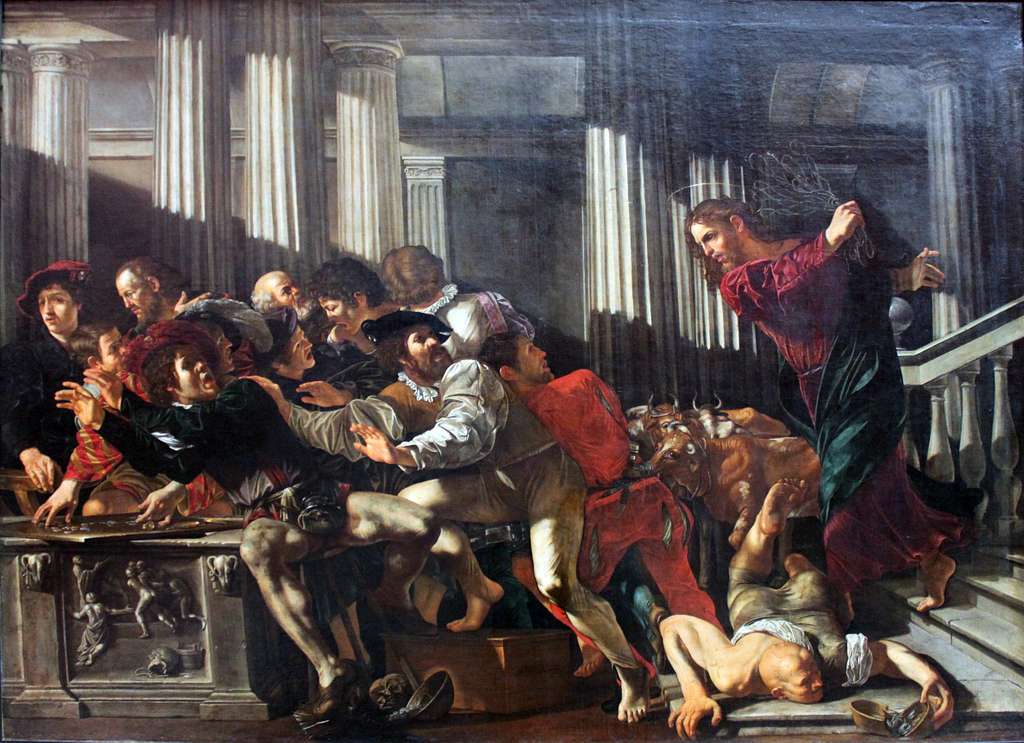
Firstly, the turning of the tables:
1610 Cecco del Caravaggio Christ expulses moneychangers anagoria at picryl.com. Public Domain.
What is the charge Jesus levels at all those who are buying and selling in the Temple?
“My house shall be called a house of prayer”; but you are making it a den of robbers.’
‘A house of prayer (for all peoples)’ is from Isaiah 56; the ‘den of robbers’ from Jeremiah 7. He stands in the great tradition of the prophets in announcing this conviction of evil.
A den of robbers? The pilgrims coming to Jerusalem had to risk being attacked by bandits on the way. Criminals lurked in the hillsides next to the pilgrim roads. But if they had survived that and got to Jerusalem, they now face the real bandits, says Jesus – the people running the Temple. Their concern is less with it being a holy, spiritual, and welcoming place – a house of prayer – they are running the enterprise for their own benefit.
Let this be a warning to us before we end up taking that approach, too. Think back to our discussions about the finances of the church. When we know that our regular giving is not covering the assessment we must pay to the circuit and that we rely on hiring out the premises, we are in trouble. But there is another danger here, and that is concentrating so much on the finances that we become a religious business rather than a spiritual family. We can come up with all the fund-raising ideas we like, and we do of course have to be responsible stewards of the finance and the property, but unless we address the spiritual nature of the church family first, we will go in the same direction as the moneychangers in the Temple.
Let me put this on the agenda for this church, then: we can talk about increasing our membership, and we can talk about raising more income, but unless our top priority is to be a ‘house of prayer’, a spiritual community, we shall only be a church in name, not nature.
How many of us have taken up some of the spiritual disciplines we’ve been talking about during Lent? What are we doing together to grow in grace? Jesus says, this is important.
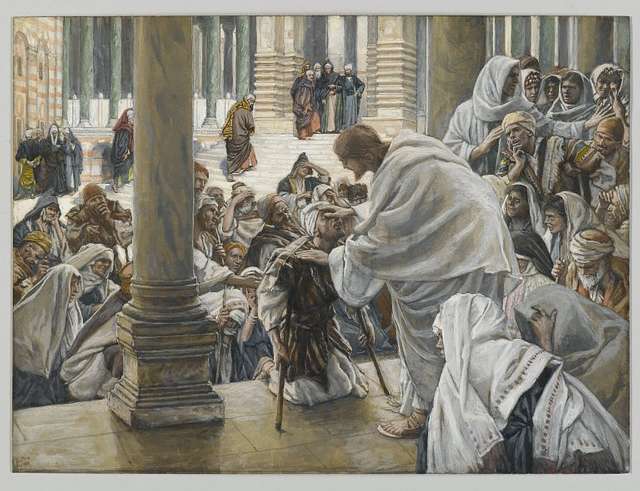
Secondly, the praise of the children:
Brooklyn Museum: He heals the lame (James Tissot) at picryl.com. Public Domain.
Jesus heals the blind and the lame, and the children praise him, saying, ‘Hosanna to the Son of David.’ The chief priests and scribes hate this and say, ‘Do you hear what they are saying?’ (Verses 14-16a) How dare you accept this praise!
But Jesus says it’s right for him to do so, and quotes a verse where he equates the praise of the children to him with praise being given to God himself:
“Out of the mouths of infants and nursing babies you have prepared praise for yourself” (Verse 16b, quoting Psalm 8:2 LXX)
If the authorities didn’t like Jesus already, then now they will hate him. He is accepting praise like he is God. Moreover, Jesus is implying that they have been shown up by children! The children have got their beliefs right, and the religious leaders haven’t!
Now that is provocative. This is not gentle Jesus, meek and mild. You’ve been shown up by the kids, he says, and that in a culture that thought little of the younger generations.
Imagine what the authorities are thinking. He is a blasphemer, and he expects us, with all our education, to take lessons from children!
Can you feel the tension rise? Soon, people will have to take a side. And events will take the darkest of turns.
We too shall need to choose a side. Even if that leads us into a dark place.
We come to the fifth and final sermon in our Circuit Lent Sermon Series. It began by asking what the purpose of Lent was and answered by saying it was about reorienting ourselves towards Jesus. It continued in the second week by examining our relationship with God, something I looked at in terms of friendship with Jesus.
But to grow and maintain that relationship requires we adopt virtuous habits – or ‘spiritual disciplines’ – that help us tune into God better. And so over the last two weeks the series has been about inward and outward disciplines. Those are often disciplines (or habits) that we practise on our own. In this final week, we look at habits we exercise together – corporate disciplines.
Today, we are going to explore four corporate disciplines that help us draw closer to God in Christ.
Firstly, guidance:
Road Sign at pxhere.com. Public Domain.
Are any among you suffering? They should pray. (Verse 13a)
Perhaps we think of guidance as an individual discipline, and it certainly is that as well. If we are serious about following Jesus, we shall want to know his direction for our own lives.
But it is also something we need to do together. Not only are our brother and sister Christians involved in discerning our individual guidance (as we shall see), we also need to seek guidance together for our life as the church. Is that not what this church did under my predecessor’s leadership when you went through the process that Methodism calls Our Church’s Future Story?
And just because this church did that a few years ago doesn’t mean we can now not worry about God’s continued guidance. We always need to be like ancient Israel in the wilderness, who followed God’s presence as seen in a pillar of cloud by day and a pillar of fire by night. It is a continuous process.
So what are helpful ways of discerning God’s guidance together? One author described it like this. He spoke of a harbour that was treacherous for boats to navigate safely, due to rocks. However, the harbour authorities had cleverly erected three lights. If the three lights were lined up as seen from a boat, then that boat was on the right course to make harbour safely.
He then suggested that Christian guidance is like that. For major decisions, we need three ‘lights’ to line up. They are the teaching of Scripture, the counsel of wise friends, and circumstances. It is the Enemy who wants us to rush our decisions. In contrast, the God and Father of our Lord Jesus Christ is full of grace, mercy, and love, and he is happy for us to test out things to be confident of his guidance.
An old acquaintance of mine used to say that any time she thought God was asking her to do something, she would reply ‘No.’ Why? Because she knew that if it truly were God, he would ask her again.
Let’s be serious about seeking God’s guidance together, but let’s also take the time to line up our harbour lights.
Secondly, worship:
Vibrant worship experience with raised hands by Caleb Oquendo at pexels.com. Public Domain.
Are any cheerful? They should sing songs of praise. (Verse 13b)
God is always worthy of our songs of praise. (I shall say something separate but related about cheerfulness in the next point.) Whether we are cheerful or sad, we can know his faithfulness in his goodness in creation and his love for us in Jesus. We may have our doubts and our questions, but God continues to be faithful, even when we don’t understand him. We may only understand later, but as an act of faith we continue to praise and worship him.
Worship can also be individual, but it is powerful when we gather together and worship as a corporate body. We bring our differing gifts and use them to worship, because we share in common the truth that God has redeemed us in Christ and his saving death on the Cross.
Therefore, let worship be a commitment and a priority in our lives. Let us not make feeble excuses to avoid assembling together as the Body of Christ in worship. None of that ‘It’s raining so I won’t bother coming to church’ talk. That doesn’t honour God. How much is he worth? What about those in other countries who travel many miles over poor roads and possibly in dilapidated vehicles to come together as God’s people and praise his holy Name?
God is worthy of our worship. It is our sign of allegiance. I am fond of pointing out that the Greek word most commonly translated ‘worship’ in the New Testament is one which literally means, ‘To move towards and kiss.’ But this is not a romantic kiss. It is the kiss of allegiance. Think in our culture of a new Prime Minister or a new bishop being appointed. Each of them has to go and see the King and ‘kiss hands’ as a sign of loyalty to the monarch.
Worship is how we do that, and particularly at the sacraments. Remember that we get that word ‘sacrament’ from the Latin ‘sacramentum’, which was the oath of allegiance that a Roman soldier took to the emperor. At the sacrament this morning, we pledge again our allegiance to Christ. That is what worship is for us, and it is at its most powerful when we do so together.
Thirdly, celebration:
Aftermath of a festive celebration scene at freerangestock.com. Public Domain.
Are any cheerful? They should sing songs of praise.
Those words again, but this time I want to major on the words ‘Are any cheerful?’ Just because we believe in the majesty and the holiness of God, we do not need to excise joy from our common life as the church.
And just because we rightly weep with those who weep, it does not mean we should not also rejoice with those who are rejoicing. And that is what celebration is about.
Is it not wonderful to hear how God is working in our lives? Is it not a cause of great joy to know that God has answered a prayer, that he has provided for a need, that someone has cause to know that he has come near to them?
But do we give opportunity for that? One of my past churches did, in a very specific way. They designated one Sunday a month as ‘Testimony Sunday’, and there was a part of that service on that day where anyone who had a testimony of God having been at work in their lives could come to the front and share that briefly with the congregation. We laughed, clapped, and sang together in response. It built up our sense that God was very much alive and active. Therefore, it built a heightened atmosphere of faith in the church.
Would it not be good to do something like that here? Maybe we too could do it in the morning service. At the very least, let me encourage you to write up accounts of what Jesus has done recently for you and send them in to be published in the church magazine. Perhaps that could be part of the appeal for articles every time we are putting together the next newsletter. Please tell the church family how God has blessed you lately.
Doing things like this encourages people. It lifts a sense of gloom and replaces it with light. It builds up the church. Don’t you think we’ve had enough discouragement in the church in recent years and decades? Don’t you think that God is still in the business of being God and of transforming lives for the better?
Then let us tell our stories. And therefore, let us celebrate together.
Therefore confess your sins to one another, and pray for one another, so that you may be healed. The prayer of the righteous is powerful and effective. (Verse 16)
You might think that after all the talk of guidance, worship, and celebration, it’s a bit of a downer to conclude with confession. Dave, if you want joy in the church, why do you now end on a note of misery?
But actually, this is not about doom and gloom, even though we are sorrowful for our sins. Look at the context. This confession is in the context of seeking healing. And while I am not for one moment saying that all sickness is caused by sin, what I do see here is that confession removes barriers to blessing. Unconfessed sin gets in the way of God’s work. It is a blockage. We confess our sins at least in part so that God’s grace may flow with less hindrance among us. Living with unconfessed sin is a sure way to block the blessing of God in our lives, so let us confess as a way of removing the blockage.
Here’s another thing, though: I’m listing confession as a corporate discipline. Isn’t that a bit alien for Protestant Christians?
No, not at all. For one thing, it’s by no means accidental that we include the confession of our sins and the assurance of our forgiveness in our corporate acts of worship. Not only will each of us individually have failed Jesus in the seven days since we previously met, we also sin together and therefore jointly need confession and forgiveness.
Moreover, there are biblical examples of God’s people confessing their sins together, not least when they as a body have gone seriously astray from their Lord.
But it is also helpful sometimes for an individual to confess to another Christian. I am not advocating Catholic-style confession, because I have serious reservations about what is prescribed in that form in response to confession. Nor do I think there is something priestly about ordination, because all Christians are priests before God: we all have access to him through Jesus Christ.
Yet it can be healing to say in confidence to someone we trust – and yes, this can be someone who is in a pastoral relationship with us – I have messed up badly, and I need to know the forgiveness of God. Without giving concrete examples that would betray confidentiality, I can assure you that as a minister I have had people come to me and confess the darkest of sins, some of which they have lived with for many decades. To let them know that they are forgiven is to see a burden fall from them and to release them into new freedom in Christ.
Now perhaps I hope you see why I say confession is not in the final analysis about doom and gloom: it leads to the joy of the Gospel.
Conclusion
And the joy of the Gospel is where all these spiritual disciplines lead us. Whether inward or outward, solo or corporate, the cultivation of virtuous habits that enable us to tune in more to Jesus can only lead us to the abundant life he came to bring.
So let us use these time-honoured practices of the church to set our minds on things above and let our lives be shaped by Jesus.
You know the old adage beloved of computer programmes, ‘Garbage in, garbage out.’ Let’s stop feeding our minds with garbage, feed them instead with the goodness of Jesus, and instead live ‘Goodness in, goodness out.’
New readers start here: in our circuit sermon series so far, we have begun by asking what the point of Lent is, and answered that by saying that it is to do with reorienting ourselves towards Jesus.
In the second week, we took that further by asking what our relationship with God looks like.
Then last week, this week, and next week we’re looking at various spiritual disciplines that we can use to tune into Jesus and the will of God better. After all, since he draws us into a relationship of friendship, we shall be keen to know what he says and what he cares about.
Last week’s set teaching was on what we call ‘inward disciplines.’ This week we turn to what are classified as ‘outward disciplines.’ And to do that, we’re taking the familiar story of Jesus’ temptations in the wilderness that we usually read on the First Sunday in Lent, not the Fourth. But we’re not going to look at it in the conventional way, where perhaps we look at the meanings of the three temptations, or we highlight the way Jesus fasted and quoted Scripture. There was material about both of them in last week’s reflections, in any case.
This week, we are asked to think about four outward disciplines that help us focus on Jesus. There is no single Bible passage that refers to all four, but this one gets as close as any.
Jesus submitted to the Father’s will when he was led by the Spirit into the wilderness (verse 1). In fact, ‘led’ is altogether too weak a word. This is not on the same level as the inane ‘I feel led’ conversations of some Christians – you know, ‘I feel led to buy a Mars bar,’ and so on.
No: Jesus was ‘thrown out’ into the wilderness! The Father made his will known very strongly here – and Jesus submitted to it.
Not only that, Jesus submitted to human beings, not least in his trials and execution.
Here is an important Christian discipline: to submit to God and to one another. We submit to the will of God. We also submit to one another, for Paul tells us in Ephesians 5:21 to be subject to one another out of reverence for Christ.
Now some of you may be listening to this nervously, knowing that there is a bad form of submission. There are terrible stories coming out of some churches where abused wives were told by pastors to go back home and submit to their abusive husbands. Those same churches never challenged the husbands, and in some cases covered up for them. Please do not hear me as approving of anything remotely like that. It is evil. It should be reported to the police.
So what is godly submission actually about? It is a discipline that is designed to counter the selfishness of ‘me first’, which is so contrary to the way of Jesus. Jesus gave up the glory of heaven and – as Paul says in Philippians 2 – made himself nothing, and took the form of a servant, becoming obedient even to death on a cross.
Let that be a challenge for Lent and for the whole of our Christian lives. How am I putting the will of God before my own will? How am I preferring others to me? This is what submission is about.
Jesus goes to the wilderness alone. This is a solitary act of discerning the Father’s will and battling evil spiritual forces. It is something he would practise during his ministry when he took himself off on his own to pray.
There is much that the Bible teaches us about being together as the People of God: we are the Body of Christ and we all need each other. We worship together. We have fellowship and study the Bible together.
But we also need solitude. Every one of us needs those times when it is just ‘God and me.’ I need to relate to God myself. I need to know the voice of his love for me. I need to know what he is saying to me. I need to tell him what is on my mind and heart. Much as I need other people, I cannot rely on them to do the spiritual life for me.
This has all sorts of surprising benefits. Our willingness and ability to practise solitude with God contributes to the other side, where we relate to others. True solitude makes us better at fellowship! Being present with God enables us to be present with others. The great German Christian Dietrich Bonhoeffer said that you cannot practise true fellowship unless you know how to practise solitude with God.
So this is not a call to go off and live in a remote place as a hermit. Nor is this a call to enter some kind of spiritual loneliness. The truth of Genesis 2 remains that God says it is not good for us to be alone. We need helpers.
Perhaps we don’t like the thought of solitude with God because we might feel spiritually exposed. But that is a good thing. Because solitude does not expose us before a vengeful, angry God who wants to fry us at the first opportunity.
No: we enter solitude with a God of mercy, grace, and love. And if in that relationship he highlights something uncomfortable in our lives, it is so that he can heal it and we can draw closer to him.
Let us ask ourselves how we set aside time to be in solitude with God.
I think we can reasonably infer that – apart from the story we read where Jesus puts the devil in his place – he inevitably practises the spiritual discipline of simplicity. This is bare bones living. Just what Jesus needs, and no more.
We know that soon after this, Jesus will make simplicity of lifestyle a virtue for his disciples when he tells them not to store up treasures on earth but in heaven. Later in his ministry he will send his disciples out two by two to nearby villages ahead of his arrival, and he will instruct them not to take with them more than they need.
I can remember a big emphasis in the church when I was in my teens that promoted the slogan, ‘Live simply so that others can simply live.’ The trouble is, there is no set level below which we are living simply and above which we are living greedily. We each have to discern this prayerfully and thoughtfully.
You can even see different responses among the disciples of Jesus. On the one hand, think of the fishermen who left their nets and their family businesses to follow him. But also think of the wealthy women in Luke 8 who funded a lot of Jesus’ ministry, having stayed put.
Simplicity is not only about being able to give generously to others, it is also about being content. Look how stressed many people become because they are not content, and because they are sucked in by the advertisers and influencers. What kind of witness is it to show such people that you can have peace of mind without that strain and hassle?
Our television has had a particular fault for a while, and at the beginning of the year I suggested we look for a new one in the sales. We found a good model that would do everything we wanted at nearly £200 off the list price. However, Debbie then raised some questions and doubts about the wisdom of proceeding then and there. So we decided to be content with the current TV, despite the issue.
Where is Jesus calling us to practise the discipline of simplicity so that we have more to give or so that we can exhibit the peace of contentment?
I said in the introduction that no single Bible passage covers all of the four outward disciplines, and this is the one I cannot really infer from the account of Jesus’ temptations in the wilderness. Although if I were pushed, I would say that it follows from the discipline of submission with which we began!
But we know that in any case Jesus had much to teach about this later. You have only to go on to Matthew 20, where two of the disciples, James and John, get their mother to speak to Jesus and ask that he grant them the privilege of sitting on his right and his left in his kingdom. Jesus uses that faux pas to teach that in his kingdom leaders do not lord it over others, but serve, just as he came not to be served but to serve, and to give his life as a ransom for many.
If we want to become like Jesus, then we need to imitate him. In a sense, that’s what we’ve been talking about with all of these spiritual disciplines: do what Jesus did. As the saying goes, it isn’t rocket science.
And nowhere could it be plainer than in this discipline: service. Jesus served people when he healed them, when he gave his time to them, when he taught them. For Jesus, live was not gimme, gimme, gimme: it was, what can I give to others?
Now while this attitude is still widely admired in our society, it is also true that it is perhaps more admired in the breach. So much of our language is about us wanting our rights and wanting what we deserve.
Jesus, though, shows us a different way to live. In fact, not simply different: it’s in an opposite spirit. Serve.
We might not like the word ‘servant.’ We think of people who had an inferior status, whether we are the generation that watched Upstairs, Downstairs, or the generation that watched Downton Abbey.
And it’s worse if we think of the word ‘slave.’ Not only do we have the terrible history of slavery in the world, we have recent examples of modern slavery, such as the appalling case in the news the other day of the woman who enslaved another woman for twenty-five years and treated her with unbearable cruelty.
We cannot control how others treat us. But Christianity is not about upping our social status anyway. And in any case, God will be pleased with us and will affirm us and reward us if we follow in the footsteps of Jesus by taking the decision to serve others. And as we do so, we shall become more like him.
Sorry there was no sermon on Sunday: I had the week off. As a belated substitute, here are the outline study notes I wrote for our Circuit Lent Course for the third week.
Scripture
On study:
General Introduction
Watch this video clip from Father Ted:
Do you see Lent practices as useful disciplines or pointless self-punishment?
Watch this video and follow the discussion questions provided. (This forms an entire session on the ancient Christian meditation practice Lectio Divina.)
Study: it sounds like this is for academics! But all Christians can study the Bible, and it doesn’t have to be in an academic way. Experiment (with others?) with Ignatian Bible Study using the material on this webpage.
You could also get hold of some Bible reading notes from Scripture Union and try them out. See what others think.
If you want to look deeper, borrow a Bible commentary from a preacher or minister. Use it to look at a well-known passage.
Group of friends enjoying a sunset together. From Freerange Stock, Public Domain.
Last week, in the first part of our Circuit Lent Sermon Series, we aimed to answer the question, ‘Why Lent?’ with the reply, ‘To reorient ourselves towards Jesus.’
Reorienting ourselves towards Jesus implies one of the most wonderful truths in the Christian faith: that we were made for a relationship with God through him. It is not something that every major religion claims. For our Muslim friends, the main claim of Islam is the call to submission to God. We believe in that (in a Christian form), but we believe more. Islam has ninety-nine names for God, but one of them is not ‘Father.’
But in Exodus 33:7-11 we heard the remarkable statement that Moses was described as a ‘friend of God.’ Astonishingly, Jesus ups the ante. He says to his disciples in verse 15 of our John reading,
I no longer call you servants, because a servant does not know his master’s business. Instead, I have called you friends, for everything that I learned from my Father I have made known to you.
Disciples of Jesus are friends of Jesus. It seems almost too hard to believe, but that is what he says. Maybe we’ve been put off by those Christians who take this up in such a way that it sounds like they have a chummy and casual relationship with the Almighty. That’s not what I’m talking about. Friendship with the Triune God is inevitably different from ordinary friendships. But it is still friendship.
We’re going to look at it from two angles – Jesus’ side and our side.
Firstly, then, friendship from Jesus’ side:
Verse 9:
As the Father has loved me, so have I loved you. Now remain in my love.
‘As the Father has loved me.’ At the heart of God the Holy Trinity is love. That’s why John tells us in his First Epistle that ‘God is love.’ It is the most basic statement about the nature of God that we have. God is love. There is love between the Persons of the Father, the Son, and the Holy Spirit.
Love was there, which led to creation. God could not hold love within the Godhead, because that would be mutual self-indulgence. Mutual love looks beyond, to love others.
And the divine love was so deep and so rich that even when the pinnacle of creation, the human race made in God’s image, rejected that love, it could not stop. Such was God love that he continued to pursue humans in love, forming a people who would be his witnesses, and continually choosing and sending those who would speak for him, frequently at immense cost. Ultimately, he sent his only begotten Son, because God so loved the world. Or as Jesus put it in our reading in verse 13:
Greater love has no one than this: to lay down one’s life for one’s friends.
And so something else is true that John also said in his First Epistle – not only that God is love, but also that ‘We love, because God first loved us.’ God has consistently made the first move in love towards the human race.
Moreover, within the relationship he seeks to make with us through love, he speaks to us. We have it in what Jesus says in verse 15b:
Instead, I have called you friends, for everything that I learned from my Father I have made known to you.
Jesus has made known the Father’s will to his disciples. He has engaged in a ministry of teaching. We have the authoritative record of that teaching in the Gospels. Elsewhere in John’s Gospel in chapter 5 Jesus endorsed seeing what we call the Old Testament as pointing to him, so that we might find eternal life. And in chapter 14 he explained how the Holy Spirit would teach his followers all things and remind them of what he had said. It is not just the Gospels, then, but the whole of Scripture that we have for understanding what God says to us through Jesus. Our God speaks to his friends.
Yes, of course, there are some rather unbalanced friends who make some silly claims about God speaking to them. But the solution to misuse of this doctrine is not its disuse but its right and careful use. So we weigh carefully what Jesus is teaching us in the Scriptures. And if someone in the church family believes God is speaking to them in another more temporary way, then we weigh that carefully and prayerfully, too.
Is it not the most natural thing to accept that a friend would love us and would want to speak with us? Next week is my birthday, and usually on that day my Best Man phones me. We don’t speak as often as we might or we could these days, but I can be pretty sure that when he calls it will not be a short phone call. We shall each want to know what the other has been doing, and what our family members have been up to. We shall probably talk about everything from world politics to what music we’ve been listening to.
And is that not a small picture of God in Christ talking to us as his friends? He has the serious matter of his will and his ways to communicate with us, but he also takes interest in the small details of our lives. This is what a friend does. So yes, we can pray for the provision of a parking space, just so long as that isn’t the limit of our prayers!
If I’m honest, that doesn’t sound much like the friendship we experience in everyday life. It’s not normal in a friendship for one party to issue commands to the other. We think of friendships as mutual and equal in status. Doing what one friend commands doesn’t sound like that.
But this is not a conventional friendship. We have already at the beginning been surprised at the thought of the Author of the Universe wanting a friendship with us. Whatever it is, it cannot be the equal and mutual friendship that we are used to.
However, we can have friendships between parents and children. We can have friendships between someone who is in authority and another who is not. There may come a time in such relationships where the one with authority has to say to the other, ‘I need you to do this, please.’ Jesus gives us his commands with the voice of a loving friend, not that of a tyrant. And since in a relationship of friendship we shall want to please our friend, in this case we shall want to please Jesus by doing what he asks of us.
There is a verse in Ephesians where Paul enjoins us to ‘Find out what pleases the Lord’, and while that is sometimes simple and straightforward, at other times it is more of a challenge. The next three weeks of the sermon series will look at various spiritual disciplines we can use to tune in more clearly to what Jesus wants of us, and I don’t want to steal the thunder of other preachers you will hear on those subjects.
However, in the meantime, in this passage Jesus gives us one concrete action we can get on with to show we are serious about responding to his love and friendship by doing something that pleases him. It occurs in verse 12:
My command is this: love each other as I have loved you.
If we want to please Jesus out of friendship, we can love one another. It’s one of those easy to state but harder to practise commands of his. For just as we say about human families that you can choose your friends but not your family, the same is true of our spiritual family. In the church, Jesus puts us alongside people who are not all the same as us. We cross the generations, ethnic backgrounds, health conditions, social classes, educational achievements, finances, political convictions, and all sorts of other things that the world divides on. But Jesus is pleased when we cross those barriers and unite in love in his name, because that is his will and pleasure.
And as I said, it’s easy to state but more challenging to do. We are a varied lot as God’s people, and we don’t always fit together easily. As one book I read on the subject many years ago put it, it is like building with bananas.
But our world needs this witness. We are increasingly divided: just look at the world of politics, where people cannot disagree with one another civilly and instead label their opponents as demonic. Look at social media, where the algorithms keep on feeding you only the stuff they think you agree with, and thus force people into separate silos.
Perhaps it’s no accident that the one illustration Jesus gives us of obeying his commands out of friendship is this one. Love one another. Does it not remain one of the most important ways we can live out our friendship with Jesus? Has it not always been so? Because that friendship makes a practical difference in the world.
You have heard it said that in the early church the observation that pagans made of the first Christians was, ‘See how these Christians love one another.’ Do we not think that in our world a similar witness is needed? Jesus clearly thought it was important, because at the end of the reading in verse 17 he comes back and repeats it:
This is my command: love each other.
Conclusion
Let’s sum up: reorienting ourselves towards Jesus implies that we are being brought into a relationship with God. But more than a relationship, it’s a friendship, even if that sounds strange given our unequal status.
However, God who is in his very inner nature love, has reached out in love to the human race before we ever had a thought for him. In Jesus Christ, this comes to fullest expression in his calling his disciples friends.
Like any friendship, we desire to please our friend. With our status not being equal to that of Jesus, that will entail us obeying his commands.
And Jesus has a particularly important command for us to put into practice right away: love each other.
Other commands may not be as simple to discern as that one, but the next three weeks of this sermon series will introduce us to disciplines that help us listen to find out what pleases the Lord.
In the meantime, we have no excuse but to get on with that simple but challenging command which shows we are serious about our friendship with Jesus.
In the words of a song: we may never have this day again, so let us love like we could love. We may never pass this way again, so let us love like we could love.
We begin our Circuit Lent Sermon Series on Lent not with the temptations of Jesus but with a simple question: why Lent?
Historically, not every Christian has observed Lent. The Lenten fast began as part of the spiritual training for new converts who were going to be baptised on Easter Day, before it became more widespread.
But even today, it is not universal in the Christian Church. Many Christian traditions, especially of the more low-church and informal variety, do not observe it all, and some do not even know what it is.
Even among those who do take Lent seriously, it is misunderstood. We think that giving up something will be good for our physical health, and so we avoid sugary and fatty foods. Or – like one friend of mine – we give up something like social media. But it’s not about us.
Others realise it’s about God, but they think it shows him as a hard taskmaster who expects us to make sacrifices to earn his approval. But when was Christianity ever about that? The Gospel says we cannot earn God’s love, but he comes to us in grace and mercy through Jesus, and we respond.
Lent is about our response to God. It is about reorienting our lives towards Jesus.
And that’s why I chose the passage from Hebrews. This is what the author is calling his readers to do. He doesn’t want them to give up on Jesus, because that is what they are considering. They are Christians of a Jewish background, who are thinking about giving up on Jesus and reverting to Judaism to avoid persecution. But the writer has been saying throughout the letter, don’t do that. Look how amazing and superior Jesus is.
In this passage, he gives us three things to do that help us put our focus back on Jesus, and we’ll consider them this morning. All of them rely on the metaphor of a race happening in an athletics stadium. It may be based on the ancient original Olympic Games.
Firstly, look at the crowd:
Olympics Athens 2004 at pxhere.com. Public Domain.
Therefore, since we are surrounded by so great a cloud of witnesses (verse 1a)
Who are this cloud of witnesses? They are the heroes of faith, down the centuries. Hebrews 11 has just given a long list of them, some of whom saw great victories, others of whom suffered their way to glory. Now, says the writer, these people are the spectators in the stadium cheering on those who are in the race of faith today.
This, I believe, is what we call in the Creed ‘the communion of saints.’ The faithful down the ages are watching us and rooting for us. While I am not convinced as my Catholic friends are that we can address them in a kind of prayer, I do rather think that if they are a cloud of witnesses watching us they are likely to be praying for us in Heaven.
Let us be encouraged by this. None of these heavenly spectators will boo us, they will only egg us on to victory.
And as we run for Jesus today, let us also be encouraged by the fact that the lives of these spiritual heroes are there as an example to us of how to set about our task. We can learn so much from the lives of the saints in the Bible, church history, and today. (And incidentally, when I say ‘saint’, I mean more than those formally recognised as such by the Vatican.)
If you have ever wondered why in the prayers of intercession we often give thanks for the lives of those who have died in Christ, now you know. They are our supporters’ club. Not only do they urge us to keep pressing on, we can look at how they lived the race of faith and learn from them.
Who has been a great example to you of how to live for Jesus? Was it someone in the pages of Scripture? Did you read about a spiritual giant in a book? Did a preacher tell amazing stories about someone who gave their all for Christ? Was it someone you knew personally in the church, whose life shaped yours? Maybe they even mentored you in some way.
Treasure these people. They are a gift of God to you. Rejoice that God has used them to point you in the direction of Jesus. Let them be an encouragement. And let them mould your life.
Secondly, put down your kit:
Hands On Starting Line by Boom Photography at pexels.com. Public Domain.
let us also lay aside every weight and the sin that clings so closely (verse 1b)
If you have ever watched a track event in an athletics meet, you will have seen that the competitors have a small number of possessions that they bring with them onto the track, but which they leave in a box. These things may be useful to them, but they will be a hindrance to them in running the race.
And so here the writer tells us not only to lay aside our sins, which we would expect, but also to ‘lay aside every weight.’ There are things in our lives which may not of themselves be sins, but which will weigh us down and thus seriously slow us in the race of faith. They may be good things or neutral things. They may be items that are appropriate at other times but not now. They may well be good servants but bad masters, because we have allowed them to have too much importance in our lives. We may have focussed on them instead of Jesus.
What kind of things? Money, food, possessions, work, even relationships. All of these things are in principle good. They are even gifts of God. But when we get out of perspective about them, when we give them too much importance, when they fill our vision instead of Jesus, then they become the stuff that we need to lay aside – maybe permanently, maybe for a season.
This is one of the reasons that the Christian discipline of fasting is so helpful in reorienting ourselves towards Jesus. We need money, but Jesus is essential. We need food, but we need Jesus more. We live in a material world and so material goods are necessary, but they do not rank above Jesus. Work was invented by God, but we need him more. Relationships were one of God’s best ideas, but a mere human being cannot meet our most fundamental needs: only Christ can do that.
Therefore, we lay one or more of these aside, perhaps for a season or perhaps permanently. Not only does it help us focus on Jesus ourselves and remind us that he is Number One, our actions become an example to the world.
So for example, I do not personally believe that all Christians should be teetotal, but God will call some of his followers to do that so the world has a witness that you can live a fulfilled life without alcohol, because fulfilment comes in Christ. He will also call some Christians to a life of celibacy, to show our sex-saturated world that the idol of Eros can be dethroned, and there is a greater and truer God.
If there is something getting in the way of our devotion to Christ, even if it is not a bad thing in itself, then maybe that is what God wants us to give up this Lent, either temporarily or permanently.
and let us run with perseverance the race that is set before us (Verse 1c)
Let there be no doubt: the race of faith is a marathon, not a sprint. When we are younger, we throw ourselves into things with great enthusiasm and it’s wonderful, but we run the risk of burnout and failure because we think we are running the hundred metres. We need to pace ourselves and be ready for the fact that a key quality we shall need is endurance.
Marathon runners speak of a stage well into the race where they feel they can’t go on any further. They call it ‘hitting the wall.’ However, experience tells them that if they persevere through that phase, they will go on to the fulfilment of completing the race.
There will be those of us in our lives of faith who have hit a wall. Something will have happened that has left us thinking we can’t go on. For some, it is a crisis; for others, it is simply that we get worn down by things over a long period of time.
How, then, do we run with perseverance? How do we break through the wall? The writer to the Hebrews tells us:
looking to Jesus the pioneer and perfecter of our faith, who for the sake of the joy that was set before him endured the cross, disregarding its shame, and has taken his seat at the right hand of the throne of God. (Verse 2)
Jesus is waiting beyond the finish line for us. He too had to persevere. He hit the wall, and it was a terrible experience. It was the Cross. But Jesus knew that beyond the wall of the Cross was unutterable joy. The Resurrection. His Ascension.
We don’t just have the cloud of witnesses cheering us on. We have Jesus himself. He knows what it is to hit the deepest darkness in life, love, and faith. But he has hope for us. He was able to run his race with perseverance, because he knew what lay beyond it. His Father would vindicate him, and he would reign in glory.
We too have a vision of glory to keep us going. It’s not the end until we reach glory. Our destiny is to be with him, first of all in Heaven after death, and then in the New Creation after the resurrection of the dead, celebrating the banquet of God’s kingdom.
In the meantime, we shall have trials along the way. God may use them for good to discipline us as better runners, says the writer (verses 5-11).
But hold your head up. If you fall, get up again, because God in Christ forgives us. Take heart, take courage, get your focus back on Jesus and keep running.
Welcome to Lent.
Lent Crown of Thorns at needpix.com. Public Domain.
A year into marriage – and it will be our silver wedding anniversary this year – my wife Debbie and I decided we fancied a walking holiday in the Snowdonia region of Wales. We booked a room in a B & B near the village of Beddgelert, and looked forward to joining the hordes walking up Mount Snowdon.
It didn’t work out like that. Not long before going, we discovered Debbie was expecting our first child. Our vigorous walking holiday became a sedate one. We never got up Mount Snowdon.
Jesus, however, went up mountains quite regularly during his ministry. And every time Matthew’s Gospel records him doing so, something significant – revelatory, even – happens. In the last couple of weeks, you may have had readings from the Sermon on the Mount – his great description of what repentant living in the kingdom of God looks like. At the very end of Matthew after the Resurrection, Jesus sends his disciples up a mountain in Galilee, where he gives the Great Commission to disciple the whole world.
And here he is in today’s reading, going up a mountain again. We traditionally refer to the ‘Mount of Transfiguration.’ We expect a significant revelation of Jesus. And boy, do we get that. What is revealed about Jesus at the Mount of Transfiguration?
Here are four things the Transfiguration shows us about Jesus[1]:
Firstly, the glory of Jesus:
Jesus meets Moses and Elijah. Both of them had history of profound spiritual experiences on mountains. Moses received the Ten Commandments and his face glowed with the glory of God. Elijah saw God give him a mighty victory over the pagan prophets of Baal on Mount Carmel.
But here, only Jesus is transfigured. Moses isn’t. Nor is Elijah. However great they were in Israel’s history, they are not equal with Jesus. Only he shows the dazzling glory of God on his face and his clothes.
The message is clear. Jesus is supreme to all other religious leaders and heroes. He is not just another teacher. Nor is he merely a prophet, as Islam would say. He is so much more. He is Lord.
The natural consequence of this is that Jesus is as worthy of worship as the Father. He manifests the very glory of God.
Peter gets it all wrong. Perhaps he is tongue-tied in the presence of surpassing greatness, a bit like any of us would be when we meet someone famous and all our plans to ask intelligent questions disappear as our legs go to jelly and so do our brains. He says the daftest thing when he wants to build three shelters, one for Moses, one for Elijah, and one for Jesus. Yet again, he has missed the point.
It’s not enough to like Jesus or even admire him. The Transfiguration tells us that he is worthy of our worship – not merely an hour of our time on a Sunday, but the allegiance of our lives.
This morning, we take Holy Communion together. In our tradition, we call that a ‘sacrament.’ Now ‘sacrament’ is an interesting word. It is not a word from Scripture. Rather, it derives from a Latin word ‘sacramentum’, which was the oath of allegiance that a Roman soldier made to the Emperor. May our initial response to the glory of Jesus this morning be in renewing our sacramentum, our oath of allegiance to him, at the Lord’s Table.
Secondly, the words of Jesus:
Just to underline what Peter should have learned from only Jesus being transfigured, the divine voice from the bright cloud says,
‘This is my Son, whom I love; with him I am well pleased. Listen to him!’ (Verse 5)
As good Jews, Peter, James, and John had it imprinted on their memory that when Moses went up Mount Sinai he received the Law of God. Now, as they are up this other mountain, they learn that Jesus is not simply the recipient of God’s words, he is the giver of them. Jesus is, and he gives, the Word of God.
This is the logical consequence of the first point. If the glory of Jesus tells us about his supremacy and we offer our worship and allegiance, then that involves heeding what he says. It is not for us to treat the teaching of Jesus as merely interesting or optional: what he says, goes. It is the Word of God.
Some of us like to sit in judgment on what we read in the Scriptures – like when Field Marshal Montgomery read the Old Testament lesson at Matins one morning and began, ‘And the Lord said unto Moses – and in my opinion quite rightly’! Others of us like to analyse the words and enjoy coming up with clever theories or explanations, but then do nothing. That won’t do either.
Of course, we will struggle with some of the difficult sayings of Jesus. We may need to understand certain nuances, or their historical background to make sense of them. But in the end, what we need to embrace as Christians is that Jesus and the Scriptures are for life, not just Sundays. One of the things coming in our forthcoming circuit-wide Lent preaching series will be a challenge to study and meditate on the Scriptures more. This would be a good time to embrace that discipline.
Thirdly, the compassion of Jesus:
It would be easy after what we have just been thinking about to assume that everything Jesus says and requires of us is challenging and maybe severe. But following on immediately from the words, ‘Listen to him,’ Jesus does in fact speak to Peter, James, and John. Hear verses 6 to 8 again:
6 When the disciples heard this, they fell face down to the ground, terrified. 7 But Jesus came and touched them. ‘Get up,’ he said. ‘Don’t be afraid.’ 8 When they looked up, they saw no one except Jesus.
Get up. Don’t be afraid. Even after the overwhelming glory that comes upon Jesus. Even after the summons to listen to him. Who is this Jesus whose glory tells of his supremacy, and whose Father tells us he is and he speaks the Word of God? Is he some severe authoritarian?
No. The Jesus who is Lord is full of love, mercy, and compassion. He reaches out in kindness to his people. He is the giver of dignity to those who are bowed down. Like the Psalmist says of the Lord in Psalm 3:3,
You are the One who lifts my head high.
This is how Jesus reigns. He was God’s agent in creation, where we were made in God’s image. However much we have marred that image by our sin, he is now remaking us in the divine image. He is making us more like him. And he does that with love and care for each of us.
If we are worried about giving our allegiance to Jesus and following his Word, here is what we need to remember about him. His yoke is easy and his burden is light[2] and we find our rest in him.
This is who we are called to follow. This is who is speaking to us. Whatever has laid us low, be they fears about God or the wounds of life, he invites us to get up and leave our fears with him. We are safe in his divine presence.
Fourthly and finally, the suffering of Jesus:
9 As they were coming down the mountain, Jesus instructed them, ‘Don’t tell anyone what you have seen, until the Son of Man has been raised from the dead.’
For all the glory of Jesus, for all his authority as the Word of God, and for all his love, his next destination is Jerusalem and the Cross.
Suddenly, it feels like everything has changed. We have gone from the retina-searing brilliance of the Transfiguration to three hours of darkness on a hill.
But maybe nothing has changed. Maybe the Cross will reveal the same truths about Jesus, just in startlingly different ways. For though the world may think the Cross will be his shame, it will be his glory. The world may think he is condemned at the Cross and in one sense he is, but it will also be his enthronement.
And in the silence of God at Calvary, Jesus himself will speak his word. Seven last words from the Cross. Still, the Word of God will go out into the world, even from One suffering a cruel death. He will say, ‘Father, forgive them, for they do not know what they are doing,’ and that word will be fulfilled as forgiveness pours out with his blood.
And do we see there the Jesus who in love lifts people up? Why, yes we do. For one thing, the forgiveness we have just spoken about does that. For another, he will lift up the penitent thief next to him by assuring him, ‘I tell you today, you will be with me in Paradise.’ Moreover, he lifts up both his mother and the Belovèd Disciple as he addresses them from the Cross: ‘Mother, here is your son. Son, here is your mother.’
Nowhere more do we see Jesus lifting people up and showing love than at Golgotha. As the Welsh Revival hymn puts it,
Here is love, vast as the ocean, lovingkindness as the flood, when the Prince of life, our ransom, shed for us his precious blood. Who his love will not remember? Who can cease to sing his praise? He can never be forgotten throughout heaven’s eternal days.[3]
Conclusion
We began by talking about mountains. Sometimes, when you go up a mountain you get to see the most magnificent view. I recall seeing the powerful sight of the snow and the ski slopes when I went up the Jungfrau in Switzerland.
Here, as we have ascended the Mount of Transfiguration, I hope we gained the beautiful view of Jesus. We have taken in his majestic glory, his identity as the Word of God, and his compassionate love. Then we have seen that all of these will be recapitulated at the Cross.
I’ll finish not with the words of an old hymn but of a modern worship song, because they seem to capture these thoughts:
You are beautiful beyond description Too marvelous for words Too wonderful for comprehension Like nothing ever seen or heard Who can grasp Your infinite wisdom? Who can fathom the depth of Your love? You are beautiful beyond description Majesty, enthroned above[4]
[1] These are influenced by Craig Keener, The Gospel of Matthew: A Socio-Rhetorical Commentary, pp 436-41.
No brand new sermon this week due to a number of work and family pressures. I’ll be repeating a sermon I preached on this passage three years ago in my last circuit. If you’d like to look it up, here it is.
There once was a church member who claimed that Jesus said we should disregard the Old Testament. This seemed rather strange to others, not least because Jesus spoke of fulfilling it, and so they asked him why he made this claim.
“Well, that’s easy,” he replied. “Jesus once said, ‘Hang all the Law and the Prophets.’”
Now Jesus did say, ‘Hang all the Law and the Prophets.’ The problem is, that isn’t the whole quotation. It came when he was asked about the greatest commandment. He replied that there were two: firstly, love the Lord your God will all your heart, soul, mind, and strength. Secondly, love your neighbour as yourself.
And his punchline? “On these two commandments hang all the Law and the Prophets.”
Quite different! Context is everything. As has been well said, a text without a context is a pretext.
Bear this in mind as we look at the opening of the Sermon on the Mount with the Beatitudes today. There are so many theories about the purpose of the Sermon and the meaning of the Beatitudes. There may be up to thirty-six main theories about the Sermon on the Mount[1]! Don’t worry, I’m not going to describe them all to you!
Context, then, is our first tool for discovering what these famous words mean for us.
We begin with the fact that context tells us who the teacher is. Well, you say, it’s Jesus. Of course it is. But context is making some big claims about him. You cannot read the context and just come away with the idea that he was a great religious teacher. He was claiming more.
How so? There are a couple of indications. One is that this is the first of five major blocks of Jesus’ teaching in Matthew’s Gospel. It is a parallel to the so-called ‘Five Books of Moses’, namely Genesis to Deuteronomy. Moses had prophesied that God would one day send one who was greater than him to his people. The Sermon on the Mount is one of the first indications Matthew gives us that Jesus is the One who fulfils that prophecy. He is not just a teacher. He is greater. How great? Keep reading.
The other indication about who the teacher is comes in the fact that Jesus goes up on a mountainside. It’s another echo of Moses, who went up Mount Sinai to receive the commandments from God. But Jesus doesn’t receive commandments, he gives them. And every time he goes up a mountain in Matthew, something important and revelatory happens. Here, it’s the Sermon the Mount. Later, it will be events like the Transfiguration and the Great Commission. Jesus is the New Moses, the One greater than Moses. If you thought it was important to listen to the Ten Commandments, then it is every bit as important, if not more so, to listen to Jesus in the five blocks of teaching and when he goes up a mountain (of which this is the first example of both).
Context also tells us who is being addressed. Hear verses 1 and 2 again:
1 Now when Jesus saw the crowds, he went up on a mountainside and sat down. His disciples came to him, 2 and he began to teach them.
Jesus addresses his disciples, but the crowds are present, too. Right through the Sermon, this is teaching for disciples. But others are watching and listening. It’s still true at the end of the sermon. These are the last two verses of Matthew’s account at the end of chapter 7:
28 When Jesus had finished saying these things, the crowds were amazed at his teaching, 29 because he taught as one who had authority, and not as their teachers of the law.
It’s consistent. The Sermon on the Mount is addressed to disciples, but they are not alone. The crowds are watching.
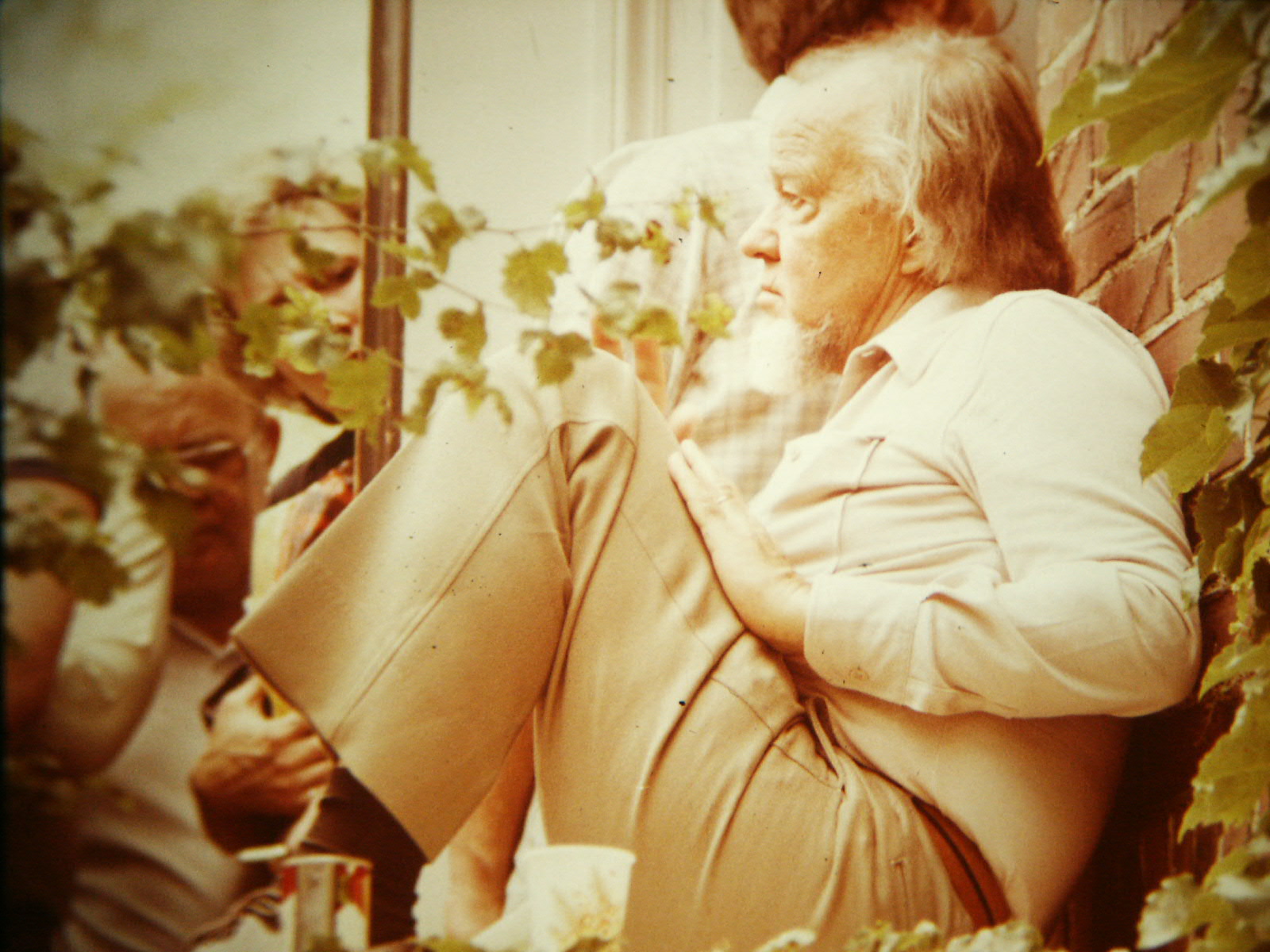
The influential American Christian thinker Francis Schaeffer once wrote a book called The Church Before The Watching World. You might say that title encapsulates what we’re about here. Jesus is teaching his followers how to be the church before the watching world. Do you want to know what constitutes a good witness in the world, according to Jesus? Then read, mark, learn, and inwardly digest the Sermon on the Mount.
Dr. Francis Schaeffer. Wikimedia Commons, Public Domain.
And so that means we’re beginning to answer another question that context helps us with: what is the theme of the teaching? This is one of the areas where those thirty-six different theories argue with one another. For example, are these political policies we should demand in our national life? No, the primary focus here is on how the disciples of Jesus live.
In fact, the recent context just before this passage might also help us with this. It comes not long after Jesus has begun his public ministry with the call to repent, for the kingdom of heaven is near. If the Sermon on the Mount is for disciples, then it is for those who have responded to the call to repentance. It is a description of what the repentant life looks like. Do I want to know if I am doing what Jesus loves, and have turned from the ways of the world? Again, our answer is to read the Sermon on the Mount. This is a plumbline Jesus holds up for us to examine ourselves as Christians and see how we are getting on with the life of the Spirit rather than the life of the flesh.
To sum up so far: context tells us that Jesus, the teacher of the Sermon on the Mount, is the Great One prophesied for centuries, and that he should be listened to with all the seriousness we give to the Ten Commandments, if not more so. He is addressing his disciples, teaching them what the repentant life looks like, and what it means to live a Christian witness before the watching world.
With all that in mind – which I hope will help you with any part of the Sermon on the Mount that you read – let’s spend the second half looking specifically at the Beatitudes. And here our tool will not be context but structure.
Structure image, Highway Signs 3. Pix4Free.org. CC 3.0.
In the Beatitudes, there is a reasonably consistent structure of each saying. They more or less follow a formula. It’s only the last one, which Jesus expands on, but even there it displays some similarities. It goes roughly like this:
Who is blessed?
What blessing will they receive?
But let’s just define that word ‘Blessèd’ first. It means, ‘It will go well with the one’ who is named[2].
Then let’s observe that broadly there is a contrast in time between the people who are blessed and when they receive their blessing. The blessèd ones are doing what Jesus commends now, in the present tense. However, the promised blessings generally come in the future[3]. This is not a guide to having an enjoyable life now. Jesus is not promising that if you live your best life now you will receive health, wealth, and prosperity in this life. This is not some manual for successful living.
See it this way. Jesus is saying that here are some of the marks of living the repentant life. These are examples of how he calls us to live before the watching world. Because of that, God is pleased with us. He will bless our obedience. However, that blessing may well only come in the future – perhaps even only in the life of the age to come.
For at present, we live in a time when two different ages are overlapping and clashing with each other. The age of sin is continuing. But Jesus has inaugurated the age of God’s kingdom, which has come but is not yet here in all its fulness. The age of sin and the age of God’s kingdom are incompatible, so they clash. That is why not all the blessings of the age to come are here yet. It is why not everybody we pray for is healed, for example. God’s kingdom has won the decisive battle at Easter – yes! – but the war is not yet finished.
What does this mean for us? Jesus calls us to live the repentant life before the world as a witness. We are not forcing ourselves on the world but showing by our lives what the ways of Jesus are like, knowing that God delights in what we are doing, and that he will show us his favour for responding to him like this. However, we may have to wait patiently to receive the fruits of that approval.
Jesus is calling us to live not as those who choose violence, even in the face of oppression, but who live humbly, seeking peace and reconciliation (which is not the same as caving in). He calls us to be the ones who trust in him, even when we think we don’t have many resources – after all, he doesn’t need a big budget to achieve great things, he just needs surrendered lives. He calls us to be the ones who witness to mercy and compassion; to be the ones who yearn for him above all things, rather than having our imaginations captured by the desires that our society elevates. To become such people, we may well mourn – not only in the general sense of those who are bereaved but mourning for our sin and the sin of the world, which surely leads us to passionate prayer for transformation for ourselves and others. We are the ones to show kindness to others, even if it means we need to carry the burden of unjust suffering.
Such a calling probably sounds unbearable. But a day is coming, he promises us, when God will vindicate us for following these costly choices. We will hear the words, ‘Well done, good and faithful servant.’ We will be blessed.
And in that respect, we shall be following Jesus himself. For surely the Beatitudes describe the kind of life he lived on earth. And he too was blessed in the vindication of the Resurrection.
But isn’t this all impractical and irrelevant? What of when we see the powerful in our world living differently and crushing others, shooting the innocent on the streets of Minneapolis and Tehran? Do we respond in kind? When Donald Trump’s adviser Stephen Millertells the CNN TV channel,
“We live in the real world, Jake, that is governed by strength, that is governed by force, that is governed by power. These are the iron laws of the world since the beginning of time”
should we not respond with similar use of force? No. We continue to live the Beatitudes. These are the ways of God’s coming kingdom. These show God’s great future. As such, they pronounce God’s judgment in a subversive way on the wickedness of our day. In their peaceable nature they reveal God’s truth and promise the downfall of violence. God will pass sentence on the wicked, but we let him do it in his way.
Let us heed the call of Jesus, to live the repentant lifestyle of peace before the watching world. We must take this seriously, because of the One who tells us that this is his way. The rest we leave to his Father who, as the Psalmist tells us, places the wicked on slippery ground that they might be cast down to ruin[4].
[1] Craig S Keener, The Gospel of Matthew: A Socio-Rhetorical Commentary, p160.
A few years ago, Debbie and I went to the cinema to see the ‘biopic’ Bohemian Rhapsody, about the rock band Queen and their lead singer Freddie Mercury. I expected the movie to end with Freddie’s death from AIDS in 1991, but it didn’t. It climaxed with the band’s triumphant performance at Live Aid in 1985. I guess it was the point that they exploded from being massively popular in the UK and a few other places to being superstars on the world stage.
If you made a biopic about the early years of Jesus, I think this is where it might end. After the amazing birth stories, the escape from Herod, his baptism, and then his trials in the wilderness, here is where it all explodes and the public ministry is launched, as he moves from Nazareth to Capernaum.
And therefore it’s natural that what we see in this story is some of the building-blocks of Jesus’ message. Tonight, we’re going to explore three building-blocks that we find in this passage and what they mean for us.
Firstly, fulfilment:
Verses 12 to 16 tell us that Jesus moved from Nazareth to Capernaum to fulfil a prophecy of Isaiah’s that the Messiah would live in ‘Galilee of the Gentiles’ and bring light into darkness.
This is a continuation of something Matthew has been stressing from the beginning in his Gospel: that Jesus the Messiah fulfils Old Testament prophecies. How does the fulfilment work here? In a couple of ways.
One is that he is now based in ‘Galilee of the Gentiles.’ Although Galilee was filled with devout Jews who were faithful to the religious Law and to the Jerusalem Temple, there were Gentile settlements nearby[1]. This becomes a foreshadowing of the later mission to the Gentiles that Jesus announced after his Resurrection at the end of the Gospel[2].
And hence, there is a hint here of what is to come: to be part of the Jesus Movement will entail not just staying comfortably with people like us but reaching out beyond social and cultural boundaries to share Jesus there. It is no good thinking we can stay with our own kind. It is no good making the church the centre and the circumference of our social lives. There is a mission beyond us, and Jesus was clear about it from the start.
The other element of fulfilment is in bringing light into the darkness. That includes light for people who are struggling in the darkness of despair. Jesus is Good News for them, because he brings a hope in him that not even death can destroy. Whatever the most dreadful of our thoughts are when we are down, Jesus still brings hope. He is the light-bringer.
Let There Be Light!! by Premnath Thirumalaisamy on Flickr, CC Licence 2.0.
But light shines into darkness in other ways, too. Most notably, Jesus shines his light onto the darkness of our sins. When we meet Jesus, we begin a lifelong process of transformation, as bit by bit he casts his light into those areas of darkness that we don’t want anyone else to see. Stage by stage, Jesus calls us to confess our dark deeds and bring them into his light. There he forgives us and begins his work of equipping us to change.
Is it any wonder that the first thing we hear Jesus saying in the passage is these words?
Repent, for the kingdom of heaven has come near.’ (Verse 17)
When Jesus shines his light onto our lives, we will begin to have a list of things from which we need to repent. We need to turn our lives around.
Perhaps like me you often resist this. But it is an essential part of God’s project to make us more like Jesus. So may he grant us the grace to go along with the surgery the light of Jesus performs on us.
Secondly, following:
Red Follow Me beacon at PickPik (Public Domain)
In verses 18 to 22, Jesus calls Simon, Andrew, James, and John to follow him. They leave their fishing nets immediately.
There is something really quite radical here. Rabbis didn’t generally call people to follow them. Instead, young men (and I’m afraid it was only men in those days) would choose a rabbi for themselves. For Jesus to go to these men, who either had not looked for a rabbi or had been rejected when they had applied, turns everything upside-down.[3] What we see here is that Jesus calls some young men to follow him who would not have been accepted by any other rabbi. But Jesus wants them. They will be among his core followers.
The early church followed through with this principle. We are pretty sure that some of the early bishops were slaves. No way would a Roman religion do that! But Jesus calls everyone, including the unexpected and the rejected.
It’s worth us remembering that Jesus still issues the call to follow him to people that we wouldn’t expect. Who would that be in our circles? Who are the people we have dismissed as potential Jesus-followers? Maybe we’ve even dismissed ourselves. Don’t do it. Jesus is calling.
But let’s also be aware that this call comes with a potential cost. Simon, Andrew, James, and John had to quit their family businesses to follow Jesus. They left their nets. They left the boat.
This was probably an act of what we would call ‘downward mobility.’ The fishermen might not have been wealthy, but neither were they peasants.[4] These young men walk out on a steady income generated from a vital profession for a life with a much more uncertain income. What did their families think?
It still happens in our generations. Someone who grew up in the same church youth group and young adults’ group as me trained to a high standard as secretary and PA and landed a job as the PA to one of the directors of one of our most famous upmarket High Street stores. But then God called her into church leadership with a new, fledgling independent congregation. Her parents were not best pleased, after all the money they had poured into her professional training. But she heeded the call.
One of my fellow ministerial students had previously been a solicitor. One day, somebody asked him, how much of a pay cut does entering the ministry mean for you?
‘I’ve knocked a nought off the end of my salary,’ he replied.
I wonder whether there is anyone here who is sensing the call of Jesus to follow him, perhaps in a new way, but that the implications are that it will be costly. You are risking financial loss, or family disapproval. Let us as a church family gather round in support of you so that you can set out on where Jesus is calling you.
Thirdly and finally, fishing:
In verse 19, Jesus says to Simon and Andrew,
‘Come, follow me,’ …, ‘and I will send you out to fish for people.’
Perhaps this reminds you of the old Sunday School chorus, ‘I will make you fishers of men,’ and maybe you now have an earworm!
The traditional way in which we have interpreted this is to think of this as a call to share the Gospel with people so that they, too, become followers of Jesus. I don’t think that was far from the minds of the early church, because one of the earliest visual images of the church was that of a boat. They saw there was a task to do of bringing more people into God’s boat.
We urgently need to release people into the ministry of evangelism, because there are so many more who need to hear the Gospel and respond. If anyone here is sensing that call, then let’s have a conversation about what we can do to train, facilitate, and support your call.
And let’s do it in a way that keeps a strong link between the evangelist and the church. The call is to fish for people, so they are brought into the boat. Too often in the past, evangelists have become disconnected from the local church. The fault has been on both sides, and we cannot allow it to continue. Evangelism is a ministry of the church.
But I want to take ‘fishing for people’ further. As I said, if you look forward from New Testament times to the early church, you end up with this application of these words to evangelism. But if you look back to the Old Testament, you see another dimension of mission, and it’s about the prophetic announcement of judgment. Here is one example from Jeremiah 16:16:
‘But now I will send for many fishermen,’ declares the Lord, ‘and they will catch them. After that I will send for many hunters, and they will hunt them down on every mountain and hill and from the crevices of the rocks.
What’s that about? The context is about God bringing judgment on his people who have forsaken his ways for worthless idols. This fishing for people is about the bad news, not the good news. It is the warning of what God will do with those who wilfully reject his truth. When Israel left Egypt, the Egyptian army tried to catch them and failed. But now, God’s messengers – his fishermen and hunters – will catch them.
Fishing for people, then, involves not only the winsome call to follow Jesus but also the warning to those both outside and inside the boat of the church to reject idolatry.
What would that mean for us today? I’ll confine myself to one example. There is only one sin that is described as idolatry in the New Testament. Greed. Colossians 3:5:
Put to death, therefore, whatever belongs to your earthly nature: sexual immorality, impurity, lust, evil desires and greed, which is idolatry.
Fishing for people, then, is not only a call to evangelism. It is also a call to a prophetic ministry. This is why it is right the Church condemns so much of what is going on in international politics at present.
But we have a long way to go in much of the church to put to death the idolatry of greed, which is so widely practised in our society. What else would we expect when we follow One who shines his light into the darkness?
Conclusion
Let’s summarise these three building-blocks:
Fulfilment – this happens when we take the Gospel beyond the People of God to others, and when the light of Christ shines into darkness.
Following – let’s be open to surprises in who God calls but be ready for the fact that when he does, there is usually a cost involved.
Fishing – for people – this is both the evangelistic call to join the boat of the church and putting the fishhooks of God’s judgment into those who wilfully reject his ways.
How far are we reflecting the fundamental elements of Jesus’ mission?
[1] Craig S Keener, The Gospel of Matthew: A Socio-Rhetorical Commentary, p146f.































 Big Circumstance

