
We begin our Circuit Lent Sermon Series on Lent not with the temptations of Jesus but with a simple question: why Lent?
Historically, not every Christian has observed Lent. The Lenten fast began as part of the spiritual training for new converts who were going to be baptised on Easter Day, before it became more widespread.
But even today, it is not universal in the Christian Church. Many Christian traditions, especially of the more low-church and informal variety, do not observe it all, and some do not even know what it is.
Even among those who do take Lent seriously, it is misunderstood. We think that giving up something will be good for our physical health, and so we avoid sugary and fatty foods. Or – like one friend of mine – we give up something like social media. But it’s not about us.
Others realise it’s about God, but they think it shows him as a hard taskmaster who expects us to make sacrifices to earn his approval. But when was Christianity ever about that? The Gospel says we cannot earn God’s love, but he comes to us in grace and mercy through Jesus, and we respond.
Lent is about our response to God. It is about reorienting our lives towards Jesus.
And that’s why I chose the passage from Hebrews. This is what the author is calling his readers to do. He doesn’t want them to give up on Jesus, because that is what they are considering. They are Christians of a Jewish background, who are thinking about giving up on Jesus and reverting to Judaism to avoid persecution. But the writer has been saying throughout the letter, don’t do that. Look how amazing and superior Jesus is.
In this passage, he gives us three things to do that help us put our focus back on Jesus, and we’ll consider them this morning. All of them rely on the metaphor of a race happening in an athletics stadium. It may be based on the ancient original Olympic Games.
Firstly, look at the crowd:
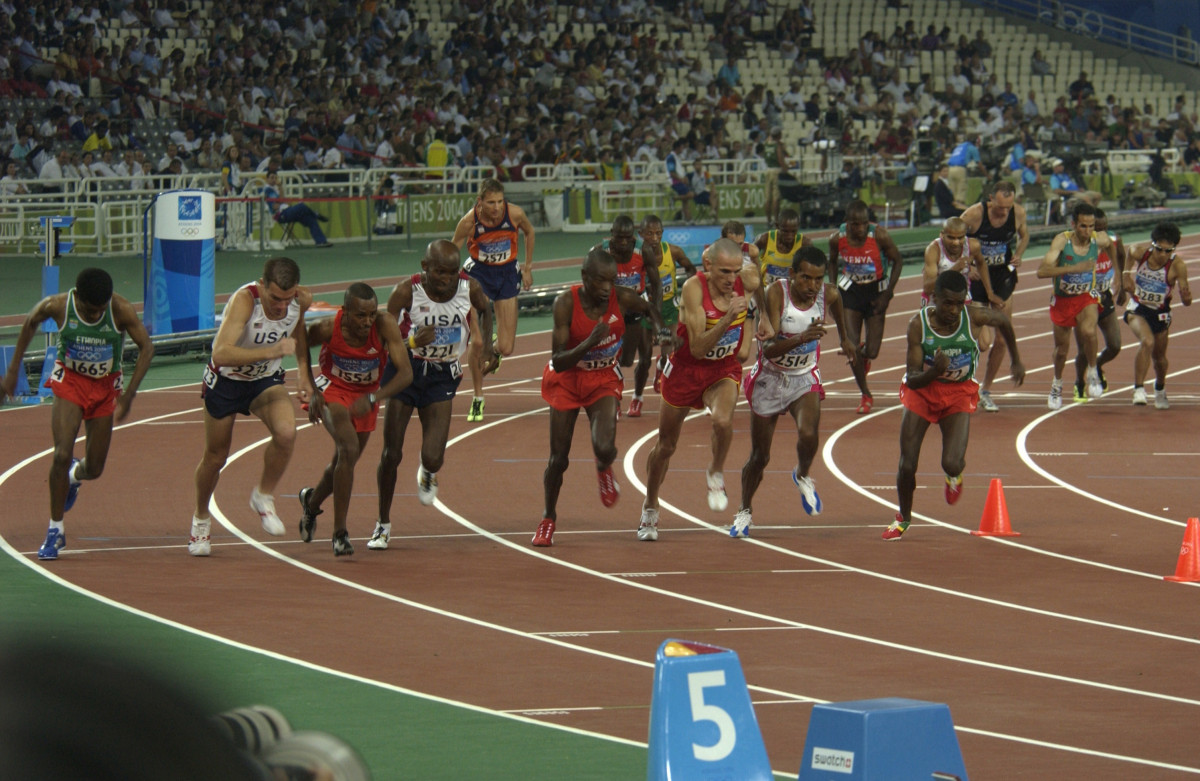
Therefore, since we are surrounded by so great a cloud of witnesses (verse 1a)
Who are this cloud of witnesses? They are the heroes of faith, down the centuries. Hebrews 11 has just given a long list of them, some of whom saw great victories, others of whom suffered their way to glory. Now, says the writer, these people are the spectators in the stadium cheering on those who are in the race of faith today.
This, I believe, is what we call in the Creed ‘the communion of saints.’ The faithful down the ages are watching us and rooting for us. While I am not convinced as my Catholic friends are that we can address them in a kind of prayer, I do rather think that if they are a cloud of witnesses watching us they are likely to be praying for us in Heaven.
Let us be encouraged by this. None of these heavenly spectators will boo us, they will only egg us on to victory.
And as we run for Jesus today, let us also be encouraged by the fact that the lives of these spiritual heroes are there as an example to us of how to set about our task. We can learn so much from the lives of the saints in the Bible, church history, and today. (And incidentally, when I say ‘saint’, I mean more than those formally recognised as such by the Vatican.)
If you have ever wondered why in the prayers of intercession we often give thanks for the lives of those who have died in Christ, now you know. They are our supporters’ club. Not only do they urge us to keep pressing on, we can look at how they lived the race of faith and learn from them.
Who has been a great example to you of how to live for Jesus? Was it someone in the pages of Scripture? Did you read about a spiritual giant in a book? Did a preacher tell amazing stories about someone who gave their all for Christ? Was it someone you knew personally in the church, whose life shaped yours? Maybe they even mentored you in some way.
Treasure these people. They are a gift of God to you. Rejoice that God has used them to point you in the direction of Jesus. Let them be an encouragement. And let them mould your life.
Secondly, put down your kit:

let us also lay aside every weight and the sin that clings so closely (verse 1b)
If you have ever watched a track event in an athletics meet, you will have seen that the competitors have a small number of possessions that they bring with them onto the track, but which they leave in a box. These things may be useful to them, but they will be a hindrance to them in running the race.
And so here the writer tells us not only to lay aside our sins, which we would expect, but also to ‘lay aside every weight.’ There are things in our lives which may not of themselves be sins, but which will weigh us down and thus seriously slow us in the race of faith. They may be good things or neutral things. They may be items that are appropriate at other times but not now. They may well be good servants but bad masters, because we have allowed them to have too much importance in our lives. We may have focussed on them instead of Jesus.
What kind of things? Money, food, possessions, work, even relationships. All of these things are in principle good. They are even gifts of God. But when we get out of perspective about them, when we give them too much importance, when they fill our vision instead of Jesus, then they become the stuff that we need to lay aside – maybe permanently, maybe for a season.
This is one of the reasons that the Christian discipline of fasting is so helpful in reorienting ourselves towards Jesus. We need money, but Jesus is essential. We need food, but we need Jesus more. We live in a material world and so material goods are necessary, but they do not rank above Jesus. Work was invented by God, but we need him more. Relationships were one of God’s best ideas, but a mere human being cannot meet our most fundamental needs: only Christ can do that.
Therefore, we lay one or more of these aside, perhaps for a season or perhaps permanently. Not only does it help us focus on Jesus ourselves and remind us that he is Number One, our actions become an example to the world.
So for example, I do not personally believe that all Christians should be teetotal, but God will call some of his followers to do that so the world has a witness that you can live a fulfilled life without alcohol, because fulfilment comes in Christ. He will also call some Christians to a life of celibacy, to show our sex-saturated world that the idol of Eros can be dethroned, and there is a greater and truer God.
If there is something getting in the way of our devotion to Christ, even if it is not a bad thing in itself, then maybe that is what God wants us to give up this Lent, either temporarily or permanently.
Thirdly and finally, run with perseverance:
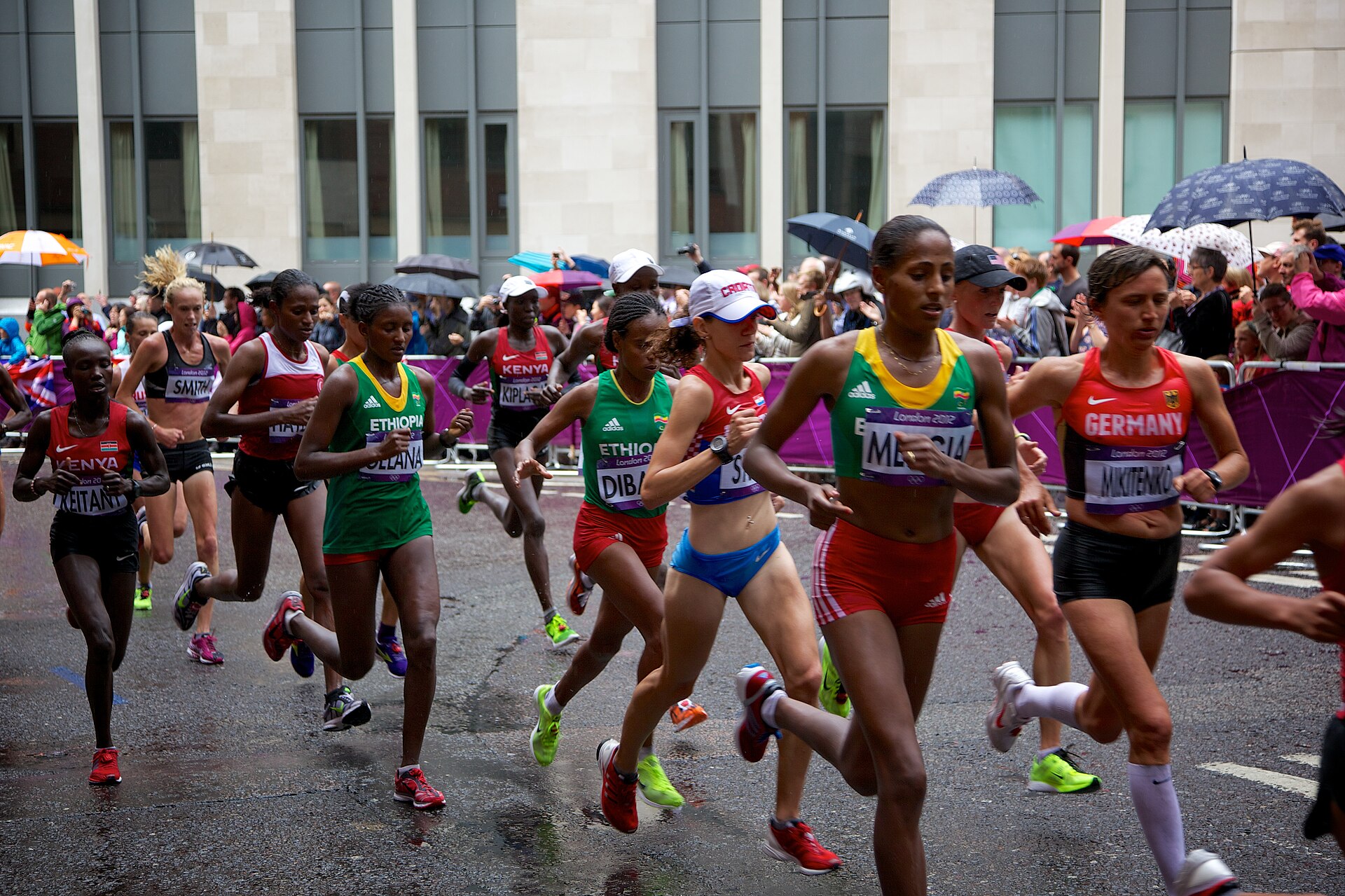
and let us run with perseverance the race that is set before us (Verse 1c)
Let there be no doubt: the race of faith is a marathon, not a sprint. When we are younger, we throw ourselves into things with great enthusiasm and it’s wonderful, but we run the risk of burnout and failure because we think we are running the hundred metres. We need to pace ourselves and be ready for the fact that a key quality we shall need is endurance.
Marathon runners speak of a stage well into the race where they feel they can’t go on any further. They call it ‘hitting the wall.’ However, experience tells them that if they persevere through that phase, they will go on to the fulfilment of completing the race.
There will be those of us in our lives of faith who have hit a wall. Something will have happened that has left us thinking we can’t go on. For some, it is a crisis; for others, it is simply that we get worn down by things over a long period of time.
How, then, do we run with perseverance? How do we break through the wall? The writer to the Hebrews tells us:
looking to Jesus the pioneer and perfecter of our faith, who for the sake of the joy that was set before him endured the cross, disregarding its shame, and has taken his seat at the right hand of the throne of God. (Verse 2)
Jesus is waiting beyond the finish line for us. He too had to persevere. He hit the wall, and it was a terrible experience. It was the Cross. But Jesus knew that beyond the wall of the Cross was unutterable joy. The Resurrection. His Ascension.
We don’t just have the cloud of witnesses cheering us on. We have Jesus himself. He knows what it is to hit the deepest darkness in life, love, and faith. But he has hope for us. He was able to run his race with perseverance, because he knew what lay beyond it. His Father would vindicate him, and he would reign in glory.
We too have a vision of glory to keep us going. It’s not the end until we reach glory. Our destiny is to be with him, first of all in Heaven after death, and then in the New Creation after the resurrection of the dead, celebrating the banquet of God’s kingdom.
In the meantime, we shall have trials along the way. God may use them for good to discipline us as better runners, says the writer (verses 5-11).
But hold your head up. If you fall, get up again, because God in Christ forgives us. Take heart, take courage, get your focus back on Jesus and keep running.
Welcome to Lent.
 Big Circumstance

What Do You Think?